Picture preach 2- sacred and profane…
Reply

We are heading off to Greenbelt again this year- so I enjoyed this clip (thanks to Jonny Baker).
My mate Alistair will enjoy the mention of those weird and wonderful podules (also heard descibed as ‘spiritual scrota’)- which he helped construct, and still bears the scars!
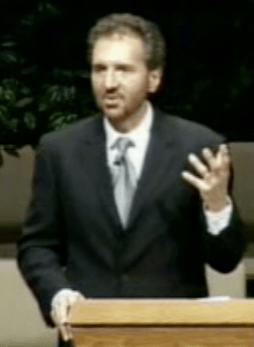
There was an interview/discussion on the radio 4 Today Programme this morning featuring the controversial American psychologist Joseph Nicolosi. You can listen again here.
This man appears to have a lot of exposure in the US- and I started a bit of internet searching to see what I could find out about him. Here is a bit of a trawl through some of the main organisations and players in this issue;
He is one of the brains behind NARTH- the National Association for research and therapy of homosexuality. Check out the many stories on the site by people who appear to have been ‘cured’ of their sexuality.
Conservative religious groups like focus on the family have embraced this viewpoint wholeheartedly. Check out their ‘Love won out’ conference.
The American Psychological Association condemned the findings, and released this primer entitled ‘Just the facts’.
The Royal College of Psychiatrists are quoted as saying this by the BBC here.
The Royal College of Psychiatrists (RCP) said there was no evidence that the treatment worked, and that it was likely to cause considerable distress.
An RCP spokesman said: “There is no sound scientific evidence that sexual orientation can be changed.
“Furthermore, so-called treatments of homosexuality create a setting in which prejudice and discrimination can flourish.”
The Royal College said the American Psychiatric Association had concluded there was no scientific evidence that homosexuality was a disorder and removed it from its diagnostic glossary of mental disorders in 1973.
The World Health Organisation’s International Classification of Diseases followed suit in 1992.
So what is Nicolosi actually saying?
As far as I can see, his theory is based on a rather unsophisticated simplistic view of the acquisition of gender, shaped through parenting style and in particular, interaction with male authority figures. Then there is a lot of quasi-scientific language used to wrap it all up in. Here are some quotes (from here);
By way of contrast- I came across this series of clips from a Gay activist who had been invited to attend the ‘Love won out’ conference. They seemed to be very graceful…
There is no surprise that Nicolosi’s message has been greeted with such enthusiasm by Conservative Christians. It ticks all the right boxes. In fact, it seems to fit rather too well, and we have to ask which came first-the ‘science’ or the ideology?
So, what do I think? I am going to make some general statements, then tell a story.
If Nicolosi is right, then homosexuality is indeed a result of dysfunctional experiences in early life. I am afraid this is rather too simplistic for me. Why do people who have the same experience in childhood (Positive or negative) develop such different sexuality? Most human characteristics develop through the interaction between both nurture AND nature. This means that causality is almost always impossible to be categorical about, even where dysfunction (which is often a social value judgment) is agreed upon- for example where people are mentally ill.
Science that begins with a narrow ideological/theological perspective is likely to be extremely problematic. Morality is not usually very scientific. But then science is never value free either- there are always interests that will introduce bias. I think we have a duty to be as honest as we can be about these however.
It is clear that there are many stories of people who claim to have been ‘cured’ by therapy of their homosexuality. I have no doubt this is true for some- as the variety of human experience is wide and wonderful. I would expect some to people to remain straight (a small group though) most to revert, and many to be damaged and disillusioned.
Gay=dysfunction? This is almost certain to perpetuate prejudice against one group of people. Perhaps this is acceptable, if your reading of the Bible allows you to draw hard lines on this issue. I think we are called to love first however- and to stand with the oppressed, not to pile stones as projectiles.
Statements that equate homosexuality with sexual molestation in childhood are simply not supported by evidence.
Blaming parents? An easy hit. Psycho-dynamic therapists have done similar things for lots of issues. There was this dreadful phrase ‘schizophrenogenic mothers’ who were supposedly the cause of schizophrenia…
Now- the story.
I used to work in a northern English town as a mental health therapist running clinics in GP surgeries. GP’s would refer people to me for assessment after which we might agree a referral elsewhere, or a short run of therapy from myself.
In this context I met lots of wonderful people- most carrying wounds. Some had had very difficult and abusive backgrounds. Many had experienced depression and anxiety. Others were living with grief. Others had secrets that were eating away at them.
I met one man whose story stayed with me. He lived with his wife of 45 years. They had three children, all long grown up and gone. He was desperately unhappy.
Soon after marriage his secret was out. He had been having homosexual affairs.
With all his might he wished that these overwhelming sexual urges that he had experienced as long as he could remember would just go away. And it being the 1960’s, and homosexuality was still illegal, and classified as a mental illness, he sought treatment.
A hospital in Manchester offered behavioural modification through the application of aversion therapy. This involved being exposed to erotic images and at the first signs of sexual arousal, he was subjected to electric shocks.
Over a considerable period of time he yo-yo’ed through life, in out of his family, gay then straight, a member of his society, then a pariah.
Now here he was. Estranged from his children, still caught up with the same confusion and pain. His wife an alcoholic. Life almost over.
Wanting and waiting to die.
Whatever your theory of sexuality- whatever moral stance you adopt- this man life has been blighted by societies response to his sexuality.
So Lord help us. Let us learn the position of love. And have no agendas that we subject others to.
And for my money- Nicolosi, go home.

Emphasis is all.
I had a conversation tonight with my friend Nick. We were talking about some planning he was getting into for a programme of Bible study for young people. He was talking about the need to get into the basics of Christianity, and how many of the young people (and some of the older ones) had very little basic knowledge of the tenets of our faith.
I thought about this for a while, and genuinely wondered about what these tenets were- and what I would teach young people if I was in Nicks shoes.
The ’emerging’ conversation has shaken loose a lot of fixed positions for me. It has helped me see that a lot of the things I held to be basic building blocks for faith were perhaps not always so solid- but rather required robust examination. It made me wonder again about an approach to faith that started with one small group of people telling another larger one what it needed to know- facts and figures of faith that they needed to internalise in order to be a proper Christian.
In my discussion with Nick, I found myself making the following statement-
“I think we modern Christians made two particular mistakes in our attempts to engage with God.
- We overvalued the Bible- wanting it to provide for us a textbook that creates a Christian, in the same way that a blueprint could make a balsa wood model plane.
- We overvalued the need to get our doctrine sorted- the finding and adopting of correct positions in relation to all aspects of faith.
That is not to say that these things are not both wonderful and important- but simply that we over-emphasised them- making them perhaps the only way that Christians could discover God. In order to make this stick, we had to pretend that there was only one way to read and understand the words, and to suppress all less tangible and less ‘objective’ spirituality- rendering it untrustworthy and dangerous.
Sure, the Charismatic movement came along and added a whole new experiential encounter with the power and wonder of God, but ultimately, I would argue that the modern Protestant faith was grounded on the two points above.”
This statement is shot through with faultlines, but I think, on the whole, I stand by what I said.
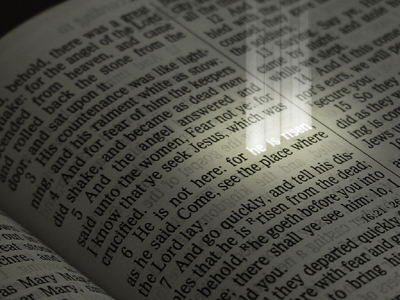
If I am right (and many would strongly disagree!) does it matter?
Does it matter as we seek to engage with young people? Do they not just need to be given some basic truth before we get all post modern and mystical? Perhaps they do. Perhaps the trampoline bouncing that Rob Bell talks about as an image of theology can only really begin once we have set up the trampoline.
But alongside the importance of the written words of the Bible, and the need to establish doctrinal beginnings- I think I would gently suggest that the emergent conversation might challenge us to add in other emphases too. Because people of faith have always encountered God through many other means.
So I am convinced that rightness of doctrine is not the precursor to being acceptable to God. It may be a consequence of this, but as far as I can see, God seems to tolerate a fairly wide spectrum.
And the Bible is wonderful- but many have lived lives in the name of Christ but have never seen one- either because they could not read, or because the canon of scripture as we know it today simply did not exist, or because the Bible was not available to them.
So what other ways to encounter God should be emphasised?
Perhaps we can only start by looking back to the spirituality of pre-moderns, and use this as a set of goggles to consider our own culture. There is much there that we would reject, and count our blessings that we are this side of the reformation- but still…
We see people seeking to engage with God through living encounters– through hardship, pilgrimage and through community. We see lives of service and humility. We see the importance of shared ritual and engagement with God in the passing of seasons and in connection to every day experience.
So might we learn from this as we seek to encounter God in our new changing context? Might we learn again the vitality and meaningfulness of the mundane, and the wonder of small adventures in which the wind of the Spirit blows us into the path of all sorts of opportunities to be shaped and changed?
The Bible will continue to be a gift to our new generations. There will be others too.
I have finally finished my collection of poetry and prose which forms a new book called ‘Listing’. I have very much enjoyed the creation of this thing, but there is so much other stuff I need to be getting on with, so it is great to have it completed.
Next- the wilderness book with Nick, and this novel that may yet find some kind of shape.
This (might) be the cover photo, taken in Benmore Gardens by yours truly-

This book, which will be published through Proost and will hopefully be available in June/July. It is a collection of words-poems prose and meditation- based on some Biblical lists-
Ecclesiastes 3
Galatians 5
Matthew 5
1 Corinthians 13
Some of the poetry I have tried out first on this blog. Here is one more- if you like it, then please get hold of the book!
Now is the time to keep
There is a time for all things under heaven…
This Kingdom is always here
Always now
Held here in the hands of we
His failing followersStanding on the shoulders
Of countless men and women of faithDiggers of catacombs
Carvers of secret Kingdom symbols
Men making missionary journeys in hide skinned boats
And setting up carved crosses
Monks and nuns holding the world in prayer
Parchment gilders
Cathedral builders
Protestors
Reformers
Transformers
RenewersSo I take from you my fathers of faith
Grateful for the gifts you gave to meFor the canon of Scripture gathered and held precious
For those adventuring out with good news
For purifying zeal
For generous, graceful orthodoxy
For those planting a cross in the gutter
And those who consort with kings
For Bible teachers and interpreters
For a hundred synods
And a thousand million books
For people lit up in the fire of the Spirit
And others who seek the Lord in silence.For Methodists and Catholics
Wesleyans and Quakers
House and Mega churchers
Baptists and Greek Orthodox
Each facet of a this precious thing
Called ChurchAnd perhaps most of all
I stand in the sheltering shadow
Of people who stood between me
And a harsh prevailing wind
Who saw through the mess of me
Or chose to ignore it for a while
And shared with me the love that draws us
And meant itAll of these treasures
Handed down
To keep

Religion, according to sociologists like Durkheim, plays a vital role in society.
It unites and solidifies our morality, our world view and facilitates social cohesion. According to Durkheim, religion is very real; it is an expression of society itself, and indeed, there is no society that does not have religion.
Since Durkheim, there have been many discussions about the value of religion to society. Some have been critical, and seen organised religion as a form of social control and a supporter of oppression and a reactionary force in favour of the status quo. It seems clear that it has indeed been used for this purpose.
The interesting question for those of us living in a post Christian world in Western Europe, is if organised religion has lost a central place at the heart of society, then are there measurable sociological effects of this on our societies?
As we lose the unifying and cohesive affect of shared faith, might we expect to see an erosion of some of the key aspects of our society? Our social and class structures, our sense of community and belonging etc?
I have been enough of a social science student to avoid making broad unsupported generalisations, and I am yet to find some recent research about this (If you come across any, I would love to hear from you.)However, it is clear that some of the cohesion seen in modern society has now gone. What we appear to unite behind these days is very different from what motivated our collectivisation 50 years ago.
So if Durkheim is right, and all societies have a shared religion, then how might we understand this in our post-Christian western societies? Particularly when the drive appears to be towards increasingly individualistic activities based on ‘choice’.
What brings meaning to life?
What allows us to express our collective consciousness?
Some have suggested that football fills this slot in many people’s lives.
We are just back from a journey down south to visit family in the Midlands. I took the photograph above at the site of the death of a young man killed on a road crossing. Family and friends had left flowers and cans of beer hanging on the railings, as well as football scarves. It occurred to me that what we regard as central to life will shape the rituals and ceremony we use to mark the stuff of humanity.
I also had a conversation with my brother in law- a great bloke. He jokingly described how his i-pod, when set to random, seemed to constantly pick appropriate songs from the thousands stored on it, to fit in with the activity or mood he was experiencing.
Is this evidence of our human need for ritual and meaning beyond the temporal and mundane? For a collectivisation of our consciousness and the need to mythologise this in the form of things sacred beyond the profane?
Or is this a fluid society in the middle of huge social change, struggling to fill what we used to call ‘the God shaped hole’ in the middle of all of us?
However we understand it, the need for meaning and ritual seems pretty universal, even for we post-moderns. And I think that God is not done with us, nor we with him.

The above image is of Arthur Blessitt followed by supporters, walking on Hollywood Blvd in Los Angeles on March 24, 2009 on his way to the premiere of “The Cross,” a film about his life on a 40-year voyage carrying the cross for Jesus around the world. Blessitt began his pilgrimage in 1969 and has carried the 12-foot (four meter) cross over 38,102 miles (61,319 kms) to 315 countries, island groups and territories, according to his website. Blessitt is listed in the Guinness World Records for the ‘world’s longest walk’.
A friend told me a story about cross carrying today.
There was a recent Easter march in town. Good folk from different churches gathered at one end of town and processed through to the other end. Someone was carrying a large wooden cross, others were waving banners, and the procession was flanked by tract sprinklers. At the end of it all folk gathered on the seafront and sank choruses through a PA never intended for outdoor use, and the seagulls got some crackly competition.
Apparently there was an incident at the beginning of the march, while people were gathering, during which someone decided to try out cross carrying. The person concerned misjudged the weight and balance of the thing, and over it went, cracking someone else on the head on the way down.
Now I know the person who recieved the full weight of the blow, and she is a lovely. I understand she is OK, but will have a nasty bruise.
There is some obvious comedic value in this story- the conviction of sin brought down on the head of one poor soul.
There is also the lesson for all of us in using the Cross as a battering ram or a weapon for our particular cause.
And perhaps most of all we should remember that a cross can be a dangerous weapon in the hands of the poorly balanced!!!
This morning, faced with the prospect of 8 easter eggs, William was like this;
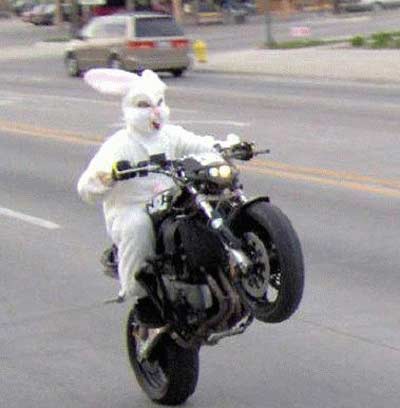
So I spent some time talking to him about this-

I was surprised how little he seemed to know.
Now to church. “Great” he said “There will be an Easter egg hunt for sure!”
Hmmmm…
 this fragile tent
