Hold: this space- new site…

Congratulations to Cheryl and friends down under on their lovely new site– looks great!

Loads of alt worship stuff, and lovely writing…

This is on their front page-

Take the clay of our lives and shape it to love
Take the clay of the church and shape it to grace
Take the clay of the world and shape it to peace
Take the clay of today and shape it to hope

And then breathe your spirit into all
again

For ever and ever
Amen

Bible Sunday…

CSL047

Today is ‘Bible Sunday‘- a celebration co-ordinated by the Bible Society, with the title ‘Living in the certainty of God’s Word’.

We are pointed in the direction of that wonderful passage in Isaiah 55– which begins ‘Come all who are thirsty…

I very much agree that the Bible is something to celebrate, so I have been reading some of the information about Bible Sunday. However, I find myself in a familiar uncomfortable place. I have posted before about some of these issues- here and here for example.

Some of it might relate to the language used in this celebration- the assumptions and presumptions inherent. The very title- ‘Living in the certainty of God’s word’- what this means for many is a closing down of debate, a final understanding of Truth– the Bible says it, I believe it, end of story. We are encouraged to approach the Bible as we would a mathematical formula- to engage with the different elements, order them correctly and so arrive at the only logical reasonable outcome.

But I have become increasingly aware that in doing this, we diminish the words. Indeed, we are in danger of recreating God in our own image.

Another image I have used before is this one
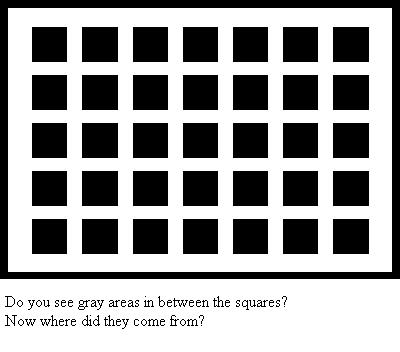
gray areas

The Bible is full of truth, wisdom, poetry, history, prophecy and mystery. We humans are logical orderly creatures, who are made to look for patterns. However, we look through at things through a perspective formed by presumptions- it is much easier that way, and it is very hard (if not impossible) to approach any issue afresh without the influence of time and place and heritage. Most of the time this stands us in very good stead. It allows us to be what we are. It allows us to build logical portable and replicatable blocks of truth. It allows us to find commonality and build Church.

But then there are those elusive dots.

We can try to ignore them, but they keep popping up- like those passages in the Bible that just do not fit very well… Or others who have understood a passage in a different way, and God seems to be blessing them. Or the realisation that what we have regarded as fixed and absolute, is suddenly- shifting…

We can regard them as irrelevant and but then they still irritate. Or we can outlaw them, suggest that they are heretical distractions- but then we find that they are increasingly difficult to ignore.

But my humble experience of the Bible suggests that they will always be there. Because the Word of God can not be contained in a book. Neither can God be reduced to a formula. God will simply not be contained.

Does this diminish the Bible for Christians? Perhaps for some, it does. For these folk, the theological blocks hewn from the huge quarry of Scripture are so rigid, that to suggest a different perspective is to bring the whole edifice crashing down. In this, we are in danger of worshiping an idol of our own construction.

But for many others, the Bible is a cherished gift- one that shines light, but also contains many shadows cast by our lack of understanding, and the assumptions made by previous generations.

So I am going to celebrate Bible Sunday by reading the passage from Isaiah 55, and reminding myself that this wonderful poetry points us not at the words, but at the word giver.

Isaiah 55

1 “Come, all you who are thirsty,
come to the waters;
and you who have no money,
come, buy and eat!
Come, buy wine and milk
without money and without cost.

2 Why spend money on what is not bread,
and your labor on what does not satisfy?
Listen, listen to me, and eat what is good,
and your soul will delight in the richest of fare.

6 Seek the LORD while he may be found;
call on him while he is near.

7 Let the wicked forsake his way
and the evil man his thoughts.
Let him turn to the LORD, and he will have mercy on him,
and to our God, for he will freely pardon.

8 “For my thoughts are not your thoughts,
neither are your ways my ways,”
declares the LORD.

9 “As the heavens are higher than the earth,
so are my ways higher than your ways
and my thoughts than your thoughts.

10 As the rain and the snow
come down from heaven,
and do not return to it
without watering the earth
and making it bud and flourish,
so that it yields seed for the sower and bread for the eater,

11 so is my word that goes out from my mouth:
It will not return to me empty,
but will accomplish what I desire
and achieve the purpose for which I sent it.

12 You will go out in joy
and be led forth in peace;
the mountains and hills
will burst into song before you,
and all the trees of the field
will clap their hands.

13 Instead of the thornbush will grow the pine tree,
and instead of briers the myrtle will grow.
This will be for the LORD’s renown,
for an everlasting sign,
which will not be destroyed.”
Persian poetry 2- Attar

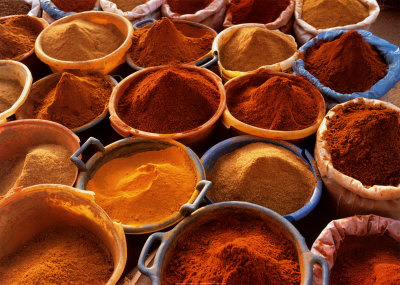
Gulab_Jaman_spices

On my continuing mission to find out a little more about Islamic culture, I am have been reading the Persian poet known as Attar.

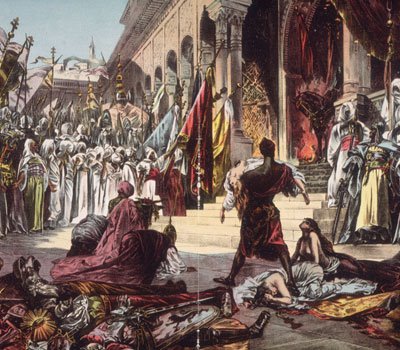
To imagine the world of Attar, we have to make a journey back around 800 years, to a far corner of what is now Iran, and to the ancient City of Nishapur, standing astride the silk road that connected the Mediterranean tradesman with the mystery and spices of the far East. In the year 1000CE, it was among the 10 largest cities on earth. After the husband of Genghis Khan‘s daughter was killed at Nishapur in 1221, she ordered the death of all in the city (~1.7 million), and the skulls of men, women, and children were piled in up in high pyramids as a warning to others, and a visible sign of the grief of a despot.

genghis-khan-murder-2

On of the people who was thought to have died in this massacre was Attar. At the time, he was said to be 101 years old.

The little we know of his life has been recorded as having been a chemist, a physician, a perfume maker and a Sufi– those who sought to live by a science whose objective is the ‘reparation of the heart and turning it away from all else but God’.

And as well as his ministry through herbal preparations and the study of essences that bring life, he was a prolific poet and mystic.

Time for some poetry…

Mysicism

The sun can only be seen by the light
of the sun. The more a man or woman knows,
The greater the bewilderment, the closer
to the sun, the more dazzled, until a point
is reached where one no longer is.

A mystic knows without knowledge, without
intuition or information, without contemplation
or description or revelation. Mystics
are not themselves. They do not exist
in selves. They move as they are moved,
talk as words come, see with sight
that enters their eyes. I met a woman
once and asked her where love had led her.
“Fool, there’s no destination to arrive at.
Loved one and lover and love are infinite.”

The Newborn

Muhammed spoke to his friends
about a newborn baby, “This child
may cry out in its helplessness,
but it doesn’t want to go back
to the darkness of the womb

And so it is with your soul
when it finally leaves the nest
and flies out into the sky
over the wide plain of a new life.
Your soul would not trade that freedom
for the warmth of where it was.

Let loving lead your soul.
Make it a place to retire to,
A kind of monastery cave, a retreat
for the deepest core of your being

Then build a road
from there to God

Let every action be in harmony with your soul
and its soul-place, but don’t parade
those doings down the street
on the end of a stick!

Keep quiet and secret with soul-work.
Don’t worry so much about your body.
God sewed that robe. Leave it as it is.

Be more deeply courageous.
Change your soul.”

Blessed insurance…

insurance

A friend told me this evening that her home insurance was discounted as a result of being ‘a church goer’.

Cue much speculation as to why this would make you less of an insurance risk.

Are church goers less likely to smoke, and so set fire to their houses? Less likely to have wild drinking parties that lead to scratches in the French polishing (remember the old advert for yellow pages? ” All quiet…”)

Or do the risk assessors have some kind of stereotypical view of Christians as solid middle class citizens who drive sensible cars stored in solid garages and whose sense of right and wrong would result in far less fraudulent claims?

But then again- have they missed something?

What about the possibility of the Rapture? All those holes in the ceiling as we rise with a trump and fly…

And I wonder if they have read the gospels? Because I am not at all sure that Jesus would have been a good insurance risk. All that associating with neer-do-wells and criminals for a start. And then there is the partying, and the crowds who break holes in the roof to let down the lame for healing.

Jesus did not go in much for the protection of his private property. He told his disciples that they did not need two shirts on their backs.

And I am forced to wonder if we people of faith should be more proud of an insurance assessment that views us as high risk.

Because our homes are open places for others in need- who might well steal and break things that we own.

Because our lifestyles are characterised by mobility as we follow after the winds of the Spirit.

Because we are not tied down to suburban safety and solidity, but rather prepared to accept the risks of the open road.

Because we are motivated by justice and peace, and that is not always popular.

Persian poetry 1- Sanai…

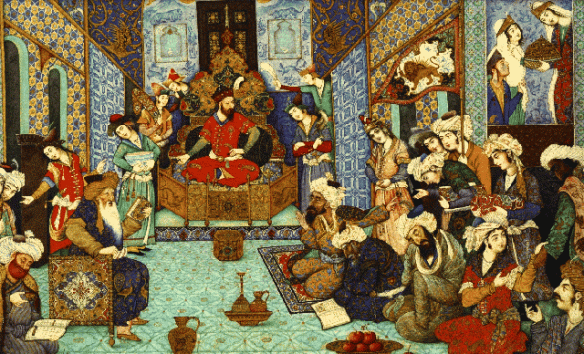
The court of Sultan Mahmud of Ghazna

I have been reading some Persian poetry.

My reason for doing this was simply because I knew nothing about Persian poetry- and in these times when the Western world is increasingly at war with most of the Eastern world, it seemed important to understand a little more the rich cultural subsoil that Middle Eastern Islamic civilisations grew within.

I post these bits and pieces like bit of a beautiful mosaic found in a river bed. I do not understand the whole picture- and never will, but I am starting to appreciate it some of its quality.

Beauty, humanity, truth, humour, a search for meaning and a longing for God.

And to encounter the culture through poetry seems to me right somehow. I suppose this is because I write poetry, but also I think this is because these poems are still alive. They have none of the dust of history.

The first poet I want to quote is Sanai.

We know little about him. He died around 1150, and was a subject of Bahramshah, one of the rulers of the Ghaznavids– whose empire covered much of the middle East- and was centred around Garzna, in what is now Afghanistan. He is thought to have been a court poet, who became dissatisfied with the shallow life of court and left to follow Hajj to Mecca.

So here are three poems of Sanai. Let them rest on you for a while-

Streaming (excerpt)

When the path ignites the soul,

there is no remaining in place

The foot touches the ground,

but not for long

The way where love tells its secret

Stays always in motion

And there is no you there, and no reason

The rider urges his horse to gallop

and so doing, throws himself

under the flying hooves

In love-unity there’s no old or new

Everything is nothing

God alone is

The puzzle

Someone who keeps aloof from suffering

is not a lover. I choose your love

above all else. As for wealth

if that comes, or goes, so be it.

Wealth and love inhabit seperate worlds.

But as long as you live here inside me

I can not say that I am suffering.

The time needed

Years are needed before the sun working on

a Yemini rock can make a bloodstone

Months must pass before cotton seed

can provide a seamless shroud

Days go by before a handful of wool

Becomes a Hater rope

Decades it takes a child

To change into a poet

And civilisations fall and are ploughed under

To grow a garden on the ruins

The true mystic

A bit of Martyn Joseph for a lazy Sunday afternoon…

Lovely day today- a walk around Pucks Glen and lunch at the Coylet Inn next to Loch Eck.

Then listening to music and reading all afternoon- I am reading this book (amongst about 10 others it seems!)- Notes from an exhibition, by Patrick Gayle– and so far am really enjoying it. It made me cry this afternoon which is a usually a sign of great writing, believable characterisation and moving story telling. This book deals with love and family, mental illness, deep Quaker faith and art in a captivating way.

But the other ingredient of a perfect lazy Sunday afternoon is music.

Here is a bit of Martyn Joseph- great guitar player and wordsmith…

Some commercials, and a little rant…

Thought I would give a couple of things a plug- information being viral and all…

The Scottish Network Churches asked us to spread information about a speaking tour in Scotland by Bishop Graham Cray, who (amongst other things) heads up the team responsible for the Church of England’s Fresh Expressions initiative. Might try to get to some of this…

The CofE has done so much to promote innovative and experimental forms of church- which has given leadership to many other denominations too- the Methodists, URC, Salvationists etc. It is encouraging indeed to see some of this coming north.

Here is the blurb-

How will we encounter God in all of life? And especially in those places where Christians most often cross paths with non-believers and have opportunity to influence society? Can we encourage Christians and church leaders to develop a personal vision for their own growth and effectiveness as disciples who are missionaries and as missionaries who are disciples? Should we provoke Christians and church leaders to possibly re-imagine life in the “gathered community” so that it effectively resources life on the front line of every day life?

LICC and Bishop Cray are “thought leaders” and have enormous practical wisdom to share and so to help us understand the theology, build principles, develop the practices, create the resources, to become Jesus’ disciples in the 21st Century. Mission Scotland hopes that exposure to this work will create an imagination for whole-life discipleship and a deep desire to engage with the questions and challenges we face as God’s people to make disciples, and to live as disciples.

The launch conference, which is the start of a series, is planned for November 28th, 2009 at St. Paul’s and St. George’s, Edinburgh. It is designed equally for church people and for church leaders. Both Mission Scotland and LICC see these events, not as stand-alone events, but as a linear discussion leading to changes in church life, and backed up with ideas and resources, changes in practice, leading to fresh confident expressions of Christians being the church, being disciples, being missionaries, wherever they are placed in Scottish culture and context.

Therefore for those who come this could become more of a journey than simply listening to one of God’s leading thinkers on His Church in Britain today.

FURTHER INFORMATION from Sarah-Jane Biggart; sarahjane.biggart@missionscotland.org.uk. 07734-101358

Also- for those of us that are interested in training and equipping leaders and visionaries for this kind of stuff, check out this training being offered by CMS.

resource

It is English based, rather than Scottish, but at least the units are bite sized, and based in Northern England rather than the deep south. It is not something that I feel I can commit to, but I mention it as I know of nothing else in Scotland that appears to offer the same level of practitioner-practical-network based learning (with apologies to ICC in Glasgow!)

Here is the blurb from Jonny Baker-

well we’re getting closer to resource starting for this year. the web site has had a makeover and looks pretty funky. resource is a course over a year of four weekends exploring themes of mission, culture, leadership, transformation, discipleship and church. each weekend is in a different location/context where we encounter a local community or two and hear their story and what they are up to, as well as some teaching, discussion and reflecting on how it all connects with our own context.

who’s it for? – this explanation is pretty good

how much is it? – each weekend is less than £100 though you have to sort accomodation. there is a bursary so if you’re strapped for cash still apply.

the weekends this year are in sheffield, london, leeds and southampton – and yes the london one is being hosted by grace and moot with a focus on alt worship and mission. you can either sign up for the whole thing or just come to individual weekeds. the whole thing is best because a big part of the learning is hanging with other people and sharing the journey together.

the first weekend is the last weekend in october in sheffield so book now! if you can’t pay now you can book and pay later.

(NOW FOR THE LITTLE RANT!

I am quite happy to be corrected if I am missing something, but it seems to me that north of the border we have a lot to learn from the old enemy in terms of renewing and refreshing expressions of church. It also seems to me that we have a particular need to build supportive partnerships in an age when Scottish Nationalism appears to be leading to a certain snobbish separatism in some parts- which I feel has no place at all amongst Christians. The tendency to build confidence and identity by denigrating the other is a dangerous and unpleasant human characteristic- and when we see this in the very heart of power, I start to feel very uncomfortable. So when we have anti English jokes made by leading politicians, allied to distorted and simplistic versions of history, and school ground popularist prejudice and abuse, then I think it is time for the people of God to stand aside and gently model a different way of being.

And if you think I have no right to say this because I have an English accent, then I ask you to consider our shared history in these islands- our mixed blood lines, and the inevitability of the misuse of power and wealth acquisition by the worst of what we are as humans. In this context, we Christians have a different responsibility- to shine light and to savour good things with salt, not to stand on narrow prejudices and perpetuate poison. There is a real chance that it will fester.

So perhaps one way we can be challenged is in the way we approach faith- how we collectivise our gatherings in a generous and graceful way- and how we can both learn from English brothers and sisters, and teach them from our experience.

Rant over.

Coming out as a universalist…

There was a story in Christianity magazine that caught my eye today. It concerned the author of this book

evangelical universalist

The author used a pseudonym, made up of the  names of St Gregory of Nyssa and George MacDonald chosen because of their rather universalist stances. ‘Gregory’ set up a blog to discuss the book here.

Some of you are wondering what on earth all the fuss is about, and even what a ‘universalist’  is in this context. For most of my Christian experience, people who held universalist views were on the slippery slope to damnation, if not already in free fall into hell. Universalists believe that God’s plan of engagement with the salvation of creation includes the aim to save EVERYONE- not just a selection of (most of) those who said the sinners prayer and so escape the fate of the apostate majority.

I know a lot of folk whose position has shifted on this- who have started to believe that the discussion about what the Bible might have to say about this issue is simply not closed (I have not read the ‘Evangelical Universalist’, but can recommend Brian McLaren’s ‘The last word and the word after that‘ as a great introduction to these issues.)

Some of the heat of this debate is that so much of Evangelical zeal is based on the idea that people all around us are lost- and  if we fail in our call to save the lost, then people may go to hell- and it will be our fault. There is a real question as to whether there has ever been a major Christian revival that has not had this kind of engine at the heart of it.

My own position is… rather fluid. But as I have said before, I remain a follower of Jesus. I do not think that all forms of faith are equally valid ways of worshipping the same God.

But I also hope that God is bigger than our narrow categorisation, and that indeed he will find a way to redeem everyone.

But back to Gregory MacDonald.

Recently, Robin Parry revealed that he was the real author.

Robin is (or was) the editorial director of Paternoster, a Christian publishing company. He has now resigned his post, reporting the concern that his stance on universalism might damage the sales of Paternoster products in the USA.

So is this what theological debate is about? The need to use pseudonyms and then lose your job if you think beyond a narrow orthodoxy?

Hmmmm…