What religion do we need, and can we remake it?

If you are reading this (after glimpsing the title) then I am going to make an assumption that, like me, you think that religion can be/might become/sometimes is part of the solution to some of the difficulties that assail the world we live in. Sure, you might (like me) be deeply frustrated by the fact that it has failed to be this so regularly and in so many ways, but (like me) you perhaps still have this feeling that ideas matter, and that ideas of the spirit perhaps matter even more…

I was listening to Brian McLaren talking about his new book (which I have not read yet) Life after doom: wisdom and courage for a world falling apart. He defined the ‘problem’, or the things falling apart in four ways

  1. Crisis of the planet – the planet not being able to cope with the amount humans take nor absorb the amount of waste we give it back
  2. Crisis of the economy – Our economic survival seems to be based on continuing to consume more and more
  3. Crisis of our politics – Our political systems seem incapable of envisioning or implimenting alternative solutions, even when offered a pathway by science
  4. Crisis of our religion – our religious institutions are not able to bring to us a deep conviction of our responsibility or connection to the living world we are part of.
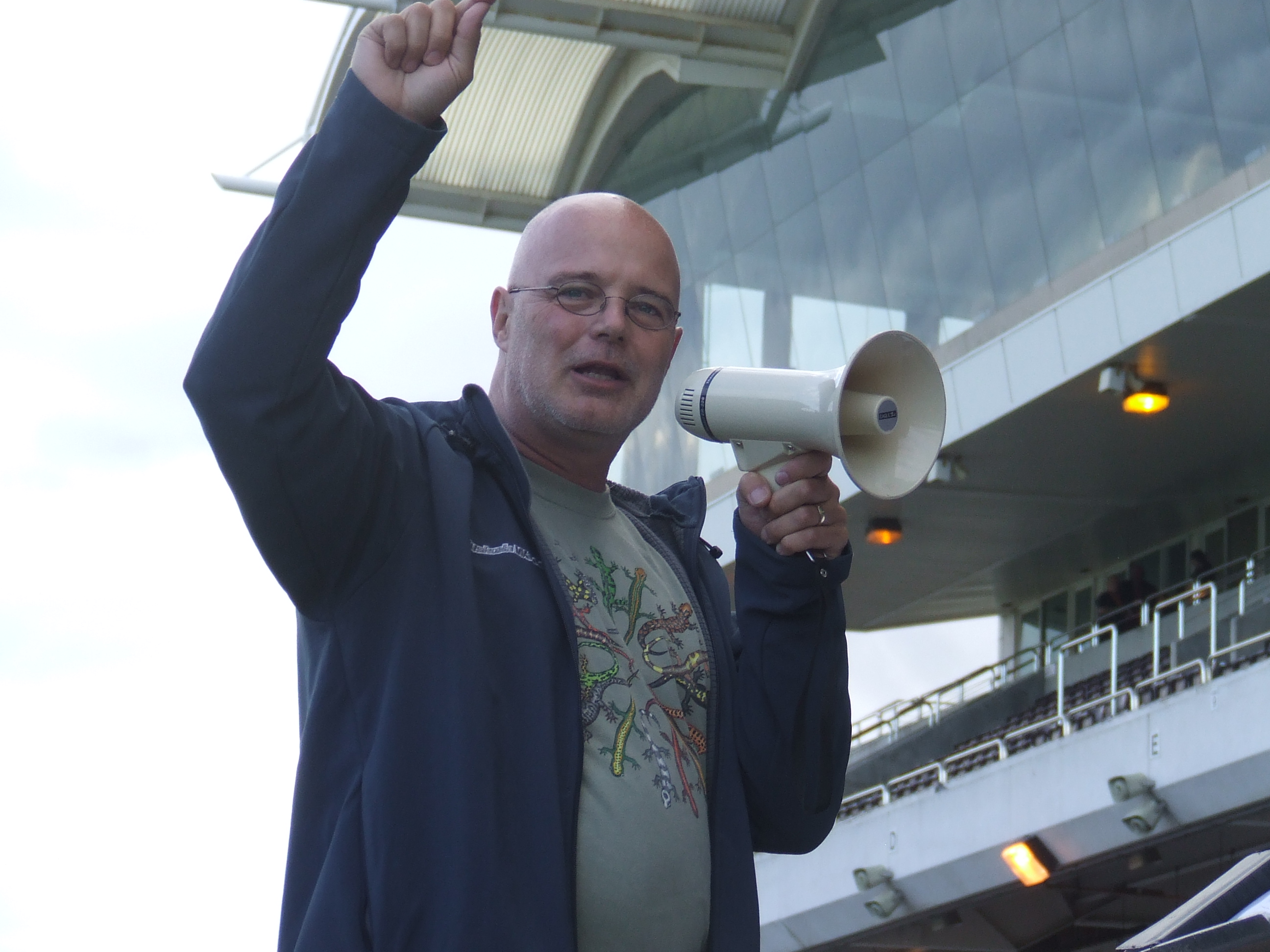
Brian McLaren makes do with a bullhorn after power failure at Greenbelt festival a few years ago..

I have written about all of these issues on this blog,but it is the last of the four crises that I have been thinking about of late. In fact, it has been a long term conversation with many of my friends too.

There is a similar-sounding issue that we might easily confuse this conversation with, aound CHURCH. I have spent too long on that journey… so much time has been spent trying to preserve the institution by making stylistic superficial changes in the hope that the centre can hold. I no longer think it can, but even if it does, how might Church inspire real change by doing business as usual? What dynamic ideas might be embraced without letting go of the old ones? The question I have begun to consider is whether it might be time to re-examine not just the flavours of religious institutions, but the fundamentals of the religion itself.

I should start by saying that I am NOT talking about inventing a brand new religion – I’ll leave that to the Scientologists. Neither am I able to comment on the reform needed in other faith traditions other than my own.

The religion that I both reject but also want to re-invent is the one named (perhaps despite his best warnings) after Jesus Christ, a historical figure whose teachings (I would argue) we have largely ignored.

Here is the thing – I don’t think I am alone. Back to those conversations with my friends. Most , like me, have left the institution of Church behind, but some are very much still within, working hard for change. The commonality between all of us is that we all long for something else, something better, but we all struggle to conceptualise what that is, and what it might look like.

I am going to try. It may take me a while. If you have thoughts or ideas that are triggered by my ponderings I would love to hear them- as long as you are kind.

From here.https://www.brin.ac.uk/figures/church-attendance-in-britain-1980-2015/

It is perhaps worth reminding ourselves of the reality of declining church attendance in the UK. It is not always a straightforward picture in the short term, for instance, some hard line conservative churches have actually grown in recent years- including the Free Church of Scotland and many Pentecostal or funamentalist gatherings – even though the long term trend is still downwards, some have seen significant increase in attendees.

But this brand of religion stays firmly within the ‘crisis’ territory outlined by McLaren above. The solutions they are offering – moral certainty in relation to homosexuality, gay marriage and the fear of Hell – do little to address the problems facing our age. In fact, given the dominance of American right-wing faith models across the whole world, we might argue that this religion is the problem, not the solution. It is at best a distraction, at worst, one that has fully accommodated itself with the same capitalist economics and politics that are throwing us towards destruction.
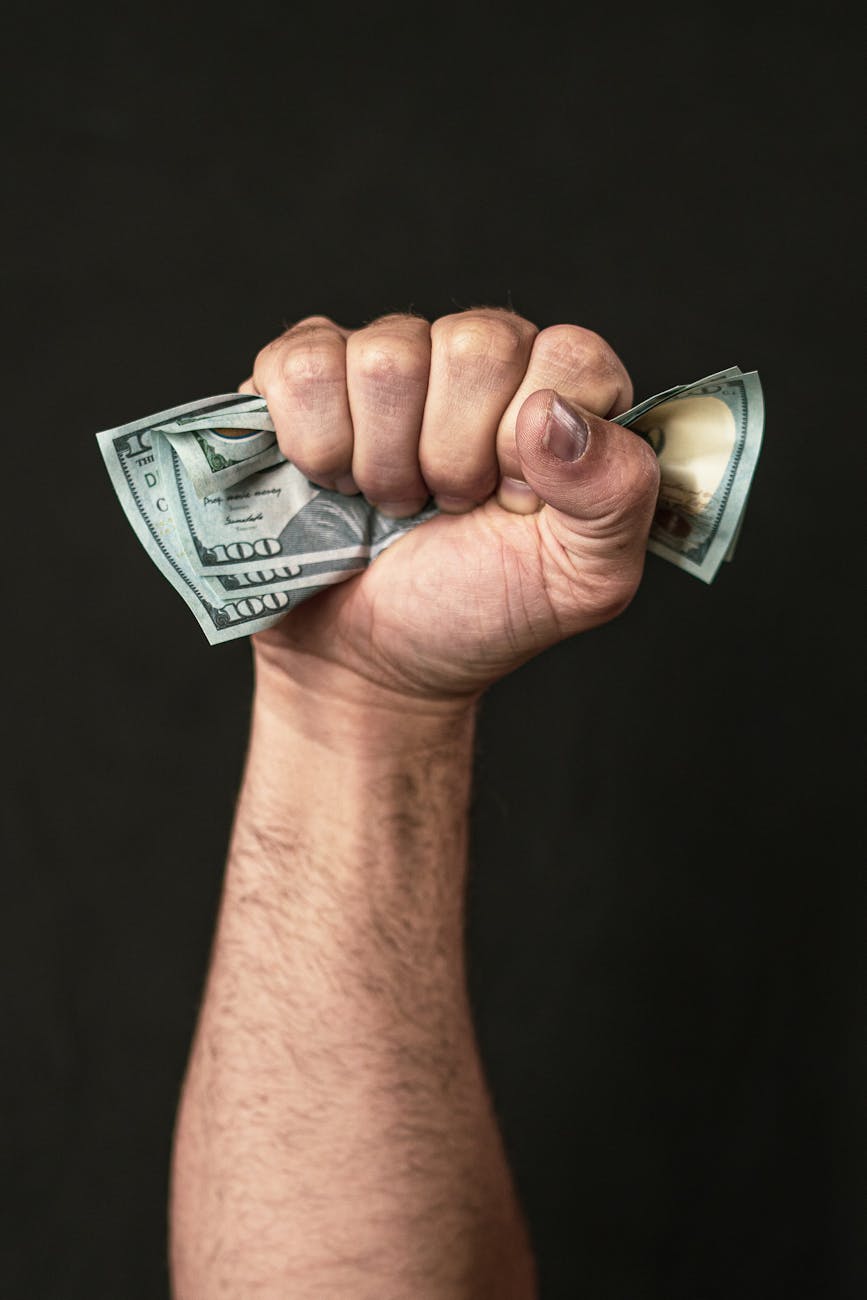
Photo by Jeff Stapleton on Pexels.com

It might be worth thinking about religion in terms of these different components’

  1. Origin story/ Messianic figure/ supporting documentation
  2. Core tenets/ docrine
  3. Mission and emphasis
  4. Community organisation

So this is where I will start… after I have done some more pondering anyway.

Rosa and Resonance part 3, connections…

A final look at Hartmut Rosa’s reframing of modernity, this time in order to place his thinking alongside some other broad themes.

Image by Si Smith, from After the Apocalypse

This post might be stating the obvious, but I wanted to sketch out a few ways that Rosa’s description of our human condition has resonated with many other themes explored on this blog. Here they are then, in no particular order…

Downshifting/slowing down/degrowth

If I am evangelical about anything these days, it is to encourage people to step back from those high pressure, high consumption, high stress lifestyles that can trap us in cycles of mortgage making and shiny-stuff-owning. Our experience has been that even when we percieve this way of living to be toxic, we find it extremely difficult to stop. Perhaps this is a cultural pressure, an mutual anxiety about being left behind or losing significance, or even falling into poverty and non-citizenship. Perhaps too this is an ecomomic issue, given that unsustainable growthism is built in to the very DNA of our ideas of what a ‘good’ economy might look like.

But even as I have tried to go against the flow – as I have turned towards simpler ways of life, as I have dug my veg beds and put up my poly tunnels – I have often wondered what difference I was making, even to myself. It has felt indulgent, a lifestyle new middle class dream in which I remake a paradise for me and mine. Is it credible that enough people might follow this path to make any kind of difference to the ecocide we are inflicting on the natural word?

Rosa had similar questions, and this led him away from ‘slowing down’ as a solution towards the more difuse and (dare I say) ‘spiritual’ idea of resonance. He pins his flag of hope to a solution dependent on a mass increase of connection to the essence, or the ground of our being, via deeper appreciation and communication with the natural world, or with the great beyond, or with art. Is this a crazy idea?

After the apocalypse

Perhaps it is crazy, but this idea oddly mirrors the arc of my last book – the collection of poetry entitled After The Apocalypse (Si Smith’s wonderful images for this book are all over these posts). I began writing the work for this book before the pandemic, as a kind of passive/active resistance to the rise of so many political and economic powers I found deeply troubling- the swing to the far right and the mainstreaming of lies and dishonesty, often in service of those who were happy to prioritise short term profit over climate or social justice.

In the end, because of the intervention of the pandemic. the book fell into three parts- before (protest) during (silence and enforced slowing down) and finally after, which dared to hope for change… even if the only way I could envisage this change was in a wider turn towards meaning, towards spirituality and connection with the earth.

Rosa would call this resonance.

It did not feel enough. I wanted to tear down border walls, remake the world better, liberate captives and feed the hungry. But given that none of these things were available to me (and even if they were, I am not the Messiah) what is left is to go deeper into the world, to live more fully and to connect with those I am in community with, both human and non human. If enough of us do this, then surely the wall will fall anyway.

(Celtic) Spirituality/Mysticism

It will be of little surprise that when Rosa talks of resonance, I hear it first and foremost as a spiritual matter.

Even the detail of how he described the process of resonance – in terms of how we feel a call towards something…

Phenomenologically speaking, we all know what it means to be touched by someone’s glance or voice, by a piece of music we listen to, by a book we read, or a place we visit. Thus, the capacity to feel affected by something, and in turn to develop intrinsic interest in the part of the world which affects us, is a core element of any positive way of relating to the world. And as we know from psychologists and psychiatrists, its marked absence is a central element of most forms of depression and burnout. Yet, affection is not enough to overcome alienation. What is additionally required is the capacity to “answer” the call: when we feel touched in the way described above, we often tend to give a physical response by developing goose bumps, an increased rate of heartbeat, a changed blood pressure, skin resistance, and so on. Resonance, as I want to call this dual movement of af<-fection (something touches us from the outside) and e->motion (we answer by giving a response and thus by establishing a connection) thus always and inevitably has a bodily basis. But the response we give, of course, has a psychological, social, and cognitive side to it too; it is based on the experience that we can reach out and answer the call, that we can establish connection through our own inner or outer reaction. It is by this reaction that the process of appropriation is brought about. We experience this kind of resonance, for example, in relationships of love or friendship, but also in genuine dialogue, when we play a musical instrument, in sports, but also very often at the workplace. The receptive as well as active connection brings about a process of progressive self- and world transformation.

From here.

Does this not sound like a mystical experience? An embodied call and response to something deeper than ourselves that ultimately is transformative?

Image by Si Smith, from ‘After the Apocalypse’

More than this, there is something about resonance that takes me back into my appreciation of the Celtic Wisdom tradition, which might be understood as first and foremost about connection with the great spirit that holds everything together. In other words, we resonante because we connect with the truest form of ourselves, which is god.

Rosa and resonance part 2…

the second part of three posts exploring sociologist Hartmut Rosa’s ideas of resonance. The first part was concerned with ‘dynamic stabalisation’ within modernity. You should probably read part one first!

Image by Si Smith, from the book ‘After the apocalypse’

Rosa’s definition of the problem, or perhaps the in-built dysfunctionality of modernity is highly persuasive, perhaps in part because we all have a sense of the gathering speed within our society and our culture. Stress is expected, even embraced. We are all running to stand still and we can not pretend that this is working out well either for us or for the planet. Having described the problem, does Rosa have a solution?

One obvious response to the accelleratoin critique is to… slow down. For a while, Rosa was known in Germany as the slow-down guru, but he was always uncomfortable with this description, at least in part because he doubted that ‘slowing down’ was actually possible. Even if we do indeed need to slow down, her thought that this was unlikely to be the full answer. Any attempt to change the course of modernity would be like swimming against the direction of a whirlpool. The rules of modernity are simply too engrained. Rosa was searching for other ways to engage and connect with the world. What he came up with was something called resonance.

In this video, Rosa takes us on the full journey. Strap in for the ride.

If you have stayed the course with this video, well done! If not, here are a few things I would point towards.

Alientation

Rosa identified alientation from the world as a defining quality – perhaps even a progressive quality – of human modernity. He describes alienation as “a specific form of relationship to the world in which subject and world confront each other with indifference or hostility (repulsion) and thus without any inner connection” (Rosa, 2019, p. 252)

I came accross this paper, exploring Rosa’a ideas in relation to nursing. Here is a quote;

In most cases, the interaction between caretaker and patient is no longer an encounter between two unique individuals who “speak with their own voice” each. Instead, the focus is on an ever-growing number of measurable, documentable, and above all optimizable parameters. How is the patient’s blood pressure? Their pulse? Their dosage of medication? What services are needed and how long will it take to perform them? What sort of insurance benefits are they entitled to? What kind of services can or should be billed? What qualifications do trained assistants need to perform what services? What parameters need to be recorded on what forms? Doctors and caretakers have to deal with documents, measurements, and display screens under constant time pressures; they are always trying to optimize their performance economically, technologically, medically, and temporally. Meanwhile patients expect the “optimal care” promised them; who their caretaker is doesn’t matter, so long as the services rendered are parametrically optimized in every respect. There is no longer any space, even at a conceptual level, for caretakers with an individual voice that cannot be made controllable (…) Nurses and caretakers, who need to account for their actions minute by minute, cannot allow themselves any open-ended interactions with their patients. (Rosa, 2020, pp. 81–88)

The eyes of every patient and child express a demand for resonance, and what is more, without resonant relationships, caregivers and educators cannot adequately carry out their work. Not only children, but also the ill (as well as the elderly and the homeless) want to be seen, heard, touched. They expect not just to be attended to, but responded to. (Rosa, 2019, p. 329)

As I may mention in my third post, this description sounds very much like something that Ivan Illich may have written 40 years ago.

Image by Si Smith, from ‘After the apocalypse’.

Resonance

It turns out that for Rosa at least, the opposite of the accelerating alienation is something he called resonance, defined like this;

…a kind of relationship to the world, formed through affect and emotion, intrinsic interest, and perceived self-efficacy, in which subject and world are mutually affected and transformed.

Resonance is not an echo, but a responsive relationship, requiring that both sides speak with their own voice. This is only possible where strong evaluations are affected. Resonance implies an aspect of constitutive inaccessibility.

Resonant relationships require that both subject and world be sufficiently “closed” or self-consistent so as to each speak in their own voice, while also remaining open enough to be affected or reached by each other.

Resonance is not an emotional state, but a mode of relation that is neutral with respect to emotional content. This is why we can love sad stories.[3]

From here.

I love that last little line about sad stories. Resonance is not happiness, neither is it positivity, or self actualisation. It is connection.

The components of resonance

Rosa believes that resonance can be identified and defined through four criteria: firstly, the ‘affection’ (or responsiveness) we experience in relation to an object, be it a piece of music or literature, a painting, a landscape or any ‘event’ triggering a personal reaction; secondly, the ‘efficient emotion’ which might be understood as our reaction to the ‘call’ of the specific external event in our own unique way; thirdly, the ‘transformation’ experienced by the subject in contact with this new external event and lastly, the fundamental ‘elusiveness’ of resonance in its long or short-term effects on the subject. 

Is this enough?

Can this central idea of resonance really describe the difference between an alienated modern human and a person living a good life? On the face of it, of course not. Rosa seems to have rejected the utopianism of Marxist theories, but their critique of structural inequality and more recently, the descriptions of colonial legacy of north/south inequality – Rosa’s resonance seems inadequate to engage with the scale of these things.

But perhaps this is the point. Trying to address big problems as small people is impossible. But small engaged, resonant people, en masse? Might he be on to something?

Hartmut Rosa and resonance part 1…

Image by Si Smith, from ‘After the apocalypse’

I came across the work of German sociologist Hartmut Rosa recently. His thinking had so many connections with things I find meaningful that I decided to do a deeper dive, which for me often means trying to gather some strands on this blog…

I would like to talk about Rosa in three parts, which will form three blog posts. The first will concern itself with ‘the problem’. In case this might seem negative, I would argue that sometimes we need a new perspective on things we already see. I think that Rosa’s work offers this in a new an fresh way.

On a personal level, Rosa’s thinking maps very closely to the narrative arc of my last poetry collection After the apocalypse. I will say more about this later, but for this reason, this post features some of the wonderful illustrations that Si Smith contributed to this book.

A return to the idea of modernity

The first insight I found interesting was that rather than the incessant talk about postmodernity (which has often felt like an elitist affectation to me) Rosa anchors his analysis of our society on a definition of modernity, along these lines;

Modernty is a form of society that (in order to survive) has to constantly speed up in order to stand still. It seeks to control all forms of human existence within the world, to constantly innovate and increase efficiency in all tasks.

In this way, modernity is always speeding up, or accelerating, if it did not do so, it would lose stability and things would fall apart. Rosa calls this phenomenon dynamic stabilization.

We should linger on this idea for a while. Firstly, it feels correct, particularly in light of growthism in our economics, or the phenomenon of planned obscelecence. We live with a strong sense of hurtling forward towards… well who knows, but it often feels out of control, as if it can only end badly, for us and for our non-human neigbours.

We can trace the way modernity affects our human relations in many ways. Here are a few examples;

  1. We look at a mountain and feel moved by beauty and form, so climb it. It is hard work so we build a road to get up easier and quicker. We build a sheter at the summit so we can enjoy the view from protection. We open a cafe there. We cut trees to preserve the view. It becomes popular. There are more eating places, shops selling things. It gets busy, polluted. The mountain is no longer beautiful.
  2. We feel stressed and exhausted in our work which makes ever more demands, so that we find it hard to spend time with our children. Nevertheless, we push them into an educational machine that makes the same demands of them, so that they too can get jobs that will exhaust them in the same way.
  3. Our religion, once a place of mystery and wonder, has been through a series of protestant improvements and innovations, in which each new and ‘better’ iteration has been seen as ‘true’.

Controllability

Rosa argues that modernity has at root a desire to control the world. With a nod to Charles Taylor, he describes this as a spiritual declaration of independence from nature.

This desire for control could be concieved of in terms of accumulation and greed, but arguably, it stems more from fear. Consider the degree to which the super wealthy might be regarded as ‘greedy’. Do they feel themselves to have ‘enough’? Or are there other more powerful drives to do with the fear of being left behind, of being less significant?

Wherever we come up against things that are not controllable – a pandemic for example, or the common everyday experience of death – modernity has a problem.

It is perhaps worth remembering here that Rosa is a sociologist, rather than a psychologist. he is less concerned with individual reasoning and more concerned with the dynamics that drive mass consciousness and mass behaviour. Often the logic of these dynamics is masked, even though they drive us in ways that are hard to understand.

Perhaps now is a good time to suggest watching this video, which attempts to sketch out Rosa’s ideas in wider form…

In part 2, I intend to consider the implications of Rosa’s ideas, and what his ‘solution’ to the problem might be…

Mark Berry and poesis…

The new Proost podcast is out, this time featuring a fantastic chat with Mark Berry.

If you don’t know Mark and his work here is a starter;

Before training to be a Youth Minister, Mark Worked as a Theatre and Music Lighting designer and a musician, he retains a deep love for the arts, and plays Guitar and Bass.

Mark began his ministry as a Youth worker in 1994, before becoming a Pioneer minister in 2005. His ministry has seen him sharing life with Far Right Skinheads, Gangs and Nightclubbers, growing a Church with unchurched young people in a secondary school, becoming a Chaplain and then a Director of a professional football club and running ‘Sanktuary’ an overnight café andsafe zone for the night time community.  

These days, Mark is working with prison leavers and (pertinent to this discussion) teaches a module on art and spirituality.

Here is the pod;

I very much enjoyed this chat – as I always do with Mark – there is so much in here that I feel the need to explore further, both in terms of my own ponderings, but also in relation to the broader issue of Proost. After all, Rob and I have done a lot of talking about what might emerge around Proost, but as yet there is no actual publishing or promoting going on. Having said that, I think this is right. We are determinded that if and when a new organisation emerges, it will do so because it is part of a movement of people who have some clarity about what they are about. We can’t do it by ourselves anyway so we need to explore and develop these ideas in community.

That word, Poeisis

In pod 10, we spoke a lot with Mark about this word, which had been very significant for him as he found meaning in artistic expression. My entry into this idea had been through theopoetics (you can read more about this here) and you may be able to hear me grappling to reach some kind of clarity as to how these things fitted together. In the end we got there, but it required a lot of subsequent chat with Mark, and another pod chat with Rob, which you can listen to here;

We would love to know what others think. Are these useful terms? Might they give clues as to our unfolding, our unveiling?

Allegory

I particularly love this; art making is itself an allegory, another way to encapsulate – no, to demonstrate – the ground of our being.

In making this statement, I am rejecting another common way to think about art, namely, as the means of defining the ‘specialness’ of humanity, as the only animals capable of abstract expression. (This also means rejecting at least in part, the ‘specialness’ of the individual artist.)

Instead, perhaps we can think about art as co-production, in deliberately deciding to join the great unfolding, the explosion of creativity which we are part of. You might chose to use religious language here- Creation and the endless excitement of a creative god – or you could just decide to leave this space wide open.

If we follow this logic, the intrinsic value of the art we make is found not in its percieved ‘excellence’, but rather the degree to which it enables reconnection to the creative stream at the heart of everything. Not that this is easy to define, but I think we know it when we encounter it.

Artistry

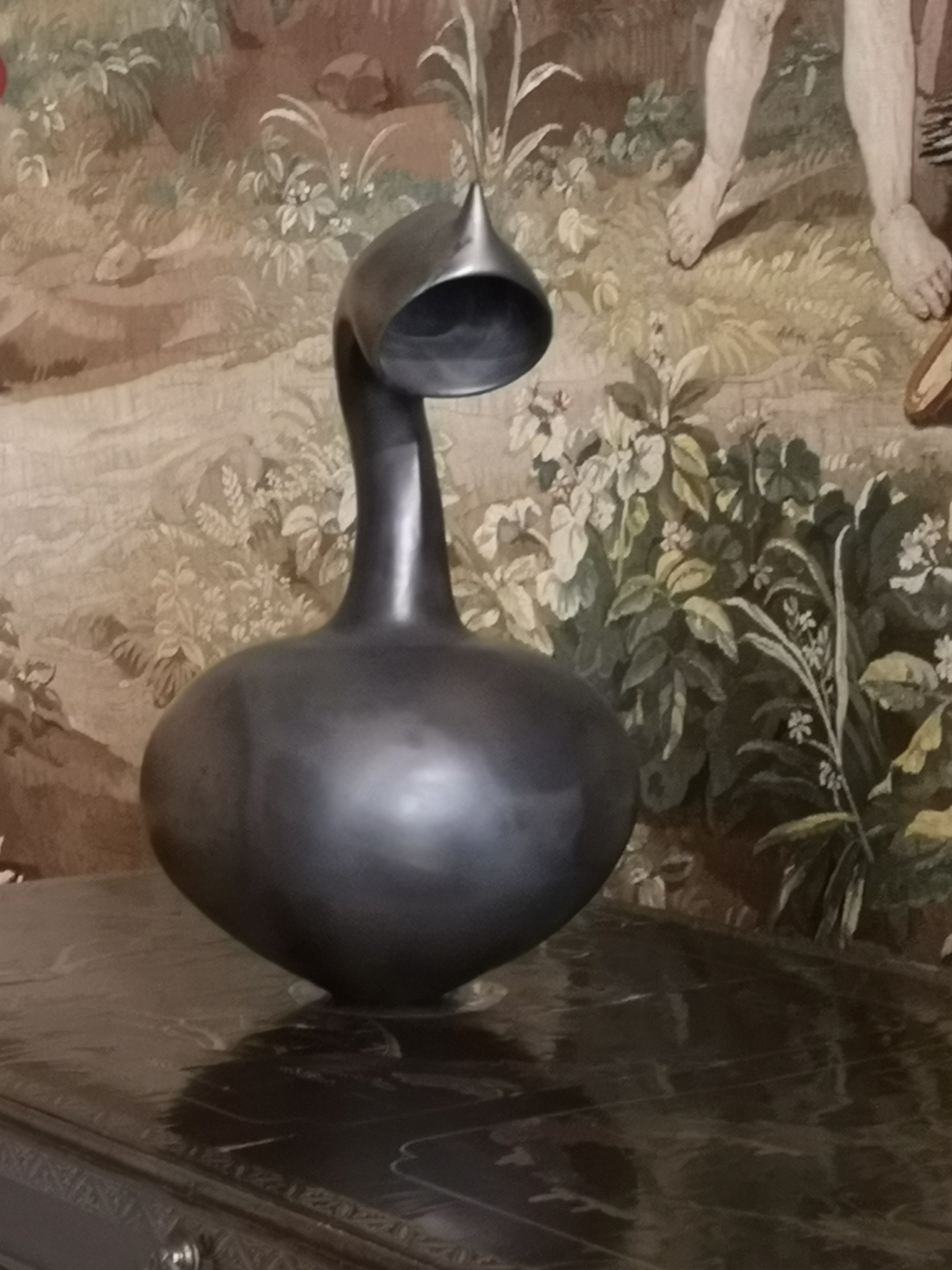
The above photo is of one of Dame Magdalene Odundo’s pots, on dsiplay in the appalling oppulence of Houghton Hall, Norfolk. The juxtaposition of empire plunder and black female art was by far the highlight of our vist there a couple of months ago.

In my above rejection of the centrality of the ‘great artist’ narrative, I must acknowledge that some people have particular gifts and skills. What they do with this gifting should be a matter for their own exploration and of course some will reach fame and acclaim in their own lifetimes. Many will not.

I am more interested in ordinary artistry – in the way that we all seek to orniment, to illustrate then to make meaning through object and experience. When we collectivise this pursuit, adding power to each other, becoming more than the sum of our individual talents, special things happen.

There has to be space and room for both.