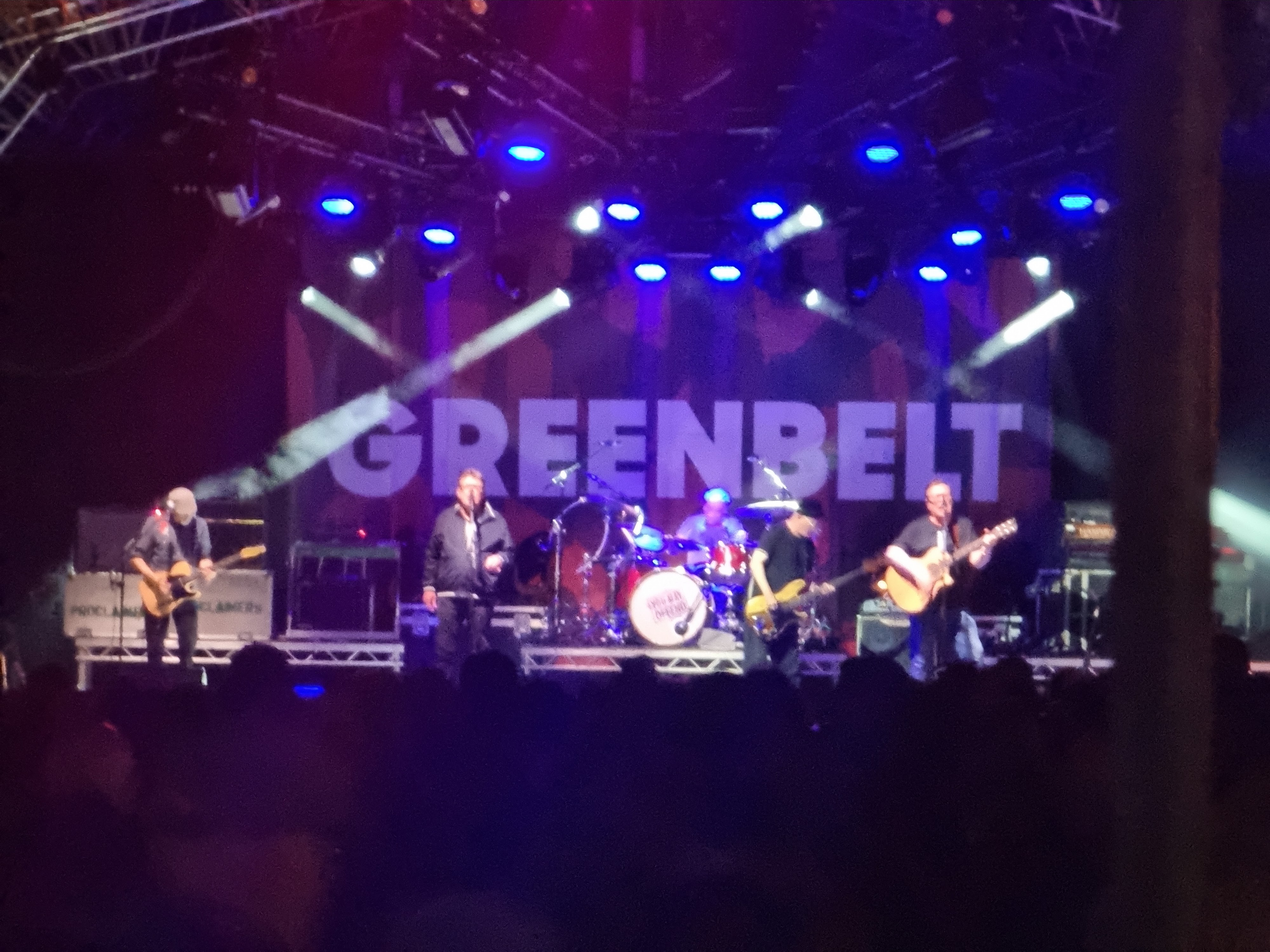
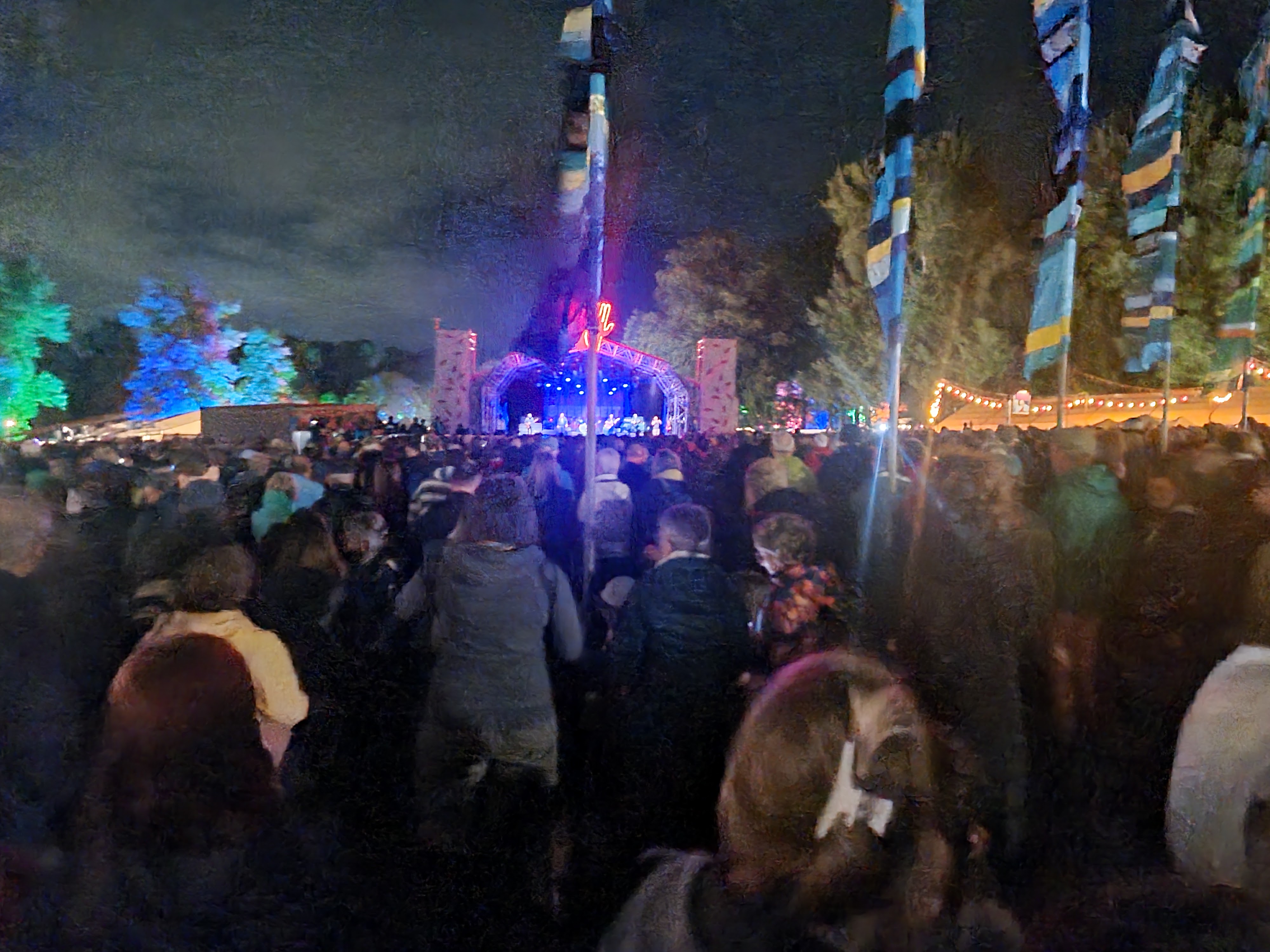
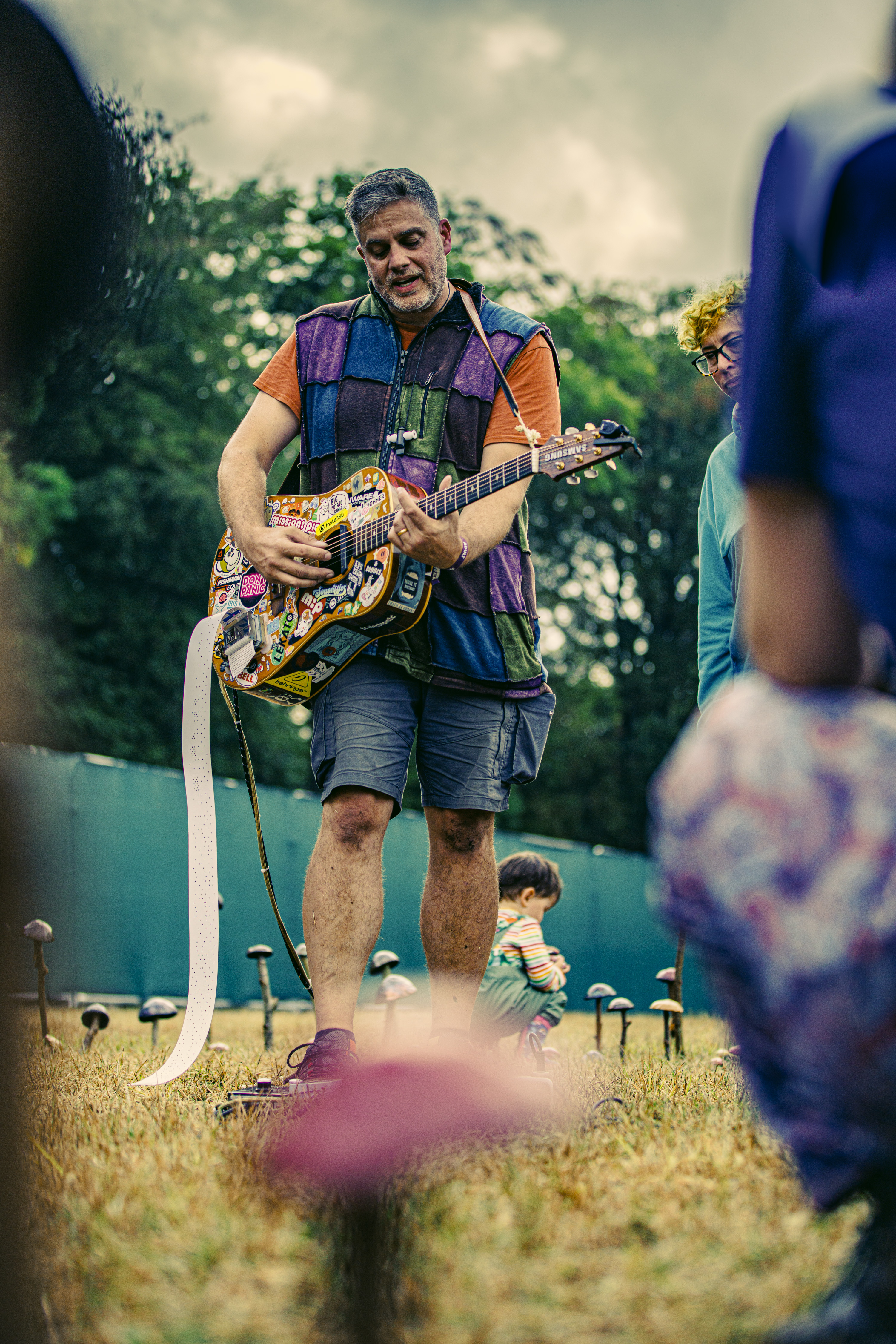
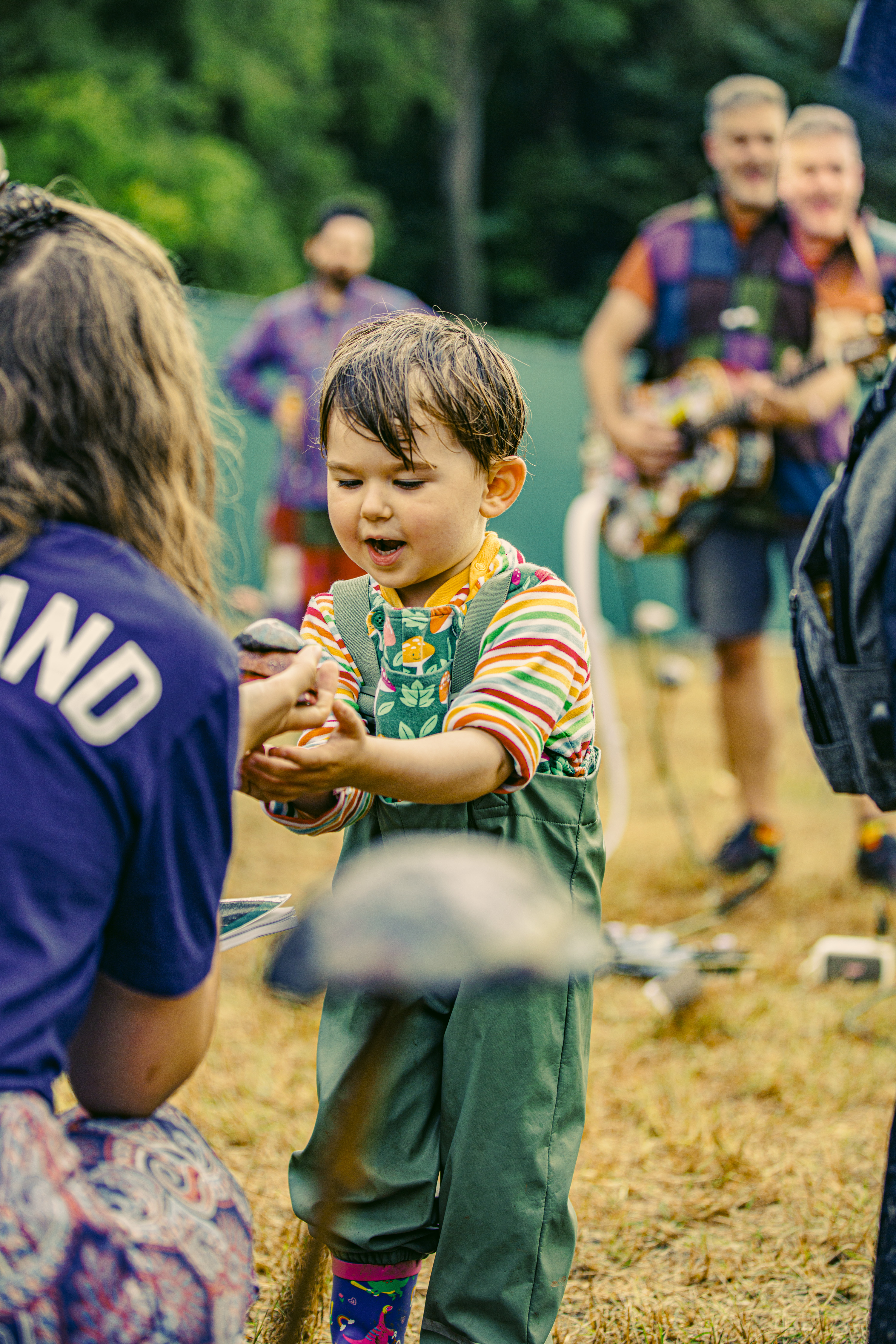
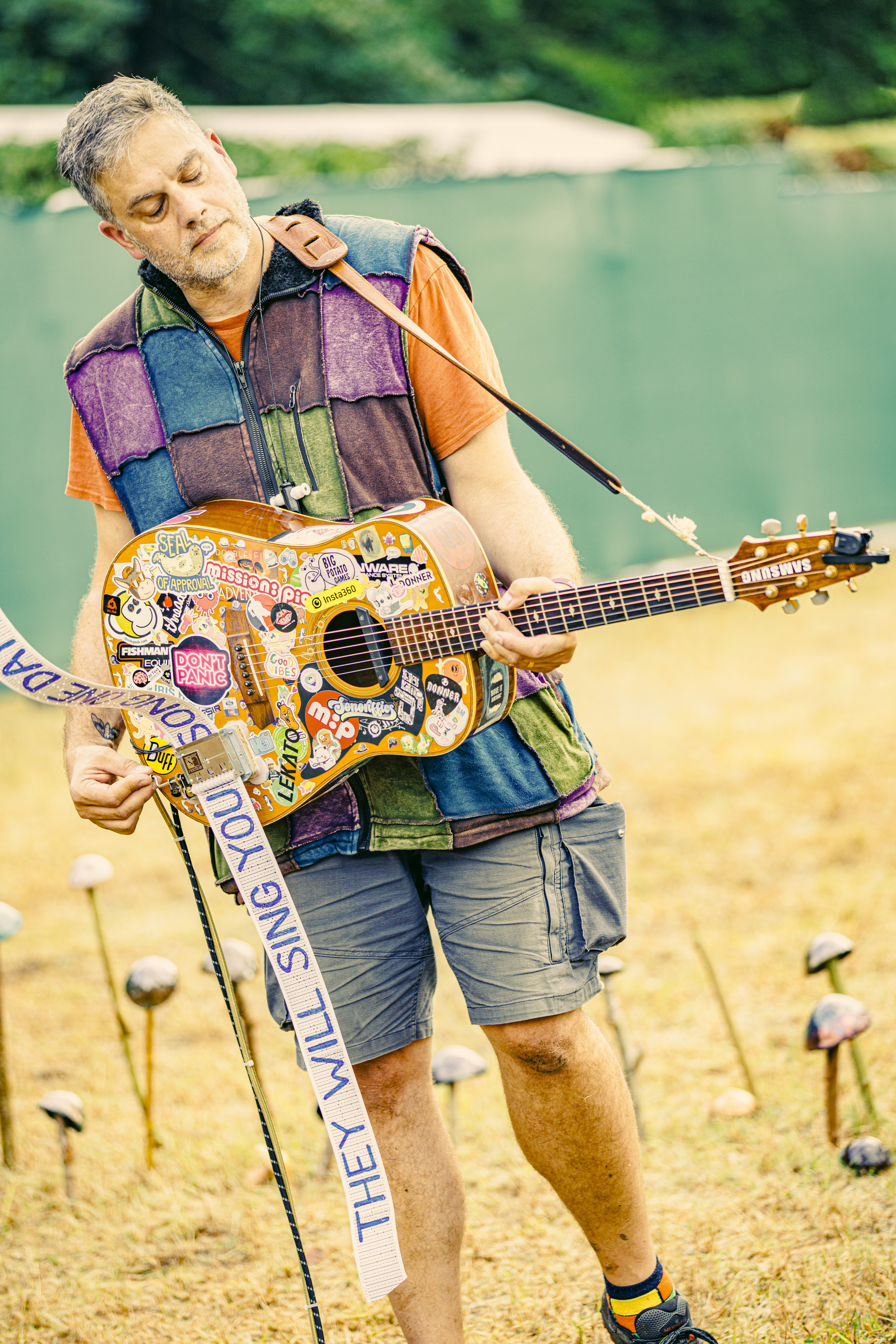
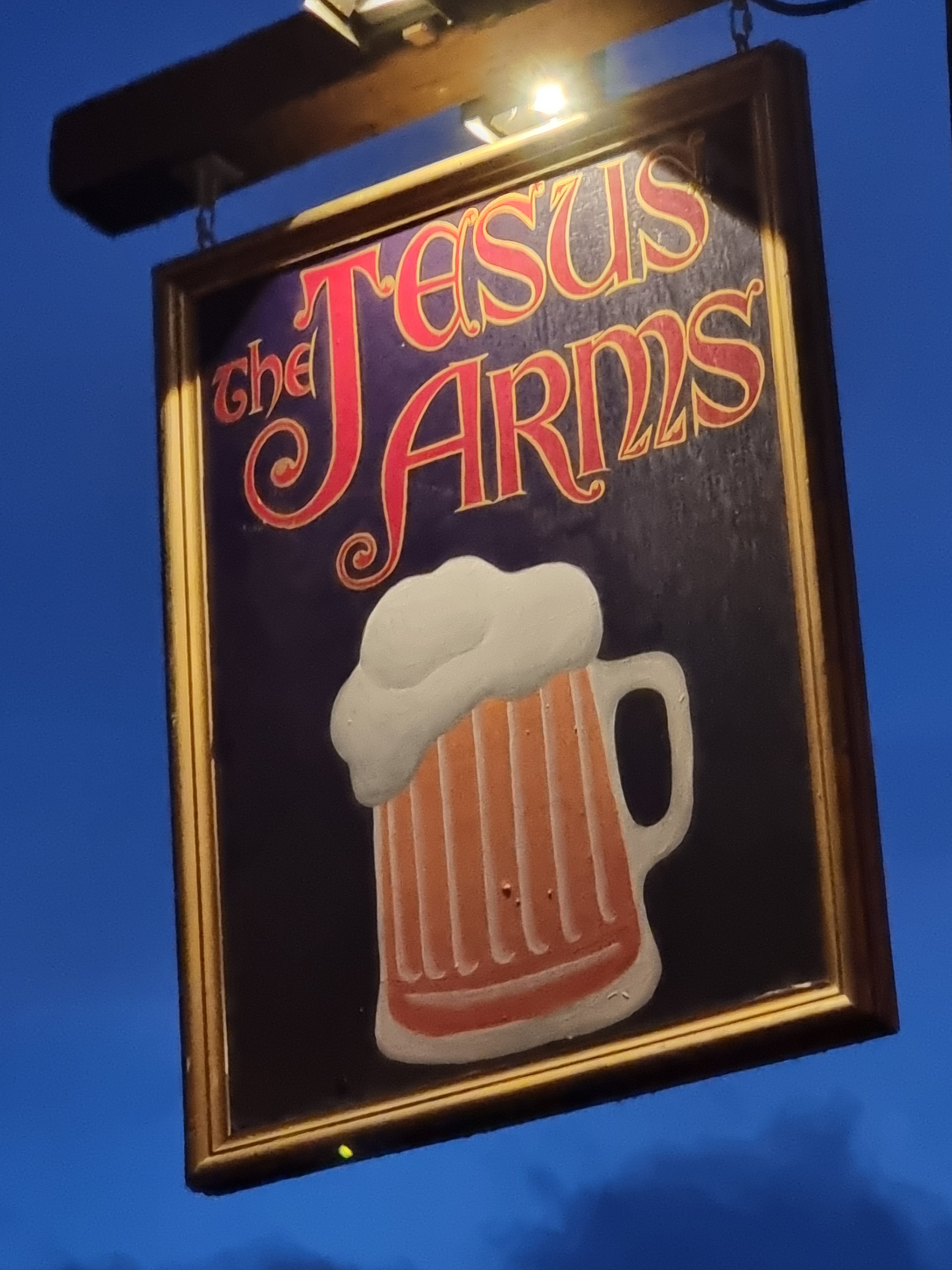
I am just back from Greenbelt festival, an annual event here in the UK that has been a place of great importance and connection for me. I first went as a young teenager in 1980 (hitchhiking there.) Back then it was all about music for me – Christian rock which made me feel like I was not alone in my strange Christian subculture. After a long break, I rediscovered the festival in the early 2000’s by which it had become a very different thing. Music was still there, but it was no longer only strange Christian bands, but from a wide spectrum of the mainstream. Faith was still there, but it tended to be outward facing, social justice focussed and often theologically progressive. For a long time, the festival fostered connections of the sorts of small ephemeral groups who were exploring the edges of faith. This move made it often derided by those of a more evangelical bent, but for me and many of my friends, it has been life changing.
The festival has continued to evolve and change, so that for a while it felt like both it and we had moved on – that it belonged now to a new generation. It was time for them to push the edges out further. We last attended about 10 years ago, until a chance to do some work showcasing Proost took us back there this year. I realised that in the archives of this blog are lots of other reflections on previous trips to the festival, so I decided to add one more.
The first thing to day is that (as with previous visits) the scale and breadth of the festival was overwhelming. I might have a plan to go to a talk/workshop/gig but this would rarely actually happen, as for me, it was all about the conversations, the lingering with friends old and new and stumbling accross something unexpected. This year, we had the delight of being there with my daughter Emily, her husband and our little three year old grandson. We tried to share him between us to I also had other duties. Alongside this, the Iona Community (of whom I am in the process of becoming a full member) have a venue at the festival with a programme of activities, so I was also keen to help out with some shifts behind the book store.
Back to the Proost element of our trip though… we have made some good progress with our ‘restart Proost’ project of late- our company now as has a new set of directors (we are still looking for a treasurer though- and others who have skills that will help with future sustainability) and we felt it was time to put ourselves out there a little amongst people who are interested in faith/art/justice. There is no better place or this than Greenbelt.
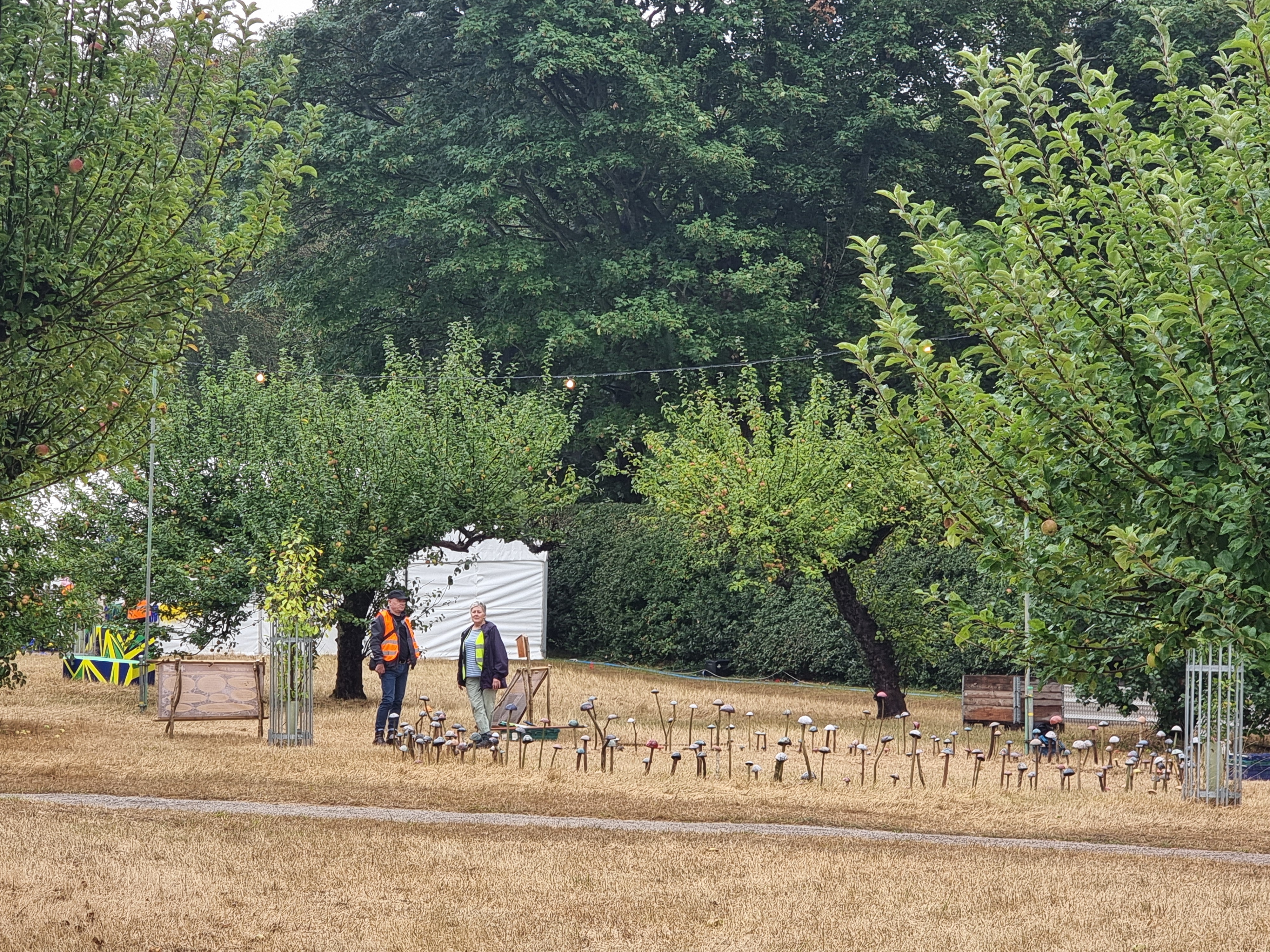
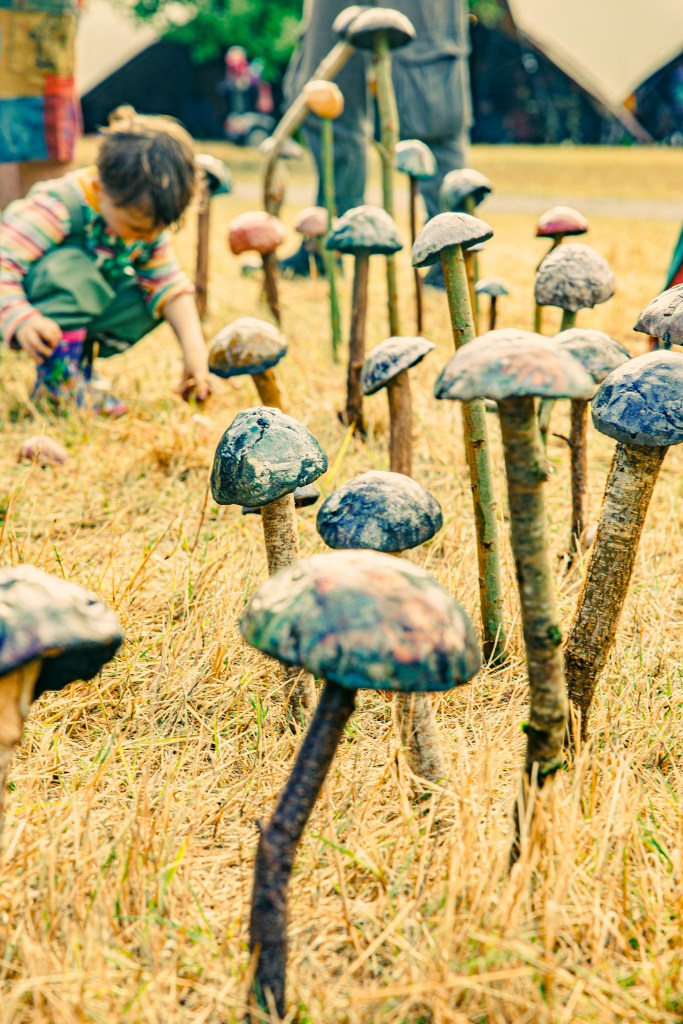
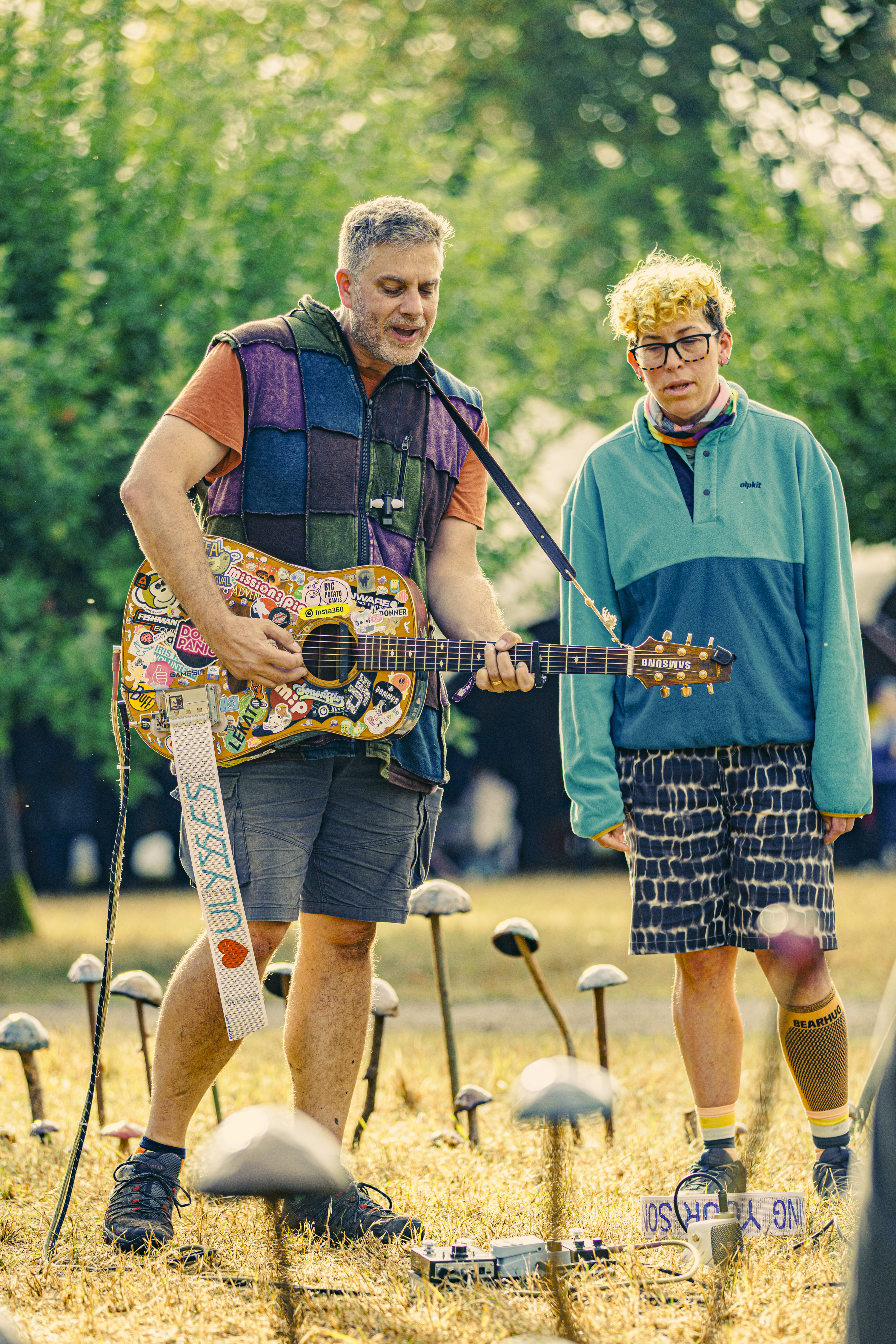
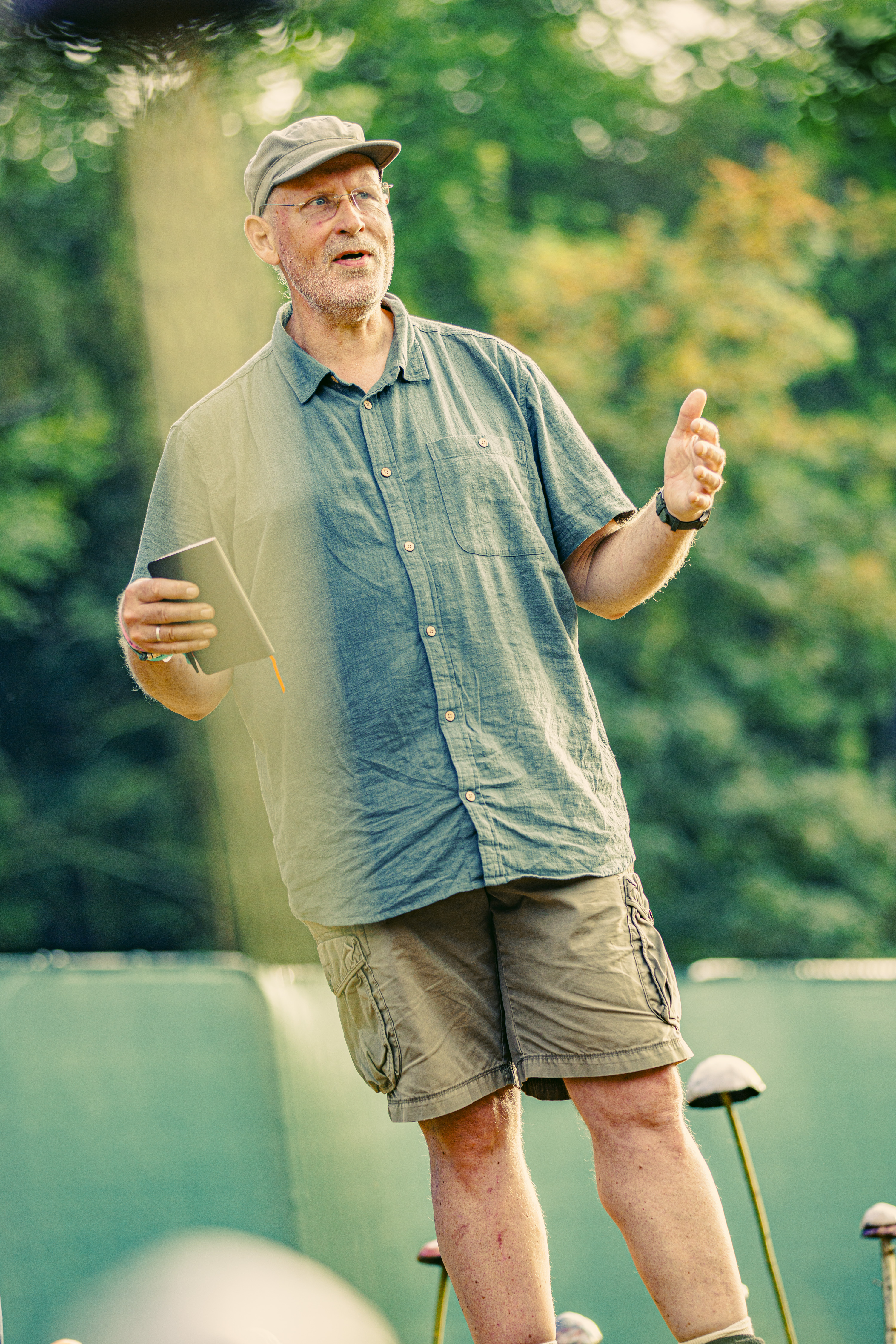
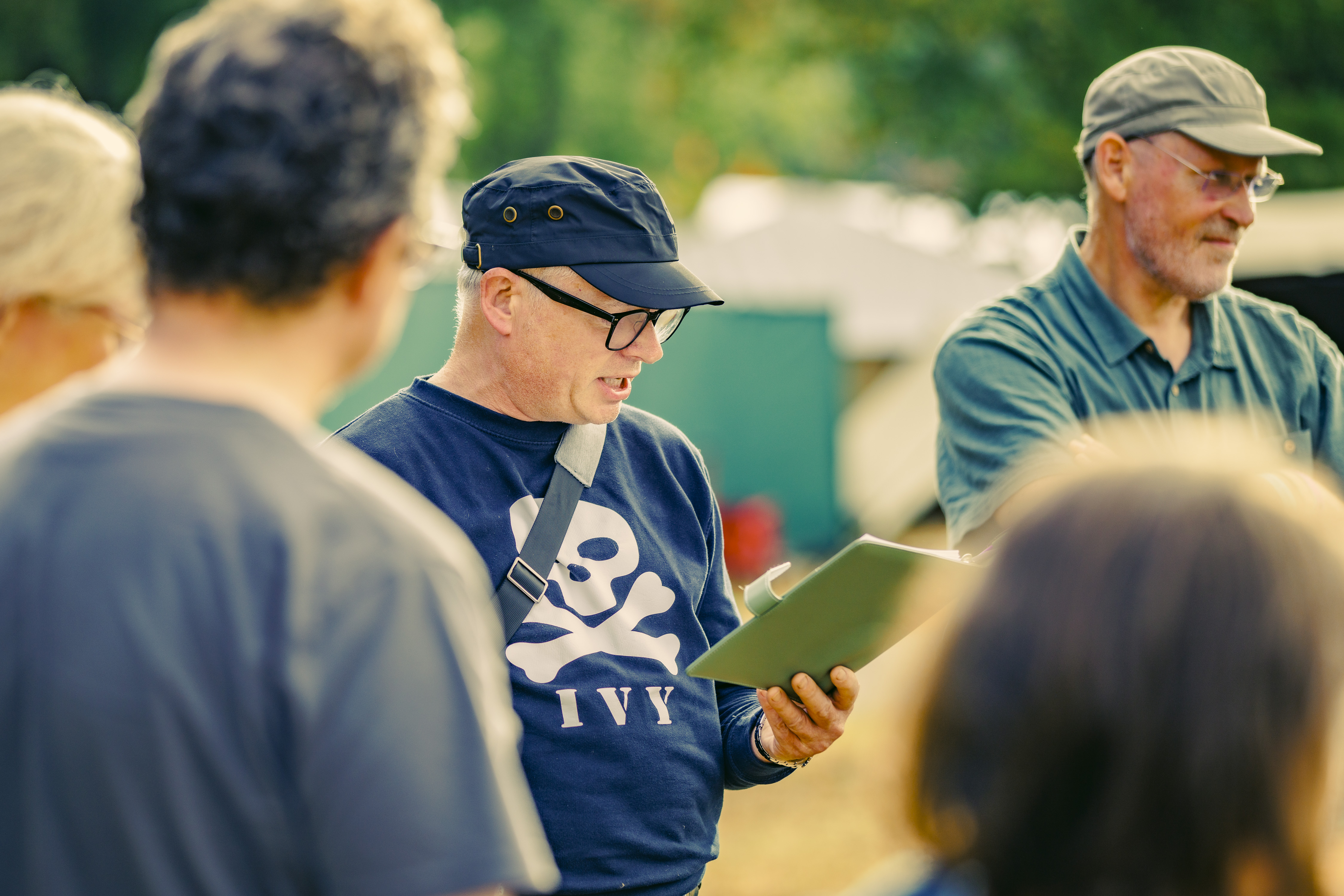
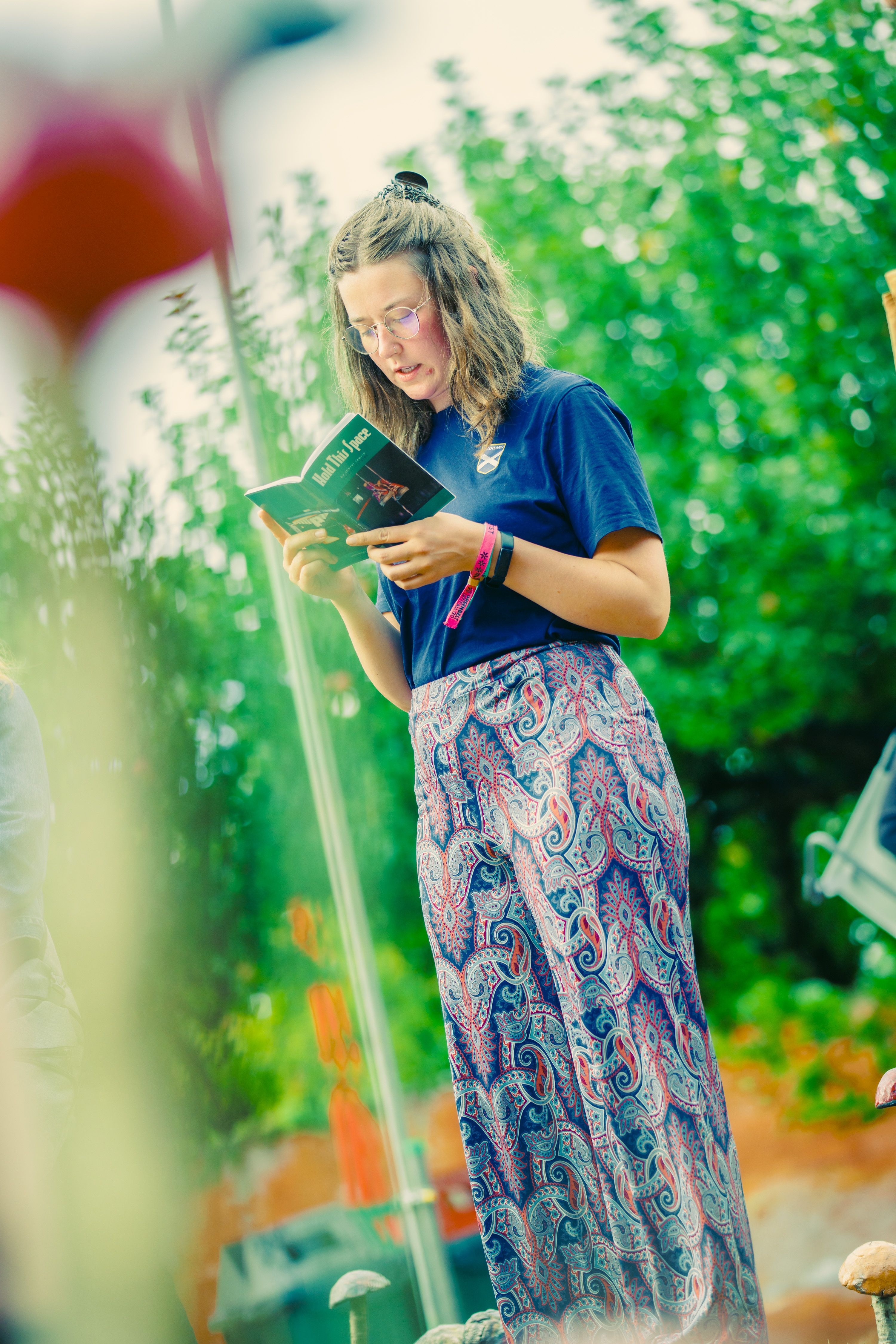
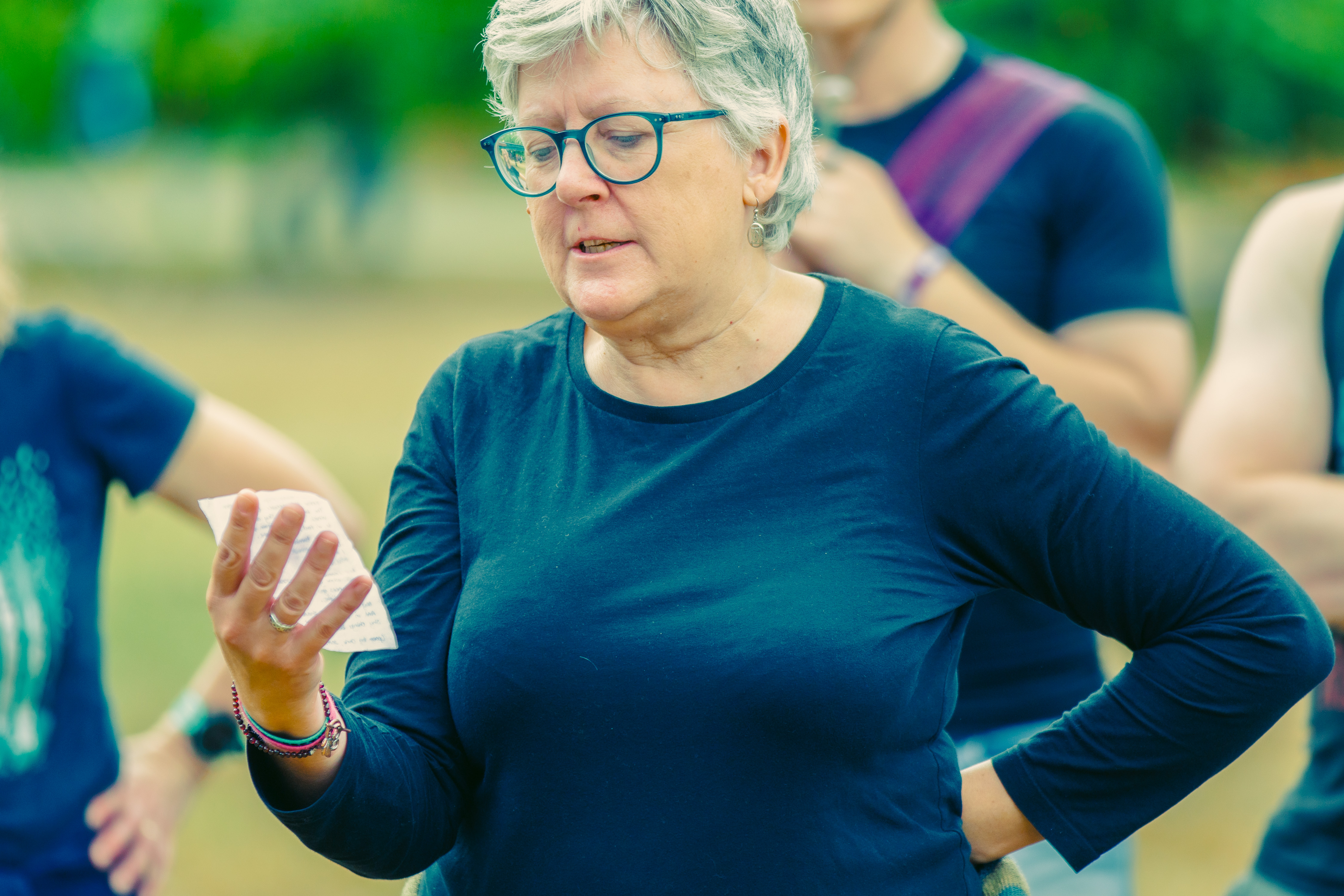
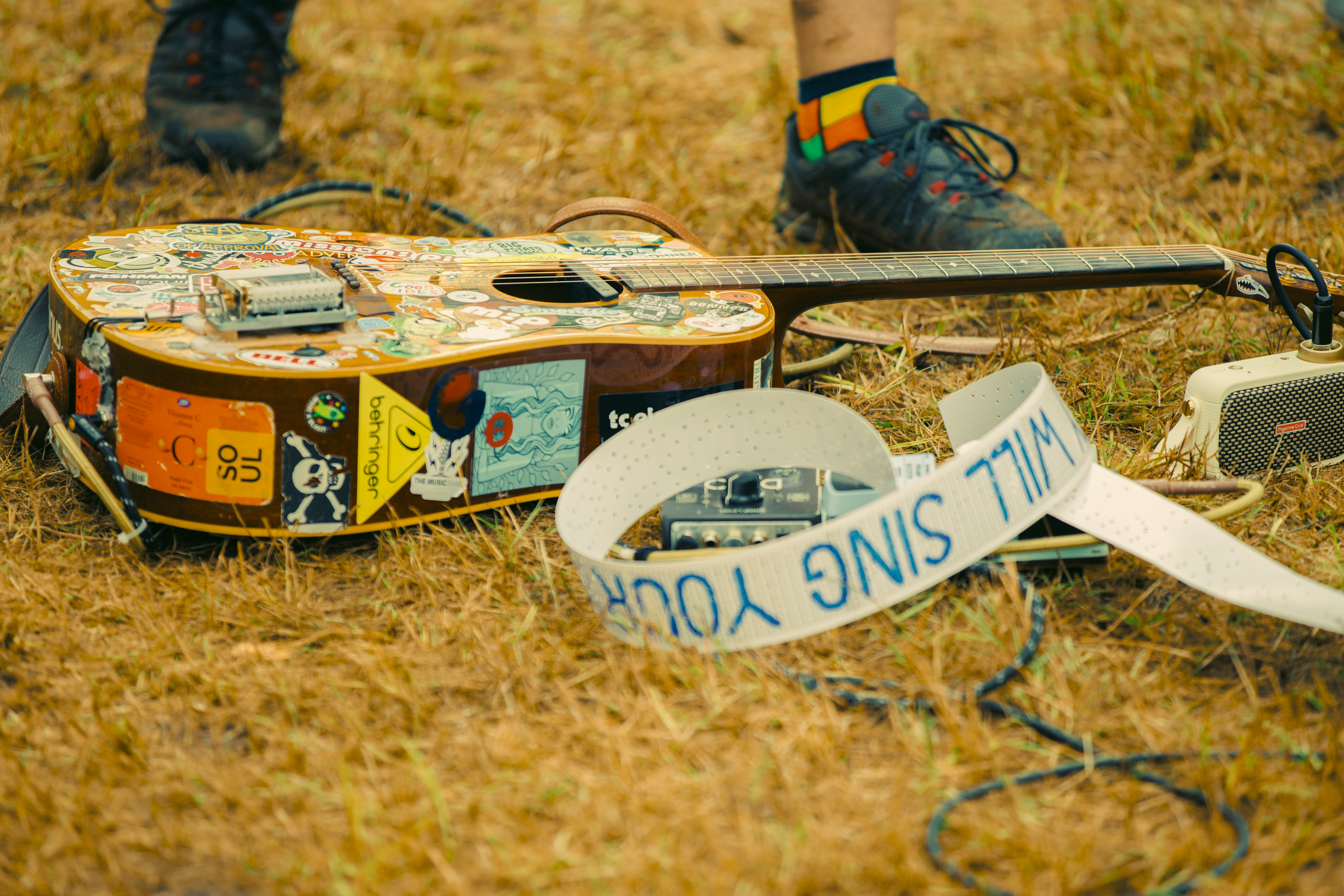
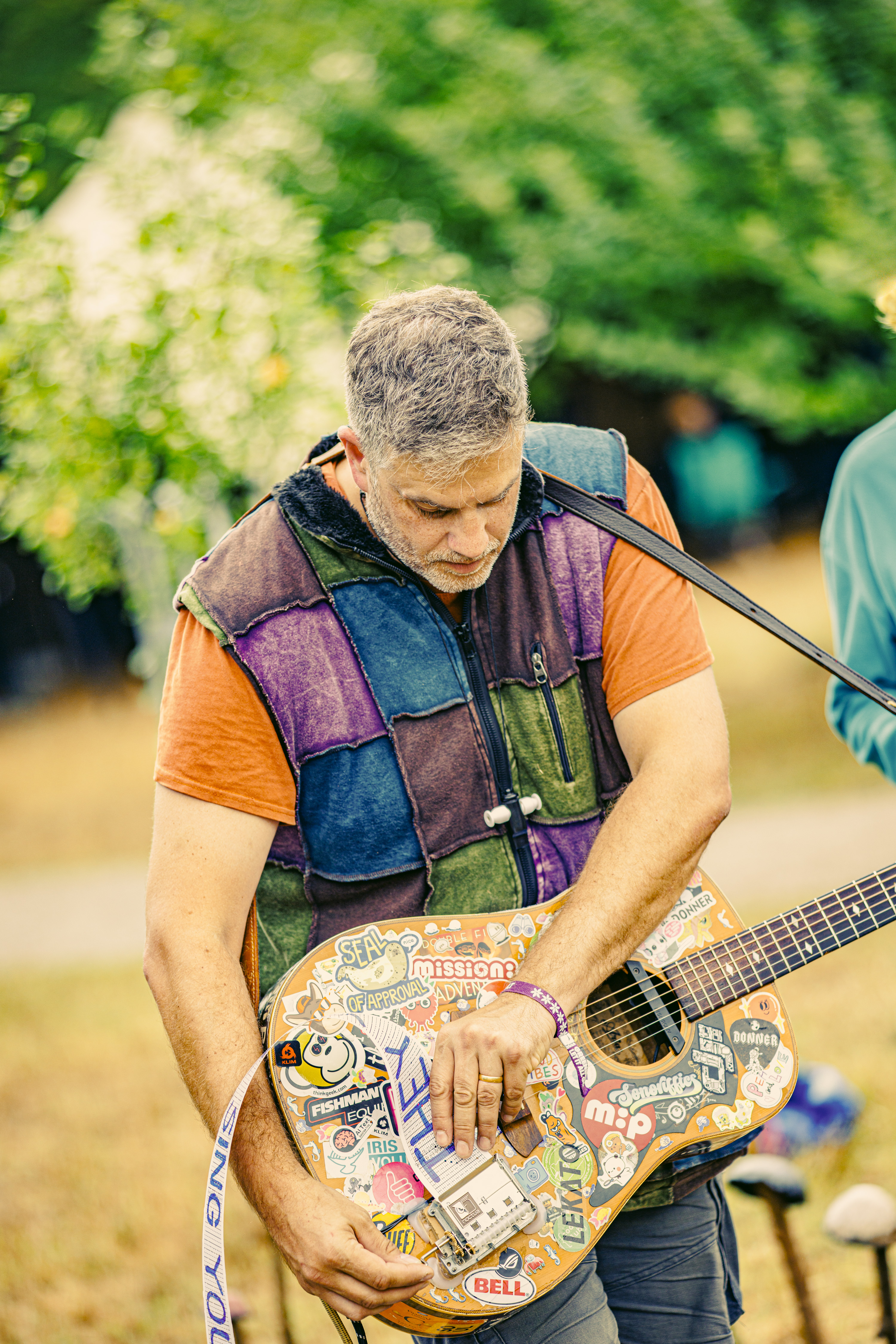
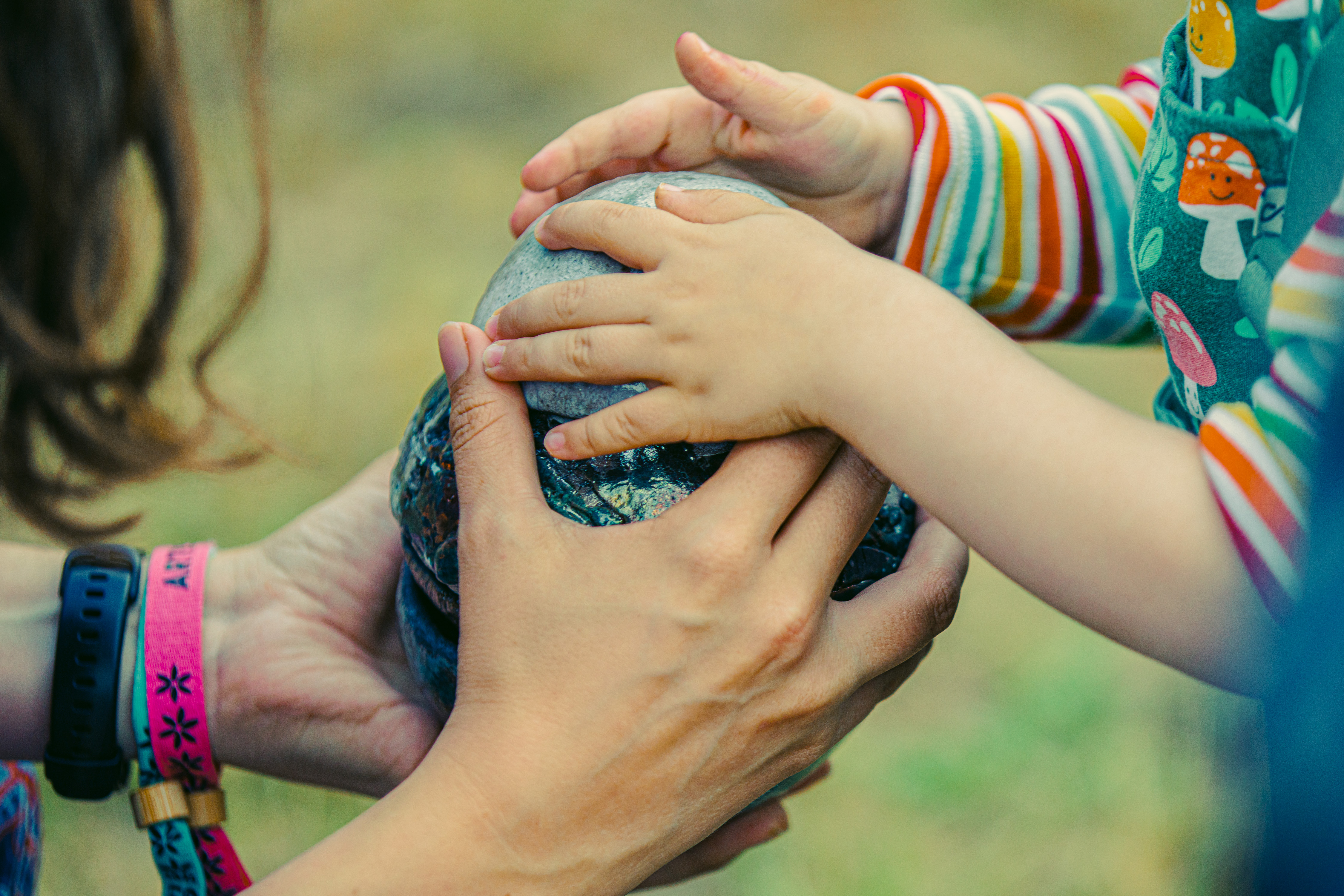
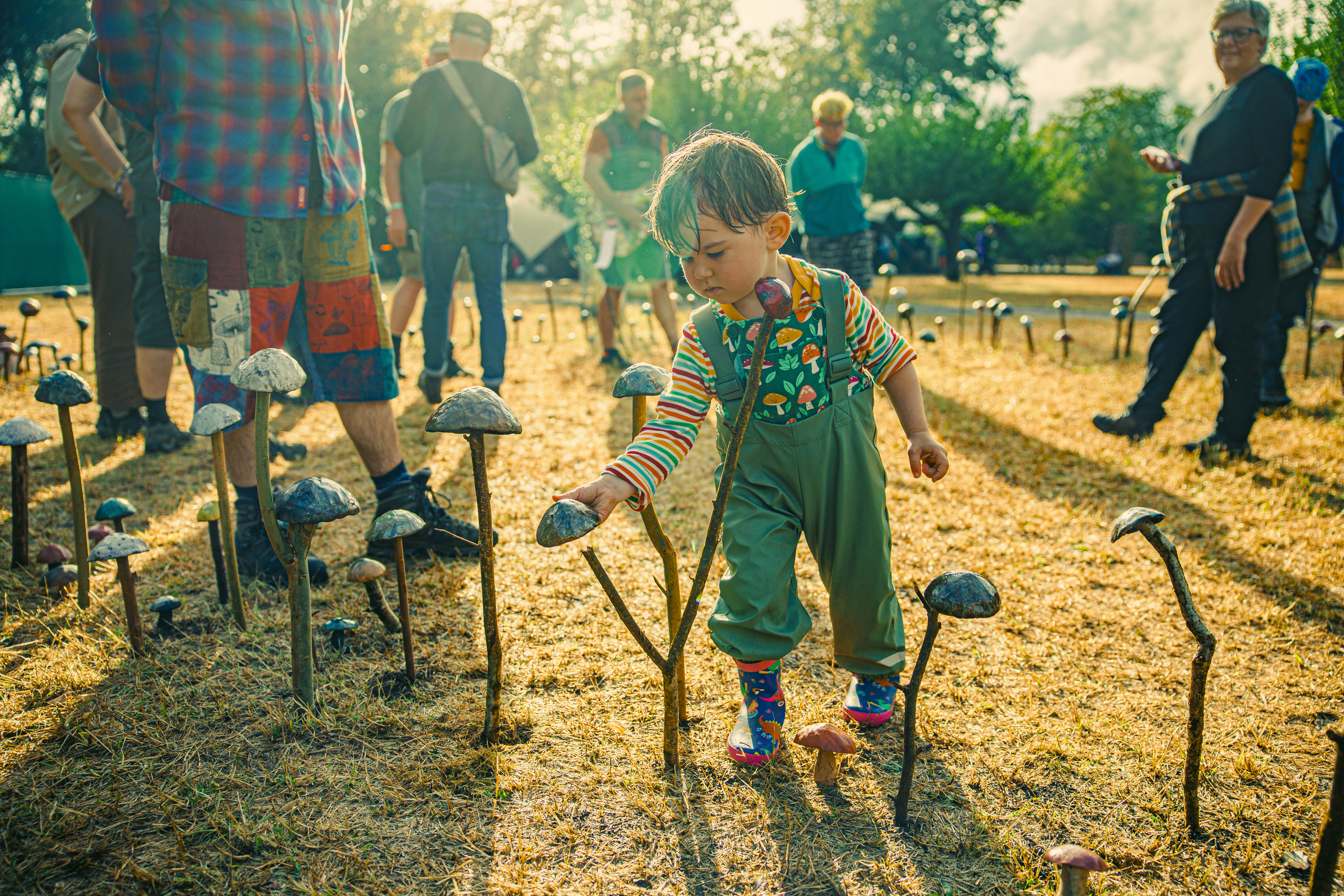
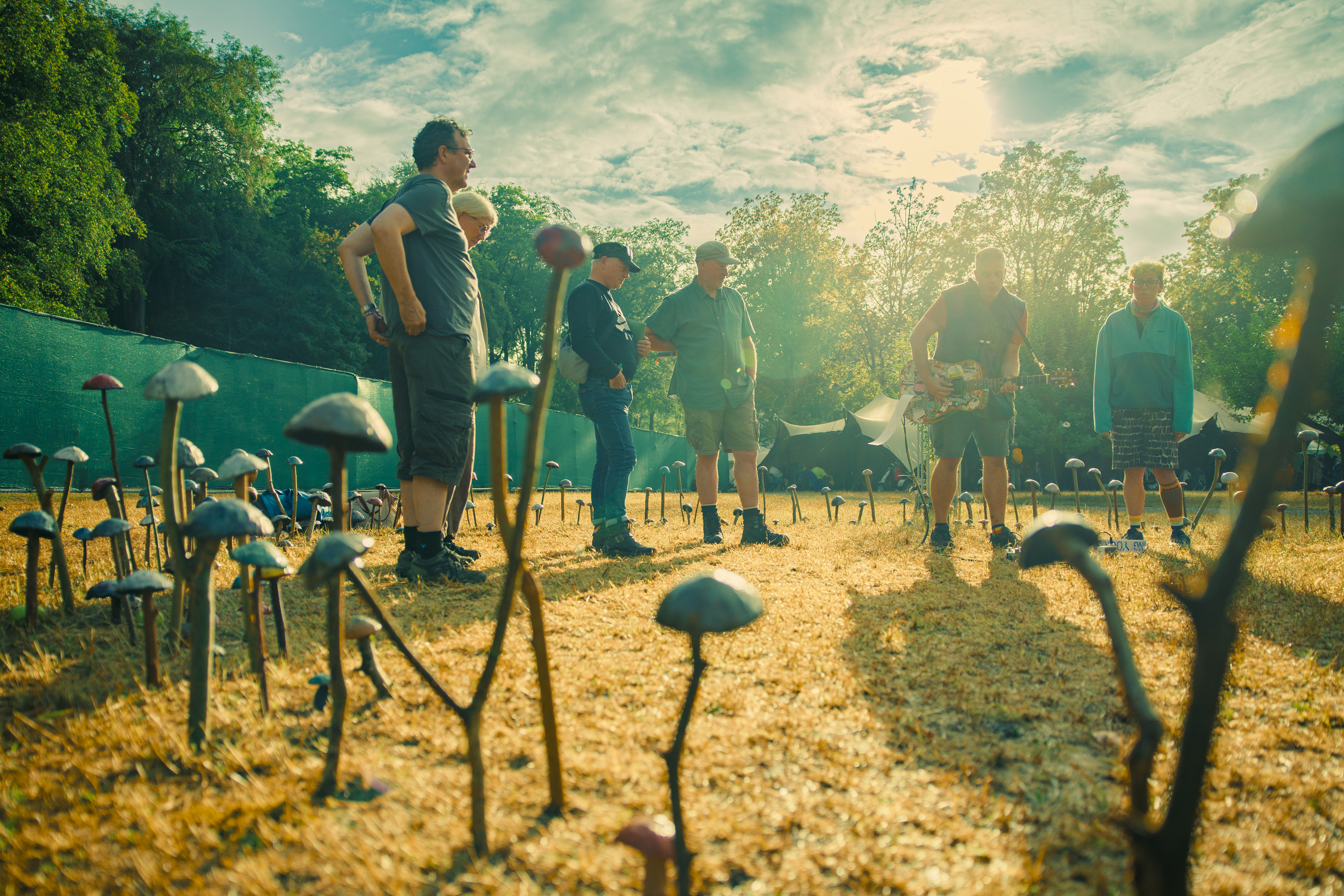
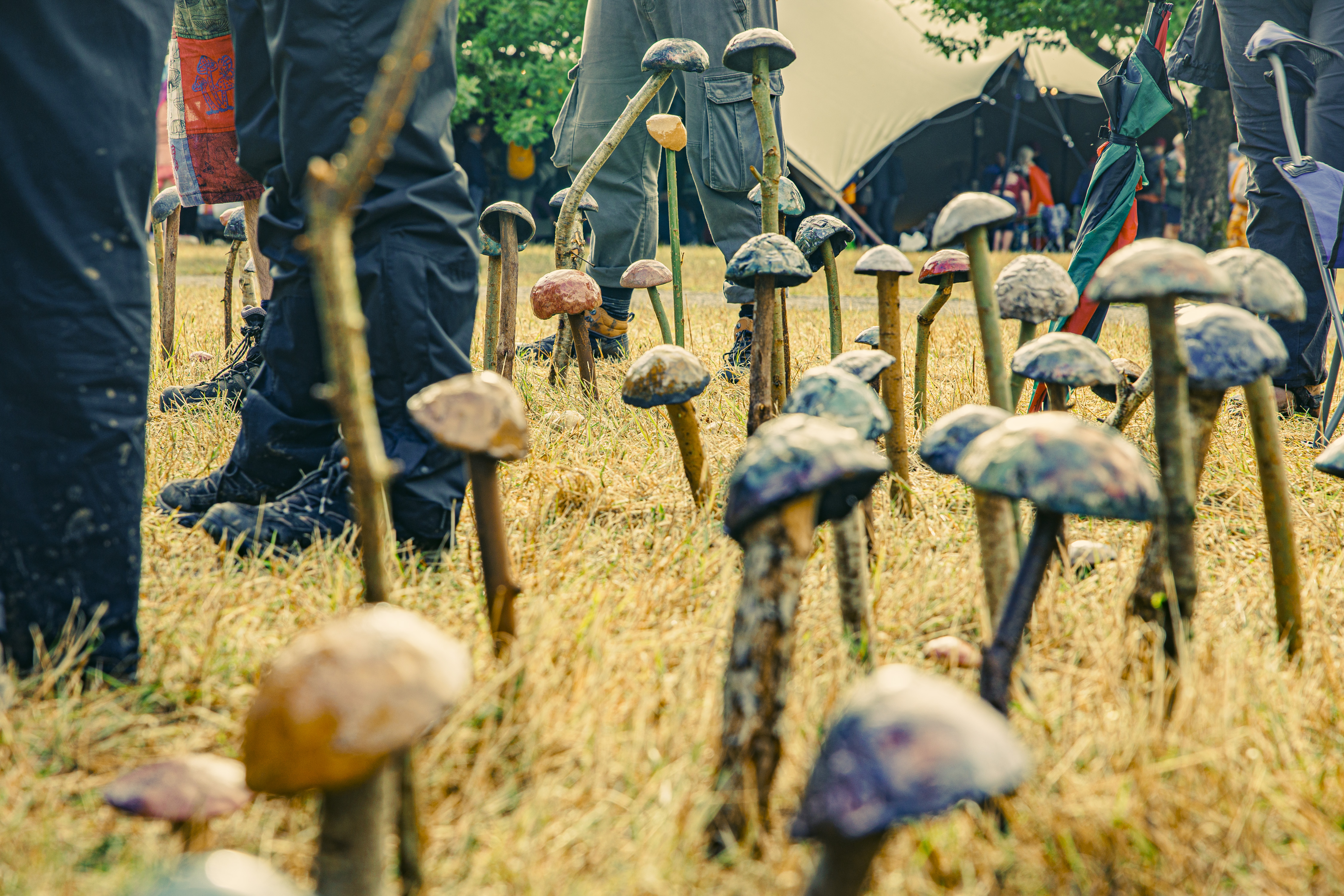
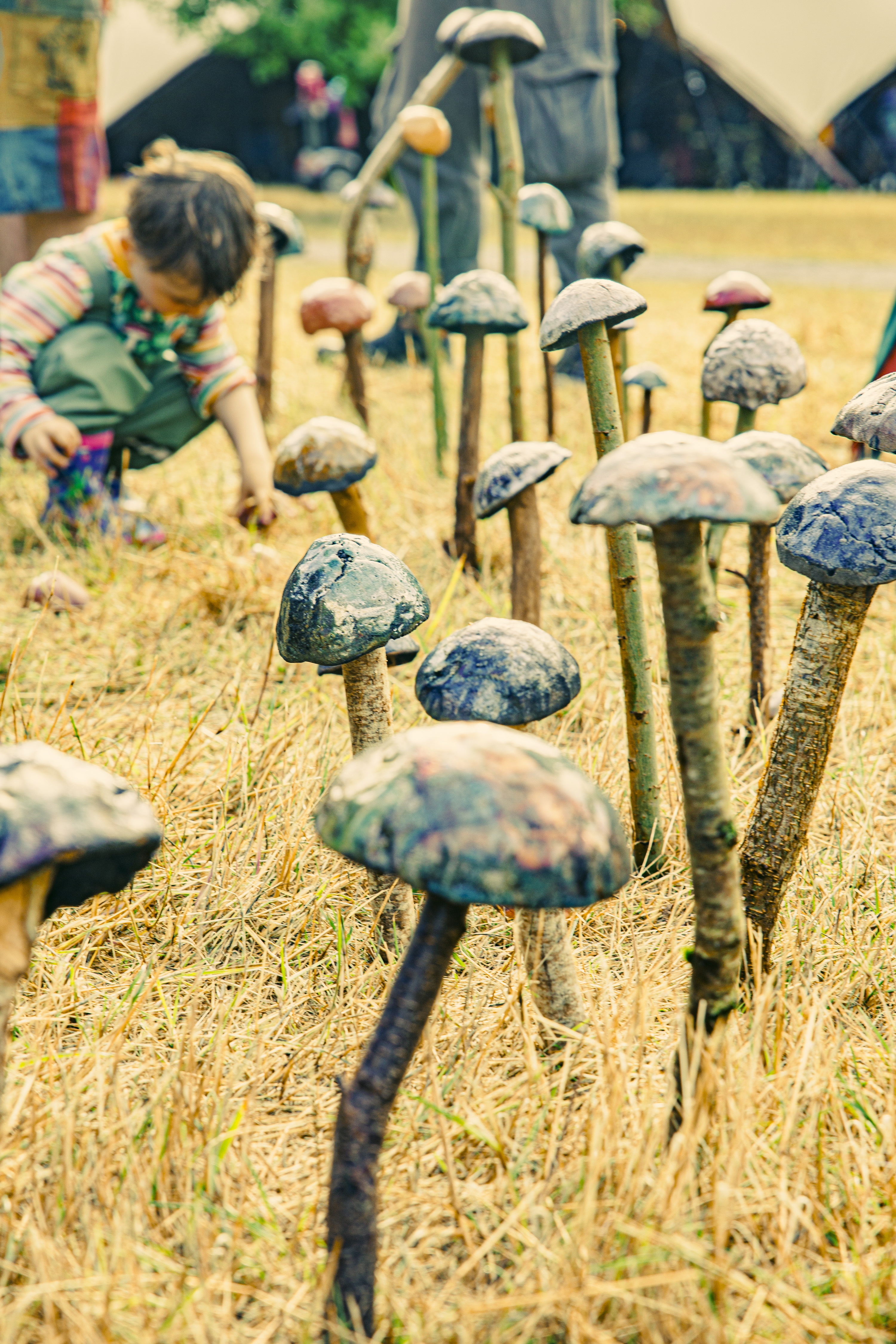
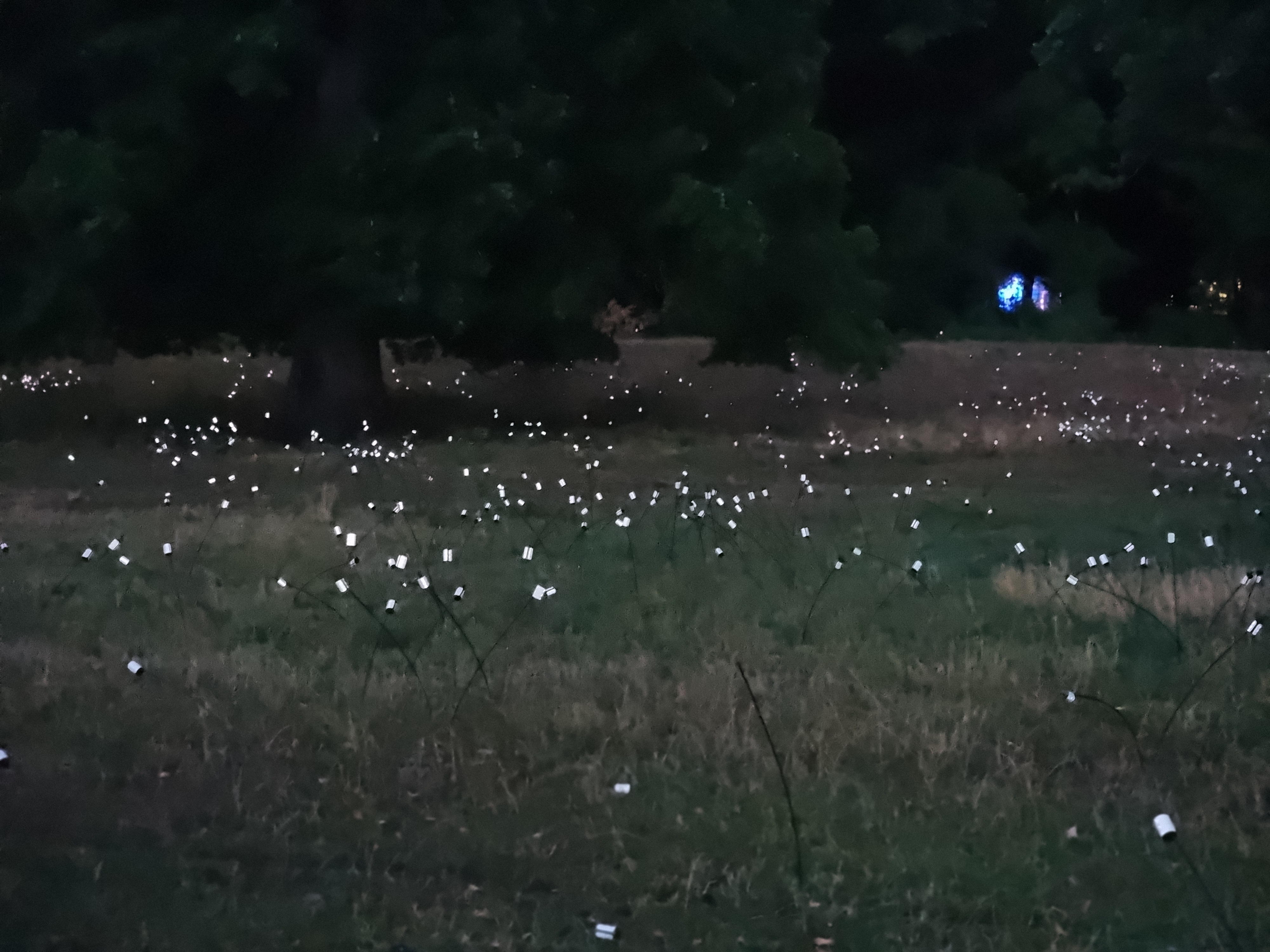
We were able to re-use an expanded version of the mushroom circle that had formed a part of the Proost Mycellium weekend in Glasgow last year. This exhibit explores the idea of deep connectedness to the God who loves things by becoming them – the god who is the substance and lover of all… the means of our becoming, our being and our relationships. I would go further than this and take on a reformed celtic idea of god being the deepest me within me and the deepest part of tree within tree. Here are some photos from the official GB photographer Mark Kensit (a lovely and super talented bloke.)
For myself and I know for Rob who was the original force behind this Proost reboot, the project has been hard going at times, like pushing a boulder up hill. So much to do, with so little time and (it certainly feels like) so little relevant talent and experience. This GB experience though felt like we had pushed the boulder up a hill and it was teetering on the pointy bit. I was truely a wonderful experience, and I am very sorry that Rob was unable to attend due to family illness.
What made it so special?
Firstly, by doing something tangible and ‘out there’, it was possible for both those who participated and others to get hold of the concept of what Proost is and might be in a much more real way.
Next, I got so spend some face to face time with Proost people I know mostly as a disembodied screen image or a distant phone call. Mark Berry and Lou, whom I have ‘known’ for years, through so many previous GB and emerging-y events… but perhaps for the first time I now feel I can count as a real friend. The same for Steve Page, who made a special trip for the day until driven away by mud… I also got some snatched times with Ant from Lofter, and met some of his family – once again I felt the sense of a deep and developing connection.
Then there was all the other significant meetings with people I already know and love- Chris and Penny Fosten, encounted totally unexpectedly whilst delivering my grandson to a children’s area (Chris has written’edited books for Proost in the past.) I also got to hear another old friend Vicky Allen at her poetry reading, and she later joined us at the mushroom circle to add to the reading there.
Then there were so many new conversations- far too many to mention here, but some of them already feel important and possibly leading to new Proost projects.
The other connecting point for me this year was with the Iona Community, who operate the Wild Goose tent at the festival, a venue for all sorts of book chats, interviews, worship events, workshops and so on. It was good to see some of my friends from the IC- Tom (and to meet Charles,) Ali and Pete, The Tracies, Marie, Ruth and so many more.
Lastly and by no means least, we got to spend time with out old friends and neighbours Simon and Ruth- and their son Nathan when he was not rushing of to direct the stewards. It has been too long!
There is no festival next year, which feels like a real shame, as they look for a new venue. The year after though, who knows? Can Proost do something larger scale?
I am just back from Ireland and the funeral of my father, Seamus Goan, aged 86. I am still rather dumbfounded that the Catholic priest who led his short funeral (not a mass) at the funeral home refused permission to allow anyone else to contribute to the service in the form of reading a eulogy or even a poem. I contemplated ignoring him and speaking anyway but this seemed like an agressive act that was not the way to send anyone off. I decided in the end that I would tell the story my way, via this blog. I am very tired after yesterday’s ten hour journey, but as ever, I process best by writing so here I am once more looking at a white screen, fingers poised.
Where to begin? How do you tell the story of a life – particularly when I only know most of it through snatched stories and second-hand memories?
Behind the wheel of an Austin A30, around 1965
The first death of my father happened before I was old enough to form memories. His marriage to my mother was always problematic and at some point he disappeared, leaving a well of bitterness for my mother to swim in. She raised two children on benefits, struggling with her own mental health, and I grew up with a constant diet of stories about my father that could not have been less flattering. Some of the grim and uncomfortable facts of this early part of his life were without dispute, but I aways knew that my mother was not a reliable witness. My late sister was older than me, and had memories of him that she always cherished – we always knew there was more to this story. It would take almost 40 years for me to start looking for the rest.
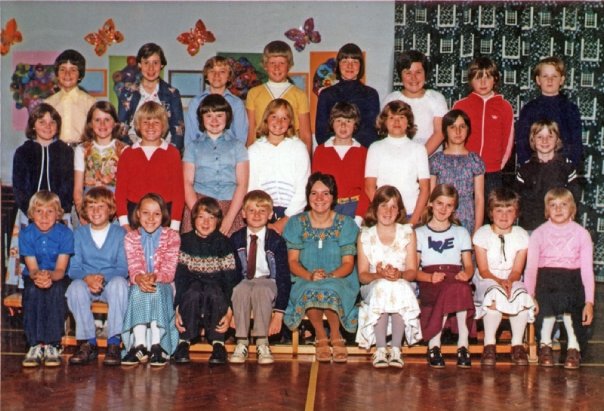
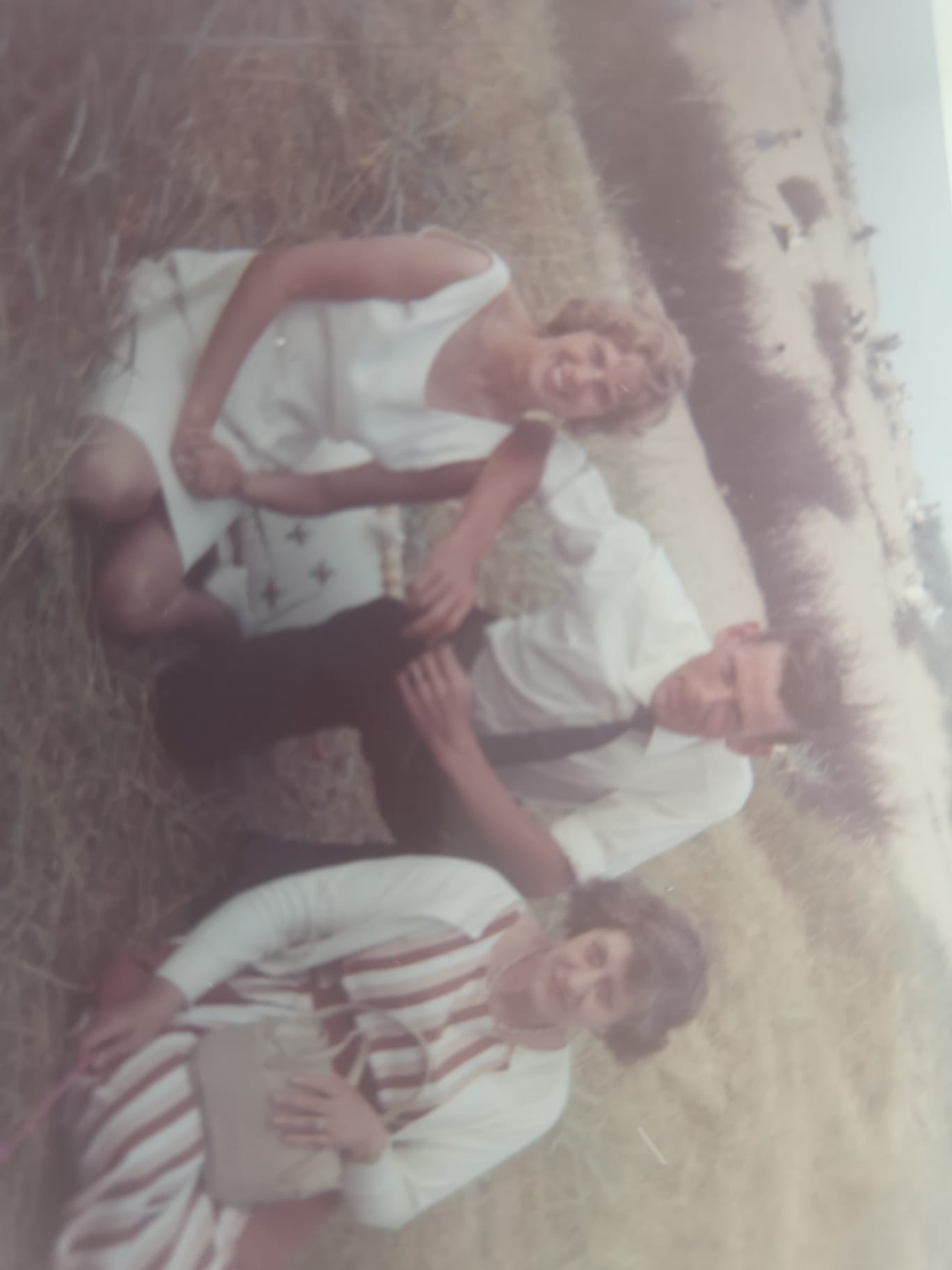
Me in yellow (with the bowl cut) back row, around 1975
The next part of this story leaps forward to the early 1990’s. We had been invited to a friends house in Blackburn, Lancashire and I was sitting in her book-lined living room whilst she finished cooking. Idly, I picked up the telephone directory and flicked to the G section to see if there were any Goans listed – something that I had often done before, with no previous success – it is an unusual name, after all. This time however, there they were- four or five telephone numbers, with addresses, each a different Goan household.
(Incidentally, the name Goan has nothing to do with Goa. Our best guess is that it is a derivitive of Gowan, or McGowan, meaning Smith or son of Smith. Somewhere way back in my ancestry, they were working with metal. But back to the story….)
Seeing these names in the Blackburn telephone directory triggered a distant memory. As a child, we used to recieve gifts from an uncle and aunt in a place called… Blackburn.
I did nothing with this information for a while, as I was not sure what to do with the knowledge. I spoke to my sister, who was tantalised and immobilised in equal measure. I said nothing to my mother. Eventually the pressure was too great, and I wrote to Mr J Goan, asking if he might be who I thought he was. Mr John Goan wrote back, and he was indeed my Uncle. I remember the nervous drive over – little Emily was sick en route, forcing a detour to buy new clothes. I remember kindness, but awkward conversations, a sense of profoundly disconnected lives and the impossibility of questions or answers. I remember meat sandwiches, which I ate despite being a vegetarian. I remember not knowing what to do next, so asking my Uncle and Aunt not to let my father know I had been in touch – a request that they graciously honoured, as it turned out, for many years.
The years passed because of my own uncertaintly, but also I did not think I could take the next step alone, because even if I could keep a secret from my mother, I could not from my sister, and it was hard to draw her out into the adventure. We had both lived with the absence, but for her it had been invested with the possibility that one day our father would return and ‘rescue’ her from the difficulties of our childhood. When this never happened, meeting him as an adult was the end to her childhood escape fantasy.
The story then moves forward another ten years or so, during which (largely unknown to me) Michaela had stayed in touch with my Aunt Betty in Blackburn, quietly keeping the channel open for future connection. By then we had moved to Scotland and life was different. It seemed important to keep pushing outwards, to let the expansion continue. I can’t remember exactly what made me finally take the plunge, except that I hit the age of 40, and it seemed like now or never, with sister or not. I had no real expectations or hopes, just the feeling that there was an integrity in reconnection, even if this might lead to unknown difficulties.
I sent a letter to an address in Strabane, Ireland and three days later, my father called on the telephone. His accent was so thick I struggled to understand, but it was clear he was very glad to be speaking. More than this, he told me that my brother Stephen and his wife Kate were also living in Scotland, only about an hour from us.
In the end it was Steve and Kate (and their son Jamie) whom we met first. We greeted them from the ferry, little Emily standing back in suspicion, the two boys instantly playing together, the rest of us starting to map things we shared and would always be different.
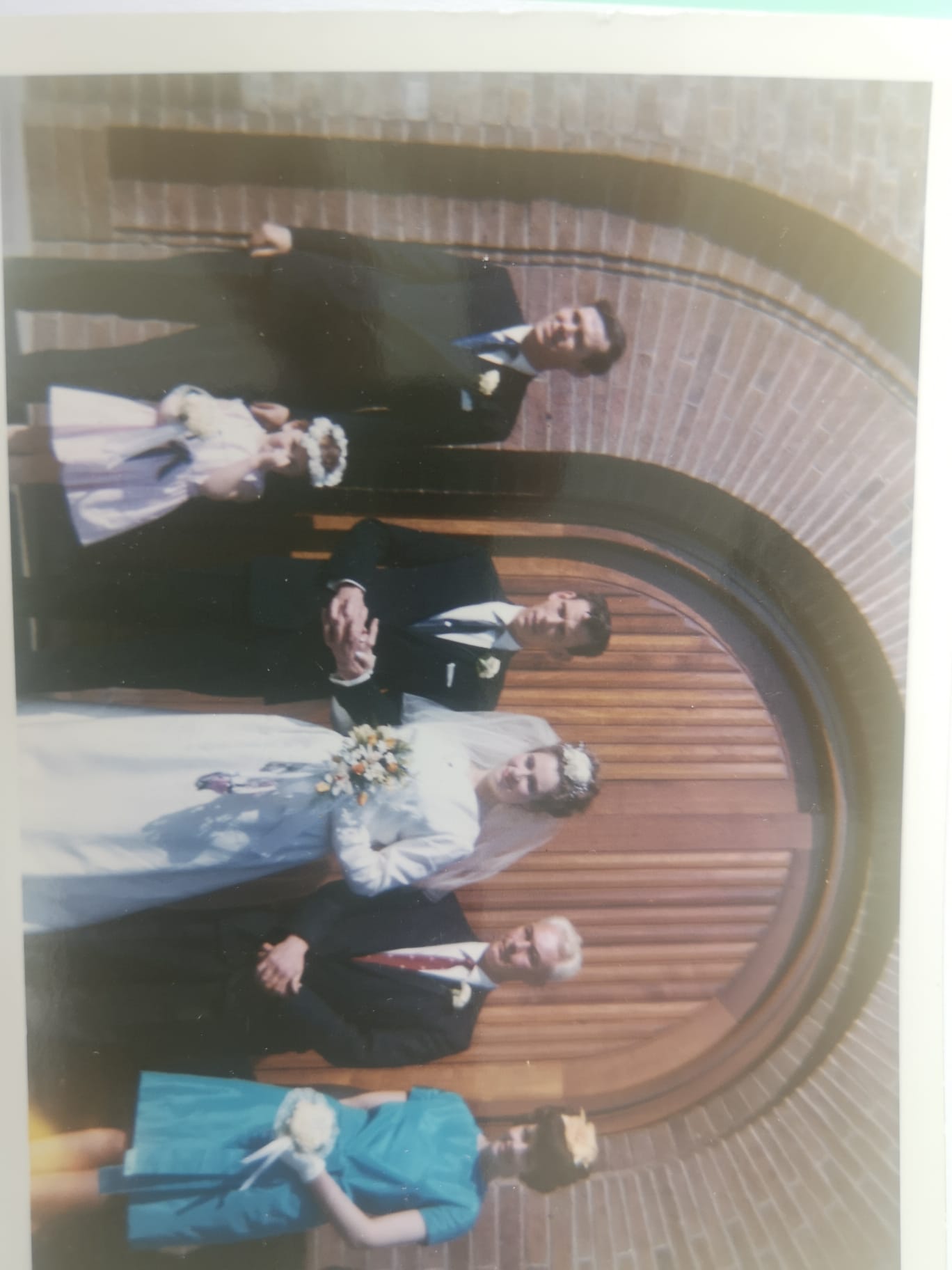
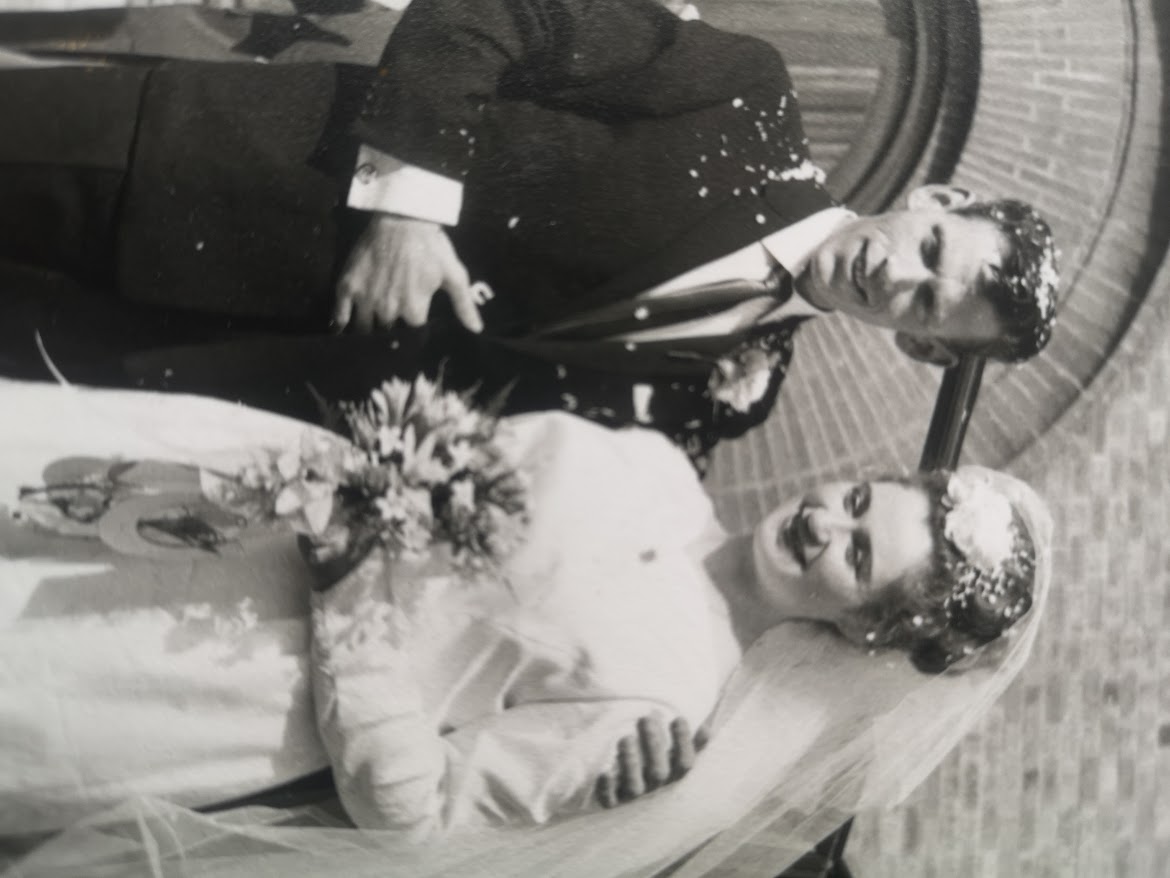
My parent’s wedding, Sutton-in-Ashfield, 1965. (My mother had to leave her job at Boots chemist shop as married women were not allowed to work there.)
My first meeting with my father was part of a trip to Ireland, during which we spent a couple of days in their tiny flat. We drove together to the Giant’s Causway, and spoke at tangents.
It was obvious from the start that I was my father’s son. We looked alike. Our temperaments were similar- a certain shy reticence. Introversion. In other ways we were very different. My life had been about seeking respectability and safety. His had been an excercise in staying one step ahead of what he had left behind, at least at first. He used different names- even to the end of his life. He spent time in prison. My mother’s bitter condemnations (of both of us) rang out loud.
On that trip to the Giant’s Causeway, the conversation was sparse, and consisted of my asking lots of neutral questions, followed by short answers and long slightly uncomfortable silences. When we arrived at our destination, I took the kids off to scramble over the hexagonal stones whilst Michaela walked along the upper shoreline with my father and his partner Peggy. In that journey, he spoke much more freely to Michaela – it seemed easier for him to talk to women. She was unable to understand most of what he was saying, but there is only a limited number of times you can ask for repetition. At the end of one long monologue, my father said “So can you pass that on to Chris for me please.” He had been unburdening himself and making some kind of explanation, and she had heard very little of it. I never managed to find out exactly what he had to say in that conversation.
Inevitably, over the next 18 years or so, I began to piece together the story of his life, mostly not from him, but from conversations with Steve and other relatives. Here is what I know – it is not the whole truth and some might be not true at all, but it is the story I can tell.
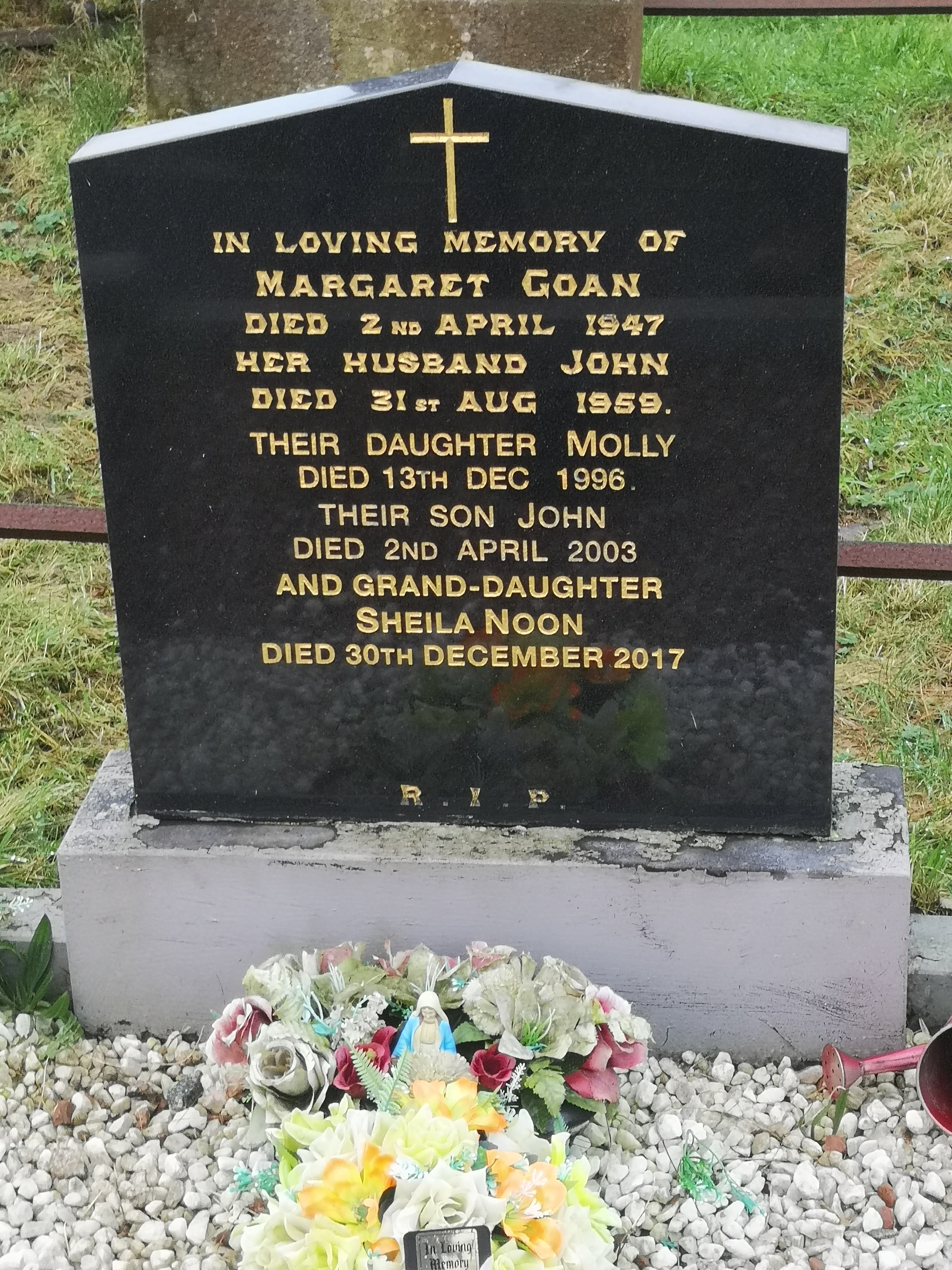
Seamus Goan was born in Sion Mills, just outside Strabane, County Tyrone, in the province known as Northern Ireland, to Margaret and John, who worked at the flax mill that gave the town its name. He was one of five children who survived to adulthood – Michael, Molly, Gay, John and Seamus.
Flax Mills meant short lives for workers, who often contracted ‘brown lung disease’, and my grandmother died in 1947 when my father was eight years old, so he was brought up mostly by his older sisters Gay and Molly. My Grandfather died twelve years later, and somehow it seems that my father barely attended school and back then was unable to read or write.
As a young adult, he followed the exodus of Irish men and boys – and his brothers – over the Irish sea to England in order to find work – remember all those ‘no blacks, no Irish, no dogs’ signs that were placed outside ‘respectable’ guest houses? He found work on the construction of the new motorway system, and whilst working on the M1 being forced up through Nottinghamshire, he met my mother and they married.
My sister Katharine was born in 1966, then I came along in 1967. By then the wedding was already over. My mother raised me with stories of much of the bad that happened around that time. Gambling addiction and the stolen items to fund the betting from neighbours. The house empty of food or warmth and the bailifs at the door for unpaid bills. The fear and shame of this time never left her, unlike my father, who left and never came back – except that is not quite true, he knocked on the door some time in the mid 1980’s, but was given no welcome, so left before my sister or I knew who he was. I later found out that he sometimes drove his car to our street in order to catch glimpses of us, but we never met again as
He lived a life away from mine which I can only wonder at.
I know that at some point a few years after he left my life, he met Peggy and fell in love again. She was from a Protestant family, born out in the sticks outside Strabane so they made a mixed couple – something difficult to do in Ireland back when the troubles were still raging in the wild west border country of County Tyrone. (Strabane lost the greatest percentage of citizens to the violence of anywhere in the country) so they made a life for themselves in Cambridge.
Seamus was still working on various contruction projects – for a long time he was running gangs installing cables for cable TV. It seems he was always held back by illiteracy, leaving a job whenever this might be found out, mostly managing to cover it up and stay one step ahead of the shame. Later Seamus and Peggy ran a pub, working long hours.
During all of this they had two children- Stephen, then Sarah. Sarah was born with profound learning difficulties and it was her care than dominated family life for the next decades. From being an absent father, Seamus became as hands-on as it is possible to imagine.
If I am going to tell this story here, do I tell everything? There are dark sides to this story, which I was tempted to gloss over, but this does not feel honest, to the story we made together. My father was always ‘on the run’ in some way. He used the names of his brothers rather than his for many interactions with officialdom right up to the end of his life, for example. He went to prison for failing to pay maintenance. He never stopped the betting on horses and was most at home in a bar. At some point his new family was disrupted because he was jailed for faling to pay maintenance (not directly to us, but rather to offset the state benefits which my mother, sister and I existed on.) Money was always tight, always an issue. Steve and I have this in common, despte our different beginnings.
A man is never just one thing – we are many. We are capable of both good and bad. We are all redeemable. We can all grow and change. Steve told me that for most of his adult life, he had never passed his driving test (remember the interchangable name thing mentioned above) but then, as an older adult, he took it and passed it. Quite what they made of him turning up for the test I don’t know.
It seems he changed jobs frequently to avoid being shamed as illiterate, but around the time that we met, the same shame drove him to learn to read. He developed a taste for novels about cowboys.
By the time I met my father, he had moved back to Strabane, a place which had always been home to him – full of a network of family and friends that anchored his whole life. He was a regular attender at Mass and became that man who could always be relied upon to drive someone to hospital or go round to unblock a gutter, or deliver newspapers to those who were less mobile.
Meanwhile, he stayed in touch with friends and family in England too, often turning up wiht little or no warning in Scotland or England, having driven long distances seemingly on a whim, but always to see Sarah who was then living in supported accommodation in Cambridge.
My sister Katharine died.
May half sister Sarah died.
My mother died.
Peggy developed dementia, with Seamus as her carer. It was difficult at times, but he remained faithful. Once, after a difficult exchange, he created some panic as he left the house and booked himself in a hotel without telling anyone. Margaret, a family friend, found him and gave he a dressing down.
Then he developed dementia himself – revealed in irrational anger towards his landlord and some quite dramatic acts of confusion.
He left Peggy at one point and got on the ferry to come to England, but then disappeared. We had to report him missing, leading to police searches of all known addresses (including ours. There was a very funny moment when they opened our hoover cupboard and we imagined him standing there…) Eventully his numberplate was picked up by the cameras on the motorway system near Manchester, and Steve went over to bring him back. After this, his licence was revoked, but this did not stop the old pirate from buying another car – leading to Steve and I going over to Ireland to make some interventions…
First Peggy was persuaded to move into a nursing home in Strabane. Seamus was lonely, so eventually he followed. Steve, Kate, Michaela and I cleared out their home. They had very little and most things went ot charity shops. I constantly found myself comparing this process to that of clearing my mothers house, who had accumulated so very much. It felt unbearably sad at times, but perhaps this was another gift from my father- to learn that life is not measured by weight of posessions.
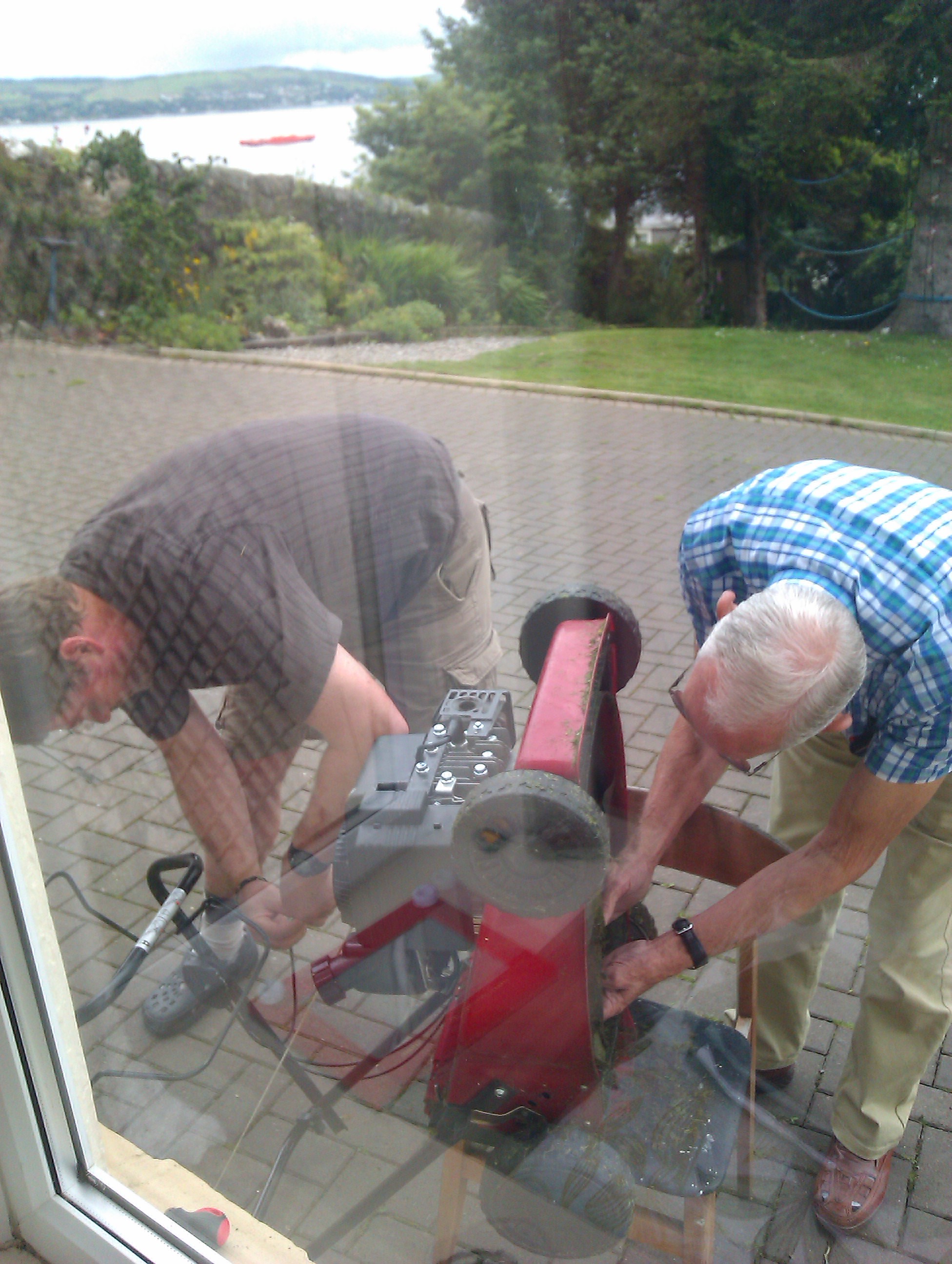
fixing a mower with my father, around 2013
I said none of this at the funeral, partly because of the religious ego that silenced any non-priestly voice, but also because it would have all been too much. I would have said something like this;
When I was a child, I was jealous of people who had ‘normal’ families. Mine was a mess.
When I got older, I realised that there was no such thing as a normal family.
Families form and fracture, like mine did, even before I could form memories of it.
It was perhaps harder for Seamus, losing his parents so young. It set him on a road that led to me.
It was hard too for Stephen and Sarah, learning to make their family work.
We know this – Despite the scars, fractures can mend.
I believe that this happens if we choose a path of love. It will always take us home.
I want to read a poem that was read at both my mother’s and my sister’s funerals that talks about love as a deliberate decision, and the consequences that it might have.
It is also a prayer for my father.
Cupped

Practice the wound of love
Let it devastate
Let it scrape your soul
For blessed are the gentled
Blessed are the meek
Blessed are those whose fullness
Is now found empty

Practice the wound of love
Rest now in that broken place
Where grief is never silent
And ragged roots of love
Tap the trampled earth
Blessed are you as you reach for love
Because it reaches out for you

Practice the wound of love
Let it devastate
For nothing ever came from nothing
(Apart from love)
At the end of everything
We are just cups
Who are cupped.
We are held.
I came across the work of German sociologist Hartmut Rosa recently. His thinking had so many connections with things I find meaningful that I decided to do a deeper dive, which for me often means trying to gather some strands on this blog…
I would like to talk about Rosa in three parts, which will form three blog posts. The first will concern itself with ‘the problem’. In case this might seem negative, I would argue that sometimes we need a new perspective on things we already see. I think that Rosa’s work offers this in a new an fresh way.
On a personal level, Rosa’s thinking maps very closely to the narrative arc of my last poetry collection After the apocalypse. I will say more about this later, but for this reason, this post features some of the wonderful illustrations that Si Smith contributed to this book.
A return to the idea of modernity
The first insight I found interesting was that rather than the incessant talk about postmodernity (which has often felt like an elitist affectation to me) Rosa anchors his analysis of our society on a definition of modernity, along these lines;
Modernty is a form of society that (in order to survive) has to constantly speed up in order to stand still. It seeks to control all forms of human existence within the world, to constantly innovate and increase efficiency in all tasks.
In this way, modernity is always speeding up, or accelerating, if it did not do so, it would lose stability and things would fall apart. Rosa calls this phenomenon dynamic stabilization.
We should linger on this idea for a while. Firstly, it feels correct, particularly in light of growthism in our economics, or the phenomenon of planned obscelecence. We live with a strong sense of hurtling forward towards… well who knows, but it often feels out of control, as if it can only end badly, for us and for our non-human neigbours.
We can trace the way modernity affects our human relations in many ways. Here are a few examples;
We look at a mountain and feel moved by beauty and form, so climb it. It is hard work so we build a road to get up easier and quicker. We build a sheter at the summit so we can enjoy the view from protection. We open a cafe there. We cut trees to preserve the view. It becomes popular. There are more eating places, shops selling things. It gets busy, polluted. The mountain is no longer beautiful.
We feel stressed and exhausted in our work which makes ever more demands, so that we find it hard to spend time with our children. Nevertheless, we push them into an educational machine that makes the same demands of them, so that they too can get jobs that will exhaust them in the same way.
Our religion, once a place of mystery and wonder, has been through a series of protestant improvements and innovations, in which each new and ‘better’ iteration has been seen as ‘true’.
Controllability
Rosa argues that modernity has at root a desire to control the world. With a nod to Charles Taylor, he describes this as a spiritual declaration of independence from nature.
This desire for control could be concieved of in terms of accumulation and greed, but arguably, it stems more from fear. Consider the degree to which the super wealthy might be regarded as ‘greedy’. Do they feel themselves to have ‘enough’? Or are there other more powerful drives to do with the fear of being left behind, of being less significant?
Wherever we come up against things that are not controllable – a pandemic for example, or the common everyday experience of death – modernity has a problem.
It is perhaps worth remembering here that Rosa is a sociologist, rather than a psychologist. he is less concerned with individual reasoning and more concerned with the dynamics that drive mass consciousness and mass behaviour. Often the logic of these dynamics is masked, even though they drive us in ways that are hard to understand.
Perhaps now is a good time to suggest watching this video, which attempts to sketch out Rosa’s ideas in wider form…
In part 2, I intend to consider the implications of Rosa’s ideas, and what his ‘solution’ to the problem might be…
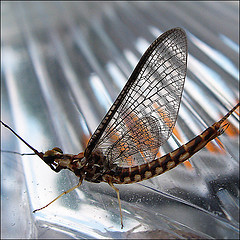
Insects that live a whole life in one of our days. Breakfast sees the end of childhood, lunch the weight of middle age responsibility, tea time the creaking of age, and with night, the sleep of the dead. Until the next generation comes into being.
Or consider the life of these tall trees.
Each slow forming ring of growth, evidence of their elevation over our own anxieties.
Each falling leaf layering the soil, laying down the food for the coming spring.
Each spreading branch offering the arm of shelter to a thousand lesser creatures. And me.
Seeding slowly and deliberately.
But even the tallest trees
Will one day
Fall.
And what of us?
What of our life time? We tend to see our journeys as linear. Even then, perhaps we are comfortable with the now, less so with the tomorrow, and the future is a foreign country, were be dragons.
Away we go, off into middle distance – always forward, but often acting as if we are standing still.
But we are born not to die,
But to live.
To trace our own arc through this space of ours –
To windmill wide and open,
To love this life
And let it love us back
Perhaps unlike any of these other circles, we humans have this gift (this curse) of knowing
I had already read the book, but this was one of those few occasions when the film some how took the raw material of the words and took them further. Like taking a charcoal drawing and turning it into a canvas laden with rich oil paint, in wonderful colour.
The film tells the real story of a young man from a privileged but dysfunctional background who turns his back on the modern culture, and decides to live a simple life- one of vital experience, deep relationships and particularly, one of absolute one-ness with the world and it’s wild places. He found his way into the Alaskan wilderness, where his ideals were tested to his own destruction, and he perished alone in an abandoned bus miles from anywhere.
This tragic event is somehow recorded in a way that is life enhancing, and beautiful. In his beautiful life, but tragic death, we are fed little slices of hope.
Life is so fragile, but those who really live- who transcend the narrow half lives that many of us fall into- these people, they seem to have found cracks through which has filtered something eternal, and somehow, more real.
Almost as if the Kingdom of God shines like a shaft of sunlight on the opposite side of the valley.
I was speaking to a friend of mine today who is a policeman. We were discussing the case of a missing woman who walked into the hills locally over a year ago now. No trace of her has ever been found. He told me that this is not such a rare thing in Scotland. People walk into the wilderness, perhaps to escape their demons, perhaps to celebrate them. Some perhaps are looking for an end to life, others it comes to as a surprise.
Not so long ago some forestry workers found a tent as they were clearing an area of forest. Inside the tent was the skeleton of a man who had lain there undisturbed for around 10 years.