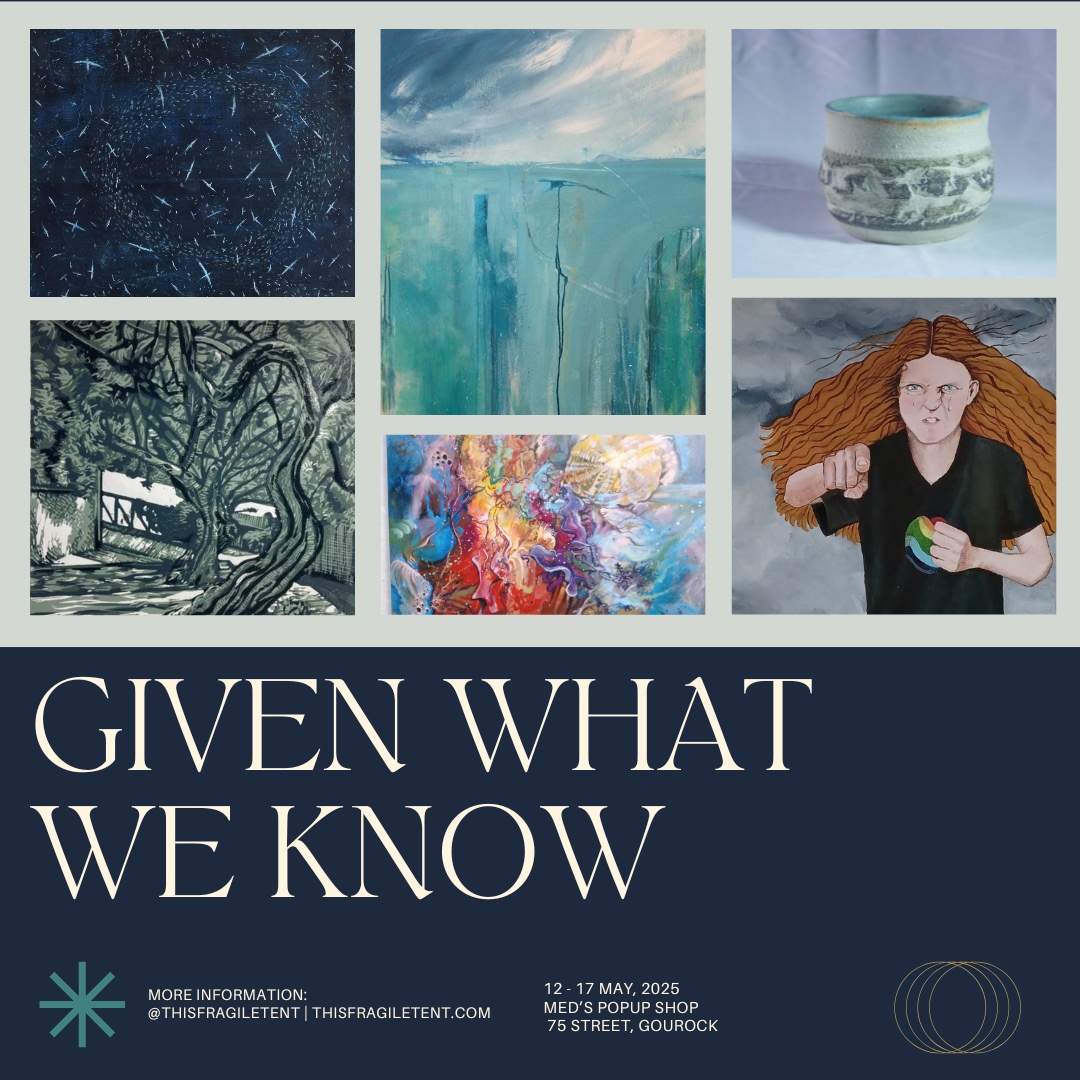
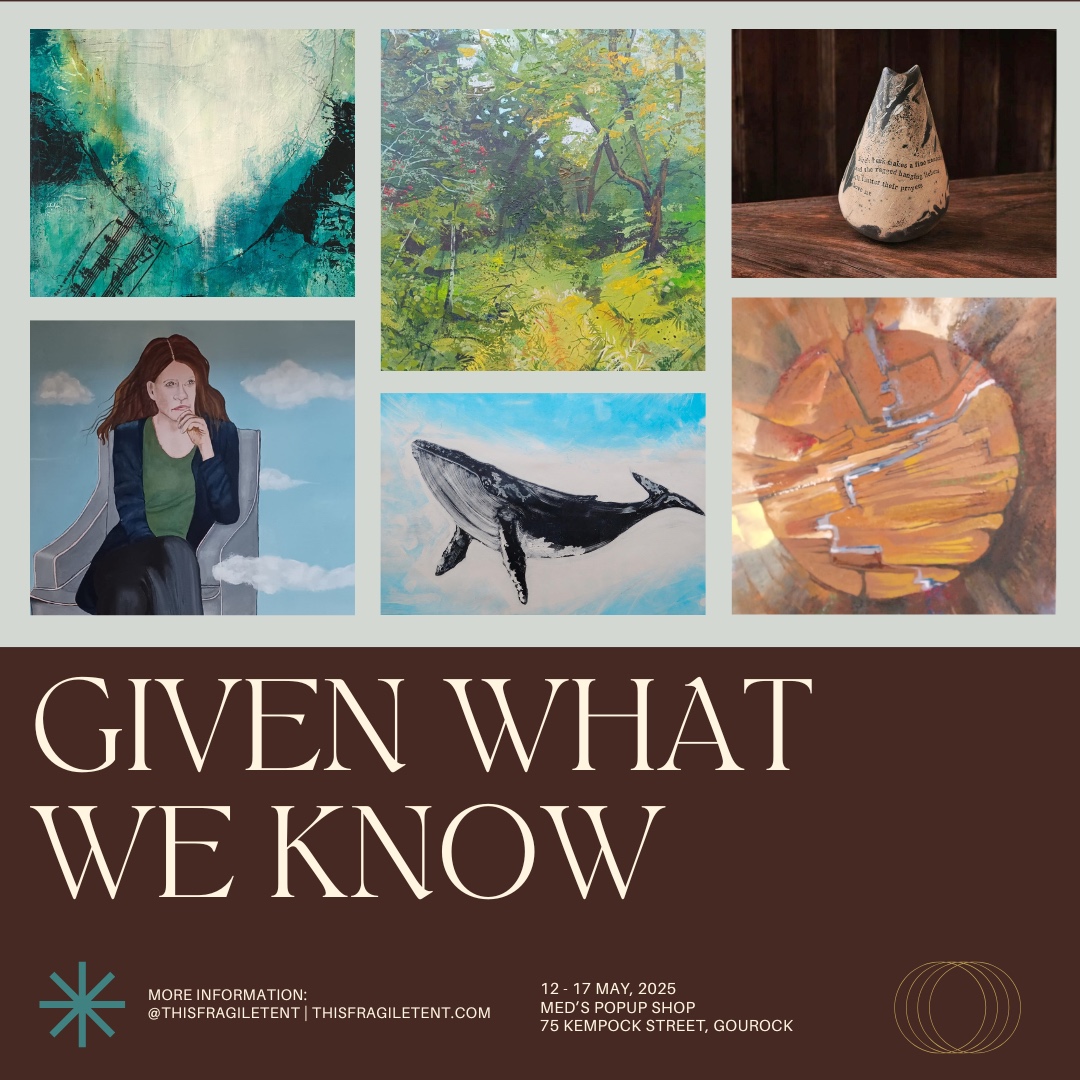
The art world here in the UK has a bit of a new trend, in the form of pop up art exhibition spaces, typically in old shops. Accross the Clyde from where we live there are two such spaces. They tend to get booked very quickly, so we booked some slots. Then we began to wonder…
Our son-in-law James makes ceramics ‘inspired’ by trauma following spending years as an oceanographer, watching the arctic icesheets melt. Meanwhile, our art and my poetry was constantly trying to explore themes of brokenness and earth connectedness. We started to wonder about a joint exhibition…
…but then we started to think bigger and invited some others to join us.
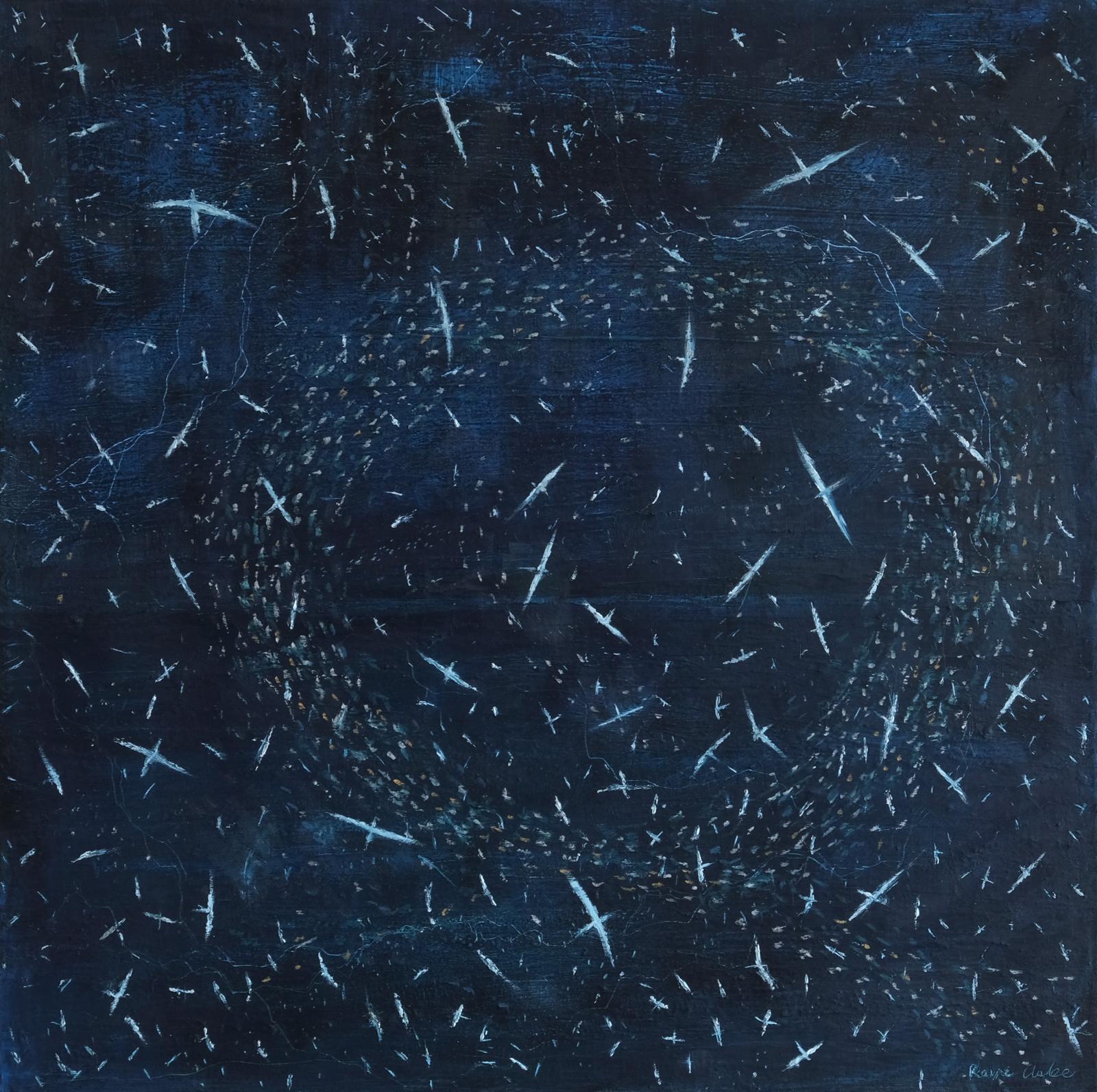
Raine Clarke with her printmaking and general creative magnificence.
Paul Knight with his creative explosion of ceramics, sculpture and ink drawings
Yvonne Lyon who is not content with being a singer-songwriter, so also makes stunning abstract art.
Here is the brief for the exhibition, based around a poem that some might recognise.
“Given what we know and what we fear about the end of things we hold dear, we will look to the birds. We will walk the woods that remain, and we will sing”
How do we respond to a world in omni-crisis in which our politics, our economics, our spirituality – even our protest movements – all seem broken?
In a world polarised and splintered by algorithms, what does goodness look like? We know there are no easy answers to these questions.
Perhaps, like us, you are experiencing hope as a rare and hard to reach commodity.
In this context, we need our artists and our poets more than ever…
Raine Clarke
Launch evening
On Monday the 12th of May, we will be having a launch evening in the exhibition space. There will be live music and Poetry, not to mention the odd tipple. Watch social media for more details!
I have been loving the start of the daily lent posts over on the proost.community blog. If you are needing something to give pause and focus during this season, you might want to check it out.
Even better, we are looking for contributions- poems, music, art, anything really.
Because today’s post was my poem, I thought I would replicate it here.
Spring window, Otter artwork by Sarah Woods.
This morning, up here in Scotland at least, the sun is shining, the sky is blue and the sea flat calm. If you had no connection to the world we are part of – if we were truly able to live in this moment alone – then it would be a day to truly glory in. In an age of smart phones and media feeds, many of us find this impossible. There is a background noise to our times that is oppressive. I will not list the reasons for this – you know already.
There is something that unites many people on all sides of the political spectrum just now – a sense that things are not right, that deep within our culture, our economics, our political systems, our ways of living life, something is not working.
Does this dichotomy remind anyone of anything? How about the beginning of 2020?
That was another glorious spring, with a different kind of oppressive background noise. It might be difficult sometimes to remember, this is not the first time that humans have lived like this. This is not the first epoch of injustice, of super-rich so-called-superheros, of wars and division making. Think about it.
So this morning I offer one of my own poems, written back in that 2020 springtime. It became part of a book illustrated by Si Smith.
Human races
The upright ape ascends from knapped flint to Silicon chip. He scratches sonnets in split slate and Solves problems (almost) as fast as he makes them. His alchemy promised gold, but instead just turned the Lights on, lighting a road ahead called Progress.
There is nothing new under the sun; the circle is still Unbroken. Empires rise whilst others fall; ours was Not the first at all. It turns out that our times were never Linear (just oscillation) and that for every page of Knowledge gained, another is forgotten.
But what are we, if not whisps of the same Spirit? We carry in us the same am-ness as all things that ever were, Hidden under thin skin and hubris, waiting for those moments Beneath stars or trees or tenderness when we remember; It is all about connection.
It has been a while since I have posted any new poetry here. This is not because I am not still writing, rather because the way that poetry allows me to explore ideas (which this blog is primarily about) fluctuates.
Today however, I am going to share a brand new poem, which makes some rather profound theological statements – ones that I know many of my friends will find troubling.
I’m not going to explore them here – at least, not yet. I am not even sure that I agree with them all just now.
This is one of the gifts of poetry – it can become it’s own voice, its own person. As well as a way of exploring then externalising, poetry can go further than this, and be part of a dialogue even with its author.
The dialogue does not even need to find agreement. It might be possible to hold more than one perspective – as if our theological constructs are just different poems.
It is in this space that this poem sits just now. In committing the words to keyboard and screen, I am able to stand back and consider them as if they were not mine.
Except they are mine. In writing them, I was consciously breaking through some barriers into places that feel new.
I was thinking about the book of Revelation today – perhaps the most controversial book in that library of books that we know as the Bible. I grew up in a kind of religion that took this book and used it as a lens to understand world events, particularly (but not exclusively) what has happening in the middle east.
This was before all the current madness, stemming from things like the Left Behind series of books, and all the American Christian Zionism.
Back then, we had people like Hal Lindsay and The Late Great Planet Earth. It was the same stuff and it earned him a fortune.
I still know people who live within this bizarre world view, in which world events are viewed through a particular, modern, Capitalist and elitist interpretation of scripture. In some ways this is the first and ultimate of conspiracy theories- ground zero. All the ingredients are there- the special secrets that will open your eyes to ‘reality’, the sense of being part of a special selection, the cataclysmic alternatives, the network of others who see things like you do and constantly reinforce your world view.
There is also the unforunate side effect of how these ideas, now almost mainstream in the US, have made victims out of already oppressed people and become a wierd distraction for many at best, perhaps actually morally corosive.
Perhaps these ideas are even antichrist.
I will not be deconstructing end times eschatology in this post. If you are interested in digging deeper into this, then I would recommend this podcast;
Back to my cogitations on Revelation. I was thinking about how we might (as with Keith Giles’ account) better approach this book as a confusing veiled analogy of the danger of Empire.
How powerfull, charismatic and despotic individuals can first seem like messiah, but then turn out to be beasts.
We do not have to look far to see examples of these kind of individuals. Ones for whom death, destruction, exploitation and subjugation are just political tools, used casually for personal power and profit.
But I will not name any person ‘Antichrist’. I have heard Christians name many people this way over the years. The Pope, Gorbachev, Putin to name but a few.
What I think I can call antichrist are those things that are against the teachings of Jesus – those things that are contrary to a movement towards goodness otherwise known as ‘the Kingdom of God’.
There seems to be a particular kind of antichrist-ness that uses the Bible as a means to achieve its aim. I find myself loathing this most of all – Jesus did the same. He seemed to reserve a special kind of anger for the religious people who were users, profiteers, division-creators, victim-blamers and hate dealers. Think about these examples;
The Sermon on the Mount:Jesus directly challenges the teachings of the Pharisees by emphasizing the importance of inner motives and true righteousness over outward actions.
“Woes upon you, scribes and Pharisees”:In the Gospel of Matthew, Jesus delivers a series of pronouncements condemning the religious leaders for their hypocrisy and self-righteousness.
Cleansing the Temple:A dramatic act where Jesus drove out those selling animals and money in the temple, criticizing their commercialization of a sacred space.
There is danger here of falling into that same old dualistic us/them, good/bad, holy/profane trap in which we retire into a trench built of sandbags full of our own rightness. But despite this danger, after conversations this week I am going to say this. Christians have no monopoly on Christ. We are all capable of being antchrist. This is true in the small things and the big things.
Lets subjugate everything to love, to kindness and to compassion – particularly towrds the weak, the poor, the broken. Anything else is empire. Anything else is antichrist.




 this fragile tent