Advent begins on Sunday. I love to allow seasons like this to shape some contemplation, and so intend to put together a daily reflection thing via my blog. Does anyone want to contibute?
Advent is about anticipating something better. Hoping for light that is still to come, even in present darkness. Do whatever you like with this this. Could be a poem, an image, a video clip, a song, or a painting, or anything else that provides a space for others to be still for a moment and reflect.
How is it that still, you love things by becoming them?
How was it that this brown-skinned man with the heart of a woman
Took upon herself another name for everything, so we could
Encounter her in all these beautiful things and bleed with her when she
Lies broken? And just when all seems lost, she whispers still –
See, I am making all things new.
Even you.
It can be hard at first to step aside from both secular and religious cliches about the approach of Christmas, at least until you allow yourself a bit of space to think again about the nature of this season.
the time when winter is still deepening, the coldness increasing, the days shortening
the creak of increasing Christmas pressure coming at us from our screens
fears of scarcity despite our abundance
the end of last year and the approach of the next
the certain knowledge that there will be a new spring
the simple, all surpassing idea of immanuel, the god who loves things by becoming them
If you would like to join us for the journey, reply here or drop me a message. You need espouse no particular position of faith. Just help our hearts open a little when we need it most.
Following on from the last post, in which I attempted to describe my feelings around a new attempt to form a climate action group for my local area, I have been continuing to consider the problem of how to respond creatively and with integrity to crisis of our time.
There is a need for all of us from time to time to take an inventory not just of our own personal place in the world, but how this relates to the great goodness the world contains. If we are to treasure the gace hidden in all things then we must also seek to be part of it and not just consume it, or be an unwitting part of its destruction. The great disatisfaction this sets up in many of us at present is the feeling that we are powerless to change the very destruction we are seeking to avoid. This itself is a place of personal and collective sickness of spirit.
As for myself, I have tried to make as many changes that I could towards sustainability – the growing of food, the recycling, the fixing and reusing, the buying second hand. However, I also feel guilty because of the destructive things that I do – the vehicles I drive, the leaky home heated with fossil fuel, the over consuming western culture within which I still participate. Like many of us, this sets up chains of cognitive dissonance that twist me up in ways that are profoundly self defeating.
I am privileged to live a comfortable life in a beautiful place between mountains and sea. This privilege places me on the outside, removed from cutting edge consequences more visible around greater concentrations of humanity, particularly in the poorer southern parts of the world. Discussions about climate change here are made from a position of climate privilege and collective blindness about the mess we have made (and continue to make) of our ecosystems. We look at mountains covered in spruce plantations and think they always looked like that. We dodge deer on the roads forgetting entirely that they are there because of a lack of natural predators. We celebrate iconic single species such as otters and sea eagles with no clear idea of their loneliness and the total unbalanced ecosystem that our patterns of farming and resource extraction have created.
My attempt to respond to these issues has already proved problematic, for these sorts of reasons;
There are some vested interests that might well get in the way- for example, how can a council funded organisation protest against the council and hold it to account?
It seems that death by detail is likely. There are so many strands of potential action (allotments, recycling, plastics, beach cleaning, forestry, diversity, single species protection, ocean protection zones, conservation farming, rewilding, etc.) How do we prioritise?
The detail is often reflected in individuals with passions and hobby horses. These are not necessarily ‘local’ or directly relevant to OUR location here and now. Again, how do collectivise around one particular issue or small set of issues?
We all have egos in the game- we like to think that our passion projects are the most important. We can then be dismissive of others and fail to add collective value.
What is the appropriate response to a climate emergency HERE in Argyll? My feeling is that small scale consumer/citizen focussed activities of the kind that are being promoted through the Dunoon Area Alliance (a funded community support organisation) (for example green mapping, recycling, plastics campaigns etc) are important in that they give people a feeling of getting involved, but they are not proportionate to the scale of the emergency. None of these actions are transformative or would make significant impact, apart from perhaps at the informational level.
There seems to me to be a difference between an activist group and small-scale community activities. Both have important roles to play but require different approaches/structures/memberships.
Activism most likely involves a degree of confrontation, which is not for everyone.
There is a lot of complacency about climate change and loss of habitat diversity here in Argyll. We consider the landscape to be ‘wild’ and ‘natural’, because it is largely open country. It is in fact neither of these things.
What then might local climate activism look like in Argyll? What are the major issues impacting on our ways of living here? What industrial processes that have shaped our interactions with the natural world, for good or ill? Which problems should be our priority and where do we put our energy? In a previous post I asked these questions;
What are the industrial processes that are destroying the Cowal environment? This takes us straight towards the three F’s- Farming, Forestry and Fishing. They are all sacred cows with huge local power and social capital. Challenging established practices will upset people we know and love.
Where can we see examples of local counter-cultural political/social/economic alternatives that we can learn from? We have to think both big and small, in that we need to hold an idea of transformation that is also LOCAL.
For example, S mentioned a small Irish town that has become fully ‘sustainable’. Coll has its own independent power grid. Other towns have gone fully plastic free. Some places have used local politics to revive collective action. Other places have converted almost all shared spaces into collective food growing areas.
What can we learn from these examples and how can we hold our own political systems to account for their lack of ambition?
I think these are important questions here, and in my mind at least, they already start to suggest areas of engagement. I have been inspired in part by this;
The thing about this piece is that despite its visual and political impact, it has created significant reaction. It was also largely the work (I think) of one or two people, who did not ask for permission, beyond talking to the owner of the land on which the structure was built.
It is also proportionate to the landscape and location. It is made of local timber and can be seen from distance, whilst doing no damage. Some people objected, but it has largely recieved local acceptance, even to the point or retrospective planning permission.
More than this, the power of the object comes from artistic, creative playful question making. It might be regarded as theopoetic. The shape and idea is deceptively simple, but the more you think about it, the more it starts to shift the way that people see things.
This structure offers a meeting point, a space to share ideas and make small revolutions. Power to those who made it, I say.
We can’t all build an ark – although then again perhaps we need one in every area – but we can learn a lot from this approach. Local, thinking big and small. Proportionate to the scale of lanscape. Using local skills. Slightly subversive, making a statement for others to respond to without preaching. Using art rather than persuasion.
There are also some clues there about the nature of the group that might support such activity. Clandestine, confronting work of this kind probably needs a supportive, safe community behind it, who are prepared to share the work and the potential adverse reactions.
I have some ideas already, but obviously can’t talk about them here yet… However, if you are local and interested to know more, get in in touch.
I attended a meeting last night of people considering starting a climate change action group. First meetings of this kind are always difficult. People come at the meeting from all sorts of positions and we all feel the need to state our credentials. The outcome was fairly predictable in that (like much of the debate on climate change!) we got lost in detail. I ended up feeling frustrated and struggling to remain hopeful.
It is no easy thing to commit to another group-based activity. Not for a battle-scarred introvert such as myself.
It was all buzzing in my head, so that this morning I was up at the crack of dawn, wanting to write some thoughts down- pretty much my standard way to process things. (If I REALLY need to work things through I turn to poetry!) I wrote this as a starter;
We are killing ecosystems. Our industrial processes are eating the planet from under us. Our over-consumption is creating huge unfairness and inequality. Here in Cowal we live amongst such natural beauty, but this obscures a terrible truth: our hillside is dying or already dead. The ancient forests are gone, replaced by ecological wastelands. Deer numbers are exploding. Everything is out of balance. In the face of all this we feel powerless. Partly this is because ‘The problem’ is not on a human scale. It is too big. There are too many components, too many power dynamics, too many distractions, too many voices who seem to offer conflicting information. Many of us have tried to change as individuals. There is a whole industry set up to make us all individual green consumers- to sell us green products and services. Mostly this is just ‘green-washing’. Individual consumer action cannot and will not reverse climate change. Many of us have also been part of collective action at some level- attending protests, lobbying MPs, starting food-growing initiatives, demanding better from our supermarkets. This kind of action can unite us and bring hope that things CAN change but they are not sufficient. The climate is still warming. Diversity is still being stripped away from our already denuded landscapes. Our problem is two-fold;
Unsustainable industrial (including farming/forestry/fishing) processes at both global and local levels
A lack of political/social/economic alternatives to the unsustainable consumer culture we have created at global, national and local levels
The question, once again, is what do we do about this. I am not interested in consumer choices. Whether I use plastic bags or drive a Tesla will not help one jot. Neither have I any patience for passive ego-preening discussions, even though I have been guilty of indulging in them too often myself. Here is my current thinking;
There is a lot of activity taking place in Dunoon already. It is good to know about it and to support it but there is no point in replicating it. Movements towards change often break down into factional competitive fiefdoms and we want no part of that. What we do not have is a local place/mechanism to express our outrage and to collectively convert this outrage to action. Whilst there are many ways that we might do this I believe we have to stay focussed first and foremost on how ‘The problem’ (as defined above) is encountered in Cowal. In other words;
What are the industrial processes that are destroying the Cowal environment? This takes us straight towards the three F’s- Farming, Forestry and Fishing. They are all sacred cows with huge local power and social capital. Challenging established practices will upset people we know and love.
Where can we see examples of local counter-cultural political/social/economic alternatives that we can learn from? We have to think both big and small, in that we need to hold an idea of transformation that is also LOCAL. For example, Siobhan mentioned a small Irish town that has become fully ‘sustainable’. Coll has its own independent power grid. Other towns have gone fully plastic free. Some places have used local politics to revive collective action. Other places have converted almost all shared spaces into collective food growing areas. What can we learn from these examples and how can we hold our own political systems to account for their lack of ambition?
And how might we express this outrage? My hope is that we can do something like this;
The outcome of this work will hopefully be playful, creative activism
Art that reveals, challenges, informs (think of the Ark)
Subversive action (non-violent and not illegal!) to raise awareness over specific local issues
Informational activities such as conferences (as per the Mid Argyll group)
Community play- building things in the landscape, feasting together, singing and sitting round fires, telling hopeful stories.
I don’t know if the others in my embrionic group will share this vision with me, and if not, I will need to challenge myself along these lines;
Like all of us, I have my history, my past failures and even worse, my past successes. I have my own hobby horses and passions. I am a grumpy poet who does not do small talk and has a low tolerance for bullshit.
Having said that, I believe in the power of community. I see no greater hope. If we can find some collective momentum through this group, I will hang in there, despite my own inevitable limitations and frustrations.
As I further reflect on all of this, I realise that more than ever, I connect with things through my spirit rather than my intellect. Whether I stay involved with this group or not will be much to do with whether it sings in my soul. At present, the song is distant, but there are interesting echoes…
Today, here in the UK we keep a two minute silence for rememberance day, inaugurated, at least in part, to help us hold in our minds the futility and brutality of the War to End All Wars (which turned out to be wrongly named.)
Despite (or perhaps because of) the increasing historical distance from the last great war, my impression is that rememberance day in Britain is becoming a bigger deal. Celebrations are more elaborate than decades ago. Silences are held in supermarkets. Social media feeds are full of Sasson and Owen poetry and the US cult of the soldier-hero has cross the Atlantic.
I often wonder if it would be the same if there had been no second world war. Much of the modern popular cultural idea of ‘Britishness’ seems to have been defined by this conflict- the spitfires and the plucky island standing as a last bastion against oppression. We case ourselves not only as victors, but as noble warriors. As if the Empire never happened. Brexit, cast in this light, is both logical and correct. Other parts of the world have a very different idea of Britishness- after all, there are only 22 countries on the planet that we have not at some point invaded/annexed/otherwise appropriated.
This matters. Consider the amount of wars since the end of the last ‘world war’. Below is an alphabetical list, which is far from complete. Most are directly related to the mess left behind by Empires, and we had the biggest of all. (Taken from here.)
Afghanistan: Civil War, 1989
Afghanistan: Soviet Invasion, 1979–1989
Afghanistan: U.S. and NATO Invasion, 2001–
African Union conflicts
Albania: Civil Conflict, 1990s
Algeria: Fundamentalist Struggle Since 1992
Algeria: War of National Liberation, 1954–1962
Angola: First War with UNITA, 1975–1992
Angola: Second War with UNITA, 1992–2002
Angola: Struggle over Cabinda Since 1960
Angola: War of National Liberation, 1961–1974
Anticolonialism terrorism
ANZUS Pact
Arab League
Argentina: Dirty War, 1960s–1970s
Argentina: Falklands/Malvinas War, 1982
Armenia: Nagorno-Karabakh Conflict, 1990s
Bahrain: Anti-Regime Uprising, 2011
Bolivia: Revolution, 1952
Bosnia: Civil War, 1992–1995
Brazil: Generals’ Coup, 1964
Burkina Faso: Coups, 1966–1987
Burundi: Ethnic Strife, 1962–2006
C
Cambodia: Civil Wars, 1968–1998
Cambodia: U.S. Interventions, 1969–1973
Cambodia: Vietnamese Invasion, 1978–1979
Canada: Quebec Separatist Movement, 1960–1987
Central African Republic: Coups Since 1966
Central Treaty Organization (Baghdad Pact)
Chad: Civil Wars, 1960s–2000s
Chad: War with Libya, 1986–1987
Chile: Coup Against Allende, 1973
China: Border Clash with the Soviet Union, 1969
China: Border War with India, 1962
China: Civil War/Revolution, 1927–1949
China: Invasion of Tibet, 1950–1959
China: Quemoy and Matsu, 1954–1958
China: Tiananmen Violence, 1989
China: War with Vietnam, 1979
Cold War Confrontations
Colombia: Internal Insurgencies, 1970s–2000s
Comoros: Coups, 1980s
Congo, Democratic Republic of: Invasions and Internal Strife Since 1998
Economic Community of West African States (ECOWAS)
Ecuador: Border Dispute with Peru, 1941-1998
Egypt: Anti-Mubarak Uprising, 2011
Egypt: Nasser Coup and Its Legacy, 1952–1970
Egypt: Sinai War, 1956
Egypt: War of Attrition, 1967–1970
El Salvador: Civil Wars, 1970s–1980s
El Salvador: Soccer War with Honduras, 1969
Eritrea: Border War with Ethiopia, 1998–2000
Eritrea: War for Independence, 1958–1991
Ethiopia: Civil War, 1978–1991
Ethiopia: Revolution, 1974–1978
Ethiopia: War with Somalia, 1977–1978
Ethnic and Religious Conflicts
European Defense Community (EDC), 1952–1954
F
Fiji: Ethnic Conflict and Coups Since 1987
G
Georgia: Civil War, 1990s
Georgia: South Ossetia War with Russia, 2008
Germany: Berlin Crises, 1948–1949 and 1958–1962
Germany: East German Uprising, 1953
Ghana: Rawlings Coups, 1979–1981
Greece: Civil War, 1944–1949
Grenada: U.S. Invasion, 1983
Guatemala: Civil War, 1970s–1990s
Guatemala: Coup Against Arbenz, 1954
Guinea: Coup and Massacre, 2008–2009
Guinea-Bissau: Civil War, 1998–2000
Guinea-Bissau: War of National Liberation, 1962–1974
Guyana: Ethnic Conflict, 1960–1992
H
Haiti: Civil Conflict, 1990s–2000s
Hungary: Soviet Invasion, 1956
I
India: Ethnic and Separatist Violence in Assam Since 1979
India: Invasion of Goa, 1961
India: Jammu and Kashmir Violence Since 1947
India: Naxalite Maoist Uprising Since 1967
India: Nuclear Standoff with Pakistan Since 1998
India: Partition Violence, 1947
India: Sikh Uprising, 1970s and 1980s
India: War with Pakistan, 1965
India: War with Pakistan and Bangladeshi Independence, 1971
Indonesia: Aceh Separatist Conflict Since 1976
Indonesia: Communist and Suharto Coups, 1965–1966
Indonesia: Irian Jaya Separatist Conflict Since 1964
Indonesia: Wars of Independence, 1945–1949
International Arms Trade
International Criminal Court
Invasions and Border Disputes
Iran: Coup Against Mossadegh, 1953
Iran: Islamic Revolution, 1979
Iran: Nuclear Standoff Since 1979
Iran: War with Iraq, 1980–1988
Iraq: Gulf War, 1990–1991
Iraq: Kurdish Wars, 1961–2003
Iraq: Revolution and Coups, 1958–1968
Iraq: U.S. Invasion, 2003–2011
Ireland: The Troubles, 1968–1998
Israel: Attack on Iraqi Nuclear Reactor, 1981
Israel: Conflict with Hamas and Hezbollah, 2006
Israel: Palestinian Struggle Since 1948
Israel: Six-Day War, 1967
Israel: War of Independence, 1948–1949
Israel: Yom Kippur War, 1973
Italy: Anti-Mafia Campaign Since 1980
Ivory Coast: Civil Disorder, 1999–2004
J
Jordan: Civil War, 1970
K
Kenya: Mau Mau Uprising, 1952–1956
Kenya: Post-Election Violence, 2007–2008
Korea, North: Nuclear Standoff Since the 1990s
Korea, North: Seizure of the Pueblo, 1968
Korea, South: Invasion by the North, 1950–1953
L
Laos: Pathet Lao War, 1960s–1970s
Lebanon: Civil Conflict, 1958
Lebanon: Civil War, 1975–1990
Liberia: Anti-Taylor Uprising, 1998–2003
Liberia: Civil War, 1989–1997
Liberia: Doe Coup, 1980
Libya: Anti-Qaddafi Uprising, 2011
Libya: Qaddafi Coup, 1969
Libya: U.S. Air Attacks, 1986
M
Macedonia: Ethnic Conflict, 1990s
Madagascar: Independence Movement and Coups, 1947–2008
Malaysia: Communist Uprising, 1948–1960
Mali: Ethnic and Political Conflict, 1968–1996
Mauritania: Coups Since 1978
Mexico: Drug War Since 2006
Mexico: Zapatista Uprising Since 1994
Middle East Negotiations
Mozambique: Renamo War, 1976–1992
Mozambique: War of National Liberation, 1961–1974
Myanmar (Burma): Civil Wars and Coups Since 1948
N
Namibia: War of National Liberation, 1966–1990
Nepal: Maoist Insurgency, 1996–2006
New Caledonia (France): Independence Struggle, 1970s–1990s
Nicaragua: Contra War, 1980s
Nicaragua: Revolution, 1970s
Niger: Ethnic and Political Conflict Since 1990
Nigeria: Biafra War, 1967–1970
Nigeria: Coups and Ethnic Unrest Since 1966
Non-Aligned Movement—The Bandung Conference
North Atlantic Treaty Organization (NATO)
O
Organisation of the Islamic Conference (OIC)
Organization of American States (OAS)
P
Pakistan: Taliban Conflict, 2004–
Palestine: First Intifada, 1987–1992
Palestine: Gaza Conflict, 2008–2009
Palestine: Second Intifada, 2000–2006
Panama: Torrijos Coup, 1969
Panama: U.S. Invasion, 1989
Papua New Guinea: Bougainville Independence Struggle, 1988–1998
People’s Wars
Peru: Shining Path Rebellion, 1970s–1997
Philippines: Huk Rebellion, 1948–1953
Philippines: Moro Uprising Since 1972
Philippines: War on Islamic Militants Since 1990
Poland: Imposition of Martial Law, 1981–1983
Puerto Rico: Anti-U.S. Terrorism, 1934–1954
R
Romania: Fall of Ceausescu, 1989
Russia: Chechen Uprising Since 1994
Rwanda: Civil War and Genocide Since 1991
S
Serbia: Kosovo Secessionist Movement, 1990s
Sierra Leone: Civil Conflict, 1990–2002
Solomon Islands: Separatist and Ethnic Conflict, 1999–2003
Somalia: Civil War Since 1991
South Africa: Anti-Apartheid Struggle, 1948–1994
Southeast Asia Treaty Organization (SEATO)
Soviet Union: Conflict with Iran over Azerbaijan, 1945–1946
Soviet Union: Conflict with Turkey, 1945–1953
Soviet Union: Downing of Korean Airliner, 1983
Spain: Basque Uprising Since 1959
Sri Lanka: Tamil Uprising, Late 1970s to 2009
Sudan: Civil Wars in South, 1955–1972; 1983–2005
Sudan: Conflict in Darfur Since 2002
Syria: Anti-Assad Uprising, 2011
T
Tajikistan: Civil War, 1990s
Terrorism: Global History Since the 1940s
Thailand: Military Coup, 2006
Thailand: Muslim Rebellion, 2004–
Togo: Coups and Political Unrest, 1963–1990s
Turkey: Kurdish War Since 1984
U
Uganda: Anti-Amin Struggle, 1971–1979
Uganda: Civil Conflict Since 1980
United Nations
United States: War on Terrorism, 1990s–
Uruguay: Tupumaro Uprising, 1967–1985
Uzbekistan: Conflict with Islamists Since 1999
V
Venezuela: Anti-Chávez Movement Since 1999
Vietnam: First Indochina War, 1946–1954
Vietnam: Second Indochina War, 1959–1975
W
War and Weapons Conventions
Warsaw Pact
Western Sahara: Polisario-Moroccan War Since 1975
Y
Yemen: Anti-Government Uprising, 2011
Yemen: Civil War, 1960s–1980s
Z
Zimbabwe: Anti-Mugabe Struggle Since 1983
Zimbabwe: Struggle for Majority Rule, 1965–1980
Perhaps wars are inevitable. Perhaps some evil always needs to be resisted, and this sometimes requires us to kill people. You could even take this logic from the Bible, despite the correctives made by Jesus recorded in the same.
Here is a poem from Listing which I offer as my qualified remembering of what war is, grateful that I have lived in peace, despite what was happening in other parts of the world where soldiers were fighting in my name.
I have form. I was a social worker, and we have long been regarded as the ‘woke police’. I have also written previously about my feelings regarding so-called ‘political correctness’, saying this; If it is ‘political correctness’ to seek speak of people who have been broken and marginalised with dignity and respect- then I am all for political correctness. For some, these confessions will render invalid any further comment on what ‘woke’ might mean, and that is part of the problem. The debate is so polarised, so politicised, so that it has become almost impossible to be thoughtful or neutral.
Given the normally pejorative way we hear the word ‘woke’ used, it may be a surprise (or perhaps not) to hear that the word began as black resistance against prejudice and oppression. It was almost unheard of until it began to be used as a call to stay awake following the killing of Michael Brown in Missouri by police in 2014. In the febrile partisan (and institutionally racist) US environment, the term soon began to be used as a single-word summation of leftist political ideology, centered on social justice politics and critical race theory. This framing of “woke” wass soon entirely bipartisan: It was used as a shorthand for political progressiveness by the left, and as a denigration of leftist culture by the right.
The anti-woke backlash
How do we try to understand this new phenomena of antagonism towards all things ‘woke’? Is it just reactionary crankery, or perhaps something more sinister? On the right there appears to be a firm consensus that ‘woke’ liberalism is a direct enemy of ‘freedom’, defined loosely by the percieved (or actual) de-platforming of writers/artists/speakers whose views do not fit the liberal ideal. Liberalism is then seen as corrosive to the traditions of society.
It is of course notable that hose rendered victims by this woke liberalism are noticably different from the people that the original ‘wake up’ was meant to protect. They are whiter and from much more privileged backgrounds. Their victimhood is celebrated as surprise as much as outrage.
Meanwhile those pointing out the actual victims of widening inequality within society can be dismissed as ‘woke warriors’. In this way, we see a familiar switcharoo – a way to claim victimhood in the face of the victimhood of others, in a way that could be described as ‘gaslighting‘.
Perhaps there are real victims of woke liberalism; people whose views do not fit the mould, and so have been cast out of their positions as writers/broadcasters/journalists/speakers/comedians/musicians. I am sure Morissey would define himself as one of these. Or perhaps their freedom to hold certain views directly result in a lack of freedom for other people. There is no equivalence here, surely? Hundreds of years of slavery and exploitation weighed against the calling out of historians like Andrew Roberts and Lawrence James for their defense of Empire?
What motivates those who fight against the woke?
Here in the UK, we have a government at the end of its own extreme neoliberal rope. One of the sidenotes of Liz Truss and Suella Bravermans time in the public eye was their apparent commitment to fight the good fight against the woke. Who can forget this;
Nothing unites like a common enemy, and much of this feels like the search for just that. The puzzling thing for me is the degree to which it remains a successful ploy. People I respect seem genuine in their disgust at something that may or may not exist and is as easy to hold on to as smoke.
Are they seeing something I am not because of my own woke lefty prejudices? Or perhaps the sense of being boxed off from our own identities by the rise of something ‘other’ it iself a universal fear, particularly in a society in which our grounding and identity has been splintered and eroded by consumerised individualism. Without a strong sense of our own collective identity (we are above all social apes after all) we are all the more fearful of losing what we have left.
When we add things like replacement theory to this mix, it becomes highly toxic. Arguably it is this combination that has allowed the logic of the ‘toxic environment’ our government has proudly promoted in relation to refugees entering the UK.
Of course, the anti-woke backlash is not new. For example, it is fairly well understood now that British antipathy towards the European union that was finally consumated in the Brexit vote had its origins at least in part in the writings of the clown king himself, Boris Johnson, during his tenure as a right wing commentator. He was able to spread lies and distortions to create in the minds of the British public an idea of the EU as political correctness ‘gone mad’, characterised as a tangle of red tape and unbent bananas. This article in the Irish Times says it all. Johnson used the same old switcharoo, making victims where there were few if any.
In the USA, the stain left by the civil war has left racial fracture lines deep in the psyche of the nation. Racism and half-percieved fear-based prejudices are political engines exploited to this day, not least by Trump and his fanatical supporters. He has overtly supported far right groups and railed against the poor immigrants he wanted to keep behind his great big beautiful wall. When the facts of injustice were not on his side, the anti-woke blunderbus was aimed at critical race theory, as if this was the cause of the very problems it was trying to highlight.
If you are caught out in a lie (as Johnson and Trump have been repeatedly) most liars do not tell bigger lies, rather they find ways of making liars out of those who have called out the lies in the first place. This is the anti-woke trick – a way of nullifying injustice by whataboutary and putting on the clothes of victimhood. It is as old as the hills.
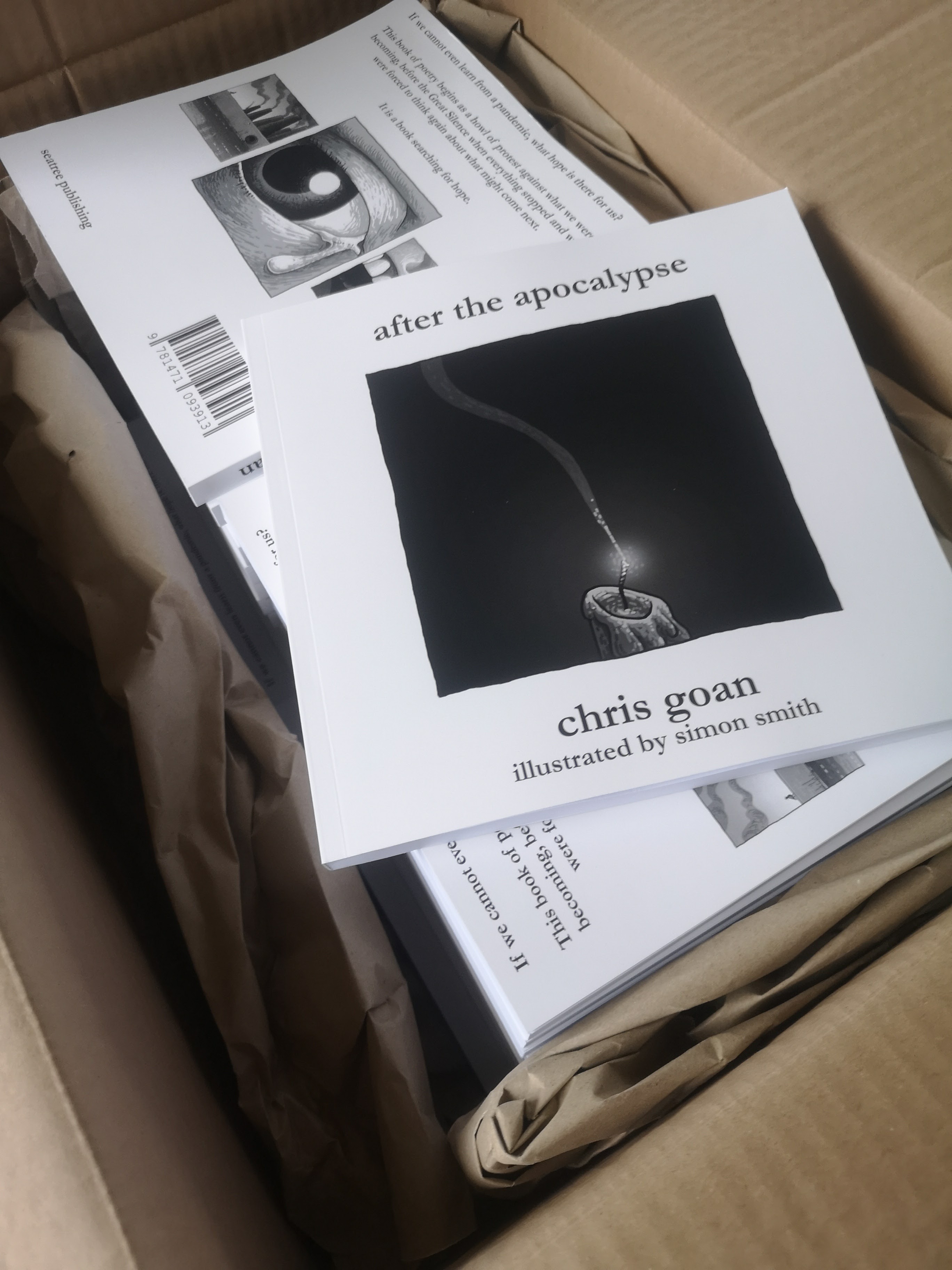
After all the hard work by lots of people to get the book into some kind of shape – the editing, the design work, the proof reading… and of course Si’s magnificent images – I think it time to take make grateful pause.
It is not perfect. A few errors slipped through. The print quality on the images has not totally passed the Smith test. Despite this, I am feel a sense of satisfaction that I have not always felt after a book has been completed. I think it is because this book, despite its limitations, is as honest as I can be. Its limitations are my limitations. If it carries any hope, any beauty- these are ones that I have lived through or am reaching towards. Also, despite the commercial nature of any project like this, the book was not written to sell anything. It started in frustration, anger and dissatisfaction with the world we have made, and ends in a great sigh of connection with the spirit that sings within us all.
I hope people will read it, but if you don’t that is OK. I needed to say these things anyway. More than this though, I feel a sense of responsibility towards the ideas that the book contains.
I stand by the anger. There is lots to be angry about. But we can not exist on anger alone.
I appreciate the pause that poetry gave me, the chance to ponder and reframe the way we look. But pausing is only the beginning of change.
And even if the book offers no blueprint for betterment (because I know my limitations) I think it carries some clues. It feels to me as if these are not my own insights, but ones I have discovered, almost by accident, in the margins of the scribbles I was making as poetry was forming. This is the gift of poetry – it takes is both inside ourselves and then, if we are lucky, it draws us towards new places.
Or perhaps it is nothing to do with luck. My contention is that if a solution is anything at all, it begins in the ‘theatre of the spirit’ (as Havel put it), or to put it another way, we first have to re-encounter the meaning of our lives as individuals, but even more so collectively. We have to remember that the human world we live in has been made by humans, so it is quite possible to re-make it.
In the next season of the life of this book, I hope to be bring together some actual ‘theatres of the spirit’, by putting together some gatherings where we read together and dream together. If you are interesting in hosting/attending then get in touch.
It is hard to choose poems from the book now. They are all fragments of a five year journey. But this one will do.
.
I want to live
.
I want to live in a world in which refugees are welcomed
As if coming home. As if the food they are given
Was cooked by their own mothers.
.
I want to live in a world in which people share what they have
With those who have nothing. Where fear of scarcity is foolish
Because we finally recognised abundance.
.
I want to live in a world in which love for neighbours
Made hedges and fences inconvenient. As if real estate
Is not real after all.
.
I want to live in a world in which guns are things for museums
Behind glass with suits of armour. Where tanks are
Used only to store liquid.
.
I want to live in a world in which nothing is expendable, as if landfills
were already full. As if bags of bolts and empty cans
Can be used again tomorrow.
.
I want to live in a world in which children are thrilled by birdsong
and gloriously appalled by black beetles. Where great adventure is made
This thing that we can loosely call theopoetics may not have one narrow definition, but that does not mean that we can’t describe it, both in concept and (more importantly) as a practise. As part of my own personal exploration, I have been gathering some of this material together and here is some of it, hopefully organised in a way that makes sense.
The bits and pieces here have been gathered from the web, both fixed pages, podcasts and videos. There are a few books out there which i have not read yet, and probably never will, because I am much more interested in theopoetics as a way to understand and shape practise, rather than as an intellectual exercise.
A piece of community art made by a wonderful group of people brought together by an experience of grief
Definitions
This is a paraphrase of the definition provided by ARC, whose webite is here.
Theopoetics is what happens when art/form/style/forms and intersection with spirituality, with a focus on community, change and embodiment.
It is about seeking to make the practice of poesis – the meaning making – one of the central parts of life.
It is not new. It is not ‘another way of doing god-stuff’ – rather it points to things that have always happened and always been part of religious practice.
Theopoetics requires that we have space in which to make our own spiritualities, which might be understood as a rejection of ‘monorthodoxy’, and the deliberate decision to allow a generous concept of orthdoxy, in which it is not true to say that there is ‘no such thing as rightness’, but rather that this is much broader than our prejudices might have led us to believe. This is not the same as saying ‘everything goes’, but it would suggest that our adventures are not just limited to one denomination, one tradition or even one faith.
Practise
Like many theological movements, it perhaps started in reaction to a concern about how we have place some forms of theology on pedestals, particularly seeing it as an intellectual journey. In this way of doing theology, art, if used at all, is merely metaphor through which we encounter intellectual truth. This kind of theology tends to be white, male and controled within the acedemy.
BUT, within theopoetics, the act of creating art is itself an epistemology (which is another way os saying that it becomes a different kind of knowing. Or perhaps a way of understanding the limits of our own knowing.
Perhaps we can also say that the process is as important (if not more important) than the product, or the object that is created. The act of making resonates with memories/hopes/hurts/loves that we feel within our bodies as much as we name them consciously.
It might be about helping us engage with our present or about letting go of our past, letting the spirit connect with the Spirit…
We are describing art here as a spiritual discipline, in which we make things out of our community and our shared experience as well as individually. In this we consciously value both creativity and co-creation.
Art might also been seen as prayer…
…or protest…
…or as a way to be hopefully consciously engaged with our own culture, our own location.
Embodyment
I have heard this word used for some time now, and have at times felt threatened by it. Perhaps this is because I have never been particularly comfortable with my own body. As a young man, my religion taught be to hate my physicality, particularly my sexuality, which was almost always to be supressed and was a source of shame. I was always taller than those around me, and often overweight, which, when combined with a crippling lack of self consciousness meant that my escape was into my head – to the worlds I could create, or have created there by others. Like many of us, I learned in a deep subconcious way that my body was not to be trusted, that it was ugly and that the best parts of life were lived externally, intellectually and even excarnately, via the on-line world that increasingly characterised my being. Add ot that, my body is older now, with all the changes that brings.
To hear the word ’embodyment’ being used as a spiritual practice is in stark contrast to the religion I inherited, but that is not to say that there were no embodyed experiences. I grew into a relgion that was charasmatic, with ecstatic ‘moves of the spirit’. People were ‘slain’ or shaken from head to foot. People danced. People shouted. As I reflect on that from a safe intellectual distance, it is interesting to me that in order to move beyond the intellectual straighjackets, the mostly middle-class white English people I grew up amongst needed some kind of holy-spirit madness to give them permission to engage their bodies with mystical experience. My memory of much of this is that I watched from the outside, playing musical instruments, disturbed and slightly embarrassed by much of what I was seeing, desperate to look like I belonged. Other people were fully caught up in these experiences. I thought there was something wrong with me because I was not.
So what does embodyment look like to me now? I think it has to start with small things. I have to first stop trying to force an experience that years of conditioning (and my introverted personality type) have taught me to avoid. There are many practices such as exercise, meditation, centring, etc that might be able to help me, but the one that I have found most useful is… art.
As I create (for example as I begin to contruct a poem) a lot of the work takes place within my head. My chosen medium is after all the written word. However, increasingly I seek to go beyond the bounds of my understanding and to attend to what is happening within my body. For me this often begins with my emotions. As I write it is not at all uncommon for me to weep or to discover that I my heart is racing and my teeth are clenched.
In writing poetry, I am also seeking to connect. This is really hard to describe, but anyone who writes as much as I do will know that there are times when you are not writing the poem, rather it feels as though you are recieving it. These moments are not intellectual so much as mystical. They are a bodily response to something that feels beyond my body. I would always resist describing this experience as being ‘given to me by god’, because who am I to say where inspiration comes from? Rather I am happy to say that I sought connection to the deeper parts of my body which are themselves part of the great becoming.
To throw in another buzz-word, we might also say that poetics is concerned with Intersectionality – theopoetics as a way towards a new place. Intersectionality is an analytical framework for understanding how aspects of a person’s social and political identities combine to create different modes of discrimination and privilege. It is perhaps not suprise that theology made on the margins through art would have this as part of its DNA.
Perhaps we might also see embodyment itself as a radical practice, in that the body has long been a place of suppression. Power and prejudice is aimed at, and felt by, the body. To deliberately reject these powers and say that this is MY body, inside of which MY art matters, and MY understandings of the living god matter- this is itself a political statement.
This also resonates powerfully with the idea of ‘pre political spaces’ in which change is dreamed and rehearsed, and in which ideas about change start to form and find cultural momentum. I wrote about this here.
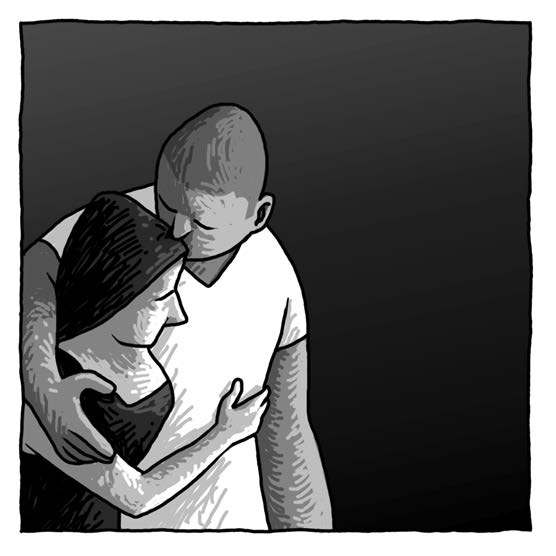
It would seem appropriate to finish with a poem. Unsurprisingly, my last book has gathered much of my poesis, or my theopoetic journey. More than this, it has also hugely benefitted from Si Smith’s poesis, as in the image above.
This poem is my truth for today;
I choose goodness
I caught a glimpse today
Of my capacity for goodness
I thought it gone away
But there it lay
Like a laughing flapping fish
With its mouth wide open
For despite being the epicentre of my own unfolding event
I still know what it means to love
Despite all my callow grasping
I know what it means to give
Despite my tendency to measure myself and find you wanting
We have been thinking about the shocking ‘othering’ that has typified our nation’s response to the world wide refugee crisis. There are of course many beautiful exceptions, but by and large here in the UK, we do not make the outsiders welcome. Rather we fear them, label them and export them even if they manage to climb over our high walls. How can we, insignificant and insulated as we are, respond? How can we express our outrage in a way that is meaningful? How can we look deeper? How can we invest in the hope of change and the progression towards something better?
There are lots of active ways of course- getting involved in protest or seeking to offer some kind of direct support to those in need, be it financial or physical. These things are a vital part of any change process.
But there is another component. How do you shift the zeitgeist? How do you start to change wider opinions? For this, we need to engage in the ‘theatre of the spirit’. Here we need our artists. We need our theopoets.
Michaela is one of these, but she would look at me very impatiently if I suggested it to her. She does not waste time on theological ponderings, being too busy with other things.
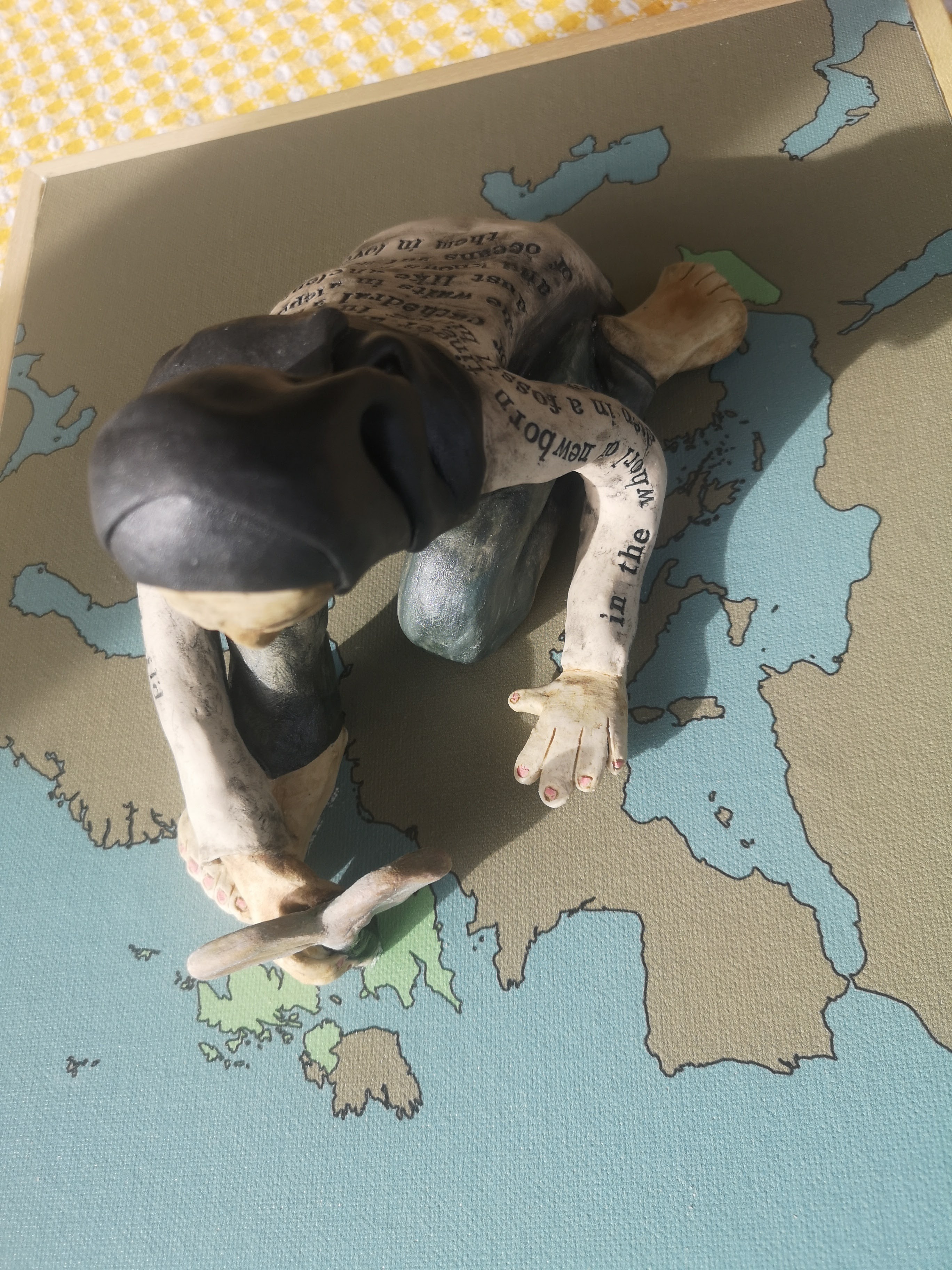
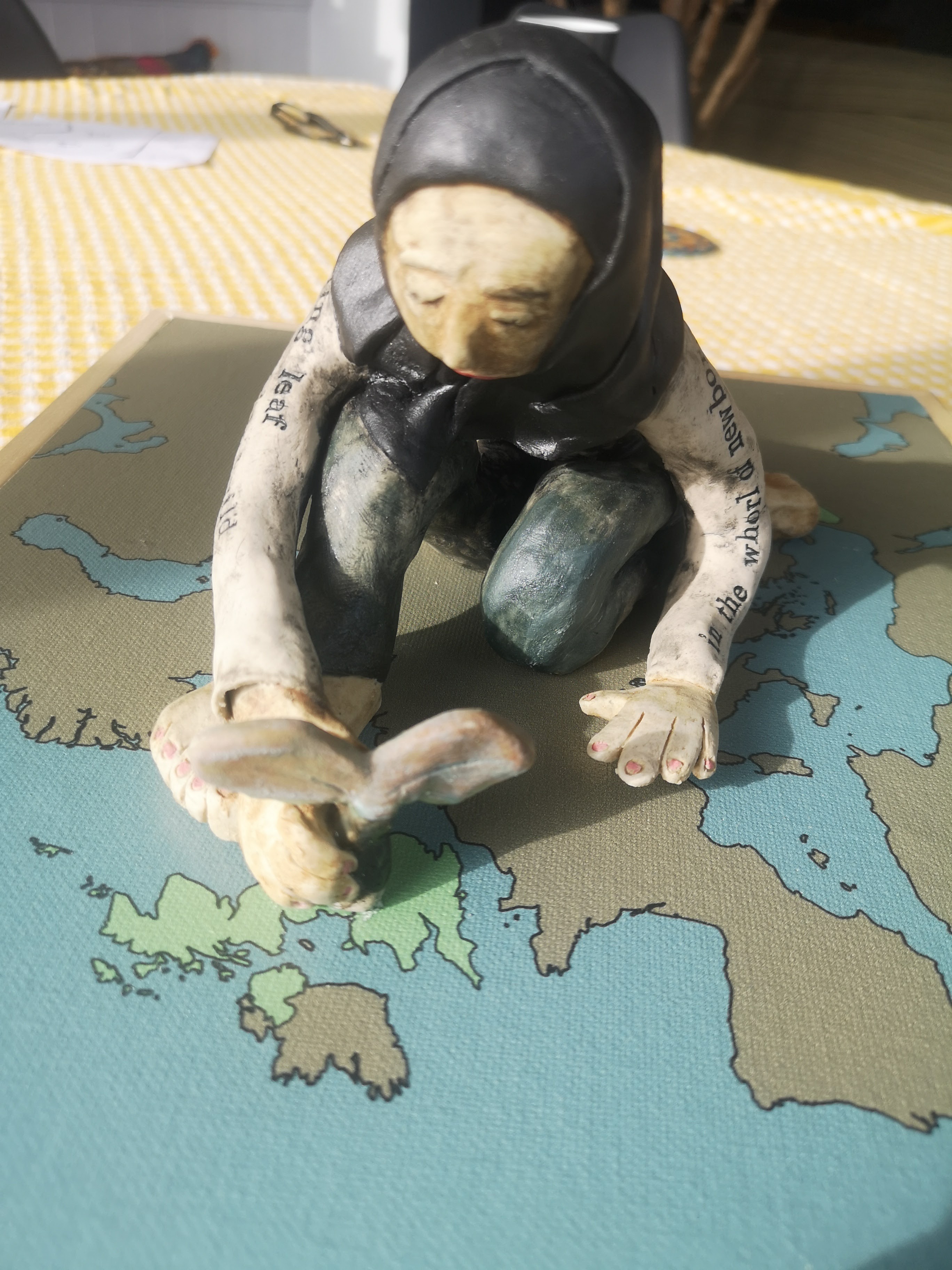
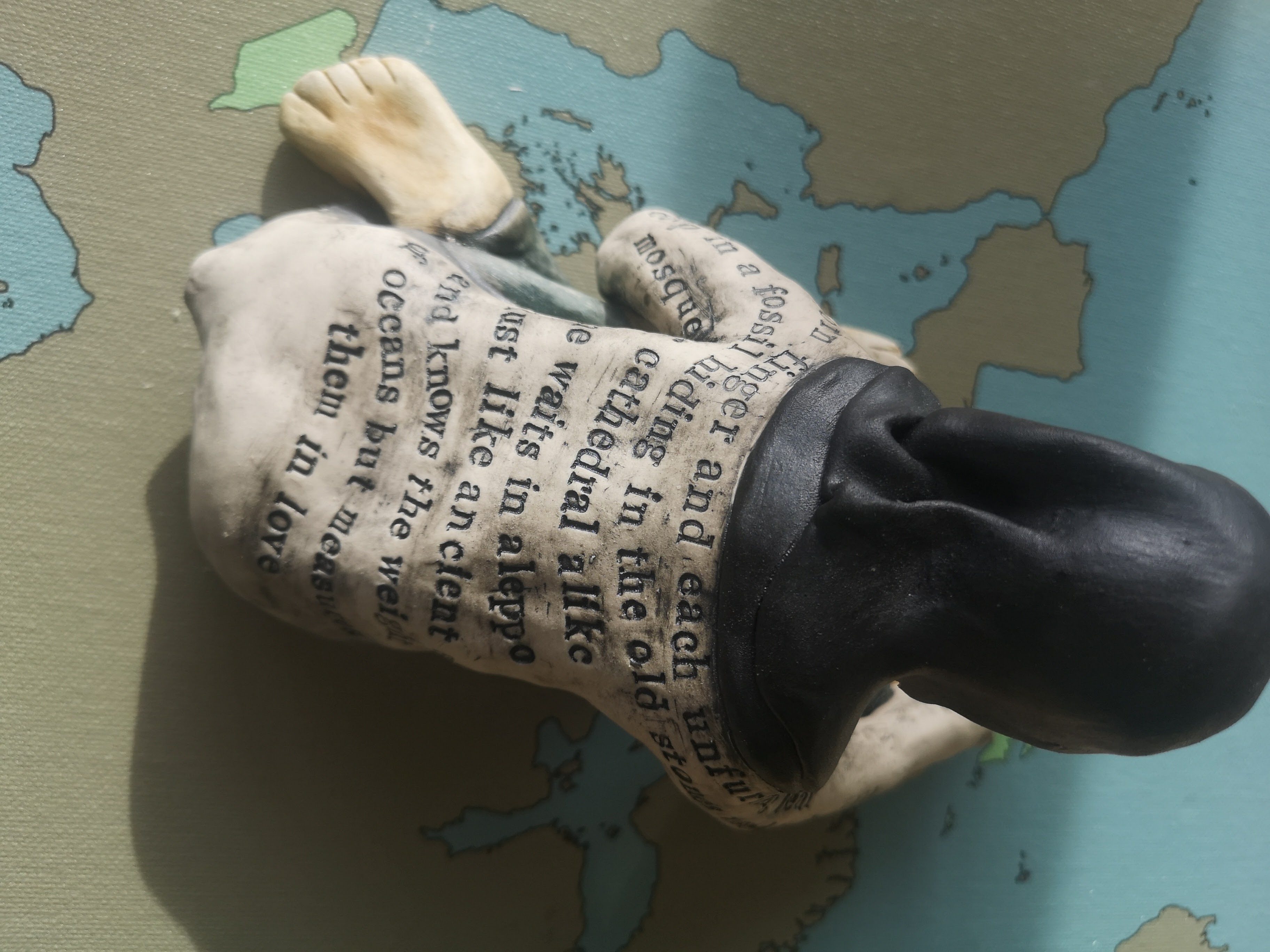
She took a poem I wrote, extracted her own truth from it, and made this;
It features a woman wearing a head scarf with one foot in Syria, planting a young shoot in the UK.
She is mounted on a plinth with a large map.
The poem I mentioned is this one;
Gods
Sometimes I fear that we were given only empty promises
by a far-away-god who casts knowing glances while
We wind towards inevitable destruction like unregulated clocks.
The god of love, who will watch most of us burn.
The god of grace whose good folk gorge whilst others starve.
The god whose justice is skewed and whose faithfulness is unreliable
The god made entirely in my own image, and
Both of us are broken.
.
But sometimes, just beyond the spectrum of visible light
I glimpse the afterglow of a different god
Who is in all things, but is not enclosed
Who is in everything, but in not exclusive
Who is above all things, but never aloof.
Who is below all things, but never debased
Who centres himself everywhere
but lacks circumference.
Who confounds all those who seek to constrain
Where she might be recognised.
.
(In the whorl of every new born finger and
every uncurling leaf.
Deep in each fossil hiding in the old stones
Used to build mosques or cathedrals
The god who waits in Aleppo dust like ancient seed
The god knows the weight of the ocean
But measures it in love.
On being confronted by this piece, our reaction is not intellectual alone, it is also physical and spiritual. This is the nature of art. This is the nature of theopoesis.
One of the problems we have in trying to grapple with theopoetics is that it is almost impossible to define. Certainly there does not seem to be one single definition. You might argue that this kind of amorphous, pliable, porous approach is typical of many other post-modern ideas, typified by the retreat from hard-edged scientific truth, which is often understood as an instrument of power and control. You might be right.
But why do I gasp when I see a flight of swans or geese heading south as the winter approaches?
I return to the idea of ‘the poem’. I know there is a danger here as theopoetics is NOT about poetry – or not only about poetry – but hear me out. Remember that one third of the Hebrew bible was written as poetry, and that poetry has formed the bedrock of other religious movements, most notably the great Sufi writers of the middle east.
Here is the question though; what is a poem and where is its power? Or to put it another way, where is the truth of a poem and what use is it? You could also ask, who decides WHICH poems are important?
I would argue that there are many ways to answer these questions.
Form, meter, rythm, technical matters. (In other words, all the things I hate to think about when I write poetry!) You can decontruct a poem down to individual parts and miss the point entirely
The experience of WRITING the poem. For me this often a visceral experience. If I shake with anger, or weep real tears then I know I am writing something that matters. This does not make it a ‘good’ poem – or does it?
The subject matter of a poem is important … or is it? I love poetry that is prophetic and speaks truth to power, but a poem can be about anything and still relate to the greatest human issues.
Then there is the READING of a poem. They are often like swans in flight in their ability to make me gasp. Many do not, so I skip past them. There are technical and content reasons why some grab me more than others, but I feel this first in my body, as a physical reaction. It is like a spiritual narcotic.
The truth of poetry is almost always ambigious to some extent. This is the nature of language – it often contains layers of meaning, and poetry mostly makes this less clear, as a deliberate practice, employing similie and metaphor not to explain as much as to open up spaces. We project truth on to poetry as much as we extract it.
Some poems have been ‘adopted’, almost like official anthems. The meaning of these poems has almost always been obscured or distorted. Consider Blake’s ‘…and did those feet in ancient times walk upon England’s…”
There is an open question for me about how we read scripture-poetry. The apocalypse of John? The beatitudes? The majestic poetry of Isaiah? Should we be allowed to read these differently or should we treat it ALL as poetry even? If so, how does this change the way we approach the text? Do we diminish it, or do we make it more true?
Finally consider how poetry at school tends to be suffocated by the educational imperative.
All of which is another way of saying that creative spiritual experiences of the kind we might describe as theopoetical will ALWAYS be difficult to define. Perhaps this is the very heart of their usefulness. In an age of sectarian cerainties we need ways to once more be confronted with mystery and unknowing, which is the very heart of mysicism. But this is certainly not about the absence of meaning. It is about the pregnancy of the moment when we sense a connection being made to what some (but not all) call god.
Theopoetics invites us to focus on the how. The doing. The shaping of the thing. The heartbeat. The physical reaction. The beauty of it. The love that inspires towards action.
What this looks like in practice is as varied as… poetry.
My contention is that ideas matter. Consider how our current UK government has taken inspiration from certain ‘think tanks’ to apply a philosphy of extreme liberal economics. Ideas, when operationalised, can change the world.
Theological ideas have a particular kind of power as they have god (or gods) on their side. Even whilst we are witnessing the decline of religious participation in the western world, theology remains a powerful force for good or ill, dominating the discourse at the heart of the politics of the most powerful nation on earth and forming the fracture lines of many a hostile border.
On an individual level, many of my friends have been going through a period of deconstruction, when they have questioned much of the theological underpinnings of the faith they inherited. My own deconstruction journey into this territory is writ large across the whole timeline of this blog. But deconstruction is only ever part of the process. A friend said it like this recently in an e-mail;
I am certainly in the time of that journey where I am looking for those trustworthy guides … I know that deconstruction does not fill me up with anything, it only warns me against what I know I do not want to become. So, finding meaning is what I hope for.
Trevor Williams
Where do we start then? Whom do we trust to lead us? Where are the apostles, the prophets, the authors we need to read, the preachers that we need to listen to?
Perhaps more importantly though, can we trust our own hearts to lead us? This takes courage, but it also takes a certain kind of self-compassion, accepting that we do not have to be perfect. We do not have to get it all ‘right’. The measure here (as in the beginning of it all in Genesis chapter 1) is not purity, but goodness; goodness that embraces the inevitability of failure as well as the hope that we can do better.
In previous post (which I cannot find, but I’m sure I talked about it somewhere before) I confessed to applying these three things to my own search for meaning.
I acknowledge those whose teaching/writing/leadership has inspired me, consciously holding on to those things I inherited that is ‘good’. These act like signposts or filters or channels through which I measure and encounter the new
What sings in my soul? I have decided to trust my own embodied reaction as a guide for accepting and adventuring. If I read something or encounter something and it lights me up emotionally/physically/spirituality (even intelluctually) then I will pay attention.
What is useful? By which I mean the degree to which ideas contribute towards my understanding of peace love and justice. If they do not seem immediately useful in this regard, I am not necessarily rejecting them as ‘wrong’, rather I am far less interested.
I am quite aware that this list is contentious. I have spoken about it to a number of friends, and some of them have been troubled by it. It may also be incomplete – for example, Trevor, in the e-mail I quoted from earlier, suggested adding ‘beauty’ to the list, something which was interesting because it resonated with a new (to me) idea I have been adventuring with called theopoetics (more on this later.)
After all, a quote from Jean Vanier has stayed with me for years about how we encounter god in all that is beautiful and all that is broken so I have no doubt that a certain kind of beauty opens me up inside… perhaps this is indeed a reliable way to encounter the divine.However, this seems more than contained within my number 2 because beauty often sings in my soul. It might be a different song to yours, but it sings loudest for me when mixed with brokenness, because there I think we find god. This is why encountering Steve Broadway’s portraits of steet sleepers was so powerful at this event;
I mentioned this word theopoetics. I confess, my initial interest was because I assumed this to be describing some kind of mash-up between spirituaity and poetry, something which sounded right down my street – after all, this has been a well trodden path for centuries so such a word seemed potentially useful. However, it turns out this was wide of the mark. I needed to think bigger, much bigger.
Lets start with the etymology of the word;
Theo; meaning ‘of god or deities’.
Poetics from poiesis, meaning ‘the activity in which a person brings something into being that did not exist before’ or more simply, ‘to make’.
So what we seem to be describing here is the process of making god.
To many of you this might sound like heresy. After all, this might mean that we are describing ‘making up’ god. Dreaming him/her in to being. Creating our own creator. Well, perhaps this is exactly what we are indeed describing.
Before you become too outraged, consider this; all our concepts of god have come from somewhere. Within the Christian tradition I come from, we base (almost) all of these on propositional truths extracted selectively from the bible. The way we read this bible becomes the primary, and some would say only, way to understand who god is, what he wants us to do and what the future holds for all of us.
But we only do this because people have previously decided that this was the best way to do things. This was the god they made for us, in the form of his written words. I don’t say this to dismiss the god we have inherited, just to point out that everything we think we know about him or her has been imagined by someone, sometime.
But back to this word, theopoetics. As far as I am able to understand, those who have been exploring this as a concept are comfortable with the idea of making god, but more than this, they are less concerned with the ‘what’ questions of faith (i.e., all those propositional truths wrapped up into doctrine) and more concened with the ‘how’, by which I think they mean the process by which we encounter god in the midst of our lived experience, in the mess of what we are becoming. The idea is to focus on the aesthetics of this experience, and allow this to shape us.
In other words, rather than getting too worked up about defining what is ‘right’ perhaps we should just explore it together using whatever activities and tools that will be most helpful to bring us closer to the divine and hopefully to turn us towards acts of love and compassion.
Particularly, art and creativity, because these seem the most helpful of all, as they allow us to be fully embodied and present in the moment of encounter. Of course, there are other ways (including the study of the bible for example!) but theopoetics encourages us towards full body encounters with creative, immersive artistic expression.
As a poet, this sings in my soul and opened a window for me, which I intend to explore further on this blog. It also resonates with the three ‘tests’ I applied above;
It has grown from a tradition I recognise, and is anchored to principles I find compelling, not least a concern for social justice and a concern to give a place for mystical experience through art and creative engagement
It excites me, by opening up some new posibilities inside. Something is singing in my soul
It might yet prove to be a useful way to think about how spirituality might shape the world towards good.








 this fragile tent