So, great men and women are meeting in Glasgow, with the fate of the world in their hands.
Meanwhile, other forces are pushing back. Using the same spoil tactics developed by the tobacco industry, the paid-for ‘think tanks’, stacked with sypathetic pseudo-science aimed to cast doubt and confuse; the politicians in the back pocket, the media outlets primed and ready to push an agenda suited to those whose power and wealth is threatened by a change to the status quo. (If you want to know more about exactly how this works, I would suggest watching this BBC film.)
Here is another poem. My retelling of the Gaia myth.
The woman beneath the hill of the world
.
They say the earth is a woman
Wrapped in a gossamer layer of
Brown-green skin
Runnelled and pooled by
Salt tears
.
They say the woman is barren, for her sterile
Soils are not fed from the falling leaves
Now the trees are gone, and
Long tresses of her deep green hair
Have been stored as silage
.
They say the woman mourns her children
Whose bones now brine the ocean, and
Whose dawn song is no longer sung
Whose savannahs have all
Been stolen
.
They say the woman speaks to mountains
But they no longer listen; that she
Looks for signs in distant stars but their blink
Is blurred by all the smoke from her
Burning forests
.
They say the woman would write her story
Except that the black ink in her wells
Have all been pumped dry, and the
Tail-feather-quills from her favourite flightless birds
I was talking to a friend about how we do not notice change happening all around us, as if we are pre-programmed to assume stasis, even though our whole lives have been subject to continual change. We do not have to ponder long to consider how the world has changed in our own lifetimes. I am 54 years old, so was born before the internet, before mobile phones, before global warming was first widely identified (we commonly mention the first 1971 climate change conference) and before ABBA even.
I say this as we all have to live with the ever present reality of impending ecological disaster brought about by global warming. It can be overwelming and almost impossible to imagine both the scale of what is coming and how we might change the arc of recent history. Yet change IS possible. The pandemic should have made this clearer than ever.
If we add just a few generations into our change concept, then the human impact on the world around us becomes impossible to ignore. Rather than reading this as a death spiral down towards destruction, we have to remind ourselves that what is made by human hands can also be unmade, reshaped and reformed.
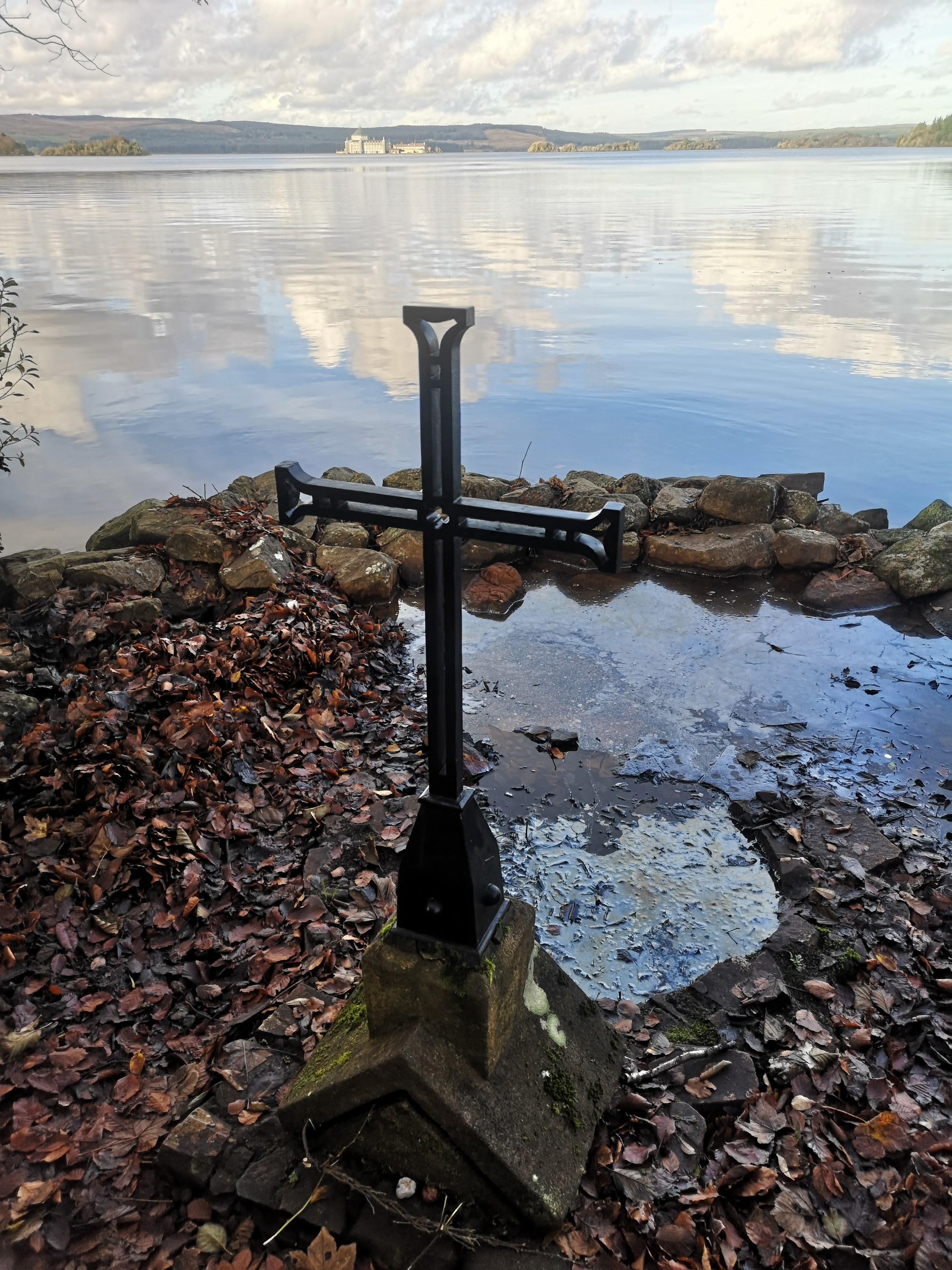
St Brigid’s well, Lough Derg, Donegal.
I am also still constantly wondering what it means to live a good life in our changing context, because personal change requires some level of aspiration. What models of goodness still apply? What do we aim ourselves towards and measure ourselves by?
The old religious ideas of goodness seem mostly irrelevent, with their emphasis on personal salvation from (mostly) sexual sin, rewarded only in the next life. I would suggest however that these models of goodness were always at best a contextualised, partial reading of the texts that they trumpeted so freely. Other kinds of goodness were ALWAYS there, but we have to reclaim them, place them front and centre and then allow them to reclaim us.
In many ways, this is what this blog is all about. I do not say this because I can claim any personal victory or success over my own demons, but rather because the journey has to start from where we are.
Today, on the teetering edge of the COP, I offer you this thought. What if goodness might require a letting go of old binary/dualistic ideas of good and bad – seductive and ego-satisfying as they always are – and deliberately moving towards ideas of deep connection, non-violence and partnership with the world and with each other. In the words of the book ‘against such there is no law’.
More than this we have to consider how this might change and challenge our attitudes. I would suggest it might be important to look in these directions;
This is just idealistic nonsense, right? Well, perhaps, but remember that change is shaped not just by power and progress, but also by the cultural context. The industrial revolution was almost entirely protestant Christian. It is time to move beyond this towards a new vision of goodness. We do not have to look far, but we have to look hard.
At present it seems that truth has never been so partial, so sectarian. Truth is what our tribe wants it to be. It is fed to us by algorithm. It has no external frame of reference.
But if you know the truth, it will set you free. What does this mean? It is perhaps not surprising that these words were spoken in the context of Jesus challenging religious dogma; blinkered narrow views that victiised and enslaved others.
As we run up to COP26, one of the greatest obstacles we face in trying to commit to real positive action is the way that truth has been deliberately distorted, by politicians, think tanks and faux-acedemics, all in the paid service of the oil industry, who have spent millions to muddy the waters.
I have been thinking about the old religious word ‘resurrection’. Like many of these words, it has layers of meaning. It also becomes a hermaneutic through which we understand other meanings. It shapes the way we see.
The raising of life from death. The coming of spring. The restart after failure. The hope that seems hopeless.
Then this phrase, which for some reason always breaks me open; Behold, I am making all things new.
Behold. I am making all things re-newed. It is not over, it is still becoming.
We are in Ireland at the moment, visiting family, staying over in the bog country, full of smell of burning peat. Imagine my surprise then when I saw this;
How is it possible that globalisation has meant that we are importing peat to Ireland- to the place famous the world over for its peat? There is madness to this, but also…
Firstly, I should not be surprised. Commodities are globalised. That is how it is. If there is a market for coals in Newcastle, then it does not matter where those coals come from. If a Canadian lumberjack needs wood for his fence, why should he not go down to his DIY store and buy wood that was grown in Sri Lanka?
Secondly, who am I to even complain? I am burning the stuff after all. I am sending up my pyre of ancient carbon. I drove here in my 10 year old diesel car which did more of the same, therefore I am a hypocrite and as such should be immediately silenced.
If we are to save the world some things need to change, that goes without saying, but one of the most obvious is the need to restore ‘local’ to be a primary consideration when trading and buying goods. There is good evidence that not only does this have a significant environmental benefit, it can actually restore communities.
Today we had a budget released that hardly mentioned climate change, by a party that recently voted NOT to enforce penalties against the privatised water companies whose systems are unable to protect our rivers from repeated discharges of raw sewage.
It seemed entirely right to re-post this poem today.
Dirty old river
.
Dirty old river all rusty and brown
Coughs out a ship from the dirty old town
Scavenging birds patrol overhead
Searching for things only recently dead
.
Last resort trawler hauls close up to shore
Scrapes the last scallop and the very last prawn
Flatiron-shaped tug smooths out towards sea
Like the impossible flight of the last bumble bee
.
Dirty old river that once was so pretty
Collects like a sewer from the arse of this city
Where once swam the salmon, the perch and brown trout
One of the great challenges, when seeking to make changes to the world, is how we might concieve of a different future. For this we need our prophetic visionaries. Monbiot is just such a feller.
Another poem of hope and connection, which suggests a world not ruled by the survival of the fittest, but rather by the eventual realisation of unification and interdependance.
This recording was made in the immediate wake of the death of my sister.