World poverty is decreasing, (says the World Bank). Lets look at the evidence…

I have been thinking for a while about the exchange between a CEO and Rutger Bregman at Davos last month- the video is dynamite and can be seen here.

The CEO sort of made the point that people like Bregman should stop banging on about tax and inequality because, after all, world poverty is rapidly decreasing. The implication then is that global capitalism is working to advance the cause of the global poor. Give people a factory to work at, or a hotel room to clean, and they will no longer starve.

The World Bank agrees, even though the reduction in poverty seems to be slowing.

The evidence is strong. Take this report from Politifact for example. They were fact checking this claim by U.S. Agency for International Development administrator Gayle Smith.

“I think everyone in the room knows that this is a moment of extraordinary progress. Over the last 30 years, extreme poverty has been cut in half. Boys and girls are enrolling in primary school at nearly equal rates, and there are half as many children out of school today as there were 15 years ago,” Smith said in a speech on Capitol Hill.

They concluded that


Smith said, “Over the last 30 years, extreme poverty has been cut in half.”
By World Bank figures, Smith actually understated the reduction. We’ve cut extreme poverty by 58 percent using the 2008 definition of extreme poverty, and 74.1 percent by the 2015 definition.
While we don’t quibble with Smith using that metric, our research shows that there are other ways of determining poverty, and those different ways show different declines. Moreover, defining poverty is not an exact science, experts say.
Because of those caveats, we rate Smith’s claim Mostly True.


The message emerging from the world’s major economic foundations ( the World Bank, the IMF etc) appears to be this;

Things are getting better. Climate change will be a challenge (See below), and there are a few areas where poverty stubbornly remains and is difficult to deal with (mainly in Africa) but on the whole, global capitalism has reduced poverty to a level unknown in human history.

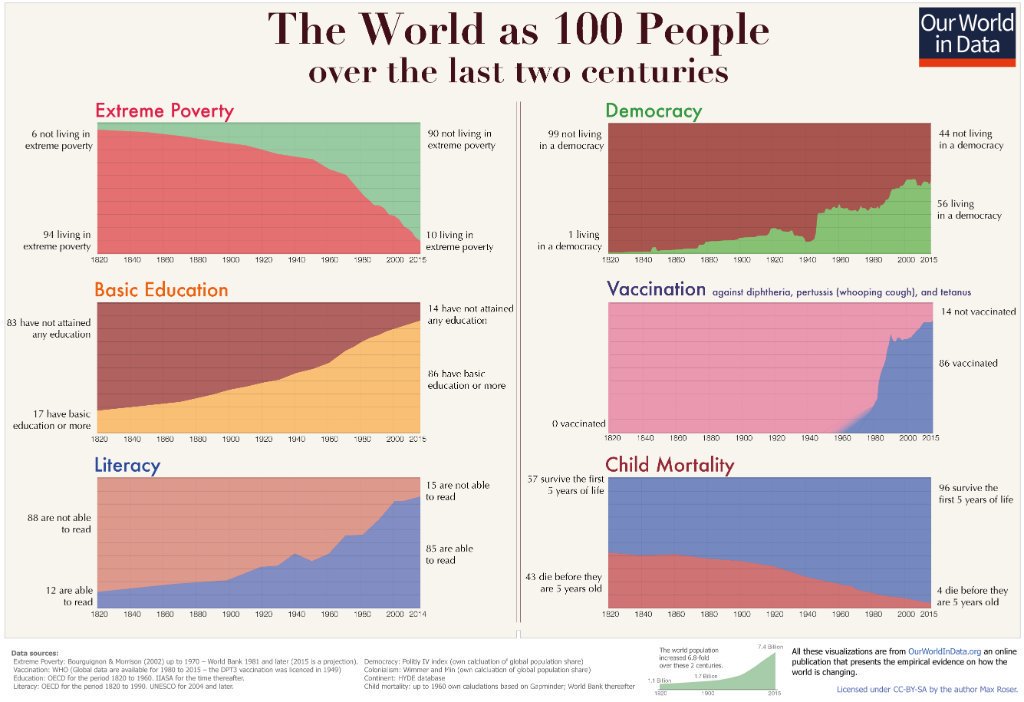
It’s all good news then? Bill Gates certainly thinks so- he tweeted this graphic at Davos;

DxSZ58_XQAAoxM8

Just in case you were starting to feel warm and comforted, I am afraid it takes but a second of examination of these stats for a whole raft of questions to emerge. 

The first problem is the tool used to measure extreme, or absolute, poverty, which was set back in 1990 by the World Bank at a figure of $1 a day (now rising to $1.90 a day, adjusted for inflation.)  There are all sorts of problems with this figure. What does it mean, when the costs of living vary so much from place to place? National poverty lines vary even within countries after all, let alone globally. 

Secondly, this analysis ignores inequality and the brutalising, alienating nature of relative poverty- being measured by society as ‘wanting’ and ‘worth-less’. It has been strongly argued that inequality creates vast sickness in both those who have and those who have not. (Check out The Spirit Level book for a full analysis.)

Thirdly, even if you use the $1.90 figure, what about those just above the line?

Fourthly, the improvements described are rarely broken down into where in the world the improvements have been made. If you take China out of the figures, then measure again over the last four decades there seems to have been very little change- 60% of people remain in poverty. 

boat_fb_en

The next problem is that the World Bank analysis is based on one solution to world poverty- economic growth. This solution gives it a major problem- how to keep the economy growing without killing the planet;


There is another question about how this all works for the global economic system…

Who benefits most from lifting people above $1.90? Could it be Global capitalism? Think about the debate in the UK right now about low paid, insecure jobs. Working people are undeniably poorer than they were, but levels of employment have gone UP. 

This is starkly highlighted in the infographic that Bill Gates tweeted- it suggests that in 1820, global absolute poverty was at 94%. Think about that. What on earth does that mean? Jason Hickel, writing in the Guardian, said this in response;


What Roser’s numbers actually reveal is that the world went from a situation where most of humanity had no need of money at all to one where today most of humanity struggles to survive on extremely small amounts of money. The graph casts this as a decline in poverty, but in reality what was going on was a process of dispossession that bulldozed people into the capitalist labour system, during the enclosure movements in Europe and the colonisation of the global south.


Prior to colonisation, most people lived in subsistence economies where they enjoyed access to abundant commons – land, water, forests, livestock and robust systems of sharing and reciprocity. They had little if any money, but then they didn’t need it in order to live well – so it makes little sense to claim that they were poor. This way of life was violently destroyed by colonisers who forced people off the land and into European-owned mines, factories and plantations, where they were paid paltry wages for work they never wanted to do in the first place.


In other words, Roser’s graph illustrates a story of coerced proletarianisation. It is not at all clear that this represents an improvement in people’s lives, as in most cases we know that the new income people earned from wages didn’t come anywhere close to compensating for their loss of land and resources, which were of course gobbled up by colonisers. Gates’s favourite infographic takes the violence of colonisation and repackages it as a happy story of progress.

Finally, I think again of my own situation. I am poor by any measure of income within the UK- not at the dollar-a-day level, but in terms of relative poverty. If we use a financial measure, that is. The fact is, I have a house, I have land. I have skills and assets. I can grow food, keep chickens. I am largely unmolested by government or oppressive regimes. I have time to think and create and write.

The World Bank can keep it’s dollars.

How to change the world…

We seem to be faced with a world dominated by epic challenges which we (the most intelligent species ever to walk the planet) are both inflicting upon ourselves and are victimised by at the same time. Mass extinction, poverty, inequality, climate change, the rise of narrow minded populism that breeds hate and division.

Is change possible, without disaster, crisis, or violent revolution? Can we ever release the energy of what William James called ‘the moral equivalent of war’?It seems to me, as often pondered about on this blog, that we are desperate for a new narrative.

A narrative of hope- one that connects our intellect to our sense of decency. (A place that used to be taken in our culture by faith)

An economic narrative that no longer makes people subordinate to profit, or the life of the planet subordinate to ‘economic growth’.

A political narrative that rejects nationalism, borders, me-firstism, empire building/empire nostalagising. One that is prepared to engage with new ideas, no just defend old ones.

A life-style narrative that rejects the pursuit of stuff to fill the vacuum left by emptiness and pointlessness.

Narratives like this, of course, are dangerous- not just to elites. They can result in all sorts of unforeseen negative consequences, because they often both arise from and create, instability. Think of the great ideological clashes of the 20th C. Did they create the circumstances that led to war, or did they emerge from it? Either way, should this mean that we resist new ideas and refuse to dream of how things can be better? Do we stick with our current narrative? I would argue that increasingly, this is simply not an option.

So where are these new narratives?

If we were to choose one dominant idea that might be said to dominate our culture at present it is this one: individualism. We are all individual consumers with our individual consumer rights living in our individual boxes driving our individual cars. It is not surprising then that the narrative of change is often framed as an individual choice too. We can make different consumer choices- softer ones. We can recycle our stuff, grow a bit of our veg, make do with a bit less excess.

I am perhaps an embodiment of this narrative. I chose to go from a £50K pa salary down to living from odds and sods and planting my own poly tunnels. I might not change the world, but at least I can feel smug as everything else goes to shit.

And that is the point. Of course individual decisions are important, but only if they are collectivised. Only if we establish a mass movement of individuals will significant change be possible.

So once again, where are the narratives that will create this mass movement? Our political parties have become stalemated by a Brexit debate that entirely misses the point- like all binary in/out yes/no referendums are bound to when faced with issues that are so nuanced that they can mean whatever we want them to mean.

But the narratives are there, if you look for them.

It is perhaps unsurprising that in order to deal with inequality, both globally and nationally, we have to talk about tax. We have to talk about wages and we have to talk about poverty. We can not just blame poor people any more, we have to look at the actual causes and sustaining factors of poverty.

We have to look at how rich people stay rich. We have to examine how wealth impacts health. We have to look at the private education system in the UK.

We have to understand the impact of unequal trade on the poorest people in the poorest countries in the world.

We have to call out those who cry ‘fake news’ at anyone who mentions the uncomfortable desperate realities of climate change.

But understanding will only take us so far. We easily get stuck on defining what is wrong – we have to then decide what we are going to do to address the wrong we have discovered.

I think we have to start by talking about ideas- treasuring them, trying them out. We have to start a mass movement towards change by allowing voices who are proposing alternatives to be heard above all the other noise. So, to add my small piece to this, here are a couple of clips featuring Rutger Bregman, the young Dutch historian who wrote a book called Utopia for Realists.

The first clip is doing the rounds on FB- you may have already seen it. (Thanks to Andrew Hill for pointing me towards it!) The second is an interview with Owen Jones about the book.

Artists and wellbeing. Time to embrace imperfection…

Here is my contention; being an artist can have a serious impact on your mental health.

There is a compulsion that drives people who are creative to create. Those of us who find space, finance and time to pursue this compulsion are truly blessed. We are living the dream, right?

But our art, whatever the medium, is a fickle thing. As soon as we think we have it, it flies away. Sometimes it seems that what we are seeking is always just beyond reach.

There are obvious reasons for this, to do with the nature of art, its indefinable qualities and the value we place upon it. How do we know that what we are creating is good? And even if it is good, why is it not better?

Perhaps it is about recognition- but this is dangerous. Few will be honest to our faces.

Perhaps we need to rely on people we trust?

But these people will typically be our peers- making their own art. Art that will be different to ours. Better.

Perhaps then it is about commercial success- the degree to which people buy what we make. But that too is a fools game, for the commercial world has many rules of success that have nothing to do with excellence, or depth of meaning.

Even those who have known a measure of success (however we measure it) tend to be riven with doubts about their ability to repeat it. If a potter has made the perfect pot, a musician the sweetest song, a painter a picture that brings people to tears, the expectancy of everyone is that they will simply do it again. They will have no idea that for each piece of perfection, there have been a hundred pieces that have been mediocre. We start to believe that lightening struck, but can not strike twice.

I think that art arises from unfulfilled yearning. From a longing for encounters with something deeper, something more meaningful, perhaps something beautiful. For many of us, there is a deep satisfaction discovered in process- in the shaping of our raw material. For some too, there is orgiastic release in performance, but ultimately, once the work is done, we have to return to the ordinary mess of our ordinary lives, which are occupied not just by the me-centric nature of creativity, but have to embrace the compromise of community.

If these words are resonating with you, then perhaps you are my sister, my brother, in the family of Almost. Almost finished. Almost good. Almost satisfied.

Perhaps though, as a new year unfolds, it is time to show our artistic selves a little of the compassion we might offer to others. I wrote the list below to myself, and for the rest of the Almosts.

No piece of art is ever perfect. We will all fail more than we succeed.

An unfinished piece is not a piece at all.

What value have the opinions of others anyway? If art is truly great, it will divide opinion almost by definition.

Create first from your heart and soul. It might not be the way to riches, but it is your only truth.

Fear kills creativity. I don’t mean performance anxiety, I mean fear of failure. They are not the same thing.

Money fears are particularly destructive. How much do you need, really?

Sometimes you can, sometimes you can’t. It is the human condition, so get over it. You are not an art robot.

Do it anyway, because what else is there?

Rather than hoping for encouragement, find others to encourage. Regard this as penance for your own self-centredness. Let this create connection.

Collaborate when you can, but don’t be afraid to say no.

There are lots of things more important than art- even though it might not seem like it at times.

Art is not bigger than God for example.

But God can be found in art.

Crisis. Migrants massing at our borders. Fear ye!

I am wasting my time right? The only people who will read this already agree with me. Those that don’t won’t.

So I will write this for my own sake. It might be therapeutic. I only wish I could do more.

The BBC has reported two ‘crises’ over the Christmas period. The first of these was the ‘drone crisis’. The other was the ‘migrant crisis’. It struck me that there was a strange synergy between the two- the language used. The fear of the faceless inhuman other. The popular perception of an infringement on our ‘rights’ to continue with our small-island Britishness with no disruption.

The implication is clear. Migrants are not people- not people like us, anyway, so pull up the drawbridge. Build a wall.

It is too crowded here.

We are dealing with austerity; our NHS and our benefits system is already stretched to breaking point.

It was logical then, when faced with small boats landing scores (not thousands, as are landing elsewhere in Europe) of desperate souls on our beaches, for our Home Secretary to come home for holiday and shout ‘Crisis’. (The same Home Secretary whose family had also been migrants, during a time when conditions were less ‘hostile’.)

Next we had to listen to him wringing his hands with the most twisted piece of logic ever spewed on to a TV screen. Should we deploy more patrol ships to drive them off our shores, or would this attract more migrants because they would feel ‘safer’?

They aren’t like us, remember?

Perhaps they are not. Perhaps they have more compassion than that displayed by our government. One day we will look back in shame.

So, as a tiny, probably pointless act of resistance, I write this, and also offer you this song, in the faint hope that we remember that people are the same on the inside,

no matter the pigmentation of their skin,

or what accent flavours their almost-perfect English,

or what name they give to god.

The Great Spirit who made everything and holds everything together…

Dear friends, may this new year bring blessing.

It has already to me. Yesterday was a day full of people, late into the night. There were dear friends who were NOT there, and they were missed, but still we had music, dancing (we actually managed some ceilidh dancing in out living room!) and conversations late into the small hours of the new year.

Earlier we spend half a day with Yvonne and Raine, talking of art and how we might connect to something deeper. Both are already doing a pretty good job of this- Raine through her art- check out her lovely website here – and Yvonne through her music (her latest sublime offering- a collaboration with poet Stuart Henderson is a out now!) In our conversation, I was reminded of the power of objects, because we talked about something Michaela made.

It is one of my favourite objects. We call him Bird.

Bird is the last of his kind.

I love this creature, with his big feet and his jaunty beak. In case you think I am overstating, let me tell you more..

I remember an album, years ago, by the Mountain Goats, about a bird who was the last of his kind. The song I remember may or may not be this one, that is not important, but what is important is the meaning it carries. The song describes how the bird feels the rain falling and remembers the people he has loved and who have loved him so he decides that “I wont be afraid of anything ever again'”

Every time I look at Bird, I think of this. I hear the song. It makes me think that those of us who are outsiders, and look forward into the next year from the fringes of things, half hidden in case of exposure, need never be afraid ever again.

Because the Great Spirit who made everything

and holds everything together

is in us.

We, like Bird, are sacred.

So, let Birds everywhere shout

Hallelujah

TFT Christmas card, 2018…

Dear friends, another Christmas is upon us. I offer you a picture I snapped in the summer of the youngest member of my family, asleep on his grandmother’s knee. Another beautiful child who emerged this year into our beautiful world. How we worry about the world they are inheriting.

But today, let us remember that at the centre of everything, there is light.

Christingle

Not what we get, or what we give

Not even those things we smugly eschew

Not carol or tree or tinsel or plastic star

Not a table groaning with far too much

Not the food bank

Not tiny Tim

Not snow or the absence of snow

Not a fat man in a red felt suit

Not movies about ‘true spirit’

(that somehow avoid all mention of Christ)

It is a moment shared

A song that soars

A hope that deepens

It is a belief that at the end of everything

(despite all evidence to the contrary)

Goodness wins, and

Love remains.

On refusing the fear of doubt… an advent meditation

A

From the place where we are right
flowers will never grow
in the spring.

The place where we are right
is hard and trampled
like a yard.
But doubts and loves
dig up the world
like a mole, a plough.

And a whisper will be heard in the place
where the ruined
house once stood.

Yehuda Amichai

A few weeks ago, I had one of those conversations with one of my oldest friends. He had made a comment using Christian language that I no longer hear often, and I rather flippantly challenged it. This led to a two hour skype conversation that ranged far and wide over faith, doubt, the origins of the Bible and the meaning of faith and doubt. Unlike most of these discussions, my friend kept this one respectful and listened carefully to what I said, but I honestly think he was shocked be some of it. Perhaps he should not have been, because I have made no secret of my relationship to the spiritual discipline of doubt.

A few years ago I wrote about it on this blog. In hindsight, I remember it as a clear choice- I had spent so long fearing the loss of faith. There were so many thing about the tenets (both stated and unstated) of the religion I had known that bothered me, but for years I coped with this by NOT asking questions. It was easier to focus on the ritual, the shared practice, after all I was busy making music and facilitating the religious expression of others. When I moved to Scotland, it eventually became harder and harder to live with the contradictions however, and there came a point when I decided no longer to fear doubt, because if my faith was worth anything, it could survive my clumsy questions. Any faith named after the man who turned over tables in temples should have no sacred cows.

For a while it seemed as though my faith would wither and die- but it did not. If anything, it made me determined that ‘Truth’ would not be my theological straight jacket, rather it would set me free.

Not that we should ever pretend that this will be easy…

Truth is hard to come by
Harder than Love

Love is hard to recognise
harder than Need

Need is hard to justify
Harder than Dreams

Dreams are hard to testify
Harder than Hopes

Hopes are hard to simplify
Harder than Choice

Choices are hard to live by
Hardest of all.

Tommy Randell

So where has all this doubting taken me? Ten years ago, I started to read voraciously. I discovered other famous doubters, including many who had been grouped together under the (now curiously dated) label of ’emerging church’. Sacred cows started to wander off into distant pastures. We could list them- all those totemic beliefs that we use to define of theological positions. We could display them as sliders and tick of our position on the spectrum of belief (perhaps we started to do this in that conversation with my friend mentioned above) but it would all be a waste of time, because I simply do not think this is the correct way to measure faith.

If faith has value, it has to transcend religion.

Does that make sense? Let me try again.

Religion codifies belief. Think of it as a magnificent cathedral, built from once-molten rock, carved and shaped and rigid. But even though faith might be helped by the shapes and spaces created, faith is not stone.

I stood before this edifice of faith

And it was magnificent –

The curve of the certain arch

The immovable pillars

The knowing eye in all this carving

The soaring ceiling shaped by countless songs of praise

But there was this penetrating drip of doubt

I could ignore it for a little while

Until the swelling laths shed horse hair plaster

And the stalactites point down from on high

The end of everything

Like any fool under falling stone all I could do was move

Out into the sunlight and the gentle rain

Looking backwards to see what might still be standing

Whether it might be anything more than just a

Magnificent ruin

But a ruin holds age with pride

Through the open vault light falls dappled into shadow

And the song of birds blows in on the wind

Chris Goan

Some will rightly accuse me of descending into just a post-modern, pick and mix, me-first faith, in which I have shaped God to fit in with my needs, wants and prejudices. I say ‘rightly’ because we ALL do this, myself included.

This is why I must also doubt the God I have created. 

This is why I must also set aside the distractions of doctrinal correctness and stop pretending that ‘truth’ is more important than love. I must doubt that kind of truth, particularly when it is mine.

After all, if we read the gospels, is this not the preeminent message of Jesus? 

This is not a surrender to unbelief, it is the promotion of a higher mission. One that is much harder.

A time for the sent ones of God
To follow the rough roads
Into the barren broken places
To look for the marks left by Jesus
On the soft tissue
And brittle bones
Of the Imago Dei
The stinking, wretched
Image bearers of the Living God

Time for the revolutionaries of God
To follow the long hard march
Unyoked and with easy burdens
Looking for the soft places where people are
Where freedom flickers
Where hopes soar
And we seek out the Participatio Christi
With weak but willing hands and sore feet
Learning to partake in the labours of love

Chris Goan

As advent unfolds, may our walk towards faith be not shadowed by unbelief. Rather may the tread of doubt take us closer towards love.

In which I go out to sea…

Well, almost.

In that true West of Scotland tradition, I have a few jobs these days. I love the way that these things come together- a conversation in the pub, a meeting in the street. A few hours work and a few quid in the pocket. One of them involves ships and the sea…

Imagine. A lifetime spent working in offices, then suddenly finding yourself hauling heavy ropes attached to floating steel mountains.

There is a NATO oil depot near where I live. The whole hillside above it is honeycombed with massive tanks and there is a constant ebb and flow of ships collecting and delivering oil. Tankers and Fleet auxiliaries mostly, from all sorts of countries. Docking depends on a small vessel collecting mooring lines and towing them to ‘dolphins’, which are anchor points attached to the sea bed. Someone not very bright (me) then carries the line up a ladder and attaches it to bollards. 

Sounds easy huh? It is- on a fine day. Quite the loveliest job in the world. But it is not always like that. Yesterday, for example, the wind was gusting to 50 mph and Stuart, the skipper, had to use his considerable skill to fight wind and waves to locate the boat whilst we donkeys timed our leap, ropes over our shoulder. Intrepid me…

It really is not that dramatic, but I keep taking photos with my phone so I thought I would share a few.

Who would have thought- from Social Work Manager to clumsy stevedore. 

Dear friends- those of you who still tread the drudgery of work that feels like it is killing you. Another life IS possible, because my work may kill me, but I think I will die happy.

Another bloomin’ book plug…

I know. I always get all “Christmas is too commercial” at this time of year. Then I plug a book. Let me explain myself….

A few years ago, I got a call from my mate Si Smith, who had an idea for an Advent collaboration. He brought together photographer Steve Broadway, meditation-maker Ian Adams and poetry from yours truly to make a book entitled We who still wait. The book offers photographs, a poem and a meditation for each day of advent, and is intended to allow us to reflect on the unfolding season.

These blokes should have a bit more of an introduction;

Steve is based down in Bristol. We have never met, despite collaborating on a couple of different things, via ‘tinternet and through mutual friendship with Si. He is a man of huge talents, with both pen and lens. You can see his prodigious daily output on his blog here.

Ian is poet of national reputation, who works to support people developing their own spiritual practices, via a whole range of lovely creative methods. He writes a daily meditation called ‘Morning Bell’, accessed via social media. You can find out about him via his Beloved Life site.

In the end, Si Smith contented himself with curating the book rather than employing his own considerable talents as an artist, illustrator and graphic novelist. Increasingly he seems to spend a lot of time encouraging other artists, making spaces for them, but you really should check out some of Si’s own work here. I would give special mention to the fantastic How to disappear completely.

Exalted company. Male company too- which is strange in my line of work. Most of the creative people I work with are women. I am not sure how this ‘maleness’ shaped the project, but it seems important to me, not for any exclusive paternalism, but because I found myself in the company of men like me. Men whose lives had meandered but continued to be driven by a creative search for something deeper. 

Anyway, why am I banging on about this now? 

Because Proost have a new edition out. It is now in A4 size, giving much more space for the pictures to come alive. It was a total surprise to me as I only found out about the new edition via twitter, communication not being a Proost strong point. I ordered a copy and it is lovely. 

Of course, as I re read poems I wrote quickly a few years ago, there are things I would change, but still the words I wrote move me. This is as much as I can ask. My poetry is rarely technical, it is emotional. 

So, in a totally non-commercial kind of way, I wondered if you might like to order your own? 

I do so in humility, but at the same time, confident in the company I keep. 

You can order it as a download, or as a physical copy, here. (There are lots of other advent resources available from Proost, including other work by Si and Ian, here.)

May the words, the images and the emotions stay with you as another Christmas approaches.


Baalam’s Ass
Numbers 22:21-38

“Look! It’s there!
Can’t you see it?
Wings like thunderclouds
Eyes like searchlights
Robes spun from the last rays of the summer sun
It is either a fairy pumped up on steroids
Or a feckin’ Angel
Not an allegorical one either.”
 
So it was that the living God
Sent a mighty Angel
To play hide and seek with a Donkey
So that a pagan sorcerer
Could speak out holy words
To confound all Israel.
 
And a whole sky-choir
Of heavenly creatures
Chuckled.


CHRIS GOAN
FROM ‘wE WHO STILL WAIT’

Refugee…

Roy Bailey died recently- a great man; a sociologist and folk singer, who had a long career, singing songs that revealed the history of working people.

Roy came from the fine tradition of agitators, and we need them more than ever.

Here he is singing a Woody Guthrie song, updated by Terry Andrews.

RIP Roy. Others will sing your songs.

I received this song from Terry Andrews in August 2017. During my concert at Towersey Festival later that month, I decided to sing the song as I knew Terry was in the audience. My anxiety was overcome by the rapturous response of the audience to the song. I and Terry were overcome by the acceptance not only of the song but of the humanity of the message it contains. So many people urged me to put the song on to YouTube. We all agreed to make this possible by filming the performance you see here. I am grateful to Martin Simpson for his beautiful guitar playing which he spontaneously offered without any rehearsal. It is remarkable to me that he can do this. Also to Marc Block who finds appropriate harmonies to this and so many songs I choose to sing, similarly with little or no rehearsal. I am also grateful to Marc, for without him agreeing too play, sing and drive me everywhere around the country I would not be still able to sing wherever I’m invited. As I say, often(!) he has extended my shelf-life as a singer at concerts and Festivals. Finally, my admiration for his technical skills and his love of folk song to Richard (Ich) Mowatt of Sounding Post Studio for arranging the recording and filming of this performance of Terry’s song. My heartfelt thanks to all of you for your support and encouragement of my continuing attempts at singing the stories I choose to perform and to you the audiences who continue to support me wherever I am invited to sing.