Wilderness retreat 2016, Lunga…

DSC_0310

Last weekend saw us away out into the western sea once more, searching for a place to rest and find some big sky to shelter beneath. This year we headed to Lunga- a first for all of us. (There are two Lunga’s- we went to the less famous one, next to Scarba in the inner Hebrides.)

IMGP9018

What shall I say about last weekend? These things spring to mind;

  • My son Will came this time- it is hard to describe how lovely it is to adventure with your son and share with him the tradition of the island
  • We had lovely sunshine
  • We had a force 8 gale
  • it is impossible to sleep in a tent during a force 8 gale
  • Mark and Barry are rather astonishing chefs, cooking the poshest food on an open fire and in a home made oven
  • Andy has too many gadgets, but having said that, he puts them to brilliant use
  • Phil suffered most (collapsed tent, explosive digestive tract) but bore it all with a smile and good humour. Deep respect
  • Graham somehow combines deep suspicion of all things wild with a child like wonder for the same. His constant flow of puns and bad jokes are a phenomenon to behold
  • Tigger had more space to bounce in this year and still had energy left to look after everyone else. If there is ever a disaster zone that needs to be sorted, parachute him in
  • Paul made best use of the silence and isolation, but still managed to contribute richly to the gathering too
  • Crawford knows each animal by name- he speaks to them and they listen
  • Neil is the smartest man I know, but also the most selfless and lovely. He carves a mean spoon


IMGP9003

What a lovely bunch of blokes to spend time with. All of them are either long term friends or becoming so- and although there were others whose presence was missed, the chance to linger in conversation that varied from deepest secrets to the pleasure all men make out of crude toilet humour was exactly what I needed.

Thanks to you who traveled with me- I am truly grateful.

IMGP9011

As part of our fireside discussions this year I used the idea of Anam Cara, or ‘Soul Friendship’ in which we take time to share something of our spiritual journey, or what meaning we are currently finding. Our faith perspectives varied from professionals of the cloth, to those who have lost faith all together in the existence of God. I would have it no other way- the point of these trips for me is not to convince or convert, but to provide an open space for encounter, with your deep self and with that rich, half percieved transcendent other, whatever language you use to make sense of this.

The Anam Cara Questions we used are as follows;

  1. How is your soul?
  • What is draining your soul lately?
  • What is feeding your soul lately?
  1. How and where have you felt the presence of God?
  2. What has been your spiritual high point? Low Point?
  3. How have you been able to serve the elderly, the poor, the young, the needy, the rejected?
  4. What challenges are you facing in these coming days?

Andy ‘six cameras’ Prosser made this lovely video that tells the story of the weekend rather better than me;

Gospel songs…

maxresdefault

I grew up listening to a kind of music that almost certainly will not have any place in your collection. Even then it was not something I could ever share with my peers. They were listening to The Clash, the Sex Pistols and then all that New Romantic Gush. I on the other hand had no interest in the pop superstars that seemed to have such power over people around me. I could not tell you even now what the Bay City Rollers sound like. The music I was listening to then was primarily white gospel rock.

There I have made my uncool confession. Please do not judge me too harshly.

If you don’t know what white gospel rock was all about then I will give you a bit of history from a UK perspective. Of course, the Americans did it all bigger and better- it remains a mass market across the Atlantic, but it was the British kind that I listened to most.

Put simply, the music it was an attempt by people mostly on the fringes of organised Christianity to deliver a Christian message using culturally relevant language and styles of presentation. It was trying to ‘sell’ Jesus. It all kicked off (for me at least) around the 70s with folk-rock-for Jesus-groups like The Sheep and Malcolm and Alwyn (Alwyn went to School with my Mum.) Then there was the early folk recordings of Graham Kendrick (long before all the Shine Jesus Shine stuff). There were lots of others along the way; Dave Pope, the Dave Williamson band,  Bryn Howarth, Jesus punk from Moral Support, Heavy Rock from Stryper and a many others. A lot of this music was gathered together at the early Greenbelt Festivals, and this was the soundtrack of my early teens.

(There was another stream of this music too, in the form of contemporary worship music. This spawned a whole industry of its own, but this is another story…)

This music has remained more or less my guilty secret for lots of reasons. In part because this is not what might be described as ‘good’ music. It was never kissed with mass approval, and critics, if they noticed it, would savage it for its derivative amateurish efforts.

It also forms part of the story of my own dysfunction; growing up in the way that I did meant that I needed to lose myself in something, and often this was this music. I have grown beyond this now however- there is now lots of other music! However…

That music was always more than just Christian geeks trying to be cool. There was something else underneath it all. At the time, I might have used spiritualised language to describe it- as if the words and tones of the songs somehow contained something heavenly. Jesus was on lead guitar and the Holy Ghost could sure pump out a deep groove.

Perhaps, but what I understand most about that music now is that it stood for something. It had something to say that had heart, spirit and soul. It was only meaningful when it moved you. Beyond all the cheesy ‘Jesus saves’ kind of messages, these white boys (and they mostly where boys) were singing Gospel.

One of my mates, who often introduces me to new music, has often questioned whether there is any decent Christian rock music. I think he is missing the point though- it is not really about music, it is about soul, meaning, passion. These things may be subjective, but they are also universally recognisable.

I was reminded of this when watching a documentary of Mavis Staples, who grew up singing with her family in the Staples Singers. They sang their way through the protest movement alongside Martin Luther king, then became one of the first Gospel super groups in the USA. Commenting on the music that was made, someone said that “…the music was not worth a shit unless it made the people shout.” This music was measured by the visible effects it had on the audience; people would dance in the isles, faint in the Spirit, be carried out unconscious.

We in the UK did not go in for such displays of religious emotion on the whole, but still I get this. For music to matter, it has to mean something. It has to have something to say. It has to seek to connect with that part of me that I can only call soul. And the chances are that even now, the kind of music that is sure to split me wide open will be the kind that brings raw passion and spirituality together. In other words, Gospel music, in its broadest sense.

I may well have grown up listening to what was mere imitation, so here a slice of the real thing;

Individualism, inequality and your mental health…

Reversing poverty requires a more progressive tax system and a shift in the political mindset

It is an old theme this, the relationship between societal inequality and the mental well-being of those who live there.

A sample of some of these issues can be found on these links;

I was reminded of some of this over the past week in relation to two different issues. The first came to us in the form of the so-called Panama Papers, which have shown us something of how the super rich have organised the world to ensure that they remain super rich, and avoid paying taxes for services provided to those who are not.

Perhaps some real change may yet come from the Panama Papers- certainly the debate it is stimulating is refreshing in that for once, the targets for media indignation are not those whom we scapegoat at the bottom of the pile.

However, my fear is that it has already become one of those media-driven righteous crusades in which we let a little blood for public consumption, but change very little. The real sobering truth is that inequality is not just to do with Billionaires who stash their booty in tax havens; rather it is tall about US. OUR lifestyles, OUR consumer choices. It has more to do with the fear that stalks us that we might lose what we have, particularly the stuff that our peers are continuing to enjoy.

Meanwhile inequality in the UK is growing. Some of this is generational, in that those of us who bought the Thatcher idea of home ownership (and unwittingly also bought the slavery to the market forces that came with it) now are so fixated on the security and value of this property that our kids can not even begin to afford to buy their own version of the same.

Some of it is regional, in that the wealth of greater London is like a black hole that sucks people in and never quite spits them out.

Its greatest effects can be seen internationally however, in the way that our wealth is not just in contrast to that of poverty elsewhere, but entirely dependent on this.

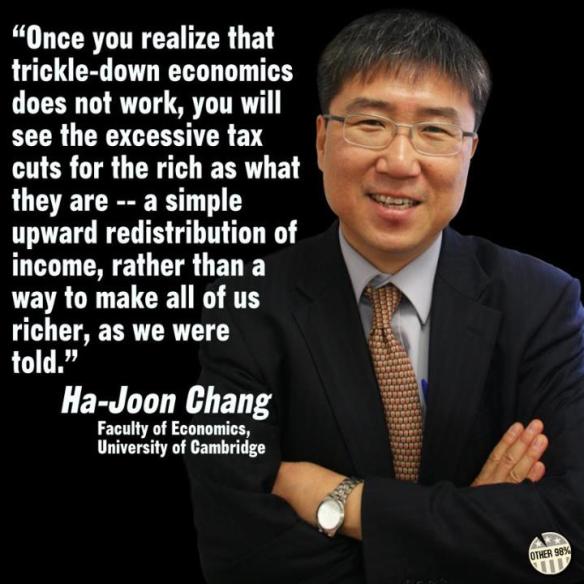
trickle down economics

But back to the point of this piece. The other thing that brought home to be the realities of inequality this week was some reading I was doing in relation to ‘Formulation’- a psychological term describing the process by which we come to an understanding of the nature, cause, story and meaning of mental distress. Part of this meant reading this guide, and in particular this section;

There is a careful balance to be struck between acknowledging the very real limitations and pressures that people face, while not diminishing their sense of hope or agency… The community/social inequalities/human rights perspective is often poorly integrated into practice. Recent research underlines the importance of this dimension.

Wilkinson and Pickett (2009) have presented compelling evidence that a society’s level of social inequality is causally related to its rates of mental illness: ‘If Britain became as equal as the four most equal societies (Japan, Norway, Sweden and Finland), mental illness might be more than halved’ (p.261). Particularly relevant to formulation is their suggestion that inequality has its most damaging impact at least partially through its personal meaning to the individual, in terms of feeling devalued, shamed, trapped and excluded. This underlines the importance of being aware of the wider contexts of formulations and clinical work. In the words of a World Health Organisation report on mental health: ‘…levels of mental distress among communities need to be understood less in terms of individual pathology and more as a response to relative deprivation and social injustice’ (WHO, 2009, p.111).

That sentence concerning how inequality results in people being ‘devalued, shamed, trapped and excluded’ should not be read as something just aimed at the super poor, but rather something that applies equally to us all.

Although perhaps some are more equal than others.

Belated Easter thoughts on atonement…

IMGP8918.JPG

I hope you all had a lovely Easter…

For us, this Easter has been one of great contrasts. We had a trip down to Nottinghamshire to attend the wedding of my lovely niece to a young bloke that I have become increasingly fond of. It was a lovely day; the ceremony was led by another friend at the church I attended as a child.

The contrast was that while all this was going on, my wife has been trying to come to terms with the death of her father, who passed away on Wednesday.

All of this obscured the feast of Easter. As someone who continues to make my spiritual journey primarily through the words and teaching of Jesus, I wanted to take some time out to reflect again on what this season might mean, in the close presence of both joy and deep loss. My rather obvious initial thought was that Easter contains both the reality of death and the hope that love can transcend even this.

As always at Easter however, I also find myself thinking about this word ‘atonement’. Those of you who are not of a religious bent may have heard of the word, but perhaps will not know that it has long been a theological football. For much of the modern era, within protestant circles at least, a very narrow, legalistic view predominated; Jesus died on a cross in order to pay the price of our sin. God the father required a sacrifice, in the form of the punishment of his son, in order to atone for those who are prepared to believe. I have made no secret of my own frustration at the limitations of this version, known as ‘substitutionary atonement’.

Back in February, Michaela forwarded me a Richard Rohr meditation that she had signed up to receive daily. He says it a lot better than I could, so here it is.

IMGP8920.JPG

Franciscans never believed that “blood atonement” was required for God to love us. Our teacher, John Duns Scotus (1266-1308), said Christ was Plan A from the very beginning (Colossians 1:15-20, Ephesians 1:3-14). Christ wasn’t a mere Plan B after the first humans sinned, which is the way most people seem to understand the significance of the death and resurrection of Jesus. The Great Mystery of Incarnation could not be a mere mop-up exercise, a problem solving technique, or dependent on human beings messing up.

Scotus taught that the Enfleshment of God had to proceed from God’s perfect love and God’s perfect and absolute freedom (John 1:1-18), rather than from any mistake of ours. Did God intend no meaning or purpose for creation during the first 14.8 billion years? Was it all just empty, waiting for sinful humans to set the only real drama into motion? Did the sun, moon, and galaxies have no divine significance? The fish, the birds, the animals were just waiting for humans to appear? Was there no Divine Blueprint (“Logos”) from the beginning? Surely this is the extreme hubris and anthropomorphism of the human species!

The substitutionary atonement “theory” (and that’s all it is) seems to imply that the Eternal Christ’s epiphany in Jesus is a mere afterthought when the first plan did not work out. I know there are many temple metaphors of atonement, satisfaction, ransom, “paying the price,” and “opening the gates”; but do know they are just that–metaphors of transformation and transitioning. Too many Christians understood these in a transactional way instead of a transformational way.

How and why would God need a “blood sacrifice” before God could love what God had created? Is God that needy, unfree, unloving, rule-bound, and unable to forgive? Once you say it, you see it creates a nonsensical theological notion that is very hard to defend. Many rightly or wrongly wondered, “What will God ask of me if God demands violent blood sacrifice from his only Son?” Particularly if they had a rageaholic or abusive parent, they were already programmed to believe in punishment as the shape of the universe. A violent theory of redemption legitimated punitive and violent problem solving all the way down–from papacy to parenting. There eventually emerged a disconnect between the founding story of necessary punishment and Jesus’ message. If God uses and needs violence to attain God’s purposes, maybe Jesus did not really mean what he said in the Sermon on the Mount (Matthew 5), and violent means are really good and necessary. Thus our history.

In Franciscan parlance, Jesus did not come to change the mind of God about humanity; Jesus came to change the mind of humanity about God. This grounds Christianity in pure love and perfect freedom from the very beginning. It creates a very coherent and utterly positive spirituality, which draws people toward lives of inner depth, prayer, reconciliation, healing, and even universal “at-one-ment,” instead of mere sacrificial atonement. Nothing changed on Calvary, but everything was revealed as God’s suffering love–so that we could change! (Please read that again.)

Jesus was precisely the “once and for all” (Hebrews 7:27) sacrifice given to reveal the lie and absurdity of the very notion and necessity of “sacrificial” religion itself. Heroic sacrifices to earn God’s love are over! That’s much of the point of Hebrews 10 if you are willing to read it with new eyes. But we perpetuated such regressive and sacrificial patterns by making God the Father into the Chief Sacrificer, and Jesus into the necessary victim. Is that the only reason to love Jesus?

This perspective allowed us to ignore Jesus’ lifestyle and preaching, because all we really needed Jesus for was the last three days or three hours of his life. This is no exaggeration. The irony is that Jesus undoes, undercuts, and defeats the sacrificial game. Stop counting, measuring, deserving, judging, and punishing, which many Christians are very well trained in–because they believe that was the way God operated too. This is no small thing. It makes the abundant world of grace largely inaccessible–which is, of course, the whole point.
It is and has always been about love from the very beginning.


Novel, excerpt 3…

2AE025B200000578-3177981-This_Topshop_dummy_that_started_the_furore_When_we_measured_a_si-a-28_1438126580996

By any measurement, Helen was a beautiful woman.


She had the sort of frame that never crumpled clothes- all willowy and slender like the girl she had never quite stopped being, despite the beckoning of middle age. Her light brown hair was shoulder length and perfectly behaved, swaying around an oval, symmetrical face. Her eyes were a startling shade of green and her skin smooth-brown and lightly freckled like a perfect beach pebble.


Hers was an effortless beauty, undefeatable by fashion mistakes or bad hair days. It was built around a kind of elfin simplicity that could render her enticingly vulnerable in jeans and old sweaters yet was also stunningly sophisticated in a silk dress. She even woke unruffled like some character from a toothpaste commercial,


Men stared, following the arc of her limbs in the corner of their eyes, thrilling to the inching up of the hem of her skirt or the brushing back of wind-wisped hair behind a perfectly formed ear- and Helen hated it. She loathed the way they flattered her and competed for her attention. She hated it too when despite her best efforts they turned to jelly as if she was some kind of Kryptonite to their not-so-Super man.


Women, however, tended watch in envy- in the same way that they might stare at glossy magazine pictures of models wearing clothes they could never afford. Some wanted to be near her, as if to bask in her reflected beauty, whilst all the time probing for cracks in the lovely façade through which they could find her gloriously wanting.


Helen had discovered early in life that hers was a kind of beauty that did not seem to draw people in- rather it had an exclusive quality like an invisible force-field. People would stare at her, then step back deferentially. This had become the unconscious defining characteristic of Helen’s relating and communing with others; she lived at the centre of a curated space, like a roped-off podium in an art gallery, a rare and expensive exhibit that should be appreciated only from hushed distance. Helen herself was insightful enough to be aware of the phenomenon, but not to understand the cause of it. In most social situations she found it impossible to fully close the gap.


As a surprising late and only child, she had never needed to compete for attention, it was given to her as if by divine right. Neither did she have to work hard to please her care givers as they seemed satisfied just to polish her exterior, to dress her, display her and reverence her.


This might suggest the ideal circumstance for creation of a self-centred spoiled child, but Helen had never really become selfish. She loved her doting parents and wanted to make them happy so she attended the ballet classes and competed in the gymkhanas. She learned to play piano competently and to provide entertainment at her parents’ dinner parties. It had been easy and undemanding to fulfil her mother’s mostly benign longings for genteel accomplishment and ornament her father’s advancing years with soft, if tedious, Sunday afternoons of companionship.


Despite growing up in this comfortable suburban idyll, Helen was always aware that something was missing, although she was never quite sure what it was. She felt it like a kind of emptiness – like finest food never tasted, or some vital person she had yet to meet. Like the violet edge of a rainbow it fringed everything she did. It was most noticeable in her unconscious yearning for more, despite guilty conviction that she already had far too much.


Over time she learnt to suppress this longing; to dismiss it as middle class cliché and the faux-ennui of privilege, but it was rather like the ache of sensitive teeth that could be triggered anew by small changes in the weather. It could often surprise her.


Helen knew that being the object of adoration also brought also great responsibility. She was the source of some kind of divine blessing on this kind and generous couple into whose life she had been inserted unexpectedly. She learnt her part well, but still the distance was there – that roped-off and poorly understood space across which she watched the others watching her.

Palm Sunday, the first day of Spring…

blossom

Sun lights upon shy green things

And we cheer

For all these things are new again


But darkness is not banished

There it remains, cloaked up in the crowd

Waiting to strike down hope


Like the late frost

Lay down your coats

For the world is warming


Wave branches cut from

Contour planted conifers

Hashtag hosanna to all those


Holy celebrities

Let blossom bloom before it falls

For they crucify tomorrow.

The middle of Lent…

IMG_20160219_155940429

We are still in the middle of season of Lent. For those of us who still seek to travel within the ancient and generous Christian traditions, Lent is all about appreciation of journey, particularly through wilderness, through temptation and through encounter with our own weaknesses.

In the depths of this encounter, Easter is so far away as to be almost irrelevant. There are no miracles here, just grit in the shoe and hard miles to travel.

This year, I decided to do without sugar- as far as this is possible in a culture that even puts sugar in baked beans. In practice it has meant avoiding anything sweet, any fizzy drinks or chocolate. It has mostly not been a difficult thing to do and has clear health benefits. It is a small thing to signify sacrifice.

But the middle of the Lenten wilderness has little to do with food choices- this I feel keenly at present. I do not long for oasis, I long to live without the need of oasis. To live not longing for weekends and expensive holidays, but rather to simply walk in the way that I am made to be. To stop searching the horizon for something to aim at, to look forward to. To stop sugar coating life and just to live for something wholesome and true.

Perhaps you understand this- your walk is also hard, maybe an awful lot harder than mine.

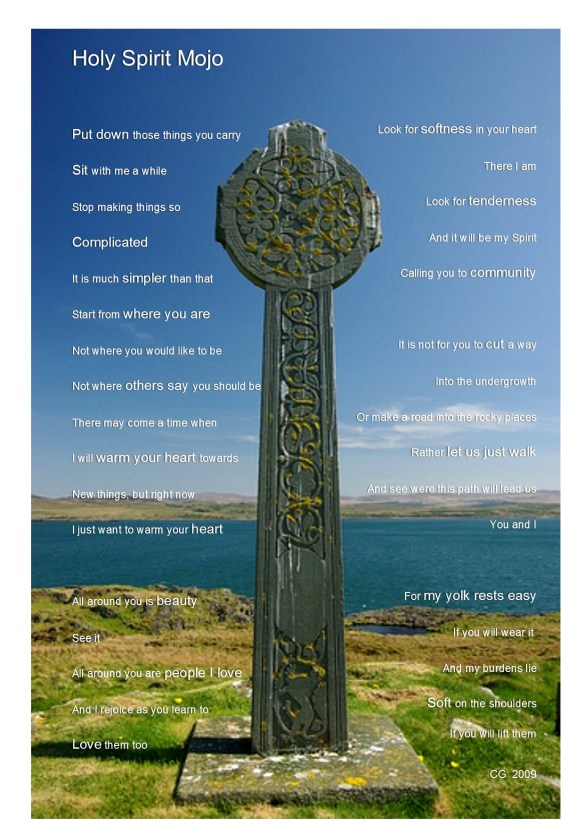
In the middle of our Life-Lent, I offer you a poem/prayer I wrote a few years ago. I dared to imagine God speaking to me, sharing a moment with one of his more troubled and wayward sons.


Holy Spirit mojo


Put down those things you carry

Sit with me a while

Stop making things so complicated

It is much simpler than that


Start from where you are

Not where you would like to be

Not where others say you should be

There may come a time when

I will warm your heart towards new things

But right now

I just want to warm your heart


All around you is beauty

See it

All around you are people I love

And I rejoice as you learn to love them too

Look for softness in your heart

There I am

Look for tenderness

And it will be my Spirit

Calling you to community


It is not for you to cut a way into the undergrowth

Or make a road into the rocky places

Rather let us just walk

And see were this path will lead us

You and I


For my yolk rests easy

If you will wear it


And my burdens lie soft on the shoulders

If you will lift them


Off-grid spoon whittler…

I was watching this advert the other day…


It made me think…

An off-grid spoon whittler.

Sounds good to me. Why would I want to be on grid when I can sit in a wood whittling spoons?

I was pretty sure that the slightly maniacal look rocked by the woman in the clip above was far less likely whilst carving spoons than it might be sitting in front of a bloody screen.

So I sliced a branch from the yew tree in our garden and set to with the knife Emily bought me for Christmas, an axe and a hook knife I bought from e bay.

Several blisters later, I made this.

I am proud of my spoon, so I went on-grid to display it to the world. Now back to the woods…

IMGP8914IMGP8915

Novel, excerpt 2…

It has been a tough week- there are lots of conflict and tensions in my day job at the moment. Part of this is to do with change, and the instability and stress it introduces into the lives of groups of people involved (myself included, despite being the instigator of this change.) Some of is has been about long established tribalism that can sometimes dominate health systems; one group of staff takes a negative view of another group and this is refreshed and reinforced by selective critical observation to the point where it becomes self perpetuating.

There has been another tension too, which is never far away in mental health circles, to do with how we understand the nature of the very thing we are trying to assist people with and how this understanding should shape the methods and practices that we employ. Tribalism is part of this understanding as well- traditionally perspectives are divided along two main lines; those who favour a biological deterministic model, and those who favour a social/psychological model. The reality of course, as outlined in my previous post, is that BOTH have to be part of our thinking, but more recently we have arguably been dominated by the former (biological) model. The whole point of establishing multi-disciplinary teams was to ensure that the different perspectives brought by different training, professional backgrounds and training might be able to work together. Let us not pretend this is always easy however.

Anyway, at the end of a long hard week wading through this kind of thing, I am left, beached like a whale on the soft shores of the weekend, waking early with it all in my head. And as with many similar challenges, I feel the need to write, to connect the whirling internal thoughts to some words. To allow them to shape me as I shape them. To be deliberate and as honest as I can about the emotion, the hopes and failings, the tiredness and the determination to keep on, keep on.

So may your weekend be full of good things. Here is a little more of the novel- the prologue…Winter sunset, the Clyde

Prologue


Night fell like revelation. He sucked at it like a brown bottle in a paper bag.

Each emerging star was speaking. Quite what language they were using was less clear however.

But it was all so beautiful.

So beautiful that it slowly lifted him from the grassy knoll he was perched upon and floated him upwards, out into the indigo air, laced as it was with slow tendrils of wood smoke from down below.  The last cry of an oystercatcher echoed out over the estuary far below him as it combed out the town beyond into long lines of light.

He blinked back an unforced tear as he drank in the fast-disappearing day slipping below the distant mountains. A whole vault of holy sky opened wide above him, shaming the Sistine ceiling for gaudy imitation.

Transcendence, they what they call this the man whispered as he reached down to take hold of a can of strong lager.

I am bloody Shamen minus the bloody happy-chants.

Who needs all that religious shite? Just give me a Scottish loch at dusk and a six cans of export…

He cackled, then caught himself short.

It occurred to him anew that there are some people whom, despite all sorts of provocation and excuse just never got to go crazy.

They would never feel the glorious loosening of the suffocating blanket of convention and social obligation.

They never know what it is like to simply let go.

What terrible lives they must lead.

He cackled again, then made a spontaneous noise that sounded like the barking of a dog.

Madness is marvellous.