Recycle through freecycle!

United Kingdom (UK) Freecycle Groups’ Homepage

I thought I would give a plug to this website…

Freecycle is a UK based network though which you can give stuff away.

It is that simple!

We all have stuff lying around the house that we no longer need or use- cameras, books, bikes, toys etc. A lot of it is destined to end up at the tip. Freecycle enables you to offer it out ot other local people who might be able to use it. If you need something specific, you can put this up as a request.

Over the past few weeks and months we have used it a lot.

We have given away a paddling pool, an old tumble drier and some other odds and ends

We have inherited an old Bell and Howell slide projector to use for worship instalations.

Friends have given away old kitchen units, computers rugs- you name it.

Give it a try!

Blogged with the Flock Browser

This is cool- Kiva microfinance website

Check this out.

It is a site that allows you to make small loans directly to small businesses in parts of the world where, credit crunch or not, people would not get the money elsewhere.

My friend Pauline suggested that our group get involved.

This is a message that I was asked to send on to others- I would not send this via e-mail, but will post it here

Hi!

I just made a loan to someone in the developing world using a revolutionary new website called Kiva (www.kiva.org).

You can go to Kiva’s website and lend to someone in the developing world who needs a loan for their business – like raising goats, selling vegetables at market or making bricks. Each loan has a picture of the entrepreneur, a description of their business and how they plan to use the loan so you know exactly how your money is being spent – and you get updates letting you know how the entrepreneur is going.

The best part is, when the entrepreneur pays back their loan you get your money back – and Kiva’s loans are managed by microfinance institutions on the ground who have a lot of experience doing this, so you can trust that your money is being handled responsibly.

I just made a loan to an entrepreneur named Leonia Benitez in Dominican Republic. They still need another $400.00 to complete their loan request of $3,150.00 (you can loan as little as $25.00!). Help me get this entrepreneur off the ground by clicking on the link below to make a loan to Leonia Benitez too:

http://www.kiva.org/app.php?page=businesses&action=about&id=66911

It’s finally easy to actually do something about poverty – using Kiva I know exactly who my money is loaned to and what they’re using it for. And most of all, I know that I’m helping them build a
sustainable business that will provide income to feed, clothe, house and educate their family long after my loan is paid back.

Join me in changing the world – one loan at a time.

Thanks!

What others are saying about www.Kiva.org:

‘Revolutionising how donors and lenders in the US are connecting with small entrepreneurs in developing countries.’
— BBC

‘If you’ve got 25 bucks, a PC and a PayPal account, you’ve now got the wherewithal to be an international financier.’
— CNN Money

‘Smaller investors can make loans of as little as $25 to specific individual entrepreneurs through a service launched last fall by Kiva.org.’
— The Wall Street Journal

‘An inexpensive feel-good investment opportunity…All loaned funds go directly to the applicants, and most loans are repaid in full.’
— Entrepreneur Magazine

Blogged with the Flock Browser

Leadership in the new context, lessons for post-charismatics…

There are many questions to be asked in the wake of the so called  ‘Lakeland outpouring’. I asked some of them here but I came across the post below on the ‘subversive influence’ blog. Check it out…

Reinterpreting the Lakeland Fallout : Subversive Influence

Because, I very much agree- the issue is not really about Todd Bentley- but it is about leadership. It is about the power and control we give to (or is taken by) Christian leaders- who are seemingly unassailable because they are seen as anointed from on high, and are perhaps supported by the machinery of a spiritual institution that is all powerful, at least to it’s members.

For people like me, who no longer feel inclined to ally myself closely with movements like these, it might be easy to step back into our small groupings and feel all superior. After all, we knew this was going to happen didn’t we?

But we are at a turning point in the history of the Christian Church in the west, at least. The old is shrinking, and the new is… well where exactly?

Is the church emerging? Is something new being built that will become the proclaimers of the Kingdom of God in this new context?

I hope so, but we have a long way to go yet- and it seems to me that like any other human organisation, our new church will experience conflict, broken relationships and lack of clear direction…

Jesus Promised us the Holy Spirit, as comforter and guide. But it seems that he has also always used LEADERS… and  we who have been part of whatever the ’emerging church conversation’ is now going to call itself desperately need leaders.

Brother Maynard said this;

My informal appeal to post-charismatic and missional bloggers for the month of September might be to spend some time thinking and writing on the forms of leadership (apostolic or otherwise) which we need to see in the church today. What characterizes this form of leadership? How do we recognize leaders, and how is their authority derived and exercised?

Well I am a month late- it is now October, but I will belatedly attempt to take up the challenge!

Leaders.

They have to be big strong accomplished and invulnerable don’t they? They have to charismatic and Charismatic, attractive and attractional, visionary and focussed. Leaders are focussed on goals and strategic targets- and the organisation of resources (money and people) towards the achievement of these.

Except I think that this kind of leadership no longer works. It is no longer works for me. It makes me want to walk in another direction. My context is Post-Christian semi-rural Scotland, and our attempts to engage with our neighbours in a place where church has a poor reputation, and for most, little relevance.

Before I go on, I had better describe something of where I live, work and worship…

I live in a small town, but I am still connected to friends who live in urban situations. I am used to management in my working life (which always seems to me to be a very different thing from leadership) and now find myself within a small community with no designated ‘leader’, with all the strengths and weaknesses that this leaves us with.

We are small. We seek to be partners with others, not competitors. Our ambitions are shaped by bringing our limitations and strengths together, offering them to God and asking him to use them. So for us, leadership remains very much like facilitation- taking a loose agenda and encouraging one another to take some risks. The true leaders are those who are prepared to take a slightly larger risk, whilst always seeking to put the love for others before the task at hand…

Tensions are manageable, but painful. People’s commitment to the group is based on relationship, so the very existence of our project demands that we look after one another.

For us, this sort of works- most of the time. I suppose it kind of fits our characters, the context that we have grown out of, and the time and energy our group members have to spare. There is a kind of core group, but a lot of others who are less involved, and might or might not see themselves as ‘members’, but still contribute to and benefit from some of the things we do.

But this kind of absence-of-leadership does not resolve all of the issues. I decided to make a list of leadership issues that apply in my own context. Forgive me if some of these are obvious- but I think that they need to be re-stated.

  1. As things get bigger, they become more complex. Does this mean that things must always be more centalised? Does the imagery of industrial or military command structures really ever fit a church context, or should leadership be best understood as a supportive network– where the comparisons are better made with web-based networking or discussion sites like Facebook or Wikiedia? Here, the issue is not control- although subscribers might have to agree to a degree of regulation. Rather it is a network based on trust and mutual commitment. LEADERSHIP in such a network seems to require a whole different set of skills- the maintenance of good communication, facilitation, ‘framing’ discussions and issues to allow others to engage and respond, providing opportunities for engagement- but not removing responsibility or using power.
  2. But power always remains an issue? There will always be power differentials. Some will always have more to say, more influence and more abilities etc. Does there need to be a way of balancing this- sharing it out? Whilst democracy might not be the aim, methods of engaging and making sure that the voices of the marginalised are moved to the centre also require leadership.
  3. We all need people to look up to. This may not always be healthy, as unrealistic expectations on both sides can emerge- but it seems to me that this network will form around people who others look to with respect. They in turn will look to others who they respect. The danger is that this system throws up more hierarchies- more Todd Bentley’s. We need to have a way of celebrating gifted individuals, whilst making sure that their giftings are not overvalued.
  4. We all need a hand on our shoulder sometimes. Finding sypathetic and understanding mentors in this network can be hard. Without mentoring, how do people grow into the new spaces that church is moving into? How are they held accountable? How is gifting recognised and encouraged?
  5. We all need to see the bigger picture. Housegroups are great, but most of us also love to meet in a larger group- to make some more noise at times, and feel part of something bigger. Internet connections are no substitute for human ones. To bring people together requires organisation. Organisations need to be led.
  6. Women, minority groups etc. can no longer be excluded, and must be encouraged. For too long, the white, male, middle class church professional has been centre stage. It’s time to share.
  7. Authority, orthodoxy and mission statements- these are corporate words, not Kingdom ones. In a network, these will still be important- but should be decentralised. People should be encouraged to work out their own understandings, within practice, not within the academy, or even the blogosphere! There might be some room for ‘big theology‘- but it should be general, and generous. The emphasis should be on ‘small theology’ (Karen Ward’s words not mine) worked out in community. Lets agree that we will disagree on much, but share most. There will always be a difference between broad PRINCIPLES and POWER STATEMENTS that rely on expert interpretations.
  8. Leadership should be judged by servanthood, not by status. Easily said, I know. But there are some things that can be done to encourage this- make some leadership positions time limited perhaps.
  9. People are always more important than projects. That is not to say that we should avoid doing stuff if it upsets people- but that we should get that 1 Corinthians 13 stuff out as a set of goggles through which we examine our programmes, lest they become resounding gongs.
  10. The roles of apostles ( and the other 5-fold ministries)? How does someone come to be called an apostle? I think that this is not a title, but a role performed by a very few- whose influence is recognised over a long period of time. These people have great responsibility, but will always be fallible and human. Let us never pretend they are super-Christians- in fact some of them will be super-human (in the sense of being all the more connected with their humanity). As for the other ministries- i wonder whether we should keep the focus LOCAL, and measure it in COMMUNITY…

I think that is enough for now…

Check out also this really interesting series by futurist guy that begins here

Blogged with the Flock Browser

Emerging church- a review from the blogosphere…

Well, it had to happen.

The emerging church is no longer ‘the new thing’. In fact it might well now be the old thing.

Does that mean that we have now emerged, and so do not need the label or the ‘conversation’ any more?

Here are some links to blogs that wrestle with this issue- if you are interested in this issue, then these guys are well worth reading;

Jason Clark blogging at deep church

tallskinnykiwi

Scott McKnight

I have posted two earlier discussions in this vein too- here and here

So what do you think? Has the term become a liability- something to be defended, but useless as point of definition?

If so, why do I feel a sense of loss?

I think, for me, it has been a useful portal to a whole set of thoughts, challenges and concepts that have turned me upside down, but have been a real blessing in my life, and in people all around me.

It has also been a way that our small and isolated group could reach out to people in the wider world,and find support and common understanding. Does our planned but as yet unrealised) ‘Emerging Scotland Network’ (see here) need a new name even before it begins?

And if the label is dead- what next? The emerged church? The missional church? The new monastics of Dunoon/Watford/Wherever?

I suppose in others, I still wonder if this is a movement towards something, or away from something else? And whilst the journey may be life long, then there are still fellow travelers, and way side inns- otherwise who will survive the journey?

In my self, I just kind of feel that I have lost a lifeboat, and it’s back to swimming again.

So I will use the term for a little longer… how about you?

Scottish ‘Greenbelt’ festival?

Gayle Findlay (Check out Gail and Stephen’s site here) asked us to give this a push.

Gayle has been involved in the worship events @ Greenbelt festival and this year there was some discussion concerning whether there was enough interest to set up a Scottish festival.

Here is the info-

Greenbelt Scotland
You might have missed the informal session at the Festival but we’re investigating the possibility of a Scottish version of Greenbelt. Many Scots don’t come to the Festival because there is no August Bank Holiday and they don’t want to take their children out of school. There are no definite plans, but there was enough enthusiasm from the session to want to take a further look with anyone who might be interested in getting involved in supporting, planning, volunteering or even just attending a Greenbelt Scotland*.  You don’t need to be Scottish — some at the initial meeting came from the north of England, it might also appeal to the Irish to come across the water. If you are interested and would like to be kept informed of any plans, send an email to
greenbeltscotland@greenbelt.org.uk
So that we can keep in touch. Another meeting is planned in the Autumn somewhere in middle Scotland–we’ll keep you posted.

Watch this space!

Greenbelt 08- a Goan review…

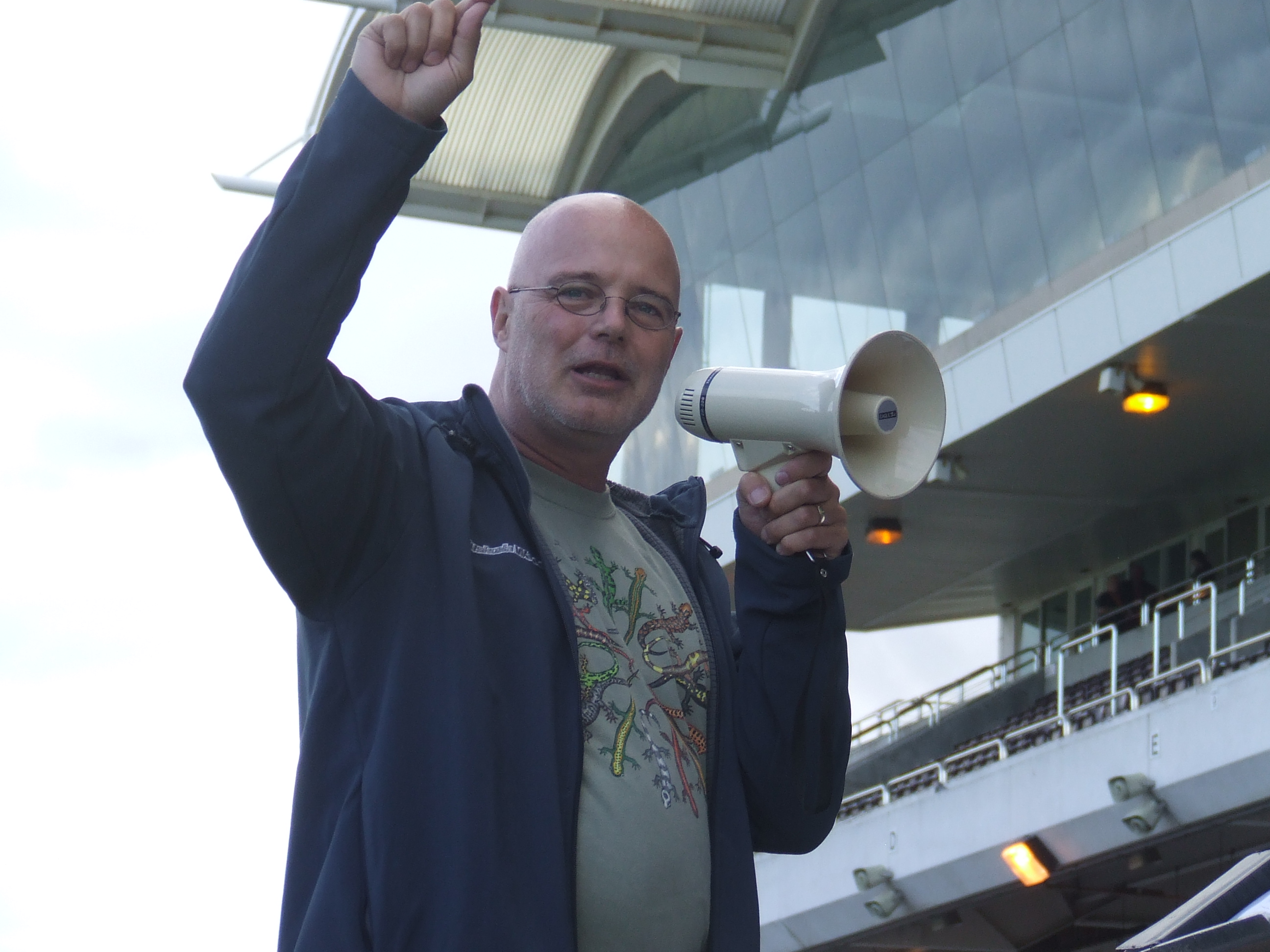
Brian McLaren makes do with a bullhorn after power failure...

Brian McLaren makes do with a bullhorn after power failure...

We are back.

Greenbelt 2008 was great- it was Michaela and the kids’ first time, and I think it was a bit of a culture shock for M at least. Will took it all in his stride, nintendo in pocket for the boring bits, and we only saw Emily every now and again- she had a ball.

M struggled with the crowds, the thousands of tents with guy ropes akimbo, and, of course, the questionable hygiene arrangements. But we all had highlights that we brought away as memories.

For Michaela, I think it was the communion service, visiting a spiritual director, and some of the talks.

For Emily, it was meeting new friends, a hard core screemy-teeny band called Fightstar and having the freedom to be herself in a large setting.

For William, who knows? Bless him, he is so easy with life. He seemed to really enjoy some of the ‘Children’s Greenbelt’ activities- particularly the chance to hold a snake, and to sing some songs. He badly needed some partners in crime- but seemed quite happy to hang out with the adults.

For me- a mixed bag really.

I loved Seth Lakeman’s set on Saturday evening- he made me proud- not sure what of exactly- perhaps that English-ness thing again.

I really enjoyed Brian McLaren, but more in agreement than revelation.

I also enjoyed hearing Philip Yancey- he is a really good speaker, and it was good to put a voice to the books. His combination with the Saltmine theatre company made me cry several times (in a good way!)

I somehow missed loads of stuff I wanted to see- partly because of family things that mean that time is shared in different ways, and partly because you just get overloaded at festivals like GB, and the effect this has on me is to make me wander aimlessly, sticking my head through tent doors and then moving on…

I missed out on a planned beer with Simon Smith because he was mad-busy doing some very impressive art stuff, and likewise Gail Findlay and Stephen Tunnicliffe, who were engaged on other Greenbelt business. I did manage to spend some time with old friends Mark and Denise from the Rhondda Valley, along with John, who is always great company. It was really good to see them again.

Along with fellow Dunoonite and Aoradh member Alistair (who had been volunteering the week before constructing various weird arty things) we performed a short version of 40 at the Proost lounge event on Saturday evening. Not sure how it went down, but it seemed to hold peoples attention, and feedback was good. Mark did us proud by reading the part of Jesus in a lovely rich Welsh accent (He asked if we wanted him to perform as Richard Burton or Uncle Bryn… I think he opted for the former in the end!)

The Proost lounge thing clashed with a discussion about whether there should be a Scottish Greenbelt (Scot belt? Tartan belt? Thistle Belt? You decide!) This was led by Doug Gay, and seems an interesting proposition. Huge amounts of work though- step forward the masochists!

Anyway- attached are a few more photies…

Emerging church- a useful label?

In our small group in Dunoon, Scotland, we have only fairly recently started using the term ’emerging church’ in a way that is not wrigglingly self conscious.

This was in part because although our group has many of the characteristics of what the EC supposedly represents, we have never agreed that this is the label or yardstick that we would use. It is only as other Christians have attacked us for being ’emerging’ that some of us have had a look at this label again, and thought- yes, that kind of fits.

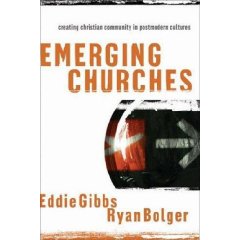
But it is not as if the label is well defined anyway. The 2006 Gibbs and Bolger book ‘Emerging Churches took a well researched swing at this, and I found it really helpful- but to be honest, I also had this feeling that if you look at a diverse movement of Christian activists and malcontents, and search for common strands- you then become responsible for creating a movement as much as defining one.

I wonder if there is also a kind of intellectual snobbery about not wanting to be defined. Many of us have escaped from solidity and predictability in the way we practice our collective faith, and the last thing we want to rush towards is another denomination.

Perhaps others felt the same way- the Methodists, or the Anabaptists- do you think in the beginning, with all the excitement and promise of something new, that they enjoyed the fluidity and freedom of lack of form and structure- and they enjoyed the lack of definition too?

I see that Andrew Jones, AKA http://tallskinnykiwi.typepad.com has started a survey asking whether we should ditch the label altogether. He is suggesting ‘Emerging missional church’ as a possible alternative- although this seems likely to raise lots of issues too. Andrew does a great job of putting some structure to these concepts here though. I am looking forward to hearing him speaking at Greenbelt festival in a couple of weeks…

Other so called EC leaders have already dropped the label too, like Rob Bell. Brian McLaren also appears to wish there was a better term. Someone put together some clips on youtube that gathered some of these thoughts.

This clip hints at some of the battle lines that are revealed when the EC label is invoked. I suspect that some of this heat alone might make leaders under fire want to find a better label.

I suppose ultimately, we will no longer be emerging- but emerged. And then we will submerge, to be replaced by another generation who emerge all over again. And God bless them as they challenge all of our cherished and no doubt concreted and inflexible doctrines and practices!

But as for me, I am not ready to get rid of the label yet. Apart from anything else- it gives us somewhere to navigate from.

And it might help us find fellow travelers of like hearts and minds to support and encourage, because Lord knows, we certainly need this.

Here in Scotland, some of us are in the early stages of trying to network more effectively- if you want to know more about this, then check out this earlier post

Scottish emerging church network?

Last weekend I was in Glasgow, where Michaela and I met up with Thomas, Iain and Stewart in Starbucks. This was our first ‘meeting’ growing out of a facebook group we set up called EMERGING SCOTLAND. I suppose we began to dream of new things, and new possibilities…

A few others had tried to get along, but life got in the way- you were missed, but there will be other times!

Those of us that were there had this common idea that those of us engaged in fragile new ‘church’ stuff need to find common support and encouragement, and we need to get smarter in the way that we do this! Because no-one else seems to be doing it that we can find, we thought we would have a go.

As a way of gathering other thoughts and feelings- here are some questions that we would love comment on.

If you have friends and contacts who are not facebookers, and you want to circulate the questions for a wider discussion, or even other networks you can tap into, then feel free to get the word out there…

Here goes…

1. Would you value/have time to participate in/be interested to know more about/ a more developed support network in Scotland?

2. If so, what would you need from such a thing in your context?

3. What might it look like?- Do we meet, do we offer to come and support one another in practical ways, or is the on-line stuff, with all its possibilities and limitations enough?

4. Can you/we cope with doctrinal variation? How much?

If you are interested in getting involved, and have thoughts as above- we would love to hear from you!