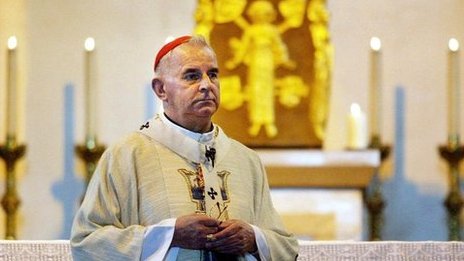
Cardinal O’Brian compares Gay Marriage to the laws on Slavery?

Did anyone hear this discussion on the radio this morning? Cardinal O’Brian, the head of the Roman Catholic Church in Scotland was being interviewed about same sex marriage and made some rather startling statements.

I found it really hard to follow some of his logic, even as someone who has been in and around churches all my life.This is what he was saying;

If we allowed gay marriage, it would amount to ‘shaming’ the country.

We would be taking standards that are ‘human rights’, from the UN declaration of human rights and turning them on their head.

We would be redefining marriage to something it is not, as marriage could only happen between a man and a woman.

He then compared gay marriage to what might happen if the government suddenly decided to legalise slavery. Thought this a ‘very very good example of what might happen in this country’.

Then he started to describe the ‘thin edge of the wedge’, referencing the Abortion Act in the 60’s.

I could start to tell you my position on this issue, along with whole pages full of justifications. I could get into the relationships between scripture and culture, and the authority of certain OT texts.

I could also discuss the position of love as opposed to legalism, and the fact that sexual ‘sin’ has taken far to central a part in our understanding as opposed to (for example) gluttony or usury.

I could also tell you how bored I am with the way church is ripping itself to pieces with this issue. How hard hearted and foolish we look from the outside. How different camps use this issue as a ‘totem’ of acceptability.

I could wonder aloud why we could not just agree to disagree and focus on finding a path of grace to walk on for our own lives.

And I could describe the feeling I have that this issue will look and sound very different in 30 years time, in the same way that remarriage after divorce and (dare I say it) slavery are viewed as theologically different now than how they have been previously.

I could also talk about how church leaders who seek to ‘defend’ the church, or take us back to some mythical state before ‘progress’ damaged and destroyed our Christian way of life are often talking utter nonsense. As if God is not big enough to stand up for himself.

But rather than all of this, I will just say that the Cardinal made an ass of himself.
Is God inspired by our politics?

Interesting article in the Guardian about a study led by Lee Ross of Stanford University in California into the interaction between faith and politics.

 …the Jesus of liberal Christians is very different from the one envisaged by conservatives. The researchers asked respondents to imagine what Jesus would have thought about contemporary issues such as taxation, immigration, same-sex marriage and abortion. Perhaps not surprisingly, Christian Republicans imagined a Jesus who tended to be against wealth redistribution, illegal immigrants, abortion and same-sex marriage; whereas the Jesus of Democrat-voting Christians would have had far more liberal opinions. The Bible may claim that God created man in his own image, but the study suggests man creates God in his own image.

If you are like me, you are right now deciding that those whose political views you do not share are the ones who have invented more of their Jesus than you have.

Because basically Jesus is like a really good version of me. Me on a good day.

 Preachers, politicians and co-believers tend to emphasise and de-emphasise different aspects of the Christian canon; so conservative Americans study the Old Testament with its homophobic rhetoric and eye-for-an-eye morality, whereas liberals look to the New Testament Jesus who was sympathetic to the poor and the meek.

Evangelical politics is not, of course, limited to the US. Many social conservatives in the UK align themselves with the Christian right, and MPs such as Nadine Dorries take inspiration from US campaigns against abortion or gay rights. But perhaps the most striking aspect of the study is that it turns on its head the claims by many religious politicians, such as Republican nomination candidates Rick Santorum (“I’m for income inequality”), Rick Perry (“Homosexuality is a sin”), or the UK’s Nadine Dorries (“My faith tells me who I am”), that their politics is inspired by their God. This study suggests instead that their God is inspired by their politics.

I suppose this was the risk God took in giving us all free will.

The foolishness, the folly of God.

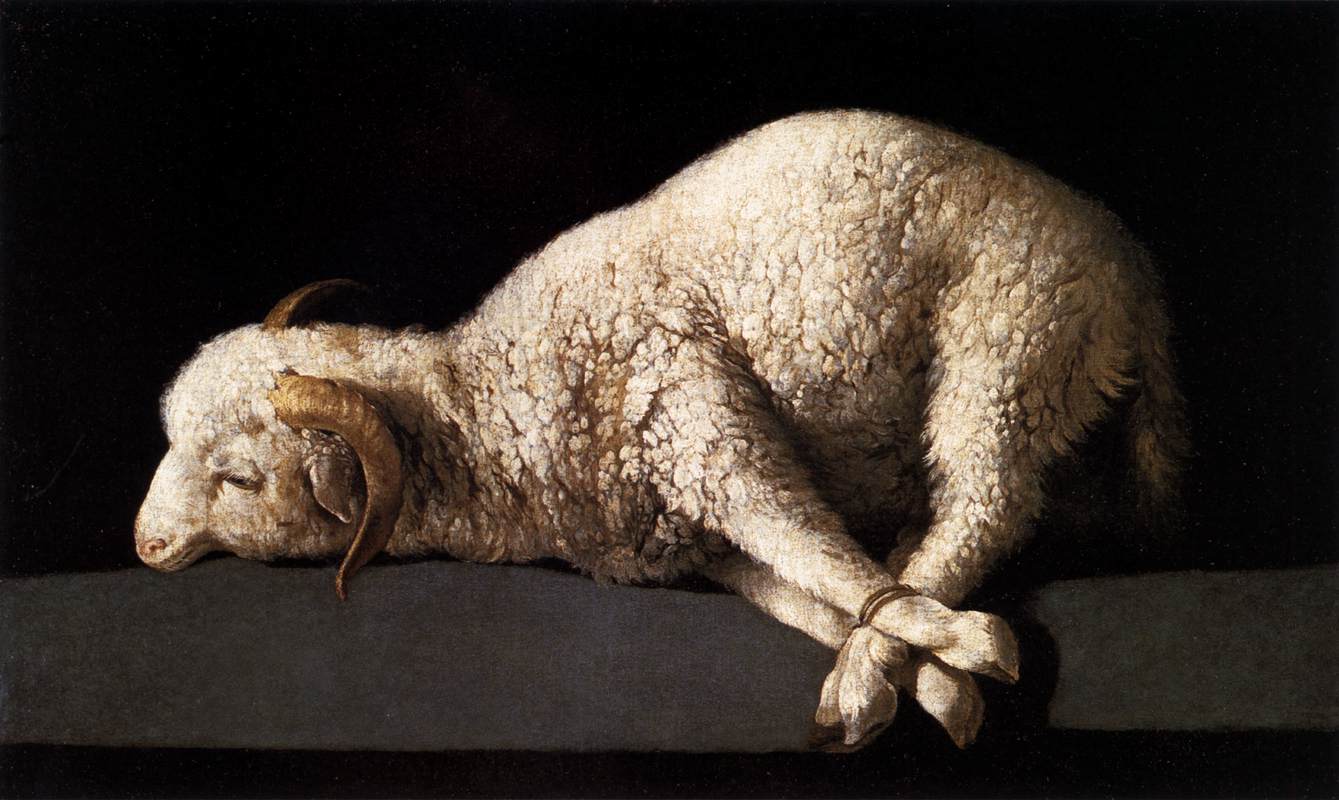
Who lies like a bound lamb on the altars we build.

Travelling well with the Jones’s…

Image

Many of you will already follow the on going adventures of the Jones family- Andrew (aka TSK) Jones blog is after all essential reading for many of us who are interested in what is happening on the edges of the known (and not yet known) Christian world.

A year or so ago, the family were living in Orkney off the northern coast of Scotland, when they bought an old truck, converted it into a living/entertaining space for themselves and all sorts of others. You can read something of their adventures travelling through Europe, Asia and North Africa here.

The point of all this travelling was to connect with all those small beautiful projects, and small and beautiful people who were working out the mission of Jesus in the lesser known places, and to support and encourage them.

It is an adventure that many of us feel a combination of envy, admiration and incredulity in relation to. It seems both bonkers and wonderful at the same time.

Anyway, the point of this post is to give a plug to Andrew’s new book project- you can pre-order it in order to support the next phase of the Jones journey, into Asia.

Details of the book, and how to order are all here.

We need people like the Jones clan to remind us that other ways are possible, and that other lives in far away places might teach us much about our own, so go on- order the book now!

Doubts and loves dig up the world…

A year ago I wrote a piece about doubting the existence of God. It received quite a bit of traffic for a while as it seemed to hit a chord.

Many of us who have been part of an overly concreted doctrinal system of belief have struggled to acknowledge doubt. It is almost as if any small incorrect belief would form a crack in the whole edifice of faith that might bring the whole thing tumbling down. To avoid this apocalyptic end to everything we have built our lives upon we contort ourselves into all sorts of defensive positions.

In my case, this involved two main strategies-

  1. Do not go there. When you feel the approach of doubt, turn in the other direction. It is better not to ask the difficult questions as the answers might be too much to cope with. Distract yourself with narrower, safer issues.
  2. Dishonesty. Better not to talk about doubt as this might infect others as well as yourself. You also might find yourself ostracised by the fervency and inflexibility of others.

Eventually of course something has to give or we become like stagnant pools, unable to flow, unable to sustain any kind of life. Faith fixed and defended becomes something else called religion. And religion belongs in the text book not in the soul.

I was reminded of this again after listening to this from Giles Fraser;

For my own experience of faith is that belief and unbelief commonly nestle alongside each other. Indeed, I cant make any sense of a faith that doesn’t include unbelief as a powerful element. “My God, why have you forsaken me” is, after all, the cry of Jesus at the very centre of the Christian drama.

As with much that is of the soul rather than the brain, faith and doubt finds voice in poetry. Giles quotes a poem he read that forms part of a memorial for Israeli prime minister Yitzhak Rabin, murdered by a religious man because he sought peace.

From the place where we are right
Flowers will never grow
In the spring.

The place where we are right
Is hard and trampled
Like a yard.

But doubts and loves
Dig up the world
Like a mole, a plow.
And a whisper will be heard in the place
Where the ruined
House once stood.

Yehuda Amichai

What do you want to be when you grow up?

Michaela reckons that when you are small this is what people ask. They do not ask what you want to do but rather what you want to be.

A subtle but important difference she felt.

Michaela wanted to be a nurse. Nothing really surprising there, it is a rather typical thing for girls to aspire to, or rather it used to be. Hopefully the options have broadened out these days. Certainly Michaela has no desire to be a nurse any more, although when you think about what nursing might have seemed all about to a small girl- the caring, the looking after, the seeking to heal and restore- these attributes are still part of who she is. You might even say that these were who she was always meant to be.

Can you remember what you wanted to be when you were small? Might it contain something significant about your way of being, if not your current way of doing?

I wanted to be in the Navy.

I wanted to sail to far away places and have adventures. I wanted to be in a fast ship along with lots of people doing similar things. I still get a little excited when sleek grey ships pass the house on the way out to who knows where. I want no part in war, but still I find myself proud and unable to turn away.

As I think about it now, I wonder about the longing in me for the far horizon. There is in still the need to form a band of adventurers and go to explore new places, new ideas, new ways of being.

That ‘being’ word again…

Or perhaps it was always just about the uniforms.

Knox casts a shadow…

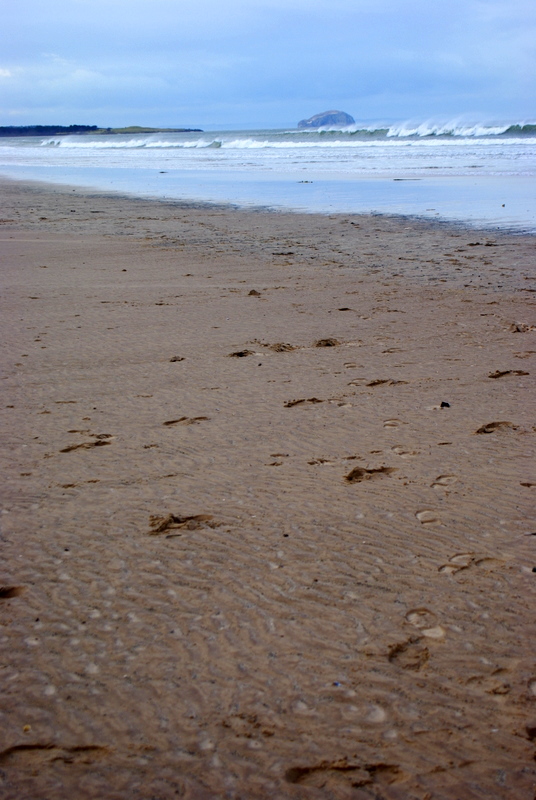
We spent today over in Haddington with my brother Steve and his wife Kate. It was a really lovely time, spent walking around the old market town and visiting one of the lovely beaches that are all over the coast thereabouts.

Haddington is a quiet market town these days, but this was not always the case. It was at one time the fourth biggest city in Scotland, after Aberdeen, Edinburgh and Roxburgh.

As we walked back to Steve and Kate’s house, I noticed a little set of stone stairs, all overgrown and boundaried by old railings. It seemed to lead up to a platform under an old tree. Further investigation revealed a stone monument…

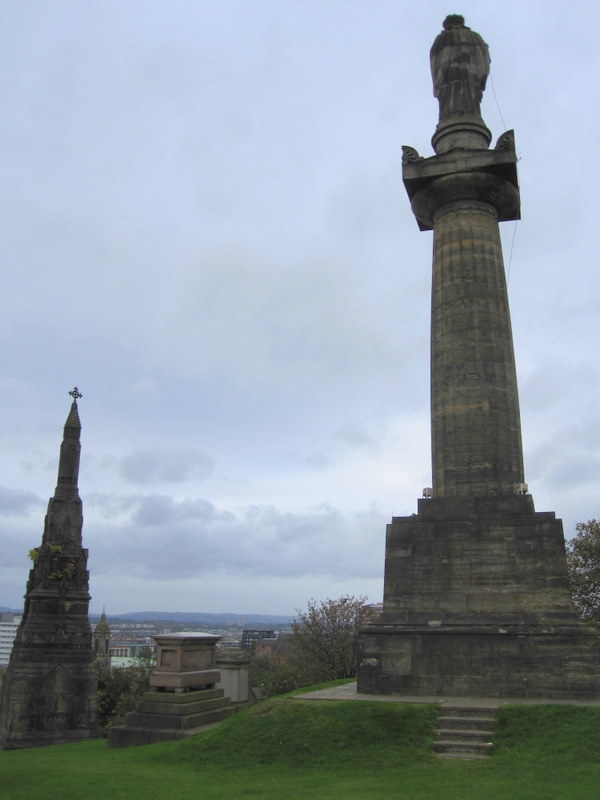
It was hard to read, but basically it commemorated the birthplace of John Knox, protestant reformer, scourge of the unrighteous, whose memory is marked by a far more visible column that towers over the city of Glasgow;


Knox lived a long and colourful life. His reforming zeal burst into a political/religious powder keg and led to armed revolution and murder. Ends justified the means. The Prince of Peace required the intervention of armed mobs.

And it all started in Haddington, when Knox was born a farmer’s son, and lost his mother early. Perhaps in a different place, with a happier childhood…

Today it all seemed to me to be sad, and a little absurd. I found myself asking again what good came out of all this religious warfare. Was any of it necessary? Is there anything that we can still be proud of with the benefit of hindsight?

Knox himself seems to scowl out at us from the pages of history. What kind of splenetic wrath would he subject us to if he could but see the outcome of his reformation?

Meanwhile the sea rolls over the beach and grains grow finer. And I seem to have fewer answers.

And that is OK.

Religious education in British schools…

There was an interesting article in the Guardian the other day suggesting that spending on religious education in British schools amounts to around £1 per pupil per year.

Not very much.

Does this matter? Well the author of a government funded report, Dr Conroy obviously believes that it does.

Does it really matter? If RE is really in such a state, shouldn’t it be
allowed to whither on the vine? My answer is a resounding ‘no’, and
that ‘no’ is based on what we saw in those schools where RE is done well. What they reveal is that good RE is about something absolutely fundamental: a space for serious, critical exploration of the meanings and values by which we live.

To live good lives, individually and together, we need to be able to make sense of our world and ourselves – and RE offers the only place in the curriculum where that can still be done systematically.

Most people I know who believe strongly in religious education come from a perspective of ‘defending the faith’ (whatever that faith might be.) What is interesting about this report is that it is not anchored to any idea of Holy Empire- rather it just appears to believe that religious education allows for a kind of moral and ethical evaluation of our communities and institutions that the rest of the curriculum simply does not have room for.

It also goes on to identify what is thought to be ‘good’ RE, and what might be ‘bad’. The ‘good’ seemed clear enough-

The point is that if we really intend that children should learn from religion as well as about religion then they must be introduced to the intellectual practice of trying to understand a particular set of beliefs and practices in their own epistemological terms, and then be allowed to apply critical faculties to religious claims. Such teaching does not turn religion into something foreign which ‘others’ do, but into something much closer to home in which we all participate – for we all have beliefs and attachments, and we all have to make sense of life and death.

However the ‘bad’ seemed to offer a little more in the way of surprise;

But what marked poor provision, above all, was teaching which contented itself with introducing students to the surface phenomena of religion. We saw RE teachers fall into the trap of responding to serious student questions (‘but why does it matter that Jesus died on a cross?’) by deflecting it or asking another student to answer. Prima facie this looks like the democratisation of the classroom but, at a deeper level, it is often driven by a fear of making substantive or normative claims, combined with limited time and resource and exam pressures. Such strategies lead to superficiality-as one student put it in a focus group when asked about the ‘usefulness’ of RE: ‘Let me put it this way, if a Jew came round for tea, I would know what to feed them!’ Learning about ‘facts’, important as it is, too rarely translates into a serious grasp of theshape of another’s life world.

To see the place of faith (as a lived experience, not an archaic abstract concept) advocated for so effectively, not least within the pages of the Guardian seems to me to be remarkable.

First day of lent…

In the unfolding year, it always seems surprisingly early, like snowdrops…

Our kitchen reeks of pancakes after last night- I think I must have cooked about 100, for family, friends and house group in order to mark the beginning of a time when we need to get serious, intentional and reflective as we move towards Easter. For some this is marked by doing without- fasting from a food, or an activity. For others, we mark this time by doing something extra- committing ourselves to some regular meditation or act of service for example. Marking these yearly rhythms is increasingly important to me, not least because of the influence of a friend.

Over the last few days we have had an old friend staying with us, Maggy Cooper, who is a retreat leader at St Beuno’s Abbey, a Jesuit spiritual centre in North Wales made famous by the BBC programme ‘The Big Silence‘. Some of it has found it’s way onto you tube if you missed it- and it really is worth watching for anyone who is at all interested in the power of ancient traditions (I have blogged about it previously here.)

When we meet with old friends, we find ourselves looking back over our shared journeys. All those years where we have been challenged, encouraged, and laughed together. Also all those more subtle ways in which we influenced one another- the convergence of ideas and opinions, and ideas that, once shared, take on a deeper significance in our lives.

Maggy is one of those people for us, and it was great to see her again…

Africa and the emerging church leaders…

The other day I was listening to some news about Uganda’s anti-homosexuality bill. It aims to criminalize the “promotion” of homosexuality, compels HIV testing in some circumstances, and imposes life sentences for entering into a same-sex marriage. It would also be an offence for a person who is aware of any violations of the bill’s wide-ranging provisions not to report them to the authorities within 24 hours.

Does anyone remember those ‘Transformations’ films? They described huge revivals sweeping through cities across the world, transforming whole communities. One of them described the revival taking place in Uganda;

How does a country undergoing such a process of freedom from oppression start to impose oppression on people as a result of their sexuality? Is this really the logical progression of revival- puritanical oppression of minorities?It should not surprise us I suppose – the lurch to the religious right is unfortunately a common phenomenon in Africa and elsewhere. It is all so depressing.

However, today I read on Brian McLaren’s blog something about a whole different movement – Amahoro Africa. It did something good to the heart to hear stories of how Christians are seeking a different kind of transformation.

I would love to go to this, but am not sure I would be much use…


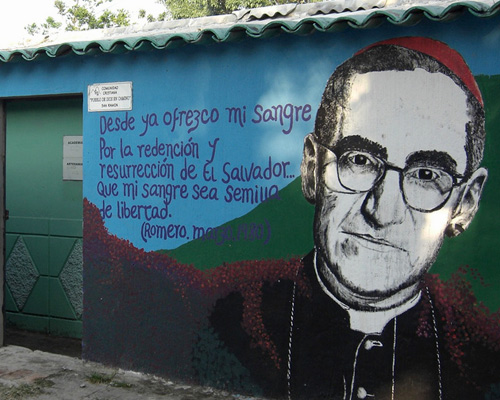
Oscar Romero on the Kingdom…

Via the Emergent Village daily ‘minimergent’

A future not our own

A prayer / poem by Archbishop Oscar Romero
(murdered, 24 March 1980)  


It helps, now and then, to step back

and take the long view.
The kingdom is not only beyond our efforts,
it is beyond our vision.

We accomplish in our lifetime only a tiny fraction of
the magnificent enterprise that is God’s work.
Nothing we do is complete,
which is another way of saying
that the kingdom always lies beyond us.

No statement says all that could be said.
No prayer fully expresses our faith.
No confession brings perfection.
No pastoral visit brings wholeness.
No programme accomplishes the church’s mission.
No set of goals and objectives includes everything.

This is what we are about:
We plant seeds that one day will grow.
We water seeds already planted, knowing that they hold future promise.
We lay foundations that will need further development.
We provide yeast that produces effects beyond our capabilities.

We cannot do everything
and there is a sense of liberation in realizing that.
This enables us to do something,
and to do it very well.
It may be incomplete, but it is a beginning, a step along the way,
an opportunity for God’s grace to enter and do the rest.

We may never see the end results,
but that is the difference between the master builder and the worker.
We are workers, not master builders,
ministers, not messiahs.
We are prophets of a future not our own.