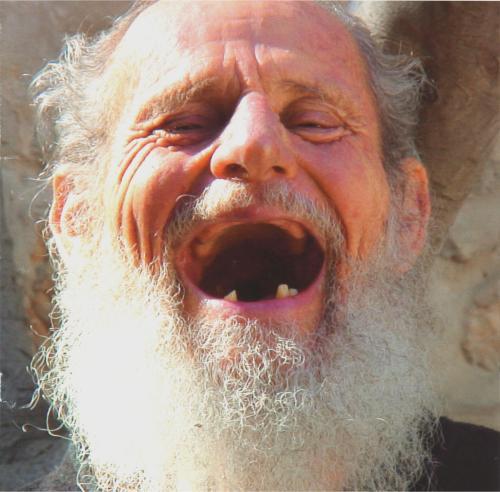
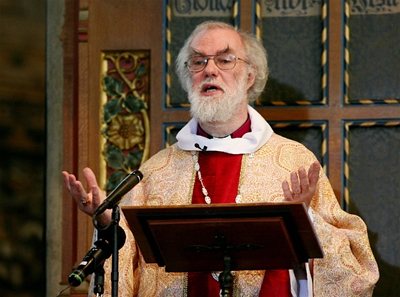
Some words from the Archbishop…

There was a lovely interview by David Hare in the Guardian yesterday with Rowan Williams- here.

It reminded me again why this man is something of a hero of mine- his deep, thoughtful, compassionate stance on so many of the issues facing us, and his fierce intelligence. I thought it worth extracting a few quotes from the article…

When he observes that economic relations as they are currently played out threaten people’s sense of what life is and what reality means, surely what he’s really saying is that capitalism damages people. To my surprise, he agrees. Does he therefore think economic relations should be ordered in a different way? “Yes.” So is it fair to say, then, that he’s anti-free market capitalism? “Yes,” he says and roars with laughter. “Don’t you feel better for my having said it?”

He goes on to rehearse what he insists he’s said before (“I don’t mind saying it again”) about how no one can any longer regard the free market as a naturally beneficent mechanism, and how more sophisticated financial instruments have made it even harder to spot when the market’s causing real hurt.


Is he paying too high a price for keeping together people who believe different things about gender, priesthood and sexuality? “I’ve no sympathy for that view. I don’t want to see the church so balkanised that we talk only to people we like and agree with. Thirty years ago, little knowing what fate had in store, I wrote an article about the role of a bishop, saying a bishop is a person who has to make each side of a debate audible to the other. The words ‘irony’ and ‘prescience’ come to mind. And of course you attract the reproach that you lack the courage of leadership and so on. But to me it’s a question of what only the archbishop of Canterbury can do.”


“We must get to grips with the idea that we don’t contribute anything to God, that God would be the same God if we had never been created. God is simply and eternally happy to be God.” How on Earth can he possibly know such a thing? “My reason for saying that is to push back on what I see as a kind of sentimentality in theology. Our relationship with God is in many ways like an intimate human relationship, but it’s also deeply unlike. In no sense do I exist to solve God’s problems or to make God feel better.” In other words, I say, you hate the psychiatrist/patient therapy model that so many people adopt when thinking of God? “Exactly. I know it’s counterintuitive, but it’s what the classical understanding of God is about. God’s act in creating the world is gratuitous, so everything comes to me as a gift. God simply wills that there shall be joy for something other than himself. That is the lifeblood of what I believe.”


I ask him if he’s happy to be thought of in a tradition of Welsh poet-priests – George HerbertGerard Manley HopkinsRS Thomas? “I always get annoyed when people call RS Thomas a poet-priest. He’s a poet, dammit. And a very good one. The implication is that somehow a poet-priest can get away with things a real poet can’t, or a real priest can’t. I’m very huffy about that. But I do accept there’s something in the pastoral office that does express itself appropriately in poetry. And the curious kind of invitation to the most vulnerable places in people that is part of priesthood does come up somewhere in poetic terms.

“Herbert’s very important to me. Herbert’s the man. Partly because of the absolute candour when he says, I’m going to let rip, I’m feeling I can’t stand God, I’ve had more than enough of Him. OK, let it run, get it out there. And then, just as the vehicle is careering towards the cliff edge, there’s a squeal of brakes. ‘Methought I heard one calling Child!/And I replied My Lord.’ I love that ending, because it means, ‘Sorry, yes, OK, I’m not feeling any happier, but there’s nowhere else to go.’ Herbert is not sweet.”

“And you like that?”

“Non-sweetness? I do.”


Two screens…

Today I worked from home. There is sickness in the house- M and I seem to have picked up some bug or other, and as a result, sleep was largely absent last night.

So I toiled most of the day on some reports- including ‘equality impact assessments’ relating to proposed service redesigns. If that sounds boring- well perhaps, but it actually relates to the need to save money from already overstretched budgets so actually, it is an ominous kind of boredom. It relates to an activity that will potentially have impact on lives and livelihoods. So forgive me- this post is a wee bit of therapy for my soul.

Open all along the bottom of my screen however, mixed in with various documents I am trying to make sense of, are other kinds of writing.

I found myself flicking between two screens-

One contained a file into which I am typing dead, anodyne yet scary words into an predetermined format.

The other contained a poem I am working on.

The contrast is palpable, and painful at the same time. Like being caught between the body and the soul. This dual life that modernity has condemned us to.

Not that we have any kind of right to an easy life, full of creative choices and mystical mountaintops to be conjured at our own choosing. This kind of self-activating-self-fulfillment-self-absorption is equally repellant.

But how we all long for a life of simple integrity, where what we have is enough, and all the more so shared.

And how (today at least) I hate bureaucratic solutions to human problems- no matter how necessary.

Time for a poem I think. An old one, from ‘Listing’

Blessed are those who are poor in spirit…

Blessed are they in failure
Blessed are they in repeated defeat

And blessed are they in
Every empty success

Blessed are they when plans, laid out-
Are stolen

And dreams are drained by

Middle age

Blessed are the wage slaves
And the mortgage makers
Blessed are those who keep on treading

This treadmill

Blessed are they who have no hope
And for whom life is
Grey and formless

Blessed are the B-list
And the has-been’s

Blessed are they at the end
Of all their coping

For here I am

And here I am building

My Kingdom

Perfected Intentions :: ALTER VIDEO MAGAZINE

Vodpod videos no longer available.

Saw this today- it made me smile. And think again about the people that influence me- and make me want to be better.

There are lots of other interesting video clips on the Alter Video Site too…

Are we more than just the sum of our biochemistry?

I have been thinking a little about a radio programme I listened to in the car yesterday- a discussion about the nature of our humanity on Start the Week on Radio 4.

The thrust of the argument came from Raymond Tallis– scientist, poet, philosopher, doctor and novelist (I wonder if he has time for origami too?) He is the author of this book

Tallis’s argument goes something like this-

“To seek the fabric of contemporary humanity inside the brain is as mistaken as to try to detect the sound of a gust passing through a billion-leaved wood by applying a stethoscope to isolated seeds.” So argues the philosopher and clinical neuroscientist Raymond Tallis. He condemns the growing use of brain science to try to explain every aspect of human life. In his new book, Aping Mankind: Neuromania, Darwinitis and the Misrepresentation of Humanity, Tallis attacks the idea that we can understand humanity through ‘biologism’ – the belief that humans are essentially animals and can be explained in biological terms. Although our existence was brought about by evolution, Tallis asserts that humans are profoundly different from animals. Moreover, he claims that biologism and ‘neuromania’ are dangerous for society, fuelling a belief that there is no hope of moral progress for humans.

Tallis is an atheist, who has no interest in the supernatural- but does appear to be driven by an deep interest in the nature of humanity- and of an appreciation of art. He also seems to like a bit of controversy.

In thinking about the discussion the other day (but not through reading his book) I was thinking about this thing called ‘humanity’- who we are, and what we are capable of.

Are we special?

Because we can reason and emote and deceive- does this make us different from the other animals?

And is the greatest evidence for the superior nature of humanity to be found in our libraries or our great galleries, or in our nuclear warheads?

Did God make us a little lower than the angels, crowned with glory and honour, or is this just arrogance and self delusion?

And because we are able to even ask questions like this- does this make it so?

I believe in the possibility of humanity to rise- to become agents of truth mediated by grace. Our biochemistry seems to both confirm this and to conspire against it. We were made this way.

So although I want to agree with Doctor Tallis, I wonder whether it really matters- even if the ultimate human reality is biological, painted by electro-chemical dots and dashes, then is this all that we might ever hope for?

Or do we believe in the incarnation of spirit in body?

The religious power invested in objects

Vodpod videos no longer available.

(Sorry I think this video may only play in some regions, and for a limited period of time.)

I watched this film last night- a documentary tracing the journey through one and half millennia of religious objects, saints remains and art made out of body parts.

My personal favourite was a little silver case containing the eyeball of a Catholic priest hung drawn and quartered some time around the reformation in England. Body parts were parboiled and displayed around town- at which point some brave soul popped out an eye ball to save as a keepsake.

What I was less aware of was the fact that for hundreds of years, in order to celebrate mass, the relics of saints were required- contained in mini- altars and often invested with huge power and wealth. It was this trade in body parts and objects- from the thorn crown of Jesus and bits of the ‘true cross’. to fragments of bone and hair purported to be from saints old and new that was one of the targets of the Reformation.

Certainly, growing up in an Evangelical reformed tradition we found all such things ludicrous- idolatrous and heretical even. They were one of the more visible things that seperated us still from any close relationship with the Catholic tradition.

Of course- we had our own objects of sanctification- I remember in one church I belonged to there was a carved communion table, which was moved about three meters- leading to bloody revolt by some members of the congregation.

The power of the symbol, and the anchor that connection to people who have gone before us in faith- these things seem to me to be important still.

As I watched the programme I was amazed at the obvious power that the objects had over the presenter- and also on me. It was difficult to be cynical in the face of such obvious veneration.

Having said all that- like most of our religion- it clearly had the capacity to go badly wrong. All that mad trading, and competition to get the best objects. And the possibility that the objects become more important than the object of the objects.

There is a shorter clip of the opening of a mini altar and examination of some remains (including hair supposed to have belonged to St John) here. In fact- I will add this video as a different post, as it is quite something.

I do not believe that I have any right to doubt the devotion of people who made objects like these, or who worshiped around them. Whilst I might not seek to collect any bits of saints to give meaning to my faith- I do believe that my experience of God is enhanced by symbols- by spaces and by objects within them.

Greenbelt beckons…

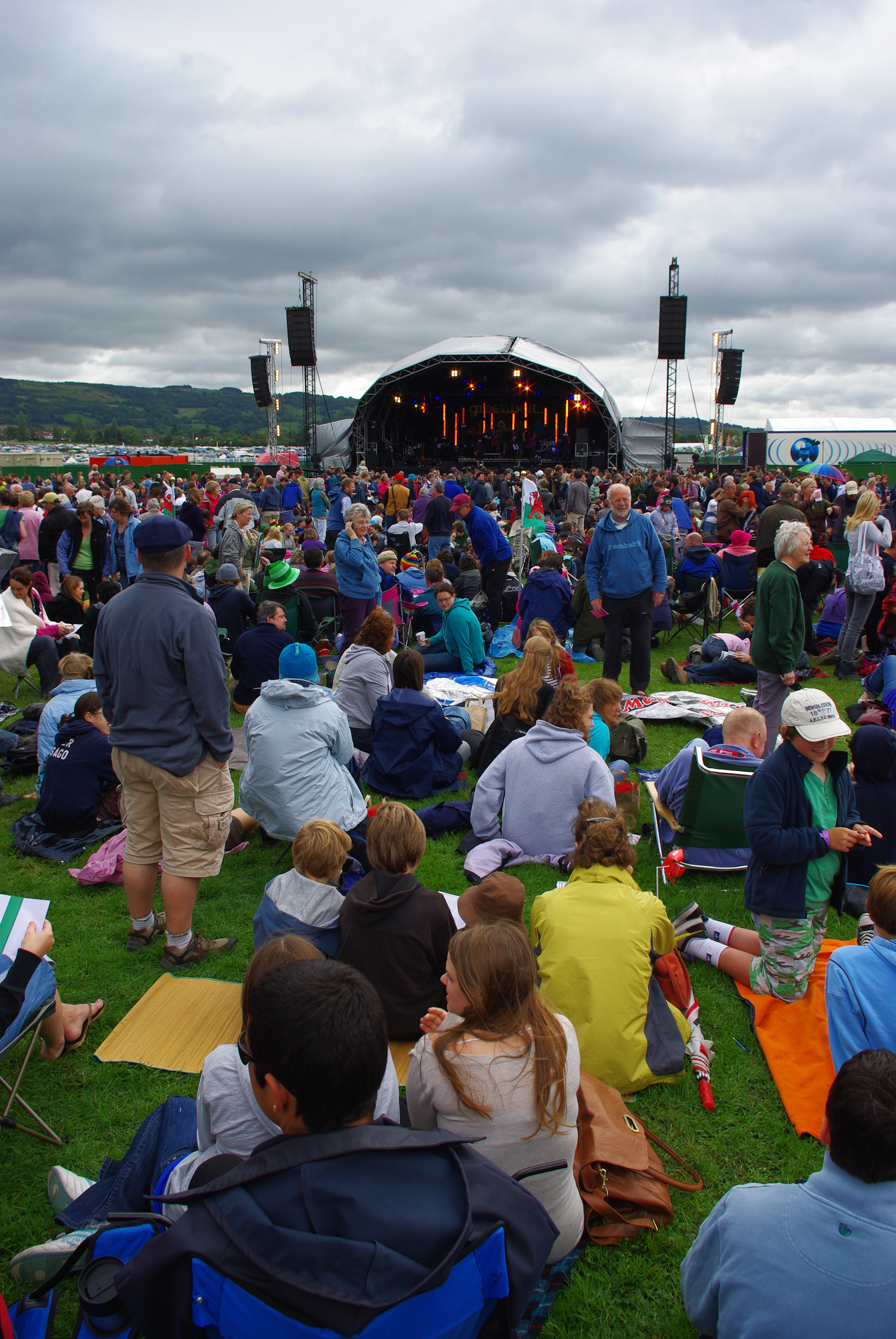
Aoradh spent tonight planning for some events we have up and coming- including our worship slot at Greenbelt Festival.

Greenbelt suddenly seems close, and we are still really at the ‘playing around with ideas’ stage. However, this is usually my favourite part of any project- the bit where you get to create things out of next to nothing- and how one idea sparks another, then another. The theme this year is ‘Dreams of home’- we are playing with some themes around the Feast of Tabernacles.

I am also doing some poetry with Proost– recorded and available on headsets around the site. I have not written that yet either! To be honest, I am a little worried about this- my poems tend to be so introspective and private- and these poems have to sit alongside those of two really great performance poets- European poetry slam champion Harry Baker and the equally brilliant Padraig O Tuama.

Oh dear- I can’t do that. Or that. I suppose that as ever, I need to stop worrying about what others do, and just trust that what I am/have is enough. I can do that. I think. Perhaps I will write a poem about it.

Anyway- there is lots of good stuff at GB this year- some music I really like- A Show of Hands, Kate Rusby,  as well as headline speakers Rob Bell and Brian McLaren.

If you are going this year, and you read this blog- drop me a line, perhaps we can share a beer/coffee.

Otherwise, Aoradh’s worship slot is on Friday night this year- 7pm I think…


A story about falling from a great height…

There is power in the story.

Jesus spoke into the Rabbinical tradition of teaching through the telling of challenging and difficult stories.

I heard an old Jewish story the other day that goes something like this…

A Rabbi stood with his son at the bottom of a set of high wooden stairs. Lifting him on to the first stair, the Rabbi urged his son to jump. It was not very high, and the boy trusted his father, so he jumped into his open arms.

Next the Rabbi placed his son on the second step. This was a little more scary, but still the boy trusted- so he jumped again- and landed safely in his father’s embrace.

And so it went on- each time climbing another step, then the jump, and the catch. “Well done my son” said the Rabbi.

Eventually, the son stood at a dizzying height, peering down at his father in trepidation. “Jump son, Jump” said the man. So, with shaking knees, he took to the air.

And his father watched the leap, and stood back.

The boy clawed himself to his feet, bleeding and crying.

“There, my son” said the Rabbi “That will teach you.”

What on earth is that all about then?

Something about the uncertainties of life, and the inevitability of suffering.

The failure of all authority figures, sooner or later.

And- most disturbingly of all- the unpredictability of God. The apparent injustice of God.

Or perhaps the deeper, mystery of God. God beyond the temporal. God the uncertain.

No tame God whose role is to grant our lifestyle wishes.

A God who calls us to leap- with no promise of featherbed landings.

But leap we must- sooner or later.

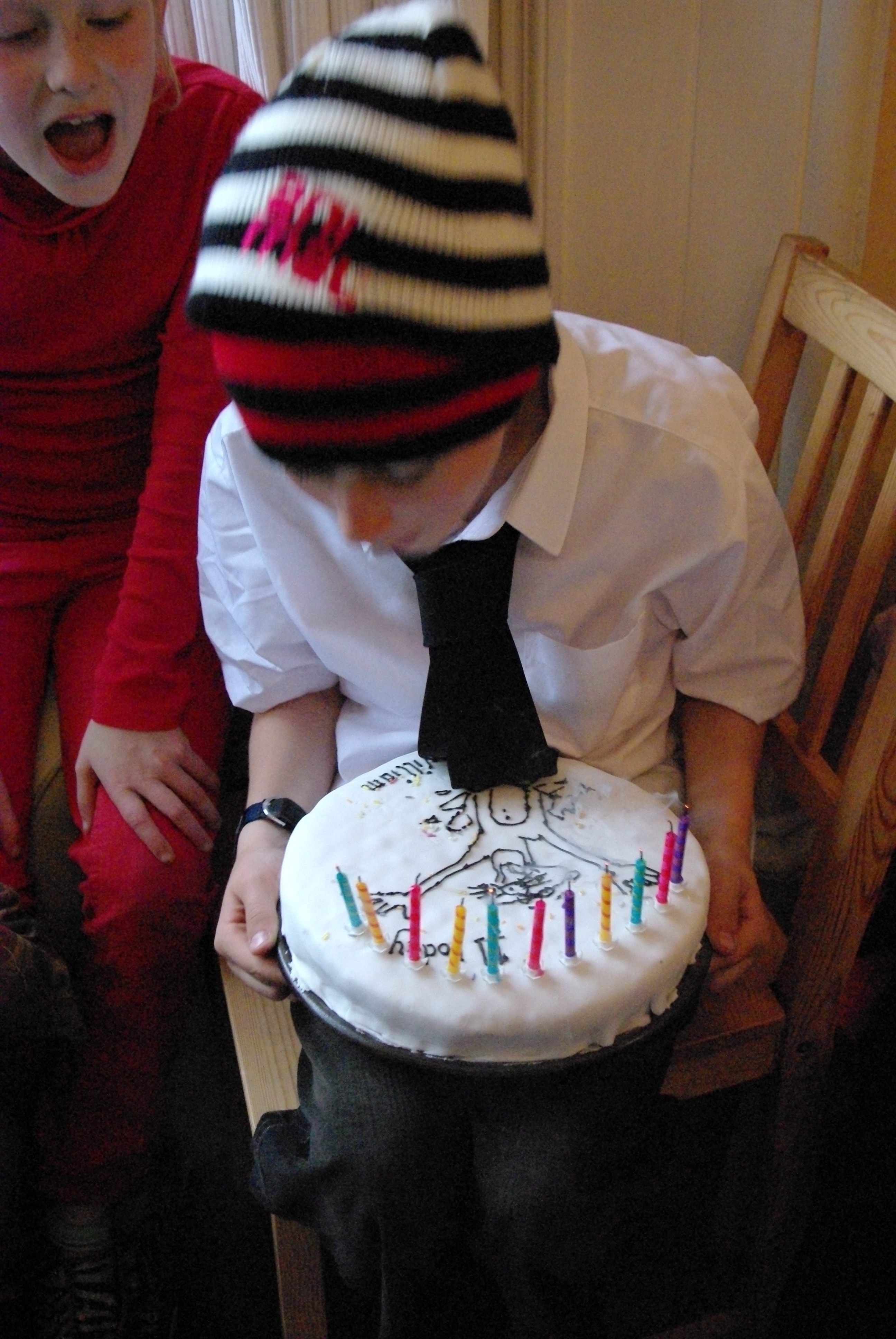
Happy birthday William!

William is 11 today!

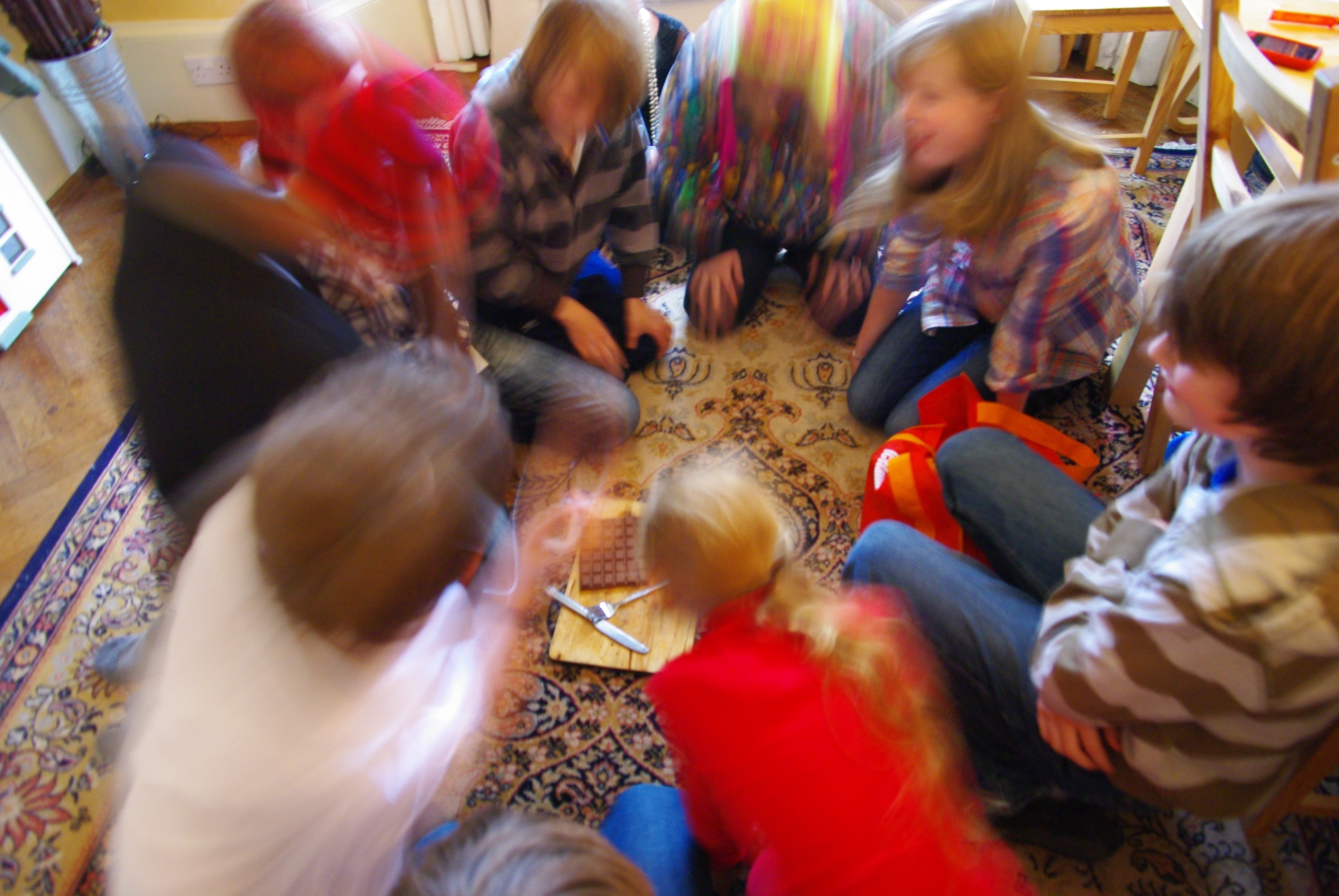
We have just done the party. All the mess is cleaned away. Peace descends- apart from Emily playing some dreadful dancing game on Wii in the next room. After a long day (much of it  in a small room with the suits trying to decide what services to cut) I am ready for some peace.

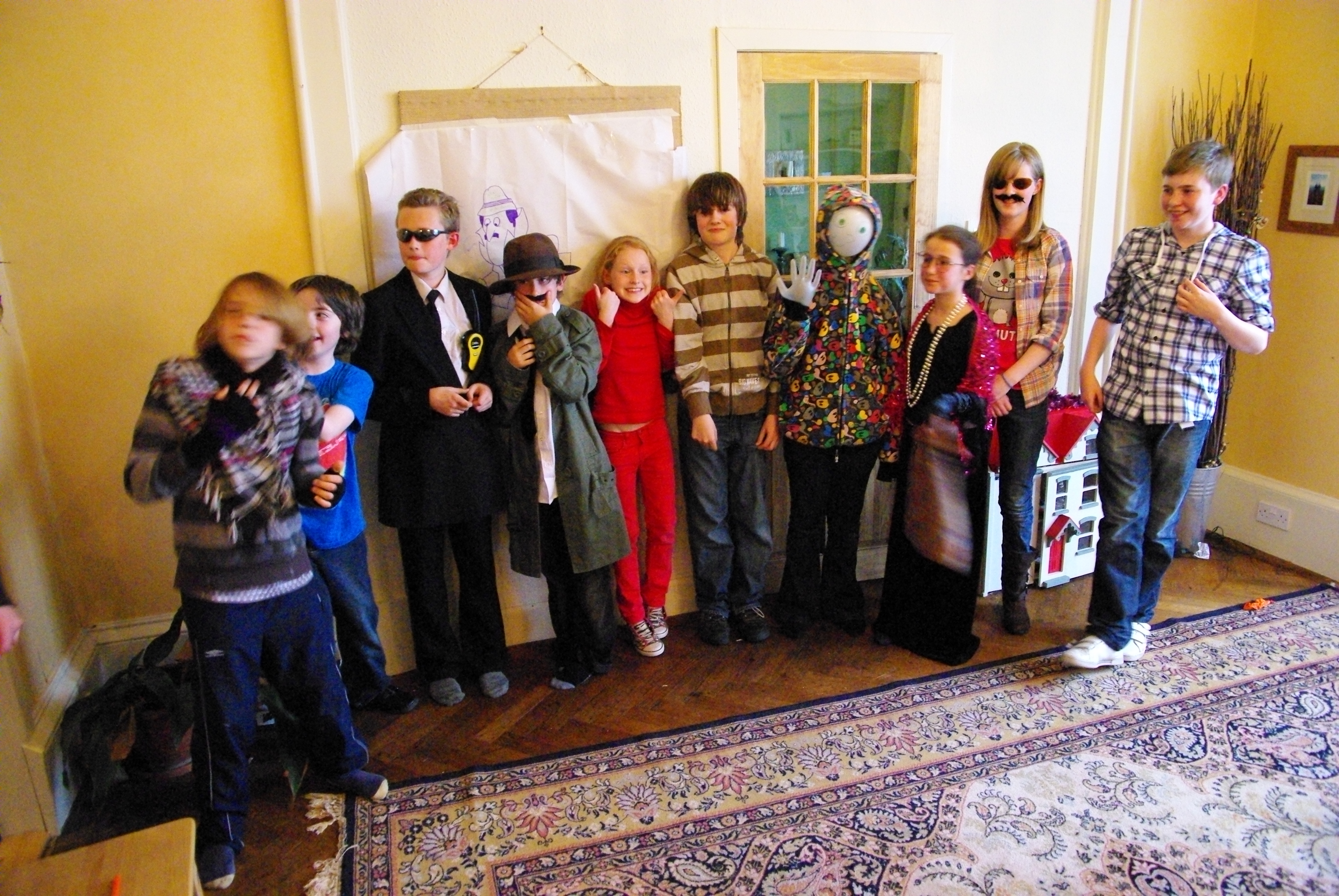
But Will had a great time so it is all good. This year he had a ‘Detective Party’ with fancy dress and games like ‘pin the magnifying glass on the detective’.

And as ever- when kids are happy, parents have a special feeling somewhere deep inside. I think it is related to love.

Is there hope for Evangelicalism yet?

Vodpod videos no longer available.

10-15 years ago, when I was attending a fairly large Evangelical Church near Preston- more or less everything this church seems to stand for, I would have celebrated enthusiastically. I loved the Church I attended, and the wonderful people it contained (I still do) although I felt considerable frustration about how isolated we were from engagement with real need in our communities.

Although to be honest, I spent most of my time behind an instrument of one sort or another, so my rhetoric did not necessarily match my actions.

As time went on, these frustrations grew- it was ever more obvious to me how Church can suck you in then suck you dry, and how activists within church spend all their time serving the machinery of the church, with little room left for anything else.

These days, I suspect that there would be a lot about Frontline Church in Liverpool that  I would struggle with- in terms of theology, world view and underlying culture. Not to mention the politics.

But I am grateful that there are places like this still.

Grace factories.

And although grace can not really be manufactured, where people are motivated by their faith towards acts of love- then we should rejoice…

As John Harris puts it in the Guardian-

The next day I meet a former sex worker, now apparently off drugs, set on somehow starting college and a regular Frontline worshipper. “I was a prostitute and a drug addict for 11, 12 years – maybe more,” she tells me. “God is so forgiving – he wants me to win.” Wider society, she says, is “too judgmental … it’s: ‘That’s a prostitute, that’s a drug addict.’ They don’t want to know.” And how has the church helped her? “Oh, it saved my life,” she shoots back. “I would be dead if it wasn’t for this church.”

A question soon pops into my head. How does a militant secularist weigh up the choice between a cleaned-up believer and an ungodly crack adict?

Does maturity always require suffering?

This was the question we discussed in house group this evening, after listening to Richard Rohr speaking about the spirituality of the second half of life.

He felt that the answer was yes (probably) and quoted a psychologist, who was asked the same question- to which he replied “It is entirely theoretically possible to achieve maturity in life without some degree of suffering, but it is just that in 30 years as a clinical psychologist, I have never seen it.”

It makes sense. A similar argument can be made about any change- it tends to require some kind of crisis. Sure you can decide to change- and make some lifestyle choices- throw in a bit of life coaching and counselling to discover your inner onion, but mostly we just end up indulging in a bit of wish fulfillment whilst we move the furniture about the same old rooms.

Whereas real change tends to come upon us by necessity, through crisis, and suffering.

Is that why Jesus said ‘Blessed are those who mourn, for they shall see God?”

The next question I suppose is- does suffering always lead to maturity? And the answer to this I think is- no. Suffering can lead to us constantly trying to rationalise it all- to the blame game and the guilt game. And so we become bitter and trapped in the shadow of the events that have befallen us.

Richard Rohr spoke about how suffering might contribute to maturity in a way that made some sense to me- about how we get beyond the need to know, to understand and to intellectually grasp the realities of God- and just begin to accept that

He is.

And we are.

Now- not yesterday or tomorrow.

Just now.

It is about being fully present, in the loving presence of God- and this being a place where the surface tension becomes less and less important in the awareness of all that deep green water below.

So am I mature? well- Not really. Does that mean that I might embrace the suffering that will surely come my way? Not likely. Rather I might hope that my dose of it is small- the odd tweaking of the scar tissue I already wear perhaps- rather than a screaming tunnel of hell that others experience and somehow still survive.