Calvin on unbelief…

Quote of the day comes from a most unlikely source- John Calvin. Not my favourite source of inspiration I have to admit-

Here it is- with thanks to Fiona!

“The Godly heart feels in itself a division because it is partly imbued with sweetness from the recognition of the divine goodness, partly grieves in bitterness from its calamity; partly rests upon the promise of the gospel, partly trembles at the evidence of its own iniquity; partly rejoices at the expectation of life, partly shudders at death.

This variation arises from the imperfection of faith, since in the course of this present life it never goes so well with us that we are wholly cured of the disease of unbelief and entirely filled and possessed by faith.”

John Calvin, “Institutes of the Christian Religion,” book 3, chapter 2, paragraph 18

On standing in a place of (un)belief…

I have been thinking about that old polarity of faith/unbelief recently. This because of a few significant conversations with friends who have been grappling  with their faith, and also because it has long been an issue for me.

The old Evangelical way of understanding faith is all about assurance- we would quote Hebrews 11 v1-  Now faith is being sure of what we hope for and certain of what we do not see. Faith was something breathed into us by the Holy Spirit- it was about certainty, security, muscular purposefulness. Without faith it is impossible to please God.

Except it never felt that way. And so I wondered if God could ever be pleased with me.

Over the years I became more open about the  insecurities of my faith- and discovered that I was far from alone. Sure, I know some lovely people who have not a shadow of doubt- they would echo the words from Hebrews. Some seemed to relax into a beautiful kind of faith, which became a deep well of joy in their lives. To be with these people is a great blessing.

But many others, like me, experience faith as a fleeting presence- ebbing and flowing. Sometimes within grasp, at other times a million miles away.

More recently I have discovered that my faith, rather than being the polar opposite of doubt, can actually flourish in the presence of doubt. It is not that doubt cancels out faith- rather that the honest place of uncertainty and not knowing becomes the means through which I seek to humbly approach God. And sometimes, there he is…

I may well carry temperamental characteristics that skew me towards this kind of faith- but I also wonder if some of this (un)believing (a nod to Pete Rollins for this parenthetical trickery) has been fostered by engagement in all of that deconstruction that happened around the Emerging Church Conversation (Capital letters seemed appropriate!) (Perhaps I am overdoing the parenthesis a little now?)

We became very used to unravelling it all- questioning everything, shaking the theological tree right down to its roots. And once you start, everything is up for grabs. Substitutionary atonement? Biblical Authority? Hell? Virgin Birth? Holy Spirit wackyness? An Interventionist God? Everything has a question mark.

I think that those of us that went through this have a faith that in many ways is stronger- but at the same time is far less concrete- far less dogmatic and assured. What Pete Ward described as ‘Liquid Faith’ may well have the capacity to move like water flowing through our postmodern culture- but there is also a danger that it finds a crack and disappears out of sight- at least for a while…

But there comes a time when deconstruction is not enough- we need to start laying down some more big stones on which to place some of our smaller ones. Or if the brick wall analogy does not work for you- time to stop jumping up and down on the theological trampoline and to rest on it’s soft sprung surface.

I think our starting point in this constructing is becoming clearer. In the words of NT Wright-

And how long must it be before we learn that our task as Christians is to be in the front row of constructing the post‐postmodern world? The individual existential angst of the 1960s has become the corporate and cultural angst of the 1990s. What is the Christian answer to it? The Christian answer is the love of God, which goes through death and out the other side. What is missing from the postmodern equation is, of course, love.’

(Sorry forgotten where I got this quote from…)

Others leaders within this debate are increasingly beginning to commit themselves to foundational beliefs- and in some cases getting a bit of a kicking in the process. I am still working on this for myself, but I have been thinking about what might help me navigate within all this creative flow- in my state of (un)belief.

Here are some of the principles that make sense to me-

  • Cynicism– it is almost always a bad thing- corrosive like battery acid. And it is infectious too. I must strive to remain hopeful- which is to say, uncynical.
  • .
  • Choice- despite my resistance (cynicism?) towards the evangelical three card conversion trick, I continue to think that faith is a choice- we choose to believe, even in the presence of unbelief. That is not the same thing as ‘pretending’, it is about putting ourselves in the place of seeking, hoping and yearning for God, and learning to live in his ways.
  • .
  • Open to encounter- It is my continued hope, and sometime my experience, that God is to be found in the most unlikely of places- “Lovely in limbs and lovely in eyes not his.”  My reaction against the ways I formerly was told to expect to encounter God (primarily through preaching and ecstatic worship) has opened up the possibility of all sorts of other encounters. And I am going to stay open to them as much as I can.
  • .
  • Open to tradition- I strive too to learn from how others have understood God, both in the past, and recently. It is easy to either rely on a narrow, pre-selected set of references- the good guys, the stars of the Greenbelt festival speaking circuit. I must navigate further, and avoid the simplistic romanticisation of older men and women of faith also- the celtic saints also had feet of clay.
  • .
  • Faith encountered through praxis and ritual- Sometimes the shape given to faith by tradition, by ritual and by practice is vital. More than just dead habit, it may become the place in which faith is rediscovered.
  • .
  • Faith in community- sharing common encounters- Can faith ever exist in total isolation? Perhaps- if you are a pillar saint. But Jesus talked about his church. The essence of the followers of Jesus was discovered in the collective- in the sharing of stories and the life of love. In this way faith is tested and sometimes broken- but often shared and strengthened.
  • .
  • Transcendence– there is much that I do not know. Much that my head can not grasp nor make sense of. But there is often this singing in my spirit- there in all sorts of small things- art, small kids, new leaves, the smell of seaweed. These things often seem to transcend my own narrow experience, and open up the possibility of something much bigger, much more eternal. And this brings me again to God.
And may God find his way to us through the cracks of our unbelief.

The spirituality to be found at a fireside…

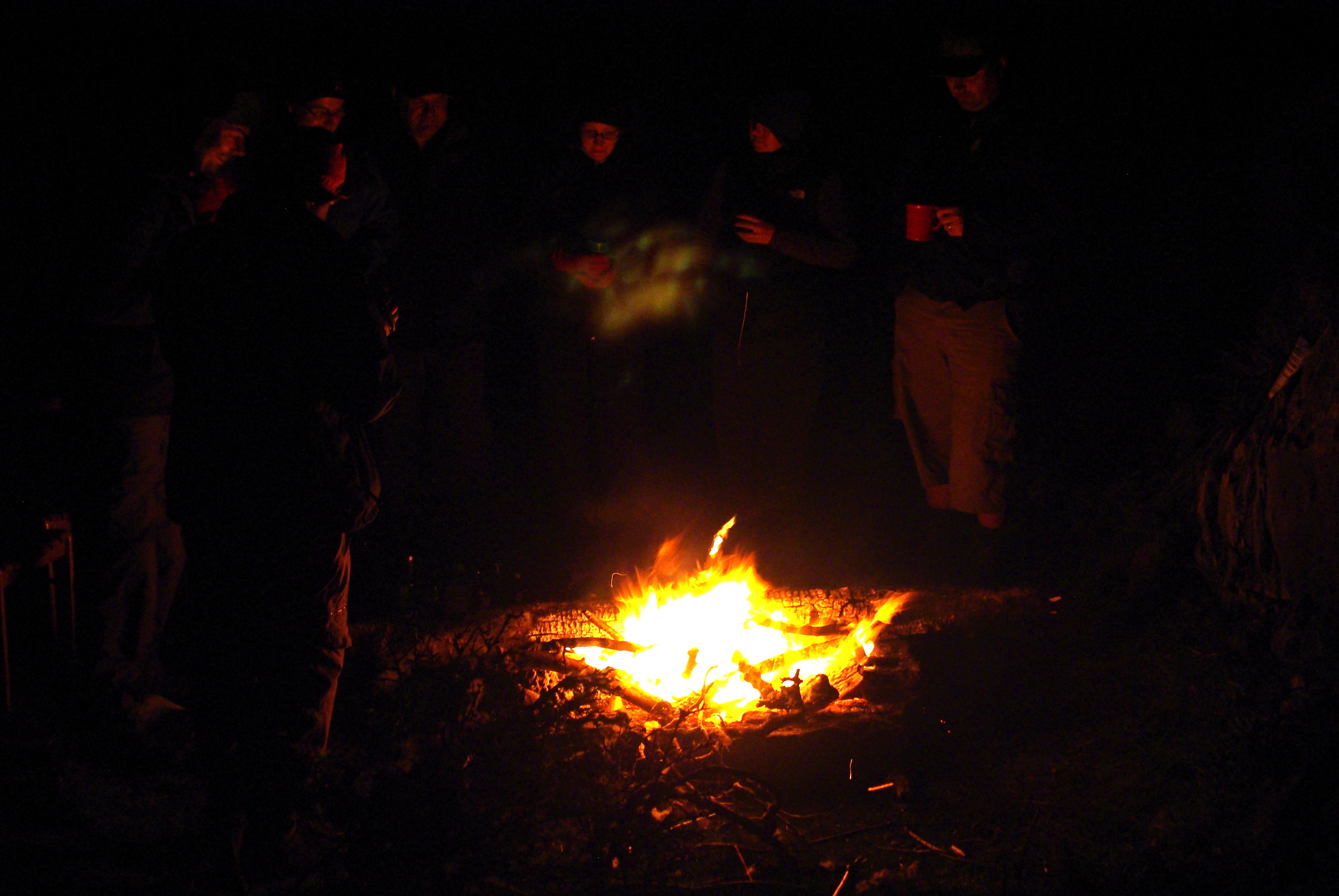
This is a photograph taken on our recent retreat. I think the glow above the fire is an internal lens/filter reflection. Cheap filters are a problem I am told! But it looks like something has been created from our gathering- or perhaps the old truth that where we gather in his name, he is in the midst of us…

Gathering around a fire must be stamped somewhere in the middle of what it means to be human. After all, it must be just about our oldest form of social gathering.

There is a story about a micro technology project that visited a village in Africa, offering to install a solar powered lighting system. “Why do we need this?” asked the village elders. “What benefits would this bring to our people?” “Well,” replied the aid workers, “you will be able to work later in the evening, your children will be able to study and use computers and your wives will be able to prepare food more easily.” The elders considered for a while, then politely declined the offer of the electricity system. When asked why, they replied “There are enough hours in the day for work. In the evening, we gather round a fire and tell the stories that make us who we are.”

On our recent retreat, we gathered round a fire. It was tricky- there were no trees on the island and a fast tide race sweeping the shores clean, so we had to gather wood from nooks and crannies all over the rocky shores. We told stories of hopes and dreams, and prayed using incense that we scattered on the fire (to symbolise the fragrance of Jesus) and iron filings that sparked us into awareness of the power of the Spirit.

My your fireside be equally warm and welcoming, and may great stories be told…

Bible nasties 5- a little discussion about ‘truth’…

OK, I have been avoiding this a little, but perhaps it is time to dig into a few philosophical ideas about the nature of truth.

It is a long time since I studied philosophy as a student, so this may well be a little low rent- but I hope it’s relevance to our discussion about the nature of the Biblical truth will be obvious.

Correspondance theory

Thirteenth Century philosopher/theologian Thomas Aquinas said this “A judgment is said to be true when it conforms to the external reality”, which is a posh way of saying that if what you say of an object is correct, it is true.  Truth is a matter of accurately copying what was much later called “objective reality” and then representing it in thoughts, words and other symbols.

This kind of truth is the common sense kind- the see it, touch it, smell it kind. It is the kind of truth that we assume that the Bible uses.

Coherence theory

Truth is primarily a property of whole systems of propositions, and can be ascribed to individual propositions only according to their coherence with the whole. In other words, truth is only testable when understood within a wider system of ideas and concepts. To understand what is true, we have to approach it from within a set of wider propositions.

Which is exactly what we do with the Bible, even if we do not always acknowledge it. We read the book of Revelation not with the cultural assumptions of a first Century Jewish follower of Jesus, living under oppression and well used to the literary format of apocalyptic writing, but rather from the truth system of a 21st C people, in the shadow of all those end times theories.

Or we read the Gospel of John and the book of Romans, then reinterpret the rest of the Bible from a perspective gained just from an understanding of these two books.

Constructivist theory

Truth is constructed by social processes, is historically and culturally specific, and that it is in part shaped through the power struggles within a community. So the truth we encounter is an amalgam of the culture and context we live and walk in, and is rarely neutral- rather it tends to be shaped by those who have the most power.

So we see the the Bible used to justify war, slavery, racism, oppression of minority groups.

Consensus theory

Truth is what ever is agreed upon by a specific group.

There have always been groups whose readings of the Bible have been idiosyncratic and sometimes downright loony. The Westboro Baptist Church come to mind for example.

Pragmatic theory

Truth is verified and confirmed by the results of putting one’s concepts into practice. So it is only when we test our ideas and concepts in real life situations, or scientific method that we can engage with truth. In this way, truth is self corrective over time.

A recent refinement, known as ‘negative pragmatism’- “We never are definitely right, we can only be sure we are wrong.”

These two ideas of truth as also closely mirrored in theological approaches to the Bible. The 19th C enlightenment sought to prove God, with the Bible as it’s source material. CS Lewis and his huge intellect might be seen as a logical outcome of Pragmatic theory applied to theological truth.

More recently, apologetics have become less fashionable. We have been forced to accept that arriving at a final understanding of truth is always going to be problematic. Alfred North Whitehead,  said: “There are no whole truths; all truths are half-truths. It is trying to treat them as whole truths that play the devil”.
Next, a wee trip through some of the philosophical heavyweights to see what they have to say about truth-

Descartes

Truth is available to us as we apply our reason to external objects. But the ultimate arbiter of this external truth is- God. I think, therefore there is God.

Kant

Kant suggested that the problem with correspondence theory is that if an external object is to be ‘true’ then it has to be recognised, and considered internally- at which point it is no longer external, no longer objective. So our encounters with truth are changed by our own interaction with them- by the person that we bring to that truth.

Kierkegaard

For Søren Kierkegaard, objective truth has real limitations, in that it cannot shed any light upon that which is most essential to a person’s life- Objective truths(mathematical, scientific, physical) are concerned with the facts of a person’s being, while subjective truths are concerned with a person’s way of being.

He is also strong on the division between objective and subjective truth- objective truths are final and static, subjective truths are continuing and dynamic. Values, faith and ethics, according to Kierkegaard, can only be understood when filtered through an individuals subjective experience.

Some inconclusive conclusions…

So- where does all this take us to, in relation to the Bible?

For me, the philosophical approaches to truth open up the idea that any ‘facts’, when viewed from a human perspective are likely to be nuanced, complex and to serve hidden human purposes. If we believe that the Bible is a human document- even allowing for heavenly inspiration- then we have to accept that it is laden with these same questions.

There will continue to be those who will assert that the truth of the Bible belongs to God- and as such it is not contingent on our engagement with it, or understanding/belief of it- it just is. The trouble is that people who assert this often appear to be willing to commit themselves to a claim to understand this truth.

As for me, I am left with two useful starting points-

Karen Ward differentiates between ‘small theologies’ (or you could say small truths)- worked out in community, and ‘big theologies’ (big truths)- belonging to academia and the church hierarchy. In this way, I think that an idea of truth can be negotiated with your friends, in humility, and in respect of the tradition. Getting it all 100% ‘right’ is not an option, or even an aspirational goal. Rather we should expect to be teachable and open to transformation by the Spirit within us.

Then there is also that bit in Romans 14 where Paul talks about ‘disputable matters’-

1 Accept the one whose faith is weak, without quarreling over disputable matters. 2One person’s faith allows them to eat anything, but another, whose faith is weak, eats only vegetables. 3 The one who eats everything must not treat with contempt the one who does not, and the one who does not eat everything must not judge the one who does, for God has accepted them. 4 Who are you to judge someone else’s servant? To their own master, servants stand or fall. And they will stand, for the Lord is able to make them stand.

5 One person considers one day more sacred than another; another considers every day alike. Each of them should be fully convinced in their own mind. 6 Whoever regards one day as special does so to the Lord. Whoever eats meat does so to the Lord, for they give thanks to God; and whoever abstains does so to the Lord and gives thanks to God. 7 For none of us lives for ourselves alone, and none of us dies for ourselves alone.8 If we live, we live for the Lord; and if we die, we die for the Lord. So, whether we live or die, we belong to the Lord. 9 For this very reason, Christ died and returned to life so that he might be the Lord of both the dead and the living.

Paul is speaking to a church in the middle of a truth war, and he says, more or less- there are more important things to be getting on with…

In which I adopt for myself, an anthem…

I first came across Over the Rhine a few years ago at Greenbelt festival- I was on my way somewhere and stopped for a few mins to have a listen, and found myself rooted right to the end of the set. I bought a couple of albums, which were OK, but more recently on the back of some rave reviews, I got hold of their new album ‘The Long Surrender’.

It is brilliant- soulful, bluesy, with tinges of Jazz and Country.

And it passed that test of all good music-of-meaning (which is all I am interested in these days)- it made me cry.

There is this one song, for instance, near the end, which I have decided to adopt as an anthem for a while. With apologies to my friends, it speaks of the best of us being broken- and in this broken vulnerability, we find each other and the beauty that life is all about…

There is also a wonderful sax solo that fades into brokenness and is tender and lovely.

Here it is- go buy the album!

Garden resurrection…

We had a lovely day yesterday.

As a celebration of Easter, some of the Aoradh crowd gathered at our house. We ate a meal together, sang some songs, then did some activities with the kids- including the ubiquitous easter egg hunt.

Then we sat round a fire, next to a little stone ‘tomb’ and told the story of the Mary, and the garden.

Then we lingered. And spoke of life, and faith.

It felt very special- in the way that deep time with friends can be… a lovely way to celebrate Easter.

Lent, 40…

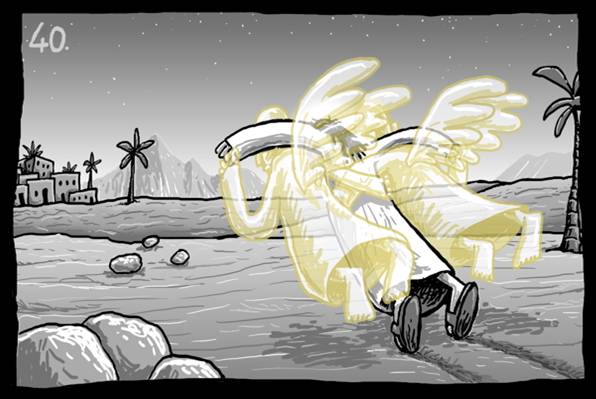
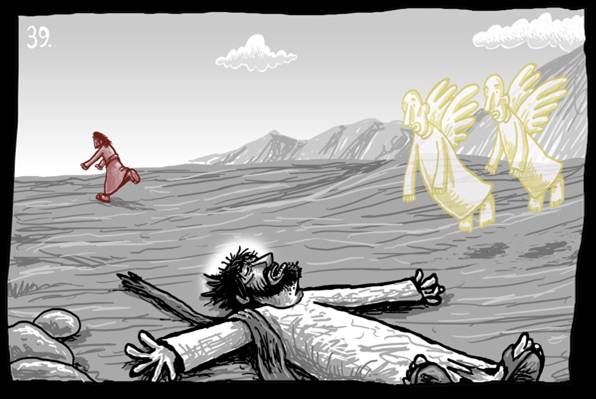
I know that strictly speaking lent ended yesterday- but here is the final piece from ’40’- Si Smith’s lovely images of Jesus in the wilderness, along with my words. It has been quite a journey. If you enjoyed it, then you can download or order a physical copy of it from Proost.

So, the journey continued- back into a world of men-

.

To all the homes and houses

And the broken down old shacks

To the Priests and the soldiers

To the slaves and the fat cats

.

To the athlete and the cripple

To the beggar and the king

To the broken and the dying

And those who have no song to sing

.

To the place where children squabble

And the old folk gossip in the square

And the singing from the synagogue

Calls the town for prayer

.

To all this living and this loving

This fecundity of life…

.

Now is your time my friends

And mine

Bible nasties 4- that word ‘context’…

I was reading about a recent archaeological discovery at Fin Cop iron age hill fort, in the English Peak District, near where I grew up.

A mass grave has been discovered- full of the bones of women and children. The bodies appear to have been thrown into the surrounding ditch and the smashed remains of the fort thrown down on top of them.

To make sense of this story, we have to understand something of the context in which the events happened- the culture, the dynastic background, the history.

I read about the Fin Cop massacre at the same time as I was thinking about all that Old Testament bloodshed. The parallels are rather obvious.

In 500BC, most of the killing that the ancient Israelites indulged in with such apparent approval from God was over. They were then a defeated people, living under Babylonian rule. But what hit me again is the approach that many Christians make to the Bible, and the stories that it contains.

The stories tend to be imported into our context with a lot of fixed assumptions.

Firstly the assumption that they are ‘true’- in the sense of being 100% accurate factual historical records of real events.

Secondly, the assumption that God is speaking to us directly through these words, which then require no testing, no wrestling- rather our role is to be passive acceptors of heavenly revelation.

Thirdly the assumption that God himself wrote the words- each individual one, and therefore any challenge to either of the two assumptions above is a direct challenge of God himself, and is therefore heresy.

Perhaps you might think that these assumptions are just fine. I have struggled with them over the years- and coped by not allowing myself to ask questions.

Because once you start, it is impossible to stop.

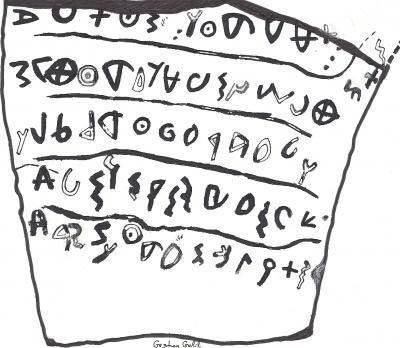
One of the first questions that start to challenge the above assumptions is this one- context. The writings in the Old Testament concern events that happened around 2000 years before the birth of Jesus. The oldest evidence for Hebrew writing is around the 10th C BC, but most scholars believe that the books of the OT were first written down around the 6th C BC. What this means is that the stories were passed down by oral tradition for countless generations.

Many of these generations, like the people who lived at Fin Cop, were short and bloody.

So stories were told of Abraham, who started it all, and of Jacob who sustained the wandering tribe during slavery. Then there were the stories of the birth of a nation out of the years in the desert, and the rise of great kings and great kingdoms. Stories justified, sustained and unified- particularly during the hard times of exile and captivity.

And in the middle of it all- woven through the whole- is God. Hopes for God, encounters with God, fears cast on to God, prayers to God. A people whose stories are covered by the fingerprints of God.

What might we expect then of these stories, when we allow ourselves to consider something of the context?

Might we expect them to be historically 100% accurate- and ‘true’? Well, frankly no. That is not their point. They were living stories to bring breath to an exiled proud people- they were not eyewitness accounts of a traffic accident (which, come to think of it, are not necessarily ‘true’ either.)

Might we believe that God is speaking to us through the words, and that our role is just to accept them with no challenge, no test, no questioning?  To which I reply Yes, and no. Wrestling and questioning with textual meaning are spiritual practices, when done with honesty and integrity- and the certainty that whatever meaning we find will be partial, and certainly not the final version of truth that will emerge from the text.

Do we need to believe that God wrote/inspired every word, completed and whole, and that to question this is heresy? My answer to this is- no, we do not. But then perhaps I am a heretic. Because I have come to believe that this view of the text has more to do with the need that a modern context had for quantifiable, objective, rationalised evidence for God.

Context is important. As are at least 11 other ways of reading these ancient writings.

But there are many ways to approach this wonderful collection of writing- all of them flawed. Because the words are always filtered through the reader.

Lent 38…

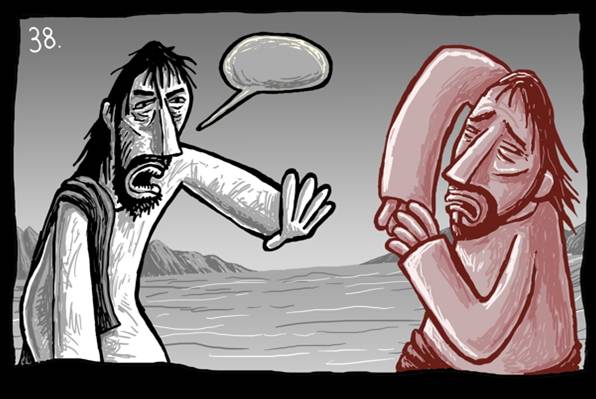
ENOUGH!

I serve only one master-

The Spirit of the Sovereign Lord is on me

He has sent me to the poor and the weak to tell them the good news

He has told me that it’s time to heal the broken hearted-

Shout freedom to all captives, and to break the chains of those you have bound

Now is the time of my fathers grace

And the destruction of your plans

And the stranger

Was gone