Lost…

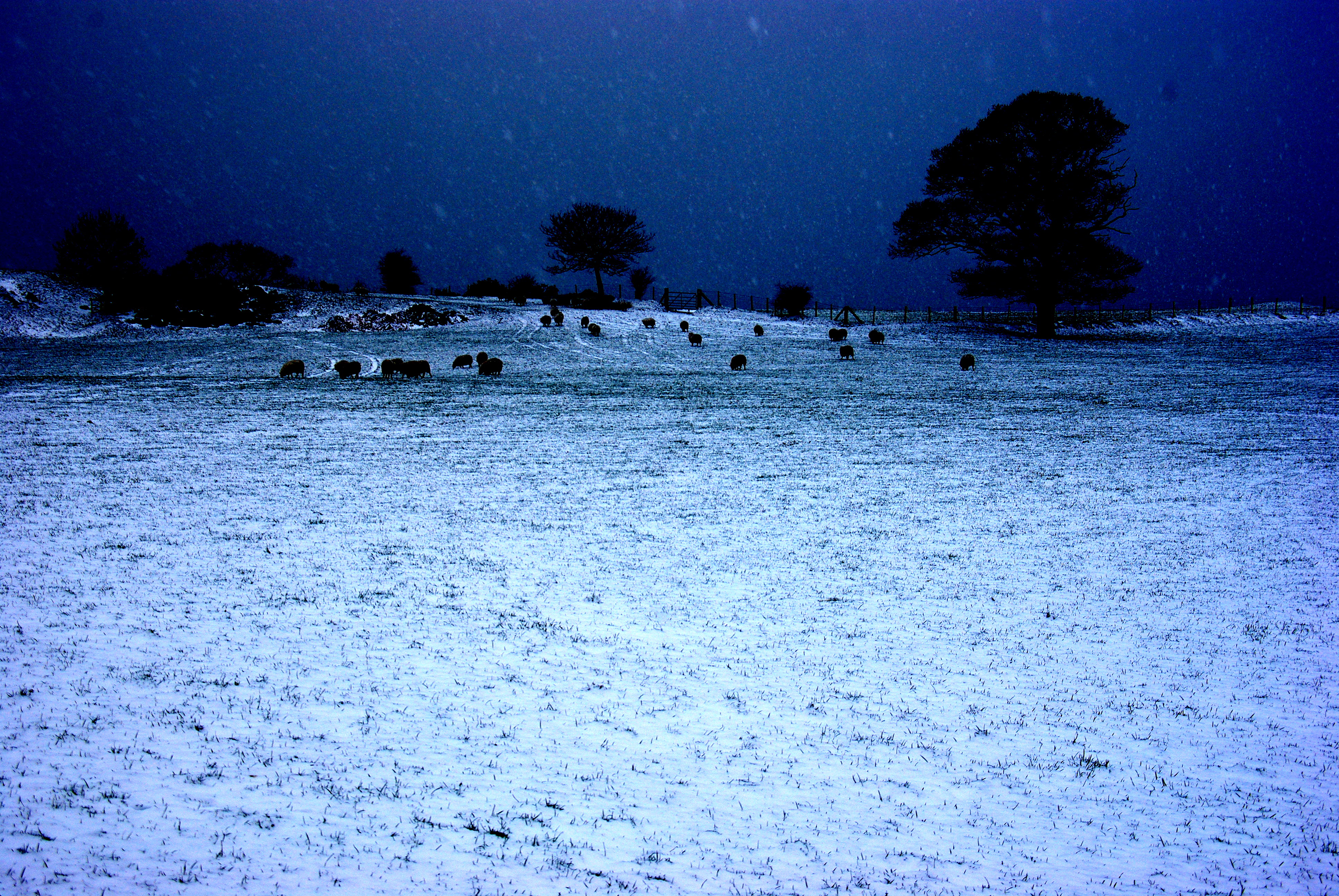
sheep, snow, high contrast


Towards the beginning of my retreat, I wrote this;


Lost sheep

Through trees wearing ice where leaves

once were, I follow the map that

someone kindly laid for me.

Over stile that skates my boots and

into fields wiped clean, skittered

only by claws of creatures who watch

me blunder by from cover.

A hedge a road a bog a bridge a pause to

mop and catch my breath, a buzzard low in

silhouette, too-early lamb almost indivisible from

mother, who all but knits for him a jumper.

I am no-where. At least not where I

ought to be. Not mappable. No surrender to

conspiracies of cartographers.

It came to me that only when we

lose a path can we discover our own.

But these too have all been walked before.

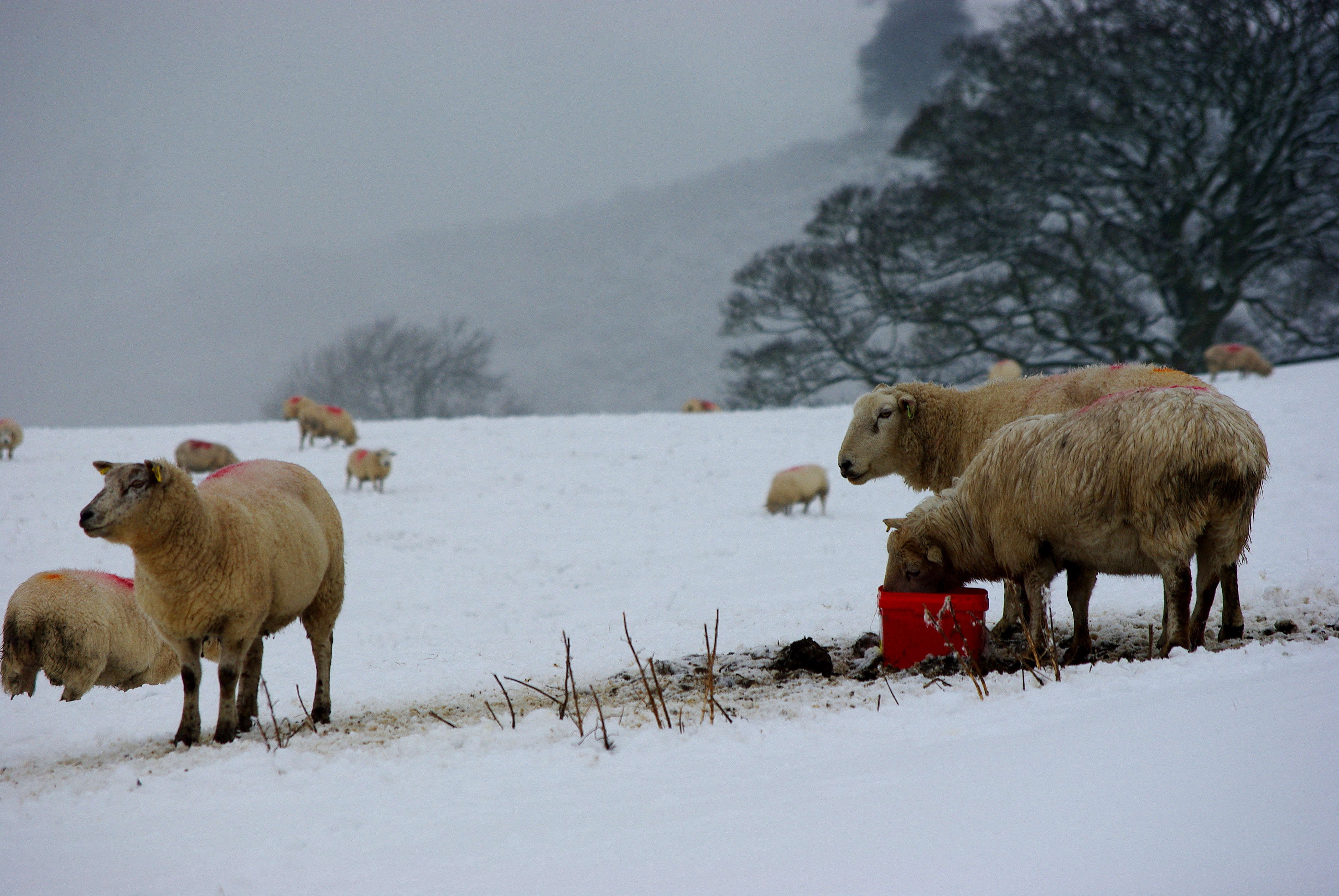
lamb in the snow

Reflecting on silence…

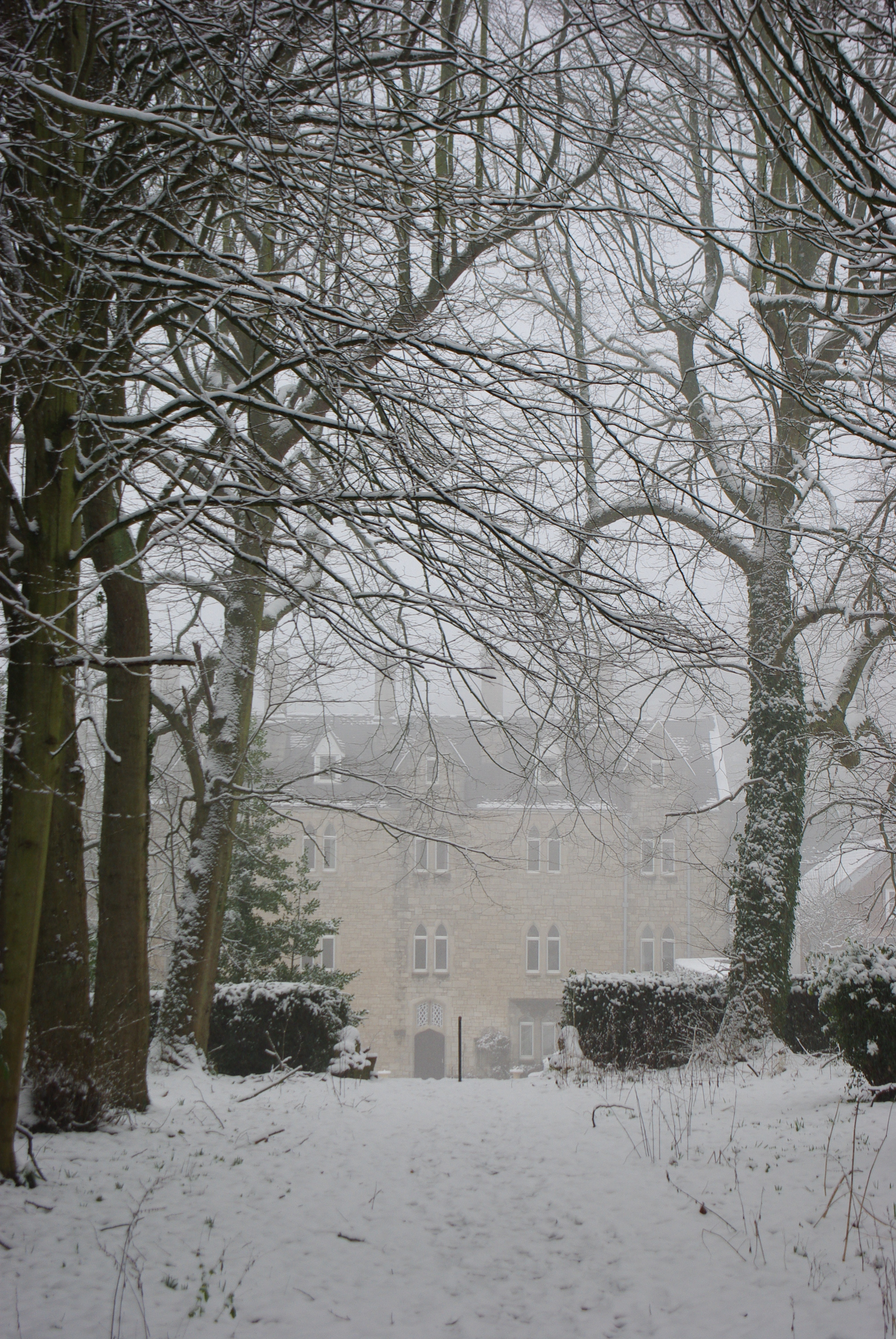
st beauno's in the snow

So here I am, sitting on a lovely Virgin train leaning its way around the corners that lead me back to home. Just the place to reflect on the 8 days now past- spent in silence at St Beuno’s Ignatian Retreat Centre near St Asaph, North Wales.

I went with as few expectations as my over active imagination could avoid, just hungry to make a new spiritual journey towards God.

The experience was not about fireworks, emotional and spiritual highs, but it was every much a spiritual journey for all that- full of humour, grace and peace. You may also be surprised to hear that 8 days spent in silence, with little reading even, was rarely boring! I thought the best way to describe it was to share some excerpts from my journal, so here we go;

Friday (on arrival.)

(St Beuno’s) is a place that feels comfortable, in a rather staid way. Because of its Jesuit ethos of silent contemplation, people do not speak to one another- rather they walk past one another and do not as much as nod. To someone schooled in the primacy of communication, it seems somehow alien. I can not decide whether it is a relief not to have to make small talk with all these strangers, or slightly missing the overt hospitality.

(I wrote down some prayers;)

Free me from performance and the need to impress

Free me from the need to be liked

Free me from the need to compete in order to feel of worth

Let me be me

So you can be you

Saturday

After a snooze I went to the Eucharist service. The out-of-placeness returned. Strange liturgy, ritual I did not understand and sung elements I did not know. I decided not to take communion as this seems to be a hot issue in the Catholic church at the moment.

I sat looking through the song book- lots of unfamiliar hymns and songs, but lots of familiar ones too. I came across this one and it made me cry

My song is love unknown. My Savour’s love to me: love to the loveless shown that they might lovely be. O who am I that for my sake my Lord should take frail flesh and die?

Sunday

Brian (retreat guide) gave me a couple of pieces of scripture again- one from Isaiah and another from the Gospel of Mark…

I then sat in the summerhouse and read Isaiah 43 1-4- which is of course very familiar- it is the same passage that Mary and Andrew gave to us when we came up to Scotland. Hmmmm. The same mixed passage- about him being with us when we pass through fire and through waters. And then the bit about sending people from the north south, east and west. Did this happen? Is it just a co-incidence- it is a rather obvious bit of scripture to give to anyone who is feeling cut off from God I suppose? Let us just hold it there and see what happens next…

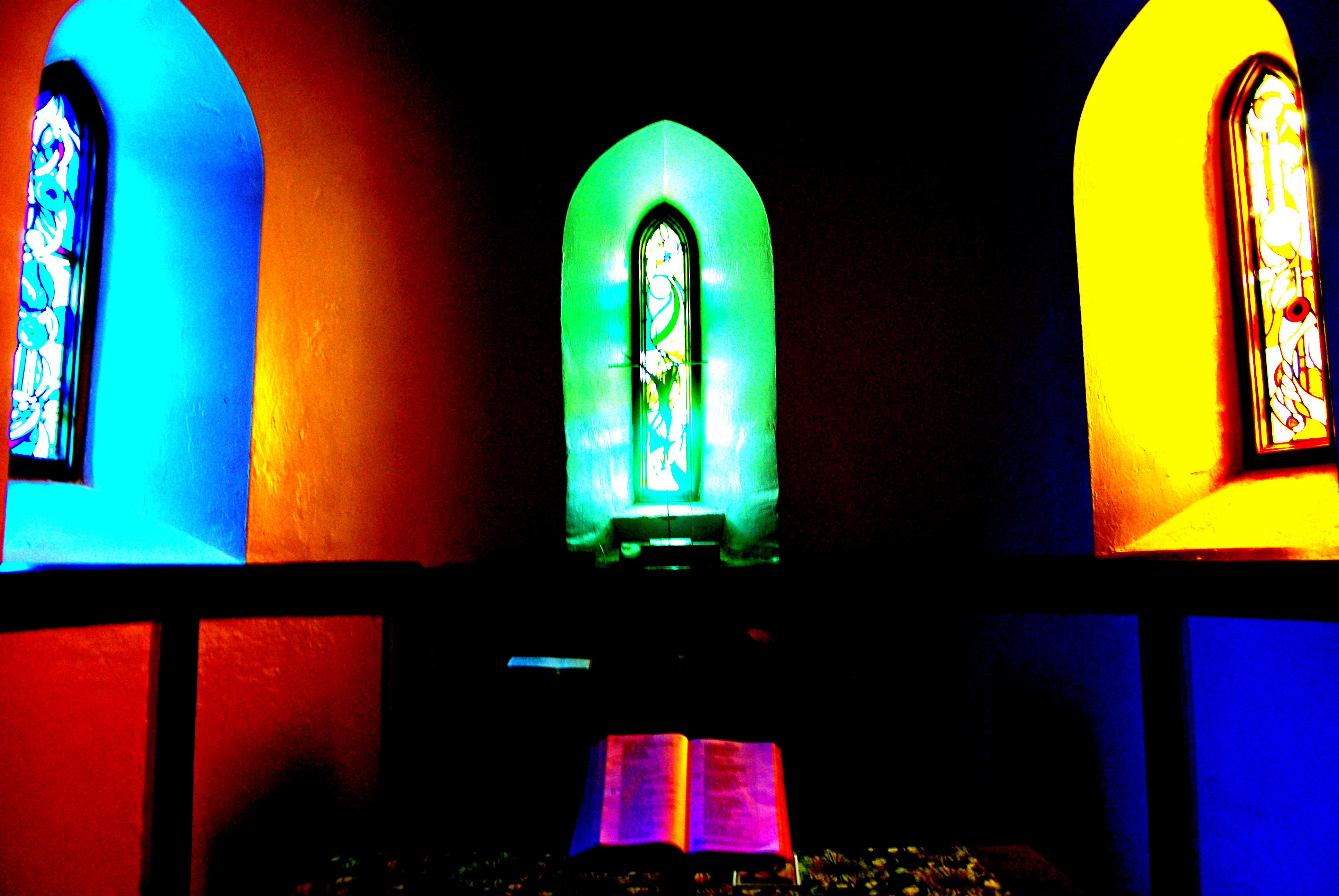
Interior, rock chapel, high contrast

Monday

(in the hills in the tiny rock chapel)

I intended to read some of the passages that Brian had given me, but before I did so I decided to listen to some music. I thumbed through the options of my Mp3 player and decided first on some choral music- that was enough to break open the floodgates, next I listened to black gospel, then Matt Redman- I was singing along and crying. Matt Redman had these constant references to breathing and breath, and each time I breathed there was a cloud of vapour mist. I spent nearly two hours in there in the end.

Tuesday

After lunch, a long walk- the sun is shining and I went over the other side of the main road, along some quiet lanes, and eventually up into the hills and forest, crunching the snow and putting up pheasants. I took no photographs, just put my head down and tramped. I think I must have walked around 6-7 miles.

On my return, after the bath, I was tired and a bit head achy and not feeling well. I did not go to the service.

If I go come home now, I would. Perhaps just as well that I can’t as who knows what the next few days will bring?

sheep, snow, hills

Wednesday

Time to go to the chapel and just be for a while.

…Back now after who knows how long- half and hour, and hour? I sat breathing out the words “Do not be afraid”, then the other translation “Peace be with you” words that Jesus seems to use a lot, and then I realised that I am not often at peace. I am usually either distracted (often with good things, but many times with trash) or slightly disturbed- chewing over things, picking at scars, hoping for things (particularly myself) to be better/more productive, more fulfilled…

…This afternoon and evening I did art. Lots of art! I am even sort of pleased with one of them… I am just back from the art space and it is nearly 11. I missed the service and everything.

Thursday

Went out to Labyrinth and sat in the hut to read Mark 4, 35-41 (Jesus Calms the storm) and Luke 12 12-32 (The rich fool and not worrying)

I liked this from the message; “…not to be so preoccupied with getting, so you can respond to God’s giving.”

There is the line too- “The father wants to give you the Kingdom itself!”

I went to the chapel for a while, then to the art space. Made a picture collage. Enjoyed it, and it more or less looks like I hoped it would. Needs a layer of PVA glue tomorrow. Also messed around with water colours- for the first time in years. Less pleased with those! I think I spent 7 hours in there- which went in a flash.

Friday

(with retreat guide)

We were talking too about reading the Bible, how a poetic reading of the Bible is different- no less truthful, but in poetry we read for a deeper truth. The words are just as precise, just as rich as any textbook, but they are set free to become active, even ambiguous. So it is that the words of God (as opposed the The Word) can come to lead us on and on and on. I suggested that I had often wished that the words of St Paul had been written as poems. “Or READ as poems” retorted Brian…

It is amazing how much we still communicate with others even in silence, or rather how much communication we perceive from others. You find yourself, after many silent days spent in the company of strangers, ascribing to them personalities based on clothes, body movement, smileyness and general demeanour. So there is one bloke who I have taken a dislike to as he stares malevolently at me, and seems to always push others out his direction of travel- particularly in the food queue. Then there is the shy woman who always scurries, and the self possessed at-ease-with-herself one. There is the man who wears expensive suits and exudes control and the nice bloke who I can only hold in the highest admiration for his willingness to fart at a silent retreat not once but three times- smiling benevolently throughout. I like him! What do they all make of me?

(after long journey in my head through Jesus death, theories of atonement…)

but this is enough for now. Pretty soon we are going to have a communion service, and I am going to take bread and wine.

Saturday

Met with Brian- told about yesterday- he gave me the death of Jesus again, then told be to be silent, and then read the resurrection! Followed by good old Thomas.

I was fairly lazy today- spent a slow morning in the bedroom reading the passages, then in the afternoon took a long walk on a loop round some roads, back into the fields, then a bath, and it was time to go out for a meal with Maggy.

Lovely meal, now just looking forward to coming home…

In reading through these fairly random excerpts, I am not sure that they fully communicate the richness of silence as a means to open up deep things of this world and the next. I was not always purposeful or fully engaged in my silence- I am a past master at going into my own skull and disappearing- part of the survival skills learnt in a troubled childhood. However, there was always a turn around, new thing to encounter. If ever things became ’empty’, I did something else- I headed for the hills, one of the chapels, or made some art.

Thanks to the lovely Brian McClorry there was also lots of humour to be had! He has an impish intelligence that often tripped over into glee with who God is.

If you are considering going on retreat- go for it. It is something you are unlikely to regret.

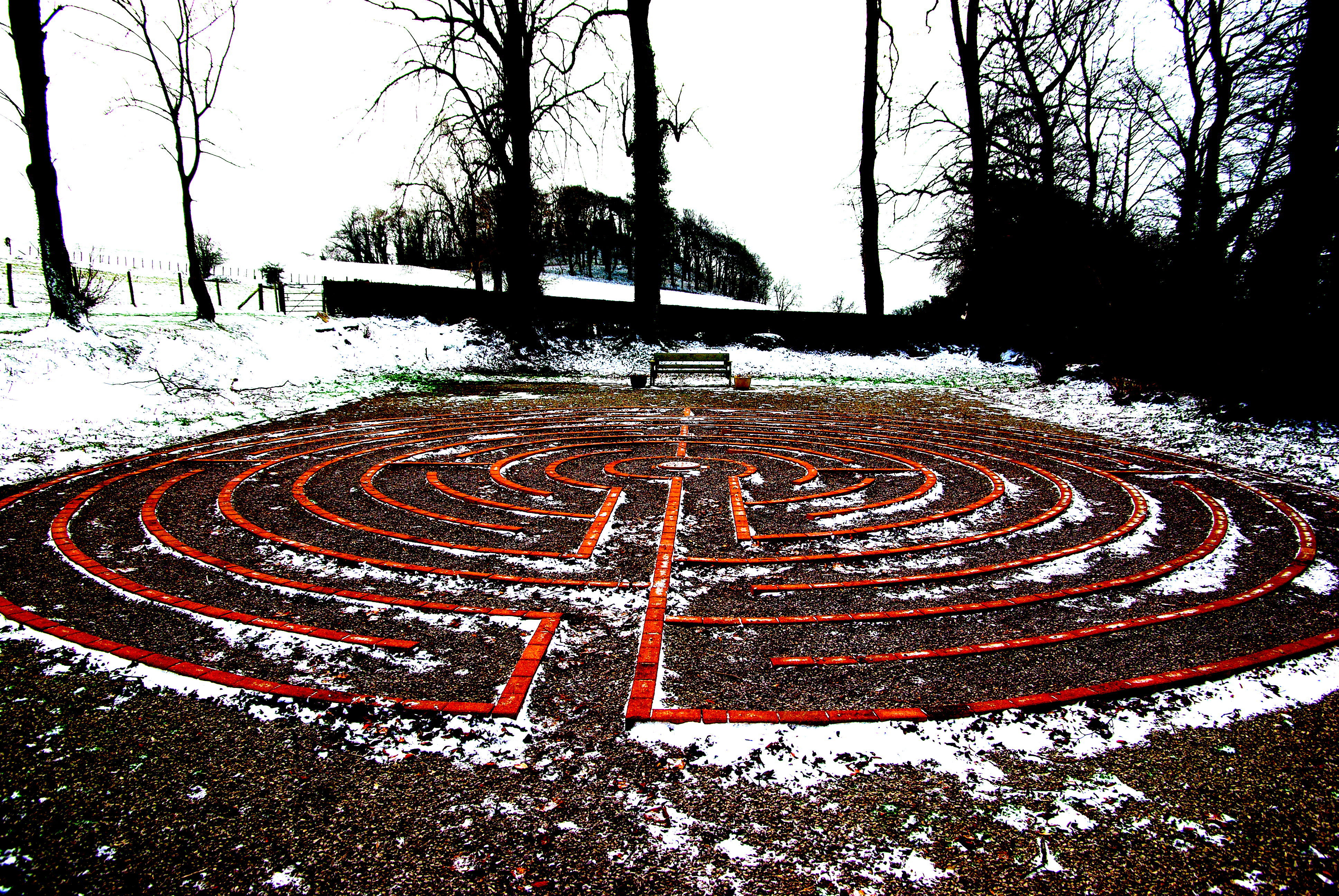
Labyrinth, St Beuno's, high contrast


I will posting a few more bits and pieces from my retreat over the next days…

Rediscovering silence…

spiritual_cinema_circle

On Friday (snowy conditions permitting!) I head off down to St Asaph, North Wales, to take an 8 day silent retreat at St Beunos Ignatian Spirituality Centre.  I suddenly know loads of people who are planning a retreat there this year- well, 4 or 5 anyway. It seems that the new direction of many of us who have been on a journey from evangelical/charismatic Christianity, via emerging/missional metamorphosis, is towards older forms of monastic contemplation- and silence in particular.

It is not surprising really when you think about it. People like me who have been immersed in leading worship have always been longing for a deeper connection with God. In the past the methods to connect have included the intense cauldron of ecstatic worship music, through to creating open spaces with non directive ‘stations’, or spending time in wild places watching the changing skies. The journey has been away from the large auditorium towards older, simpler traditions.

I do not think there is any kind of technique that gives us some kind of hot line to God. I do however remember the Abbot of Worth Abbey making statements about “silence being the window to the soul, and the soul being the window to God- it just works that way.”  It feels like the right time to test this theory- not just for me it seems.

Not without some apprehension however! 8 days in my own head. It might be an unpleasant place, a boring place, a dysfunctional place, a darn right depressing place. I expect to miss my home and family desperately. I expect to be tested and broken a little (or a lot.) Or worse than all of this, it could be an empty experience, a waste of time- a self absorbed narcissistic backwater.

Appropriately the Emergent Village minimergent yesterday was as follows;

If we were not so single-minded about keeping our lives moving, and for once could do nothing, perhaps a huge silence might interrupt this sadness of never understanding ourselves and of threatening ourselves with death.

Pablo Neruda

Hmmmm.

Being ‘spiritual’: it is bad for you?

sundial and one of the three Lichfield spires

“I am not religious, but I am spiritual.” How many times have you heard someone say this? I suppose, given the devaluation of the word ‘Christian’ with western culture, and the post-modern slide into an elastic pluralistic individualism it is one of those sentences that increasing numbers of us would use to describe themselves (as can be seen from the recent Census data.)

Despite my continued attempts to hold to the ways of Jesus, the idea of a religion-less spirituality appeals to me too; leaving behind all the baggage and rigidities of proscribed doctrine and setting off on my own spiritual adventure…

However, Sam Dawlatly kindly  sent me a link to a story in the Telegraph. Here are a couple of quotes;

People who said said they had spiritual beliefs but did not adhere to a particular religion were 77 per cent more likely than the others to be dependent on drugs, 72 per cent more likely to suffer from a phobia, and 50 per cent more likely to have a generalised anxiety disorder.

They are more likely to suffer from a range of mental health problems than either the conventionally religious or those who are agnostic or atheists, found researchers at University College London.

They are more disposed towards anxiety disorders, phobias and neuroses, have eating disorders and drug problems.

In addition, they are more likely than others to be taking medication for mental health problems.

Professor Michael King, from University College London, and his fellow researchers wrote in the British Journal of Psychiatry: “Our main finding is that people who had a spiritual understanding of life had worse mental health than those with an understanding that was neither religious nor spiritual.”

…The researchers concluded: “We conclude that there is increasing evidence that people who profess spiritual beliefs in the absence of a religious framework are more vulnerable to mental disorder.

“The nature of this association needs greater examination in qualitative and in prospective quantitative research.”

What is going on here then?

Firstly, we must look at the numbers a bit more closely- the study is not huge even though statistically significant;

The study was based on a survey of 7,403 randomly selected men and women in England who were questioned about their spiritual and religious beliefs, and mental state.

Of the participants, 35 per cent described themselves as “religious”, meaning they attended a church, mosque, synagogue or temple. Five in six of this group were Christian.

Almost half (46 per cent) described themselves as neither religious nor spiritual, while the 19 per cent remainder said they had spiritual beliefs but did not adhere to a particular religion.

Members of this final group were 77 per cent more likely than the others to be dependent on drugs, 72 per cent more likely to suffer from a phobia, and 50 per cent more likely to have a generalised anxiety disorder.

They were also 40 per cent more likely to be receiving treatment with psychotropic drugs, and at a 37 per cent higher risk of neurotic disorder.

The interesting thing is that this study is in contrast with a lot of previous research about the impact of religious belief on measures of psychological and sociological health- which sees faith has having clear benefits, even if more recent research has suggested that some of the self esteem benefits depend on the wider societal norms towards religiosity.

Accepting that this research may simply be a rogue study, there seem to me to be a few possible reasons why those who consider themselves Spiritual (but nor Religious) (SBNR) might appear to be vulnerable as a wider group.

Self selection

The link may well not be causal, but correlational. Perhaps those of us who are spiritually seeking outside the edges of organised religion are doing so because life has driven us there. Perhaps even our negative experiences of church has driven us there. It is hardly surprising that we might be seen to be stressed, troubled and even unwell. These things are not necessarily measures of the futility of the journey, but more part of any real human experience- part of the process of changing, becoming, learning to inhabit our own skin. We learn far more about ourselves in crisis than we ever do in prosperity.

The question might remain as to why this is NOT also the case for the religious? Are they not also  being challenged, shaped and changed by their contact with scripture/teaching/existential challenge? All I can say is that in my experience in Churches, this is rather rare. The pews offer comfort more than adventure.

In this sense, the idea of spiritual travellers on the road, nursing wounds on the way seems not necessarily a negative- rather it offers hope for our humanity. Despite it all, we still strive for connection with the divine.

Belonging

A lot of the presumed benefit of religion at  both a sociological and psychological level seems to be the given sense of belonging, of inclusion and connection to a wider family. Even accepting that in-groups can have all sorts of other problems, this benefit appears to be rather universal. It should not be surprising then that those who are attempting spirituality without community do not experience this benefit.

I have written elsewhere about my conviction that we experience the divine through scripture, through revelation, but perhaps most through community. We humans were made to love- and this is not an abstract proposition divorced from the mess of human contact. Nothing strips us bare, opens us up, sustains us, breaks us down, wounds us, heals us, like community. I also beleive that our approach to theology should also be one of ‘small theologies’ (HT Karen Ward) worked out in community- in respect of ‘big theologies’, but not enslaved to them.

Having said that, it seems that there are surface benefits too in just demonstrating some kind of collective respectability- even if this depends on a wider societal respect for the religious badge that we wear. I confess to less concern about this kind of religiosity. It sounds too much like the stuff that Jesus had no time for.

The lesson here then might be to encourage our spiritual seekers to connect with one another. In these times of total (but fleshless) communication, the deeper community connection described above is a rare commodity, and where it happens it is a precious flame that we should nurture.

Believing

Finally, I have been thinking about the nature of faith itself. We have many models- faith as journey, as destination, as therapy, as national identity, as absolute truth, as means of rescue from hell. From the outside all of these organised expressions of faith appear rigidly codified, doctrinal, dogmatic. They seem to demand blind observance of rules and regulations often policed by male power. Small wonder that we would be suspicious about joining such an organisation. Small wonder that pilgrims remain outside the sites of pilgrimage.

However, I am reminded of this;

Spirituality requires context. Always. Boundaries, borders, limits. ‘The Word became flesh and dwelt among us.’ No one becomes exalted by ascending in a gloriously colored hot-air balloon. Mature spirituality requires askesis, a training program custom-designed for each individual-in-community, and then continuously monitored and adapted as development takes place and conditions vary. It can never be mechanically imposed from without; it must be organically grown in locale. Askesis must be context sensitive.

Eugene Peterson

Under the Unpredictable Plant

Perhaps like others who are more comfortable with being SBNR I prefer to regard faith as a journey of engagement with the God-in-all-things. To look for the marks left by Jesus on the whole of creation. But in doing this, It has become clear to me that in order to journey we need a means to travel. We need a road, and shoes to walk it with.

Like it or not, this means of travel is religion.

It is the corrective to the self centred me-first spirituality that can often characterise SBNR journeying. You know what I mean- a pick and mix spirituality tailor made to make me feel better about the choices I have made, and the lifestyle I want to live. A situation where morality and love of strangers are elasticated around our own comfort zone. (Not that these characteristics are not to be equally found in churches of course!)

It challenges us towards connection to others who have journeyed first.

To all of those SBNRs out there- I think you are the hope and the conscience of our generation. The depth and meaning you find in the mess of western civilisation will be recorded in art, law, history and handed on to the generations to come- so may you journey well…

journey's end

Return to Kanyini…

A few years ago I wrote about this film on TFT;

Back in 2008 I wrote this;

The concept of kanyini has been brought to us by a beautiful man called Bob Randall who grew up as an aboriginal boy on the outskirts of a cattle station in central Australia. His father was a farmer of Scottish extraction, but appears to have had no concern for him at all. Like 50,000 other black kids of mixed race (between 1910 and 1970) he was forcibly removed from his mother, and sent to school hundreds of miles from home. He was forced to learn the rules of white culture- the clothes, the way of life, the religion. He learnt to appreciate the contradictions between the words of Jesus, and the actions of these, his followers. Since then, he has been a welfare worker, a songwriter, and author, and now, works with Australia’s black community.

To be a native Australian in these times is to be part of a community with huge problems- health, crime, substance misuse, soaring suicide rates. It is a community living in the shadows of the sky scrapers of new Australia, but also in the shadow of genocide, in which everything ans almost everyone who was part of the oldest culture in the world was all but destroyed.

It is also the story of a Diaspora of westerners (particularly Celts from Ireland and Scotland) often still under the shadow of their own experience of oppression and injustice, who become in turn the oppressors, murderers and rapists of a whole culture.

It is their story, but it is also ours. It is the story of what happens when we become disconnected from who we are.

Because to hear Bob Randall speak is to feel the pull of something wonderful. He describes a culture where people are connected to land. Birds, trees, all living things- they are family. The proof of this connection is that we are… alive! And because everything is connected, everything is OURS, not MINE. Everything is already created in a perfect state and our job is to become part of it.

Bob describes his memory of life as a kid like this;

These were beautiful people, because they lived in a beautiful way.

Bob’s concept of Kanyini feels right. It has simple truth- and seems to encapsulate the idea of community as I understand it should be. It has 4 components;

  • belief system

  • spirituality

  • land

  • family

I am reposting this partly because I found the film in full (as above), but also because I think that this list is a good one to consider as we look again at the year to come this is a good place to start.

If life for the people in this film started to unravel as they lost connection with the things above- might the same be true for us?

How do we challenge this, for ourselves and our communities? Our connection to something we can believe in/live for, our connection to the divine, our love of where we are located, our existence within an extended family (whether or not we have blood ties.

May 2013 be your year of Kanyini.

Reflections on the census- the end of Christendom…

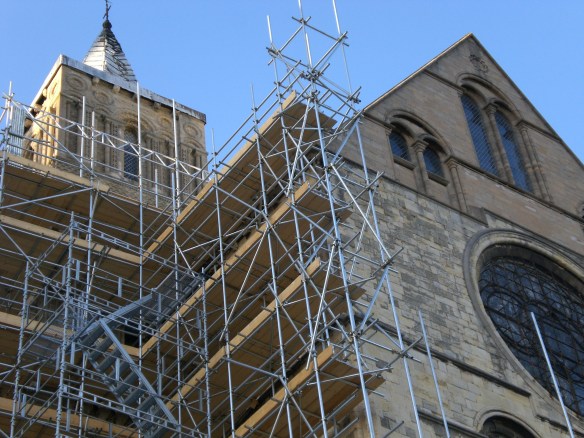
a church under reconstruction?

So, there have been a number of articles and opinion pieces reflecting on the recent 2011 census data, and what it tells us about the nature of religious belief in the UK. Here are some of the head liners in case you missed them;

• The number identifying themselves as Christians is down 13 percentage points. In 2001, 72% (37.3 million) called themselves Christians. In 2011 that had dropped to 59% (33.2 million).

• Interestingly, Christianity is not down everywhere. Newham, Haringey, Brent, Boston and Lambeth have all shown increases in the Christian population.

• The number identifying themselves as having no religion has increased by 10 percentage points from 15% (7.7 million) in 2001 to 25% (14.1 million) last year.

In response, Humanist Nick Cohen, writing in The Guardian, said this;

The number of people who say they have no religion jumped from 15% in the 2001 census to 25% in 2011. If the remaining 75% were believers, this leap in free-thinking would be significant but not sensational. But those who say they are religious are not faithful to their creeds, or not in any sense that the believers of the past would have recognised. Church attendance is in constant decline. Every year that passes sees congregations become smaller and greyer…

…When millions of people tell the census takers they are “Christians”, therefore, they are muttering the title of a childhood story they only half remember. What is more, their spiritual “leaders” know it. Long before the census figures were in, you could hear the screams that always accompany ideologies and institutions history is leaving behind…

…while everything is changing in British society, nothing is changing in the British establishment. England still has a “national” church – even though in 2010 its average weekly attendance was down to 1,116,100 (or 1.8% of the nation’s population). Twenty-six Church of England bishops are automatically granted seats in the House of Lords to support or oppose any legislation they please. On top of the decaying heap sits Elizabeth II: a grumpy priestess-queen, who in theory at least is the state religion’s “supreme governor”. In the education system, almost one-third of state schools are run by religious authorities (and Michael Gove will ensure that number will rise).

This humanist perspective is not without merit. Much of the institutions of religion in the country are indeed relics of a time when religious power was inseparable from the power of the State. Church and Government were connected by bonds at every level. The Church marked out comings, our joinings and our endings. The shape of the religious calendar became the shape of our working life. The very law of the land was approached through (an often flawed) Biblical interpretation.

But this link between ordinary people and institutional Church has been in decline for years. Perhaps the last vestige of this kind of Christendom in the life of the UK was that people who otherwise had no connection to Church, and no active faith journey, would still describe themselves as ‘Christian’. People did this almost by some kind of inherited instinct. The be Christian was to be decent, British, middle class, well mannered, one of ‘us’.

However,  the rigidity exhibited by some parts of the religious hierarchy is increasingly at odds with the culture that it is part of. There are the totemic issues- homosexuality, gender equality. There is the lack of a critical or analytical voice in a time of consumerist economic meltdown. There is the swing towards ultra conservatism in the Catholic Church, and all the sexual abuse scandals that diminish all organisations of faith.

The time for hand wringing and desperate attempts to preserve what Church used to be is long gone, although there are still people who have a passion for preserving the traditions of our institutions. And perhaps we should be grateful to them as they are a repository for our organisational memories. Without them, we lose our connection to tradition, and all the rich variety of previous experience. But it is not enough for faith to be in a museum cage. It is not enough for faith to be an abstract historical curiosity.

I have been chewing on what this might mean for those of us who still try to follow in the way of Jesus. Here goes;

Lies and Statistics.

It is perfectly possible to understand these figures as a reduction in nominal Christianity. A reduction in people identifying with a label that has no relevance to life. In this sense, perhaps there has been no real change in the last ten years- apart from the words we chose to describe ourselves with.

The word ‘Christian’.

It is however significant that people no longer what to wear this as a badge. It is a devalued word, a word that appears to have gathered to it lots of connotations that people have less use for. Ideas of stuffy right-wing judgementalism. A word that has no relevance in the here and now. It is a word that even I use to describe myself with some discomfort. But a decision to walk in the way of Jesus is not an easy choice- he was very clear about that. It is a decision to make an ever new daily adventure, and this is so much more than wearing a comfortable middle class badge.

Incarnation.

The Church is not the place where God resides in these islands- rather he lives in us. The Hebrew Temple was replaced by the human heart. He took on flesh and dwelt amongst us. In and over and through. Along with us and despite us. In the cracks of everything we are. This is not a numbers game- who cares how big your corporation has become?  This is now to be tested in new ways, in a new context.

Mission.

At some point, probably around the time of the Roman Emperor Constantine, the Church became an instrument of the state. The mission of the Church was the mission of the State. God was co-opted by the people in power. We then spent Millenia trying to disentangle the mess of this- movements would rise, then they would fall, or become assimilated. But perhaps we are now in new territory- the mission of God can be set free again in the minds of we his followers. It is not to the strong that the Kingdom belongs, but to the week, the poor, the broken.

Finally however, I find myself taking a more sociological perspective. If nominal religion anchored in the State is in decline this may be no bad thing for faith- but I still wonder if it may be a bad thing for the State.

The Church contains us, or used to. Old Emile Durkheim captured this well- he suggested that people need to be part of something bigger- to be integrated and linked and that when this begins to break down the end result is anomie (a lack of social norms) leading to a time when the anchors and moorings that hold us together are gone.  He believed that anomie is common when the surrounding society has undergone significant changes in its economic fortunes, whether for good or for worse and, more generally, when there is a significant discrepancy between the ideological theories and values commonly professed and what was actually achievable in everyday life- which to my mind describes British society in 2012 pretty well. (There is a great article discussing some of these ideas here.)

Durkheim thought that religion was one of the key social mechanisms that created these bonding social norms. However, he also thought that these old bastions of society where in decline- that the institutions of faith were dying. However at the same time he also thought that they were being replaced by new forms of sacred passions.

The question is- where are these to be found in our society? It is easy for cynics like me to rail against consumerism, ephemeral celebrity entertainment and post modern fluidity of connection and belief, but the story is more complicated.

There is a groundswell of goodness in British society. Some of is might well have roots in Christian traditions and ideas, but we see a turning towards simple living, small community life, and a rising up against the power of the big banks through the Occupy Movement.

We the followers of Jesus always have to find our own mission, our own Peregrinatio.  Here is my prayer for the journey;

Lord stain me with salt

Brine me with the badge of the deep sea sailor

I have spent too long

On concrete ground.

If hope raises up these tattered sails

Will you send for me

A fair and steady wind?

The ‘Shaping of Things to Come’ event, reflections 1…

shape


I attended this event yesterday, and will post a couple of reflections on things that were said.

I was slightly reluctant to go- partly because I was not sure just how much a couple of blokes from Australia and South Africa could really tell me about future development for church in Scotland. In this, I think I was partially right- both Frost and Hirsch spoke very well about their developed passions- each linked in with piles of books available at the back of the room, which is fair enough I suppose- both have a living to make. However, the groove that the books gave to the themes were general, not specifically tartan.

There was a considerable contrast in the styles of the two men. Hirsch was more technical, more given to making categorical statements gleaned from Scriptural interpretation. I confess to finding this a little alienating. Frost was passionate, inspirational and well practised with each story and each illustration.

It has been a while since I was in the presence of so many professional Christians. I would reckon that 90% of the people there (around 100-150) were in some form of ministry. The impact of days like this on the shape of the Church in Scotland has the potential to be significant then. I think that most of us who attend events like this are already quite well versed in the nuts and bolts of the arguments. We have read (at least some of) the books, and have had an eye constantly on the state of the Church for years. What we tend to do then is to take away a few nuggets of issues to chew on further. These will of course be different, but here is the first of mine;

Hirsch began the day by talking about the ‘Five Fold Ministries’ from Ephesians 4;

10 He who descended is the very one who ascended higher than all the heavens, in order to fill the whole universe.) 11 So Christ himself gave the apostles, the prophets, the evangelists, the pastors and teachers, 12 to equip his people for works of service, so that the body of Christ may be built up 13 until we all reach unity in the faith and in the knowledge of the Son of God and become mature,attaining to the whole measure of the fullness of Christ.

Hirsch’s contention was that Churches could not grow without a recognition of the importance of each one of the ministries of church- what he called APEST- Apostles, Prophets, Evangelists, Shepherds and Teachers. He suggested that many of these roles have been scandalously neglected by institutional church, and that because Ephesians 4 is foundational we do this at our peril.

He also said that although this is not a ‘silver bullet’ to deal with the monster of secularism and church decline, it is a ‘sliver telescope’. Without these things, we can achieve neither unity nor maturity.

My perspective skews my response to this kind of analysis. I am much more interested in church-at-the-edge, church-in-the-gutter, church-around-the-dining-table. These kinds of churches are very resistant to grand labels. Neither am I sure that Paul’s list is either foundational or fully inclusive of all the leadership roles that Church (with a big C) requires.

To be fair, Hirsch did point out that Ephesians was a letter sent not to a church in strife, or in need of outside correction, but rather to a collection of small house groups, full of very ordinary people. We are not talking Megachurch here, where individuals are raised up high on some kind of spiritualised stage. This might suggest that people who contain within them the different gifts are fully formed mature versions of the same- more that this is their starting point towards any goal.

This is where I think that the analysis has some use. We have become very used to all those personality tests, seeking to codify and categorise our humanity- often to understand better how we fit together, how we approach different issues in different ways.  So it may be with these ‘five fold’ ministries- each one looks at the Gospel from a different perspective- each one is a different mode of awareness, or form of intelligence. Here is a little more on how this might work for each one (with some of my own thoughts about the perspectives they bring);

Apostles are people who feel the ‘sentness’ of church. They keep the movement intact, guard and maintain its integrity, see the big picture.

They have to deal with personal issues and structural issues about the use and misuse of power.


Prophets are people who are highly sensitive to the spiritual depth of a situation. They listen to the voice of God. They often might use art or writing as a means to display and engage with these issues. Hirsch used the phrase ‘Canaries in the mine’- the first to sense problems, the first to notice the change of atmosphere.

They can also be difficult, awkward individuals who upset others around them.


Evangelists are recruiters to the cause- gifted communicators and networkers. Without them a movement can not grow.

They can also be driven by the buzz of the sale room, and the conquest of another closed deal.


Shepherds are people driven to heal, to care for, to nurture and to protect. They feel the needs of others around them deeply. They keep the peace.

They can also become worn down by the brokenness of other, and tend to lose the big picture because of the intensity of the small ones.

Hirsch suggested that the church has overemphasised this ministry- all those ‘pastoral’ positions in church, and points out that the Greek word associated with this gift is only very rarely (one or two) times used in the NT.


Teachers connect the dots, help others understand detail.

Most of the time this word is used in the NT refers to ‘false teachers’- pointing to the danger of what happens when ideologues get hold of the gospel and use it as a web to make their own power.


The interest for me in all this is two fold. Firstly I will talk to my friends about how this might relate to the skills gifts and characters that we have. It might be a useful way to recognise and uphold/encourage individuals.

Secondly,  it might be a useful tool of analysis- to take a look at our activities through different sets of lens.


Everyone needs heroes…

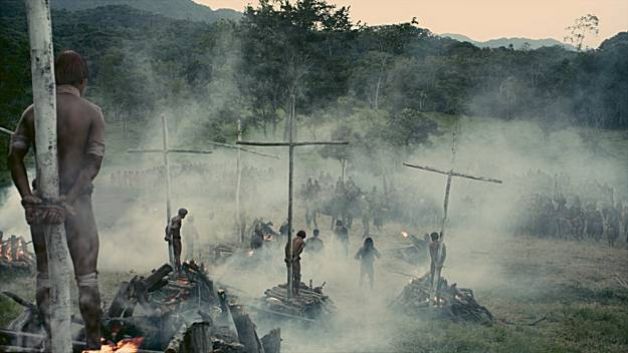
I watched a lovely film the other night- a Spanish language film called Even The Rain.  

A Spanish film crew helmed by idealistic director Sebastian (Gael García Bernal) and his cynical producer Costa (Luis Tosar) come to Bolivia to make a revisionist epic about the conquest of Latin America – on the cheap. Carlos Aduviri is dynamic as “Daniel,” a local cast as a 16th century native in the film within a film. When the make-up and loin cloth come off, Daniel sails into action protesting his community’s deprivation of water at the hands of multi-national corporations.

When riots break out in Cochabamba, protesting excessive fees for water, production is interrupted and the convictions of the crew members are challenged. Sebastian and Costa are forced to make an unexpected emotional journey in opposite directions.

It may sound a bit ‘worthy’, but it was very well made, well acted, and full of sharp irony. The crew were fired up by the injustice and genocide waged on the indigenous people of the new world by the Conquistadors, but found the modern day equivalent injustice inflicted by poverty and multinational corporations almost invisible.

Along the way we heard a lot about Bartholme de las Casas.  

I confess I had never heard of him. I have been fascinated (and horrified) by how the conquerors of the New World were able to believe that they were doing God’s work as the slaughtered and plundered in the name of the Holy Empire. It is refreshing and inspiring to discover a man of God who called it for what it was.

Arriving as one of the first settlers in the New World he participated in, and was eventually compelled to oppose the atrocities committed against the Native Americansby the Spanish colonists. In 1515, he reformed his views, gave up his Indian slaves and encomienda, and advocated, before King Charles V, Holy Roman Emperor, on behalf of rights for the natives. In his early writings, he advocated the use of African slaves instead of Natives in the West-Indian colonies; consequently, criticisms have been leveled at him as being partly responsible for the beginning of the Transatlantic slave trade. Later in life, he retracted those early views as he came to see all forms of slavery as equally wrong…

Bartolomé de las Casas spent 50 years of his life actively fighting slavery and the violent colonial abuse of indigenous peoples, especially by trying to convince the Spanish court to adopt a more humane policy of colonization. And although he failed to save the indigenous peoples of the Western Indies, his efforts resulted in several improvements in the legal status of the natives, and in an increased colonial focus on the ethics of colonialism. Las Casas is often seen as one of the first advocates for universal human rights

Don’t forget that all this was taking place 200 years before Wilberforce, our great protestant anti slavery hero.

Neither was Casas alone.

In September 1510, a group of Dominican friars arrived in Santo Domingo led by Pedro de Córdoba; appalled by the injustices they saw committed by the slaveowners against the Indians, they decided to deny slave owners the right to confession. Las Casas was among those denied confession for this reason.[14] In December 1511, a Dominican preacher Father Fray Antonio de Montesinos preached a fiery sermon that implicated the colonists in the genocide of the native peoples. He is said to have preached, “Tell me by what right of justice do you hold these Indians in such a cruel and horrible servitude? On what authority have you waged such detestable wars against these people who dealt quietly and peacefully on their own lands? Wars in which you have destroyed such an infinite number of them by homicides and slaughters never heard of before. Why do you keep them so oppressed and exhausted, without giving them enough to eat or curing them of the sicknesses they incur from the excessive labor you give them, and they die, or rather you kill them, in order to extract and acquire gold every day.”

These men were serving the Kingdom of God in the shadow of the Empire, and for this we can call them Heroes.

New name, new logo…

We are really pleased with the new logo for our wee collection of micro enterprises.

We have been developing bed and breakfast rooms, self catering accommodation, retreats, crafts and craft workshops, pottery and more over the last few months. We needed something to tie it all together. At first we used the house name (Sgath an Tighe, meaning ‘shelter of the house’ or ‘house of shelter’) but increasingly we thought that it might confuse slightly as people cannot pronounce or spell it!

Eventually we came up with ‘Recreate’ as a name- with all its implications for creation, creativity, starting again, and making use of recycled materials.

Hence our business website will be transitioning to branding around the new name, and will use a new address of www.recreate-argyll.co.uk

Here is the art work, by Simon Jones, who we would highly recommend to others on the look out for some branding/graphic design work.