Jim Crow repainted- again…

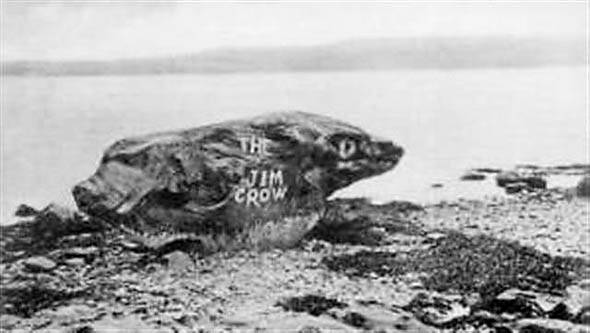
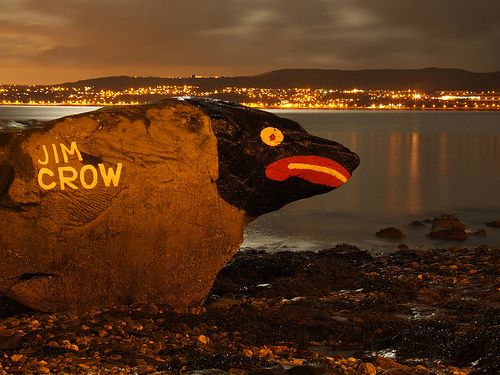
So- another twist in the local debate about a painted rock on the Dunoon shoreline.

Photo c.1900

The rock has now been defaced twice by someone who decided that direct action was required to highlight the murky history that may be behind this local land mark. Local politicians have expressed their outrage-

Councillor Bruce Marshall, chair of the Bute and Cowal Area Committee, told the Standard on Tuesday: “I was unaware that Jim Crow had again been defaced and find it hard to believe that anyone can be so petty.
“Jim Crow has been a landmark on the foreshore at Hunter’s Quay all of my life and I would not like to see it permanently lost.”

From Dunoon Observer.

Two people were seen yesterday redecorating the rock with its golliwog face.

The local paper has dealt with the issue in a rather lazy and partisan fashion. It reads like the reporter was looking for a way to dismiss any concerns about the rock, and seeking to interpret history in this light. A quote from the article

In an age where international news was not widely spread, it is unlikely that Dunoon people knew about these laws when the rock was originally painted, possibly around 1900.

It seems more likely that the rock was originally named after a Thomas Ingoldsby rhyming story The Jackdaw of Rheims. which was popular in Victorian times, The poem, about a particularly pious jackdaw made ito a saint, ends with the stanza:

And on newly-made Saints and Popes, as you know,

It’s the custom, at Rome, new names to bestow,

So they canonized him by the name of Jim Crow!

The research the local reporter has done seems to ignore the pervasive influence of ‘coon songs‘ and ‘black face songs’ in the Victorian and Edwardian music halls (right through to the dreadful black and white minstrel shows that were on TV in the 1970’s.)

People in Dunoon, and holiday makers from the big city who flocked here around the turn of the 20th Century, probably did not know much about the Jim Crow laws, but they would have known that ‘Jim Crow’ was a derogatory caricature of a black man.

As for the Jackdaw of Rheims– written by Rev Richard H Barham (under the pen name Thomas Ingoldsby,) it makes one reference to Jim Crow- as part of a long poem about a Jackdaw. Here is the question- why did Barham use this name? The song ‘Jump Jim Crow‘ was a huge international hit, with sheet music sold over all the world- carrying the caricature everywhere it went. The song was written about 5-10 years before the Jackdaw of Rheims was published.

The Observer reporter appears to assume that before the internet, before radio and TV, communication of ideas like this between continents was unlikely- that there could be no real exchange of ideas between sleepy Dunoon and America. This is to totally misunderstand our history-

Looking back from a totally different culture and time, there is no blame that can be attached to whoever first crudely decorated this rock and wrote ‘Jim Crow’ on its side. It was probably a bit of holiday fun. Using terms and prejudices that were so pervasive that they were hardly noticed.

The issue remains how we come to understand the symbolism contained within this image now– how we engage honestly with our past.

And this rock gives us an opportunity to do just that.

I notice that the local paper did not quote this-

“… there can be no doubt that the painting of the ‘face’, with its exaggerated red mouth, is a typically caricatured image of a black person, as popularised by the American entertainer T.D. Rice in the nineteenth century. […] I feel certain that black visitorsfrom outside would see this as somewhat insulting […] as a derogatory reference to their skin colour and origins.”

Institute of Race Relations.

So –  are we sure that this is just a little bit of harmless local colour? And even if it is just that- are we really comfortable with the associations that are being made, and the offence that this might carry to the descendants of slaves who had to fight on for generations against the oppression of the Jim Crow laws?

If the rock is to stay, then we need to tell these stories.

If we are to keep the face on the rock- then let us also put a big sign on the foreshore dealing with the darker side of our past…

Social work and stress…

Social work is a job for young people. Mostly.

A few survive into their 40’s- possibly by specialising, or (oh dear- like me) becoming a manager, but on the whole, the nature of the job, and the political/economic/social environment we work in simply burns people out.

It is a slow process- and is poorly recognised even within the profession- as it is usually manifested in a loss of effectiveness and responsiveness- and in these days where performance targets dominate every area of practice, this kind of thing wins you no friends in busy teams.

It is a process that must be difficult to understand when you have never been involved in this kind of work. Some of my friends have a go at me as being in an easy lazy public sector job, often in comparison to their ‘real’ jobs. I smile, but inside I want to have a bit of a go back- and ask them to try doing what I do for a while…

I want to ask them who they think will do the jobs we do if we do not?

Who will visit a family living in squalor because of an alcoholic parent?

Who will look after an old cantankerous man who has become to infirm and confused to get out of the house, and has been unable to manage to get himself to the toilet for the last few weeks?

Who will try to build relationships of trust with the people on the margins of society who have lost all social connections?

…etc etc.

Because in devaluing the people that do these things, we potentially devalue the people who need the help.

I read this today-

“Modern social work is in a state of crisis. It has always been a profession towards which society has displayed ambivalence and it is now grossly underfunded and understaffed. Tragedies and subsequent vilification of social workers and their managers are reported with increasing frequency. The profession attempts to function in an environment of obstructive administrative ‘systems’, … severe financial restrictions and conflicting demands …” –Davies, p. 9, Stress in Social Work (1998, Jessica Kingsley Publishers).

“Because they deal in actual and emotional injustice, and actual and psychic injury, the reality for social workers much of the time is that while they may bring about some relief or improvement, the most that they may hope for is some damage limitation, particularly in areas such as child abuse and criminality.” —Davies, p. 19, Stress in Social Work (1998, Jessica Kingsley Publishers).

This is a familiar picture to me. Add to this the fact that the cut backs in public spending are making things worse. I am about to lose my job for the second time in 2 years through ‘reorganisation’. Quite what I will be doing in 2 years I have no clue.

My colleague recently had a health check and was told her blood pressure was very high. A retest suggested that this might just have been temporary as a result of a particularly bad day.

‘I think I am going to take the blood pressure test with a pinch of salt’ she suggested, and then realised what she had said.

We laughed.

Thank the Lord for companionship and good colleagues. As long as we can hold on…

The battle against racism returns to Dunoon’s foreshore…

There is a rock about a hundred yards from where I live that has been decorated for about 100 years like this-

I have previously described some of the controversy that surrounds this rock (here and here.)

I recently came across another website run by someone I know in Dunoon, which was set up as a result of his concern about what the history and symbolism of the rock might mean…

He quotes someone called Dr Waters from the Institute of Race Relations as saying this-

“… there can be no doubt that the painting of the ‘face’, with its exaggerated red mouth, is a typically caricatured image of a black person, as popularised by the American entertainer T.D. Rice in the nineteenth century. […] I feel certain that black visitorsfrom outside would see this as somewhat insulting […] as a derogatory reference to their skin colour and origins.”

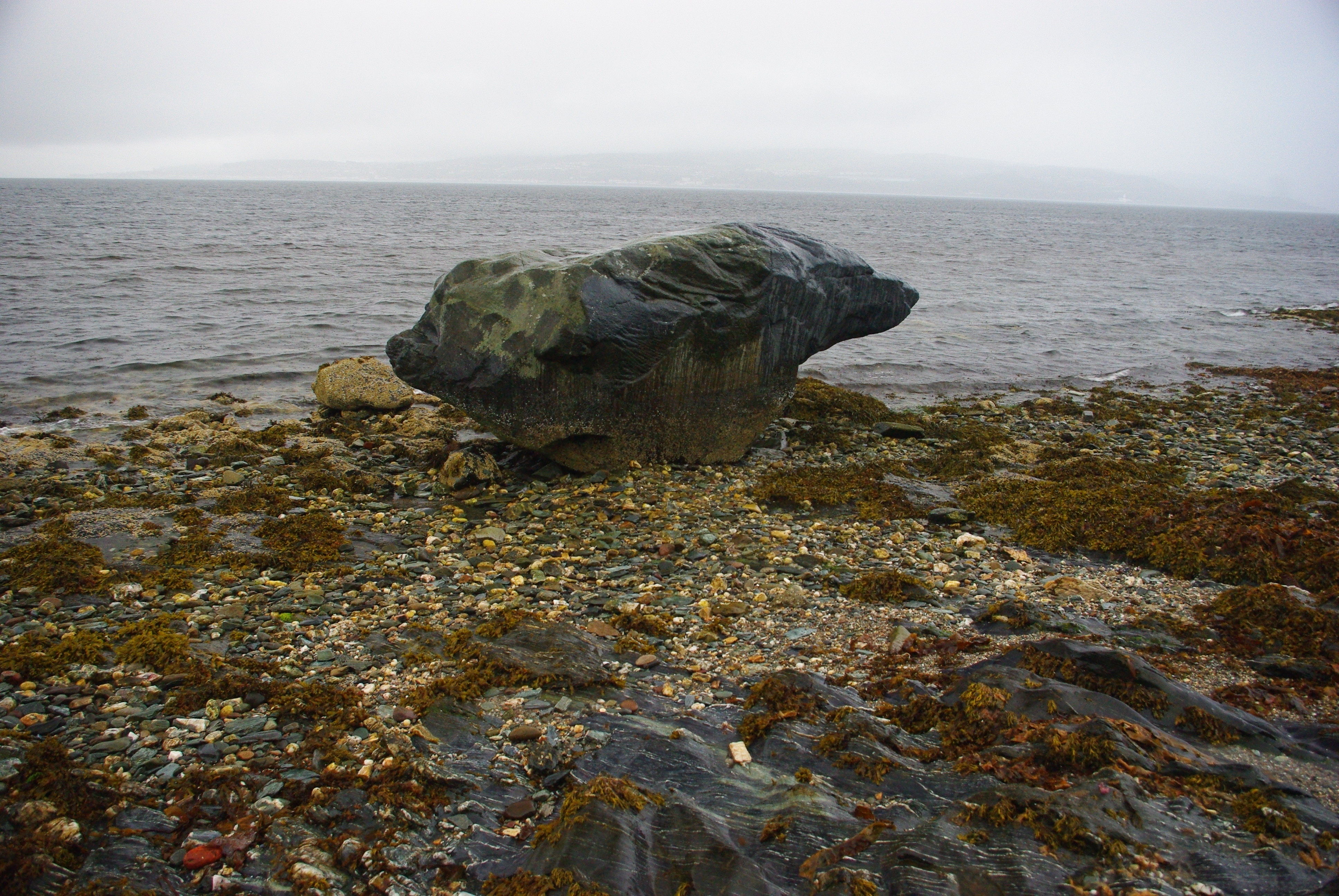
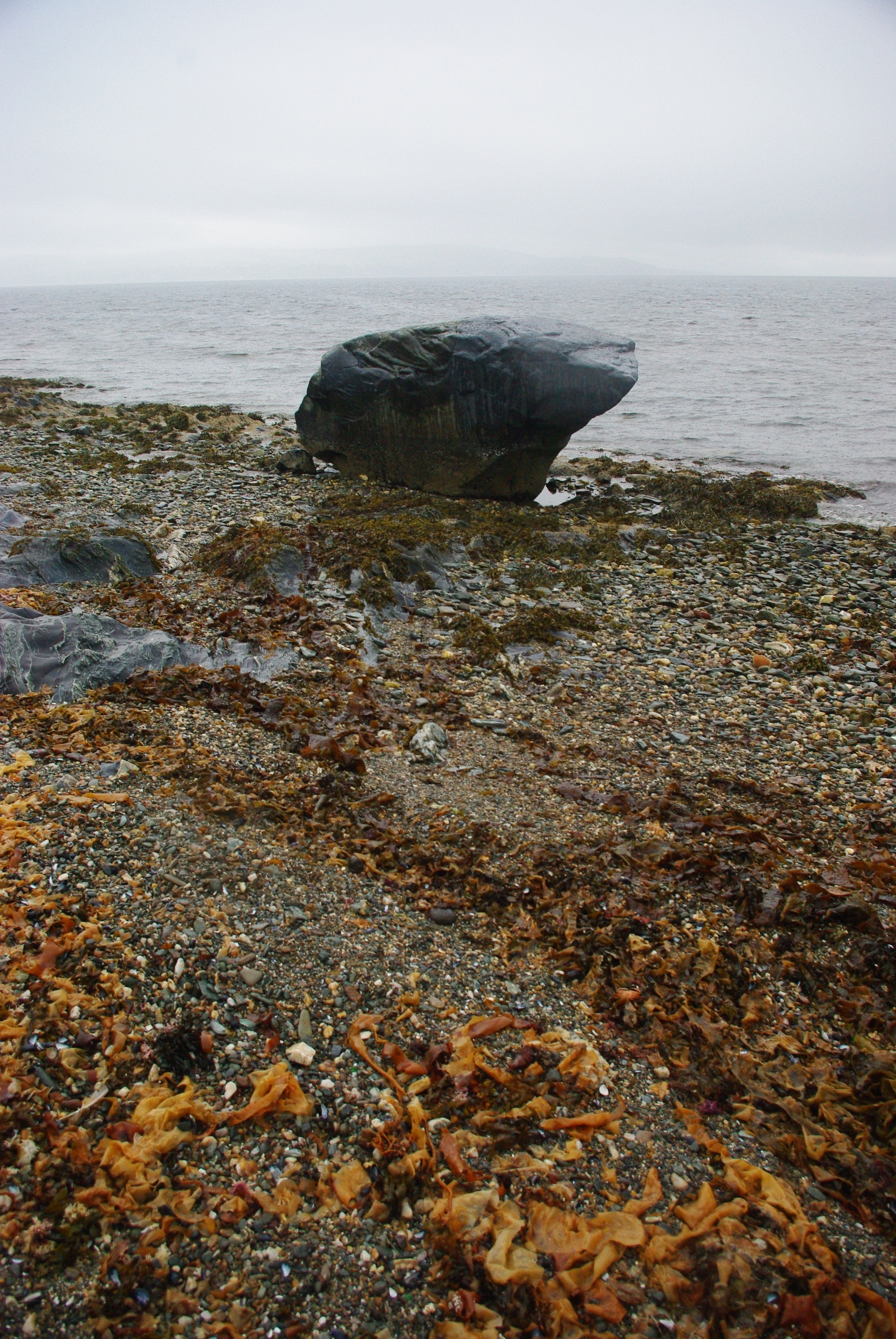
Last year someone took matters in their own hands and painted out the rock with some brown paint. They did a rather good job, and it was hard to tell that it had ever been decorated.

And as the local furore raged, someone else simply redecorated it as above.

Well, last night someone revisited the rock- this is what it looks like today-

Is Dunoon a racist town?

No more than any other I would say- although the largest ethnic minority here are the English, and we have a measure of anti-English sentiment like most places in Scotland. But narrow mindedness and prejudice are a feature of all our human communities and perhaps in small isolated towns like mine they can be long lasting.

There are not many black faces here. However, there used to be an American Naval base here until around 15 years ago, and there were lots of black American servicemen here then. Stories of race riots and segregated drinking are part of the local folklore. As are fond memories of the life and vitality brought to our community by people from African American origin.

Quite what these servicemen thought about the rock, I would love to know. Where they so used to such images that it was unremarkable? Were they told not to protest by their command structure? Or did it carry no racist meaning for them?

I hope that this latest act of direct action might yet highlight the meaning of ‘Jim Crow’ for Black Americans to people in Dunoon.

Because I think that we have should challenge prejudice wherever we find it- whether or not it is unintentional, or inherited from a previous generation with a different world view.

Rehearsing for old age…

The kids are away for a week on holiday with some friends. Gulp.

They will have a lovely time, but it is strange for M and me. We have not spent so much time alone for 14 years.

Today a storm blew along the Clyde and interrupted our industry. A blessing in wind and rain, gifting us with a slow Sunday morning reading, listening to music and snuggling on the sofa.

These days are rare indeed.

And how blessed I am that I get to share mine with M…


Today we rehearsed old age

And it was lovely

.

Our bones went soft

And our muscles ceased their strain

.

There is a storm on the old river

And kind grey light makes

Our faces take on

Graceful lines

And shadows

.

You on the sofa

And me in my chair

.

Today we rehearsed old age

And it was lovely

Greenbelt 2010- ‘Here comes everybody’

I spent a few hours yesterday making a start on constructing something for Aoradh’s worship collaboration at Greenbelt festival.

We are working with Safespace and Sanctus 1 to plan a day long worship event around the general theme of community- the people we journey with- with the title of ‘Here comes everybody’ after a Clay Shirky book title.

Part of this involves setting up a big loom in the middle of the room, and getting people to weave their communities into a tapestry- writing names on strips of cloth. Something like this I hope-

The horizontal lines will represent the presence of the Spirit of God- the attributes and fruit of the Spirit. The horizontal ones represent the communities and individuals that make up our lives.

I have been using saplings that I cut last year-

Cleaning and notching them-

And starting to construct two large frames that I will set up like a big artists easel.

It is a lovely thing to do- to take some bits of tree and construct something lovely and functional- with a view to allowing others to worship.

I’ll let you know how things go…

Scotland- top of the cocaine league…

A story on the news this morning described a recent UN drug report which placed Scotland in the premier league (you could say the world cup) of drug using.

The study found 3.7% of Scots aged 16 to 64 use the drug each year, and that we have a thriving criminal network supporting its sale.

Which raises the question- why here? Why now?

What is it about our society that sustains and encourages drug use to this level?

And what might stop us wanting to escape reality in this way, and be more fully alive to this beautiful place, full of beautiful people?

Answers on a postcard to Alex Salmond…

English Cathedrals…

I read recently that attendance at services held within English Cathedrals are growing around 4% each year since the Millennium.

No surprise really. What they offer to post modern people is a connection to something pre-modern- a rediscovery of a liturgical and spiritual tradition that goes back a thousand years. It is made visible in a ancient glass and stone, and comes alive with the continued traditions of worship and seasonal observation.

I love Cathedrals. They are one of the things that I really miss about England. They survived the puritans and the Civil War almost intact, and continue to be at the heart of most of the major cities.

On the way back from out recent trip to Telford, Michaela and I visited Lichfield Cathedral, and attended the end of the afternoon service. There has been a Cathedral here since 700 AD, built to house the bones of St Chad. Fragments of this building remain, along with the Lichfield Gospels which date to around 730AD.

But the impact of the place on Michaela and I was not anything to do with historical facts though. We sat in awe as the light filtered into the ancient building. And the sound of the choir singing away in the distance found a way through the old stone arches.

And we both cried…

Cathedrals make me cry

It was the powdered bones of St Chad

Mingled with the dust made

By the masons in the soaring north transept-

Some of it lodged in my eye

.

Or perhaps it was a glint in the light

Falling through ancient glass

On a flag floor polished into smooth undulations

By the leather of a hundred thousand pilgrims

.

Or perhaps it was the west wing

Stuffed with memorials to men speared and shot

In empire battles long forgotten

Tattered ensigns flying the cross of Jesus over genocide

Or perhaps it was the music of a choir

At first half heard and half imagined

Like the very stones breathing

Then a rolling on me like a wave, lifting me on a last Amen

.

I know not what will bring meaning

To men 1000 years from now

Or what towers they will point towards God

All I know

Is that Cathedrals make me cry

Emerging children…

Michaela told this story the other day-

Once there was a large cruise liner voyaging across a wide ocean. It was full of people of all ages, who appreciated the safety and security offered by the experienced crew. Landfall was predictable and always on time, and although there were many storms, most of these could be by-passed or ridden out thanks to the ships stabilisers.

The crew of the liner were skilled at the production of all sorts of entertainment- balls, grand dinners, deck sports and above all- childrens activities. The kids were able to have fun, and this gave the parents to opportunity to do thier own thing, without any anxiety about what the kids would be up to.

But some of the passengers became restless. The life on board was just a little too predictable, and the ports of call organised and booked long in advance. For some, what was needed was a new adventure- the call of the high seas, and the beckon of the distant unexplored shore.

So they packed their belongings into small boats, said their goodbyes, and set out with their families on the blue sea.

And as they left the liner, someone shouted-

“But what will you do with the kids?”

We had a discussion at the Tautoko weekend about kids in these new forms of emerging church/small missional community/fresh expression (or what ever the current term that we are trying out is.)

Of course, the kind of church or community who might use one of these labels are varied. Some are embedded within more traditional church structures- complete with Sunday schools, youth groups and dedicated support structures for the development of young Christians.

Other communities are like mine. Groups of families and individuals who find themselves doing church in a more isolated situation, and kind of making it up as we go along. And those of us who are parents often worry. Because this experimental freedom is great for us- it was our decision (or perhaps our calling) but what about the kids?

How will they learn the stories of faith if not through Sunday school?

How will they absorb the Christian tradition unless through participation in a Church? (Note the capital C.)

How can we take a risk with their souls- the risk that we might be reducing the influence of Jesus on their formation, and so on their future and even eternal lives?

These are questions that Michaela and I have worried about. We no longer attend formal church, but live out faith in small group meetings, housegroups and in planning worship events in public spaces. It is exciting for us, but just ‘normal’ to our kids Emily and William. What legacy are we leaving in their lives?

Back to the discussion. The room contained parents of kids from about-to-be-born right up to 18. We talked about our experiments with family worship and Jonny described how their kids had grown up in as part of the Grace community. Others talked about the value they still found in their kids attending Sunday schools.

Despite the variety of opinion- some strands emerged that were meaningful to us-

  • Guilt and anxiety comes all too readily to parents. Particularly around the bringing up of our children towards and understanding of faith.
  • Perhaps we entrust this responsibility to others too readily. And this trust has a mixed reward- in our own memories, and in terms of those who survived Sunday School into adulthood with a live faith.
  • Involving our kids in something that contains all our passions and hopes rather than just reluctant duty must be a good thing! In this way perhaps we can impart something deep and real…
  • But HOW we involve the kids is important. Naz described housegroups where adults met to do their thing- to meet their own spiritual needs- and the kids had a great time running riot in the house or garden!
  • We decided that sharing FOOD was important.
  • And that taking kids seriously- and trusting them to contribute- was vital.
  • We also noted the importance of mentoring and deliberate inclusion from OUTSIDE our kids immediate family. So perhaps this might be another member of the community recognising a skill or passion and inviting our young people to use it.
  • Finally we noted the fact that kids seem to be able to deal with modular and perhaps even contradictory experiences of faith. Our kids typically combine small group meetings, youth groups weekends, major events like Greenbelt Festival, along with forms of church that we might find rather difficult.

I am glad that we left the big ship and set sail in our small one. I only hope that the journey is full of blessings for kids.

I love this picture, taken of a little girl dancing in Gloucester Cathedral during the Tautoko gathering last year. It represents the freedom that I hope for for my own kids-