Last resort

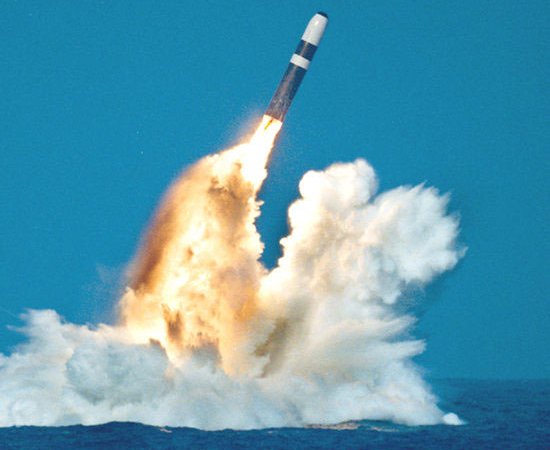
trident

Whilst continuing with our project to finally have a bedroom that it is possible to enjoy being in, I was listening to Radio 4. Highly recommended for entertainment whilst grouting tiles…

Todays offering was a programme called The human button.

It was all about the people whose job it is, either as politicians or members of the armed services, to potentially bring death to millions. They interviewed men who flew Vulcan bombers in the 1960’s, signing a receipt for their Blue Streak Nuclear missiles before take off. Unimaginable destruction in the hands of a 24 year old man.

But the most fascinating bit of all concerned a little known bit of British Armageddon etiquette, called ‘Letters of last resort’.

It seems that one of the first jobs each incoming Prime Minister is to be given instruction about the operation of Britain’s 4 Trident nuclear submarines- one of which is kept at sea at any one time, as a so-called ‘deterrent’ to any other nuclear power that should have itchy fingers over their own big red buttons.

And one of the things they have to do, is to write a letter, in their own handwriting, to each of the 4 submarine Captains. These ‘letters of last resort’ give final instruction to the Captains, should it’s line of command have been destroyed by a nuclear attack- in other words, if all of us (and our Prime Minister) are dead.

The options that the Prime Ministers have are;

  1. Retaliate
  2. Do not retaliate
  3. Place yourself under the command of the USA or Australian Governments

Few Politicians have ever revealed what instructions their letter contained. The letters are destroyed, unopened, at the change of an administration. One Prime Minister however, Jim Callaghan, revealed that he would have retaliated. Another Labour politician, Dennis Healey suggested he would not have done, as at that point the primary purpose of a nuclear deterrent would already have failed.

I find it comforting and terrifying in equal measure that even this potential last act of the human race is so… human.

The shadow cast by the cold war passes by our house every couple of months as the black menacing shapes of the Trident submarines leave the Clyde and head out on their dreadful patrols.

If we have no politician who would stop this madness, let us at least hope for people whose last resort is not to rain down death on other people’s children.

2007_01162007ireland0001

how you respond to violence depends on how you choose to understand it…

A quote from some bloke interviewed on radio 4 in relation to the latest terror attacks in India…

Inevitably, the media have been calling this awful event ‘India’s 911’.

The awful thing is that India is not unused to terror attacks- they seem to have been a constant throughout the post-Raj history. Most of these terrible things pass almost unnoticed in the west. Who remembers this from 2006 for example-

A series of seven explosions killed at least 174 people on crowded commuter trains and stations Tuesday evening in the Indian financial capital of Mumbai, police said.

Officials said at least 464 people were injured in the blasts in the city’s western suburbs as commuters made their way home. All seven blasts came within an 11-minute span, between 6:24 and 6:35 p.m. (12:54 and 1:05 p.m. GMT).

Analysts are comparing the attack with the mass transit bombings in Madrid in 2004 and London last year, saying they all involved a series of mutiple blasts and were well-coordinated.

Check out the details here…

These attacks are a little different, as they strike at the heart of India’s elite- the seat of financial power in Mumbai.

Who was responsible? No-one is sure. Al Qaeda has been suggested, although they always are. Religion and it’s power to convince people that the ends are justified by the terrible means always seems to have a part to play (check out earlier post about religious fundamentalism.)

India will blame Pakistan. They always do. And the whole world watches them looking at each other down a nuclear barrel…

Which brings me to my point. What should our response be to such dreadful violence- our personal response, and our collective response?

_41138268_bus_bomb_pa_416

Britain too has had it’s share of terrorism. For the past 40 years or so, it was related to Ireland. Now we seem to be a breeding ground for a new generation of terrorists who grow up as part of a disaffected  ethnic underclass.

When terrible things happen, there seems that governments have to be seen to ACT. This is one of the ways that democracy works. We want our governments to be active and decisive in the protection of our way of life- or at least governments think we want them to do this.

The debate becomes simple. We are under attack, we must fight back. We must not let them get away with this.

The outcome of this seems to be that Governments in turn are able to justify terrible acts in REACTION.

Almost like revenge. Payback.

A whole language set evolves- that ludicrous term ‘the war on terror’ is but part of this.

America had it’s own dreadful day of terror-

911

It was a day when the whole world held its breath, and in that instant, history found a fulcrum.

What happened next? Wars in Afghanistan, which once started will now go on, and on.

A war in Iraq, which was sold to members of the public on a set of fears that have now been found to have no basis in truth.

And a suspension of human rights, in the name of international security. State sponsored torture and detention without trial.

Shortly after 911, Brian McLaren wrote an open letter to President Bush. I remember reading it, and feeling proud that Christians-followers in the way of the King of peace- could raise their voices for justice and love and understanding, even in such a time as this. I think that this is our calling.

Never to condone, but always seek to understand. Never to accept that violence is the answer to violence. And that healing is possible, even for the most broken.

I have searched for a copy of Brian McLaren’s letter, to see how what is to be made of it with hindsight, but can’t find it (anyone out there know where I can find it?)

I think that we can already guess what history will remember most about Bush and Blair, and the stain of Guantanamo in a time when imperialism was resurgent.

One Christmas tradition that still makes me cry…

I just found myself caught up again in an advert for the Salvation Army Christmas appeal.

I have worked with Salvation Army projects in England. They have to survive in a harsh social care environment. The advert describes the familiar cutting edge of the work they do with street sleepers.

I know all the arguments- people end up on the streets for all sorts of reasons, and need to be facilitated to help themselves- out of the destructive cycles that brought them there. Well meaning sticking plasters don’t work in complex social crises.

But if I was down to the bottom of me, and found myself on the street, a hot drink and a hand on my shoulder would be no token. It might get me up the next day.

A cup of sweet tea on a cold night might not change the world, but the hand that served it might be the start of something called hope.

And a thick blanket will never wrap the worries of a generation, but a young girl whose bright lights have gone dark might instead find grace.

And if some stinking socks are removed and twisted toes are unbound in a warm soapy bowl, there will be no world peace. But it might being peace to one persons world, for a while…

So go on- out with the credit cards.

And the flugel horns.

More on Baby P…

A little lad for whom it is all too late...

A little lad for whom it is all too late...

So, three senior managers find themselves out of work. Two resign and one is suspended pending investigation (Head of Children’s services, Sharon Shoesmith- she will not be back.) Full story here.

I had posted earlier about my own reaction to the tragic news of Baby P’s death and the resignation I felt at the inevitable witch hunt that would surely follow.

Now the Social Work inspection agency (the same one that recently awarded the Haringay children’s services 3 stars for their excellent work) has now found serious failings in leadership, supervision of staff, the sharing of information and, perhaps most worryingly, evidence that kids who are suspected of being abused are not routinely interviewed alone (that is, away from parents.)

So, do I DEFEND these, my colleagues, and their obvious failings?

Well- I stand by my earlier comments- here.

And should there be a disaster in Argyll involving perhaps, a mother who is mentally ill, and a drug using father, who physically abuse a child in this horrendous way, I hope that by a combination of our closer communities, our good working relationships with colleagues in health and the police, and good practice, that we will be able to intervene and save that child.

The truth is, of course, is that even with our imperfect systems- this happens all the time. We intervene and try to make things better. Sometime we succeed. But never without a cost, that is paid out in the lives of young people as they move on into adulthood.

Argyll and Bute Council had a recent inspection from the Social Work Inspection Agency- it is there for all to read on the SWIA website (here.) It was far from positive. However, after hard work, the replacement of just about a whole management system (somehow, I survived!) and by learning the rules by which we were being measured, the follow up report was much more positive- here.

Children are incredibly fragile. And also incredibly adaptive and resilient. They survive, somehow in appalling circumstances. They even survive the states interventions to protect them.

If they are lucky.

For much of my career I have worked with adults in crisis. Many of them have been the survivors of childhood trauma- sexual abuse, beatings, broken homes and all sorts of other dreadful things. I am always amazed at how people survive…

But the dreadful truth is that dreadful things have happened before, and will happen again. And when they do- those whose task is to try to prevent these things happening will be found wanting.

That is not to say that things could not- SHOULD not- be better. But shock-reaction rarely achieves anything other than shock-defensiveness.

Meanwhile there are some very real issues facing us as we look at our attempts to protect children in our society.

  • There are the financial ones, mentioned before.
  • The community ones, in a society where people increasingly lack connection and commonality.
  • The regulatory ones- the constant drive to eliminate risk and bad practice leads to huge complexity, and individual responsibility for social workers- who in turn, take fewer risks.
  • And once we remove kids- where do we put them? Foster care placements can be impossible to find, and the homes that have not already been closed are full, and often highly problematic for the kids there.

I hope that the baby P issue will open up this debate, rather than focus on the ritual execution of yet more social work staff.

My Daughters birthday!

dscf3220

Emily is 13!

We had a lovely day- a lazy morning of presents and coffee then a trip to a cafe, and finally she had a house full of friends for a party- a kind of Goth fairy party as far as I could see.

For the first time ever, her parents were not required to actually run the party- she did it all herself- meeting, greeting, party gaming and all.

I am very proud of her.

If a little redundant.

Our role in the affair was to clean up afterwards.

Some more pics-

A baby dies…

One of the heatbreaking picture of baby P shortly before he died.

One of the heatbreaking picture of baby P shortly before he died.

I am off work today- a return of an old problem with cluster headaches. Dreadful things- a conveyor belt of Migraines. I think I am over it, and then the vision goes, the sickness and nausea kick in, and the head starts to split…

In between, I am functioning, but not very well.

Almost by way of penance, I have been catching up with some information about the dreadful story of baby P, whose tragic death at the hands of his mother and mother’ boyfriend has been all over the news these past couple of weeks.

I am a social worker, and once again I find that my whole profession appears to be on trial by media and politicians.

There seems no doubt that something went badly wrong with the plan to support and protect this little boy. His body bore the marks and scars of a dreadful litany of injuries. Faced with this information, it seems so simple- he should have been rescued much earlier- at one of the many point of contact. Here is a list of contacts with services;

78 contacts with health workers, doctors, social workers and police
2 health visitors
3 doctors
1 mental health worker
1 policewoman
4 social workers
1 family friend;
1 childminder
10 hospital visits (to at least 3 hospitals)
4 visits to clinic
5 parenting classes (the last two weeks before his death)
Seen by GP 14 times
Seen by health visitor 7 times
Mother seen by mental health worker 4 times

(figures taken from Times online- see detailed breakdown of these visits- here.)


The fact is, society needs someone to blame. Despite all the different agencies involved- and despite the fact that all child protection decisions in England are taken by multi-disciplinary conferences, the finger of blame has fallen on social workers. All the other contacts listed above count for little…

Large numbers of us, in the face of this shock, have mutated into mere gobs on legs, iterating and reiterating the last plausible prejudice that sat on us. A terrible thing has happened, it’s all down to X (fill in the prejudice) and someone’s head should bump bloodily down the steps of the Temple of the Sun, to save us from the wrath of the gods.

Our process presumes that it is normally better for a child to stay with the family, even in a household which falls far below the ideal, and social workers who go to their managers with a recommendation to commence care proceedings know that they will have to put up a very strong case.

When you consider the outcomes of the 60,000 looked-after children in our care, this is hardly surprising. Almost threequarters of them will leave care with no formal qualifications. Only one per cent will go on to enter any kind of university education. One fifth of looked-after children are homeless two years after leaving care; 25 per cent of our prison population has been through the care system. Things have to be really bad at home before care looks like a better option.

Yet in other countries the picture is very different. In Germany looked-after children do extremely well, with 95 per cent of children in the German care system going on to vocational education. Crime committed by looked-after children in Germany runs at 5 per cent of the rate of crime committed by those in our care.

Money is important. In Germany most looked-after children live in small community homes, with fewer than 16 residents. By contrast, more than two-thirds of our looked-after children are placed in foster families which cost less than a quarter of a residential placement in Germany.

Money also hangs in the air at case management meetings, and sets up serious conflicts of interest. It is the local authority managers who decide whether to go for care proceedings. They are also the people who will have to find the money to pay for care.

When budgets are tight, the best interests of the child are not always aligned with the best interests of the local authority. In fact the two can often be contradictory. And in those crucial meetings the social worker, the main advocate for the child’s welfare, is often the most junior person in the room.

As a society we need to look again at our priorities. Unsurprisingly, the current social work witch hunt following baby P’s death has already seen a rise in the numbers of kids being removed form parents. Practitioners will almost certainly take less collective risks. Given the pressures on the systems looking after kids in care, this may well be unsustainable.

Is this what we want?

I think the focus on BLAME masks a societal failure to put the needs of kids first. But given the current financial crisis, I fear that finding a scapegoat or two will be the preferred option…

As for me, I will say a prayer for this baby, and his parents. And for the imperfect workers (like me) who work in an imperfect system, and hope that we can make things better.

Consumption

shopping

Consumption.

Not the coughing theatrically into a stained handkerchief kind- but rather the acquisition of stuff.

We took a day out today to do a whole load of consuming. We went Christmas shopping. Michaela has this list that she does on the computer, complete with reference information and tick boxes. I go along as the bag man really. But hey, I get a day out with my wife.

Today we decided to brave a large ‘mall’ at Braehead near Glasgow. I have been there once before, and Michaela reminded me that I swore I would never ever go there again. But as I could not remember having said it, away we went.

What a place.

It has two polished levels of shopping- lines of every shop you would expect to be there, and not a single surprise. Each shop seems to be selling almost identical items, at almost identical prices. There is a ‘food hall’, in which awful food is sold, at very high prices. The place has not originality, no sense of place- as you walk through it, you could be in anywhere in the UK, or even anywhere in Europe.

What is it about these places that makes me so uncomfortable?

I think it comes from a constant feeling that I am being manipulated.

And that awareness of this manipulation does not help me avoid it.

I find myself a participant in a system that would convince me that it is normal to fill my life with all of this stuff- which as soon as I remove from it’s box will be worthless.

A system that depends on me buying ever more stuff, because any measurable change in the numbers of us who buy it, or the frequency by which we buy it, will send ripples through the economic systems of the world.

And should any caution or fear produce a slight reluctance to continue with this in enough of us, then stock market values plummet, financiers get nervous and banks start to tighten their credit lines. After all most of us depend on this thing called credit to buy our stuff…

Then businesses start to find that there is less need for their goods, and so they in turn slow their production, and people lose their jobs. And these people are no longer earning money, and so can buy less stuff.

And the whole thing starts to wind down into… recession!

So I had better spend more in this mall right? It is my duty to the world…

Oh but every year we say the same. Christmas is defined by this round of acquisition every year. Don’t get me wrong, I like to give stuff to my friends and family, but it seems that what I give them is so… useless, for the most part.

Is there no other way?

Well, not for us this year. We have spent the day consuming after all. But there is always next year…

I think these make the point quite well…

(You can see more of this, and some suggestions as to alternatives here.)

Miranda Epstein- cartoons about recovery

merinda_epstein_sanity_fair

Following on from my earlier post about mental illness stereotypes and the Mental Health Machine, I thought I would post some more of Miranda Epstein’s wonderful cartoons. Check out her site here.

I think they speak for themselves.

(Click to enlarge)

Mental illness- challenging the stereotypes.

1mad

Everyone at work is discussing the first episode of a BBC TV programme at the moment called ‘How mad are you?’

You can check this out on the BBCiplayer on this link

Now I must confess to being someone who loathes reality TV programmes- although I did watch Taransay one (Castaway?) which kicked the whole genre off in the UK. I am a sucker for anything filmed on a small Hebridean island.

However, the idea of this one caught my interest even before I watched it. 10 people in a castle. 5 of them have diagnosed mental illnesses, the other 5 are (wait for it) ‘normal’. They all get to perform lots of tasks and batteries of tests from psychiatrists, who then have to declare who they think is mad, and who is sane.

Anything that challenges the prejudices and stereotypes about mental ill health that still prevail is great as far as I am concerned- particularly if in the process the power relationships get reversed, and the black arts of psychiatry get placed in the hot seat…

I should confess to a bias here- I have worked as a Mental Health Social worker, then as a therapist, and now as a mental health manager. I was drawn to work in this area because my faith lit in me a desire to make a difference- to seek brokenness and try to bring healing. I have been inside the Mental Health system in the UK for most of my working life- and have discovered that it can be a very frustrating and at times an infuriating experience.

At its worst the psychiatric system in this country tends to suck in people at the most vulnerable time of their lives. The next part of their experience is often about LOSS.

Loss of freedom and choice.escher_about-institution

Loss of opportunity

Loss of relationships

Loss of employment

Loss of identity

Loss of motivation

Loss of hope

Loss of self esteem

…and once these things are gone, it becomes very difficult to transcend the circumstances you find yourself in. It becomes almost impossible to escape.

Sure, the system also GIVES people things. It offers a kind of sanctuary- either the physical safety of a ward or care environment, or a more emotional/psychological kind of security given by the label- ‘depressed’, ‘schizophrenic’, ‘manic depressive’. It also offers a whole new role- that of a ‘sick’ person, who needs help from the ‘experts’ who can treat them with medication or therapy- people who can take the messy chaos of their humanity and squeeze it through a scientific colander and filter out all the bits that are not helpful. (If only huh? I think we could all do with this process about once a week…)

And all these things too become like prison bars.

There are some encouraging signs though. Some people who have carried mental health labels are starting to take back the power. This can be best seen in the ‘recovery’ movement. Check out this article on the Re-think website, or The Scottish Recovery Network site.

Recovery thinking perhaps grew out of the hearing voices network, who dared to suggest that just because people heard voices, this did not make them less human- it did not make them mad. Many people even questioned the very nature of psychiatric diagnosis- suggesting (not for the first time) that schizophrenia was nothing more than a reaction to trauma- both trauma outside the system, then more trauma within it.

The voices from the recovery movement are mostly those who have been through the system, and managed to come out the other side. They have often found themselves in conflict with the powers within system- because they speak a different language, and do not conform. Some of their rhetoric is seen as (and perhaps actually IS) downright dangerous. They no longer are interested in talking about ‘cures’ to ‘illness’- rather they seek the right to choose their own path, and their own solutions to life crises.

merinda_epstein_the_consumer

(Cartoon from here)

That is not to say people do not need help. We are surrounded by people who are damaged and vulnerable. But many of us in the system, and many others who are subject to it, are convinced it needs to change. And the ideological challenge brought to us by the Recovery movement is like light in darkness.

And so as a Christian, I reckon that this is a flavour well worth seasoning.

The fruit of the Spirit is kindness

kindness

I was sore
Abraded by the road gravel
And you wrapped me
In a soft bed
Of kindness

I was weary from the world
And like a soothing embrocation
You took these road weary feet
And slippered them
In front of a warm fire

I failed
Again
And stared down low
Until the soft music in your voice
Brought to me possibility
That I too
Could be loved

That I too could love
In return

So may you be showered with blessings
Like blossom petals
Butterflying about you
In this beautiful breeze

kind