Filming war…

Emily regularly tells me stories about lessons at school deliberately to wind me up. It is an innocent enough sport, and I am easily defeated.

One of the things that she teases me with is the teaching of all sorts of subjects- History, Religious and Moral Education, English Literature- through the medium of Hollywood movies.

So History is taught by watching- Braveheart.

Shakespeare is taught be watching Leonardo Di Caprio pretending to be Romeo.

Moral issues are taught by watching war films- a whole series of them it seems.

I am not meaning to have a pop at teachers- I think they do a difficult job with passion and skill- but (as Marshall McLuhan said) the medium is the message- and film has this way of sowing images in our minds that are hard to shift.

And when these images are manipulations of the truth (as all film is of course, to a lesser or greater degree) then I think it is important to ask whose world view we are buying into- whose version of truth is being propagated.

It is difficult to escape the realisation that the lens is controlled by the powerful, and not the weak. The powerful even strap cameras to their bombs and missiles. It makes for great TV.


This was brought home most powerfully to me recently when watching the great John Pilger’s film ‘The War You Don’t See.’ This film deals with what happens when cameras go to war- in an age of ’embedded’ reporters, and carefully controlled press briefings.

If you have any interest in justice in an age of technological warfare waged by superpowers in out name, you must watch this film. It is available on you tube- here.

Here is the trailer

The film also makes some points about the role of war films in all of this that made me sit up. Like most blokes, I like a good war film- heroic buddy movies for the most part- escapism for those of us who have never been exposed to the harsh realities of war.

Most of us can see through the jingoism of the world war two films,  and also the nonsense of the Rambo/Schwarzenegger comic book violence, but Pilger made some interesting points about the modern crop of films- even those who appear to carry an anti war message. Pilger pointed out how they carry a myth of the soldier as innocent victim, and in doing so distort entirely the reality of modern war, which above all is characterised by it’s ability to dehumanise and so denude ‘the other’.

It is war reduced to video game and CGI.

Fiction becomes truth- fake heroism, the vindication of our way of life in the face of despotic extremism seen in the lives of our enemy. Despite the fact that the enemy then become victim to our own despotic extremism.

Just in case you do not believe me, it is worth watching the back end of this clip-

The question is still with me- does showing our kids war films make it more likely that wars like this will not be be fought in the future?

I doubt it.

How about getting hold of a copy of the Pilger film?

That might.


Song of the old dog…

Sometimes when I am walking, I pace out the words of songs and poems. I am not sure whether I am unusual in this, as I have never asked anyone else if they do the same. It can be quite meditative- almost like the intonation of a prayer-mantra.

It is something I only do when on my own- or gathered under waterproofs in heavy rain and in steep country- because then, even in company, there can be little conversation.

At times, I try to be deliberate about my choice of words- as a deliberate prayer- but more often the words just appear as half-memories, like wind blown dandelion heads to which some seeds remain stubbornly attached.

There is this one poem that is a regular companion to my solitary walking, and it is one of the first I ever remember reading at primary school. It had a rhythm and tone that captivated me. So much so that still remember lines of the poem.

I even remember the teacher who read it to us- Mrs Purvis. Who beat me with a scholl because my spelling was poor. Or something.

More than this (although I am  sure I never knew this then) I remember the poem because it expresses something that I felt about myself. I was an outsider, a paid up member of the awkward squad, uncomfortable in my own skin- and as such, in school (and in life) a most unattractive being.

The poem suggested to me that to be alone and outside could be a positive choice, and that out of the crisis might come virtue. Not all animals hunt in packs- no matter how hard it can be to be alone.

As a much older dog, I have a deep appreciation of the fireside and your companionship around it. But I went looking for the poem…

To discover that it was written by an obscure poet called Irene Rutherford Mcleod, who published a few poems around the time of the first world war. Little is known of her, although it seems that her daughter married Christopher Robin Milne- yes that Christopher Robin.

Here it is-

Lone Dog

.

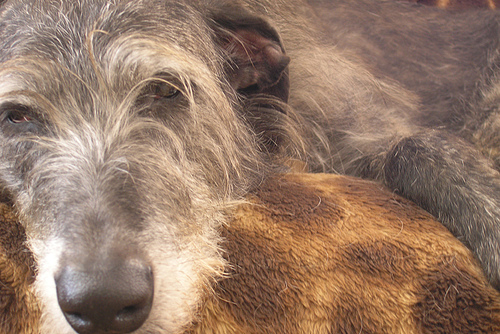
I’m a lean dog, a keen dog, a wild dog, and lone;

I’m a rough dog, a tough dog, hunting on my own;

I’m a bad dog, a mad dog, teasing silly sheep;

I love to sit and bay the moon, to keep fat souls from sleep.

.

I’ll never be a lap dog, licking dirty feet,

A sleek dog, a meek dog, cringing for my meat,

Not for me the fireside, the well-filled plate,

But shut door, and sharp stone, and cuff and kick, and hate.

.

Not for me the other dogs, running by my side,

Some have run a short while, but none of them would bide.

O mine is still the lone trail, the hard trail, the best,

Wide wind, and wild stars, and hunger of the quest!

.

And just in case you find this too bleak- Rutherford also wrote this- which also resonates in my soul-

Song

.
How do I love you?

I do not know.

Only because of you

Gladly I go.

.
Only because of you

Labor is sweet,

And all the song of you

Sings in my feet.

.
Only the thought of you

Trembles and lies

Just where the world begins

-Under my eyes.

Lent 5…

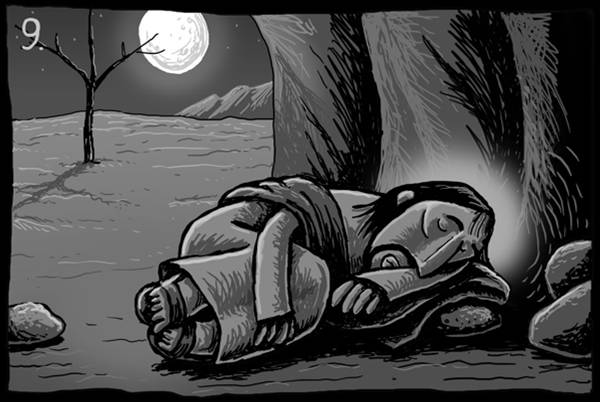
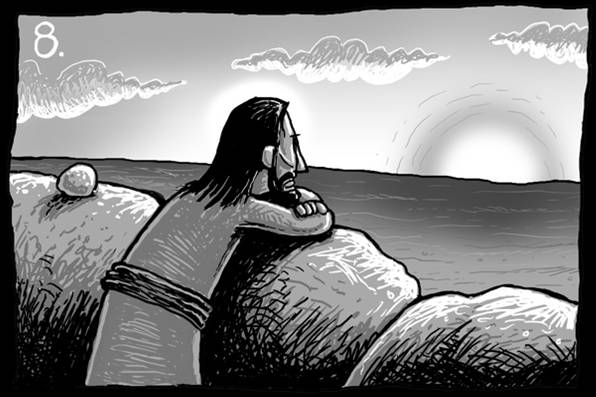
After a time, the desert seemed so big, and he, so small.

A panic rose in him. It clutched him like a hand at his throat


Who am I?

What am I?

What terrible road lies before me?

Father- my body is weak

I am a drop of water

On a rock

Under the hot desert sun

Soon I will be gone.


But still he walked- still he followed…

That voice.


New Monasticism podcast…

It is snowing here!

So my plans to go and work in the garden have been thwarted, and I am drinking tea and listening to podcasts. It’s a hard life.

But I came across something that I think is really important- a discussion at the London Centre of Spirituality about New Monasticism and Fresh Expressions of Church.

Bishop Graham Cray goes as far to describe New Monsasticism as a ‘New Wave of the Spirit.’ If he is right, then these small experimental groupings have a deeper relevance for the whole of church.

The discussion has a clear resonance for me, and my small community- Aoradh. Like most small groups, we ebb and flow, then ebb again. The energy we find as a group is easily drained by external and internal forces, and the need to seek renewal within practice becomes very real and urgent.

Strong themes that emerged from this podcast are perhaps those which most reflect our own situation-

  • Rule, order, seriousness
  • Spirituality allied with action
  • Courage, challenge
  • The pain/joy of community
  • Incarnation- being deliberately present, not removed.
  • Spiritual direction
  • Mission- rediscovering what this is about for us
  • Thanks to Moot for making this available, as I feel the need to rediscover a passion for what I do- to set my face in the Wind of the Spirit again…

    Lent 4…

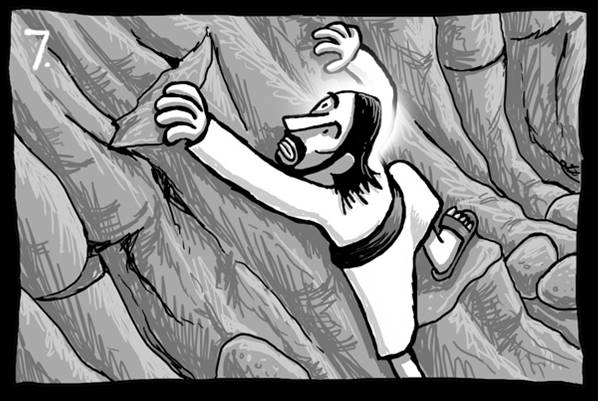
    As he walked he began to leave something of himself behind. He felt the skin of civilisation being burned away by the sun…


    Driven away by the wild animals of the wilderness.


    But with the rhythm of every step there came this incredible music… singing to him


    It’s your time…. And mine.


    Ron Sexsmith- This is how I know…

    I think this man is a genius.

    From the darkness to a seed of light
    From a garden to a sheet of ice
    I feel you move in every sunrise
    In the trembling of the leaves
    This is how I know you’re near me

    From the ashes of a broken home
    I sent a message to the great unknown
    And through the music on the radio
    You came to set me free
    This is how I know you’re near me

    This is how I know our trials are not in vain
    This is how I know we’ll rise and love again
    This is how I know

    From a moment to a sea of days
    From an ocean to a single wave
    Out of nothing came the miracle
    That loved us into being
    This is how I know it will be