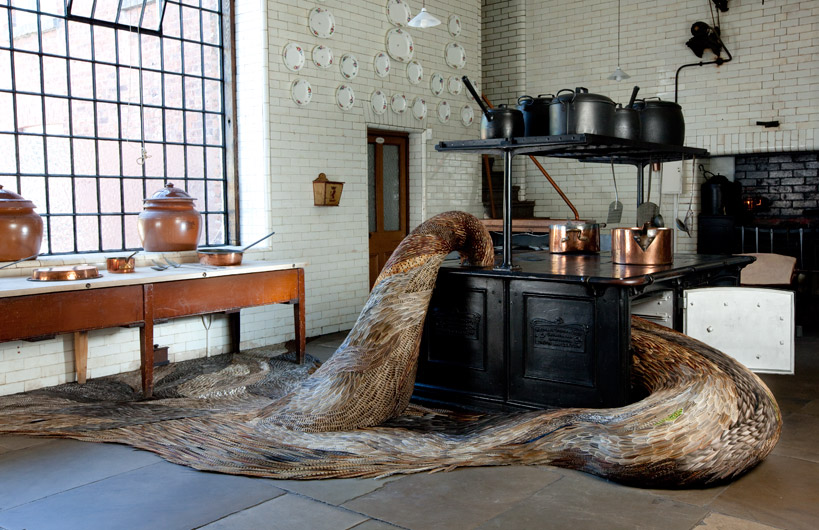
The chicken fights back…

A friends showed me this earlier.

And as husband to the keeper of the best fed chickens in chickendom, I appreciated the sentiments, and was astounded by the imagination and execution-

Here is how it was described in the Tatton Park programme-

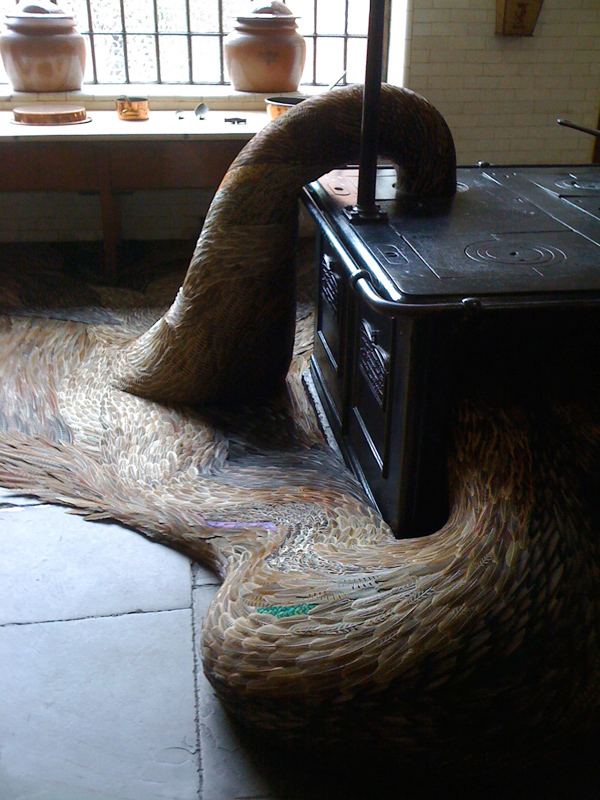
“Horrifyingly beautiful, the installation suggests a new (or perhaps ancient) and menacing presence eminating from the cast iron oven. Coiling, pluming and creeping through the kitchen, the work feels weighty, meaty. The visitor at once is taken by the gorgeousness of the piece itself – the assemblage of ‘common’ feathers presented as something completely exotic – and the shame involved in discarding objects of beauty for a perfunctory dinner.”

This fantastic piece is by artist Kate MccGwire and is made up of feathers of all the different birds that would have been cooked in this oven over the years.

They are coming to get you…

Happiness and the making of daisy chains…

There has been more in the media this week about happiness. An old theme on thisfragiletent- see here and here.

The latest interest followed the release of a report suggesting the following-

A survey of 1,000 Americans found that happiness rose in line with salary, but only until people earned $75,000 a year, the equivalent of around £50,000.

Earning more than this did nothing to boost how happy people were, according to Daniel Kahneman, a psychologist at Princeton University in New Jersey, who won the Nobel prize for economics in 2002.

Kahneman teamed up with Angus Deaton, an economist at Princeton, to analyse 450,000 responses to a daily survey on happiness and life satisfaction run by Gallup in 2008 and 2009.

The survey asked people to rate how happy they felt each day, based on their experiences of emotions such as joy, worry, sadness and fascination. They were then asked to rate their overall satisfaction with life, on a scale where zero was the worst they could imagine life to be and 10 being the best.

The researchers found that life satisfaction rose steadily the more people were paid. Happiness rose with income too, but plateaued when people reached an annual salary of $75,000. For those on more, happiness appeared to depend on other factors.

Interesting.

It raises lots of issues for me-

Why do we keep using MONEY as a measure of happiness? Sure, there is point at which poverty (our ability to meet basic needs- including those relative to those around us) will impinge on our humanity, but beyond this, sooner or later we all come to realise that accumulating wealth is simply a distraction from deeper stuff. In this instance, only 10% of the population earn more than £50K pa, so clearly this level of attainment is not a realistic or sustainable goal for wider society.

There was a great programme on Radio 4 this lunchtime inviting comment and discussion on this issue. The whole range of issues came up-

The millionaire who was adamant that his money DID bring happiness, and freedom to live the life he wanted.

The person living on £5K pa on benefits, who found every day a struggle.

The person who gave up her £50K job as she was unhappy- and returned to doing simpler things.

Happiness is a difficult concept for introspective mercurial types like me. I am happiest when I do not need to think about happiness. When I am at rest with people I love, or doing something creative, or catching a echo of the voice of the Spirit…

I am pondering again  how we as Christians are called to a different way of being- living to the agenda set by Jesus. Lives of Spirit-fruitfulness, including that word ‘joy’, which is not the same thing as happiness.  Not sure I can define exactly how it is different though, or claim to a complete experience of joy.

But I do worry about how we Christians get seduced by the same selfish consumer-oriented agendas. I think that rather than a life style enhancement (do you remember that term moralistic therapeutic deism?) learning to live as a follower of Jesus seems to me to be about seeking to live in an open way, connected to others, and to find ways of giving/graciously receiving.

All this striving for more stuff, and the chasing after experiences that give life shape and meaning- it just does not fit well with the the ways of Jesus that we learn from the gospels.

And because faith without works is dead, then Jesus calls us on an adventure- a mission. Fulfilment and happiness may be discovered along the way, but they are not the object of life, rather they might be encountered as a by product- in the midst of all sorts of other things perhaps? Suffering, persecution, friendship, pain, joy, etc etc…
On the radio 4 programme, someone said this-

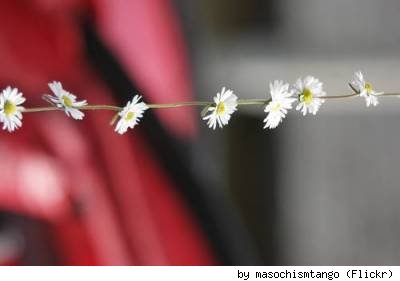
Happiness can be understood as like making a daisy chain with flowers that are close at hand

A bit trite, but I liked the simplicity of this.

You are where you are, surrounded by the people you are surrounded by, and equipped with the gifts and talents you are equipped with.

In this mix, is it possible there are also seeds of great happiness?

Pooh sticking the summer…

Just had a lovely time at our Aoradh family day.

We share a meal, then someone leads some worship. Today Paul got us telling stories of  our summer, then thinking of what we want to keep, and what we would prefer to throw away- in the the form of a Pooh stick.

Brill.

I found this bunch of berries- one of those that used to be a stamen of some interesting lilly thing, but is now rotting quickly away.

Like the summer.

As might be inferred from my earlier post, the black dog has been stalking me a little. And the approach of the dark season makes me apprehensive.

So my berry poo stick became a prayer for all of us whose mood is mercurial, and easily shadowed by winter.

A prayer that the decay of the old might still be followed by a time of new birth…

And in the meantime- my your fireside be shared with good friends.

As mine is.

On being both ugly and tall…

I was chuckling today-

I listened to this programme on radio 4 on my way round to Helensburgh- ‘Can pay will pay‘- examining the factors that seem to influence the amount that we earn.

I was slightly interested, as the whole wage slaving issue has been a theme of recent contemplation.

There were however some interesting facts. The average full time wage in this country is around £27K pa- but if you earn more, you will tend to overestimate this, and if you earn less, will underestimate.  Only 10 per cent earn more than £50K pa. The old regional variations continue- the average in some parts of the country is around £15K pa.

Slightly more bizarre are some of the other things that correlate with earning more or less.

For every inch over around 5 foot 7 inches, you will earn on average around a thousand pounds extra per year. As you can see from the dine figure I cut on the photo above, I am 6 feet five inches tall.

Woohoo, my ship may yet come in!

Unfortunately, ugly people will earn on average 20% less. The programme quoted a study amongst prostitutes, where ugliness will clearly affect your earning power- but surprisingly, no more than the average for the rest of the population- still around 20%. Interestingly, beautiful people do not seem to earn more, the effect is only if you are ugly.

Ah well, you gain with one hand and loose with the other…

Sharon Shoesmith speaks out again…

Regular readers of this blog will know that I earn a living in social work- specifically, I manage mental health services, working mainly with vulnerable adults.

But the whole social work world has been hugely affected by the tragic circumstances of the death of Peter Connelly at the hands of his mother, her partner and a lodger.

And by the media circus that followed it.

It was interesting to hear Sharon Shoesmith, the former director of Social Work services for Haringey who was sacked following political intervention, speaking to a House of Commons Committee looking into the way we protect children.

She made the following points (some of which I had previously described- here.)

In her opening remarks to MPs, Ms Shoesmith said the statistics on child murders were shocking – and had stayed the same for more than 30 years.

The Baby Peter case had led to big changes in children’s social services, she said.

“For children, the impact has been far-reaching. Since 2008 the number coming into care has increased 30%. The number we have subject to a child protection plan has doubled. Yet this wider net seems to have had little impact on the number of children who die.”

She said in the year Peter had died – 2007 – a total of 54 other children in England had also died at the hands of their parents or other family members.

In the decade from 1999 to 2009, 539 children had died in this way, she said.

“These are shocking statistics and statistics that are not known. They are too abhorrent for us to consider,” she said.

She is right, I think, to point to the negative effect of the blame culture on those seeking to protect children.

The simple truth is that scapegoating obscures the real issues, and potentially real solutions.

A minute or so of Richard Rohr…

Tonight in our houegroup we are going to listen to Richard ROHRRRRRR.

(Get it?)

He does not roar though- there is a gentleness about him which I like.

He follows in the tradition of a kind of spirituality of vulnerability, brokenness and woundedness.

And any other kind of spirituality too quickly gets caught up in power- of the earthly kind.