Worship music, revisited…

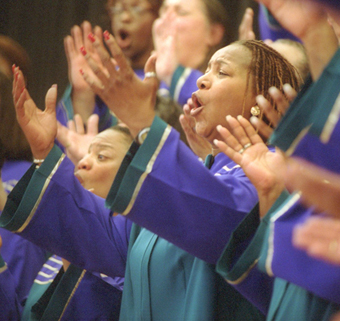
singing

A friend asked me to get involved in playing some worship music recently. He and I used to play together quite a lot, but (as I have blogged about before, here) I have found myself deliberately stepping back from worship driven exclusively by music- or perhaps to be more accurate (if a little jaundiced)- music to pep people up for a sermon.

I think I may have posted this before-

But I do not think I am ready to leave worship music behind altogether. I continue to wonder where are the songs that will carry forward the culture that is emerging in our Christian groups and gatherings, and whether we might yet rescue something from guitar driven worship from the marketing machine that made it a sacred cow.

And wondering too whether the raw creative fun that making music can be might find a new rhythm outside the institution of formal church, and still allow small groups of Christians to worship together in meaningful, authentic and inspirational ways.

And even when we ‘plug in’ and make noise, needing space and greater organisation- I wonder too whether we can do this, but avoid the ego-worship hero stuff. Avoid the search for the next Matt Redman (who was, of course, the next Martin Smith.) I like Matt Redman by the way- some of his songs are great. Some are not. Like all song writers!

On the Tautoko network site, I made these comments ( and asked these questions)-

This is a bit confusing for me. I spent years ‘leading worship’- by which I mean playing soft folk rock choruses. I became increasingly dissatisfied with this, in terms of style, underlying theological assumptions and the exclusive one dimensional character that it brought to our collective worship.

I began a journey that will be familiar to many of you- towards older more contemplative ways to approach God, and into experiments with ‘alternative worship’.

But the love of music was still on me. It’s power to move and to unite. The beauty that comes when people join small talents to make something that is much bigger than the sum of their parts.

And as I look around me, in the wider alt. worship scene, we seem to use a lot of ambient stuff, and the odd bit of singer-songwriter creativity. But we do not sing very much. Is this because it is not cool? Or is it a pendulum swing reaction against the CCM/Worship machine that has made worship music a commodity?

In my group, we have members aged 9 to 75. And people want to sing. I have found myself digging into a 30 plus year backlog of songs and choruses looking for ‘hymns and spiritual songs’ that hold some meaning and truth that fits where our group is at.

So- a few questions…

Do you sing?
What songs still have meaning?
How does music fit with the wider alt worship stuff you are involved with?

There were a few answers. There is a lot of music out there unfamiliar to me. Songs from a Catholic tradition, or from the Iona Community (often by the brilliant John Bell– who, I contend, has also written some stinkers!)

But I am yet to feel that I am building a collection of songs that are I can sing with passion and integrity in my developing context. Sure, some of them I have carried with me- reworked old hymns, or the few songs that connect with Justice issues, and the mission of Jesus. But so much of the love-songs-slightly-reworked-to-be-religious, I simply can not sing any more- even ones I used to love.

I came across this bloke, Andy Flanagan on the Greenbelt website today- who I feel an affinity with as he seems to be a cricket fanatic and Christian socialist too. Must get along to his gig @ Greenbelt if I can.  I liked some of the words of his worship songs.

But if you know of others- songs that gather some of the hopes and dreams of this thing that is the emerging church, I would love to hear them. What songs allow you to reach up towards God and offer him something meaningful and beautiful as you gather together?

I can trade you a few that mean something to me…

All good things come to an end…

DSCF4882

So we are home…

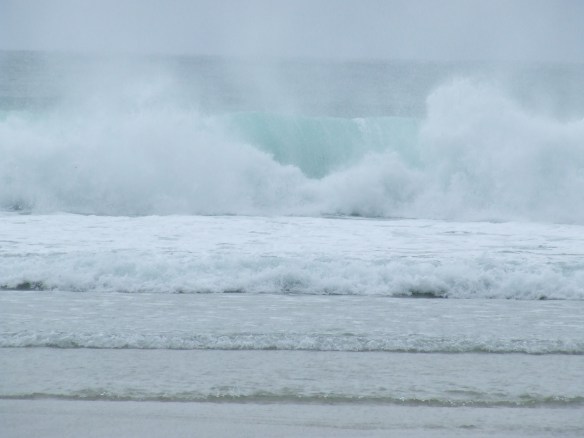
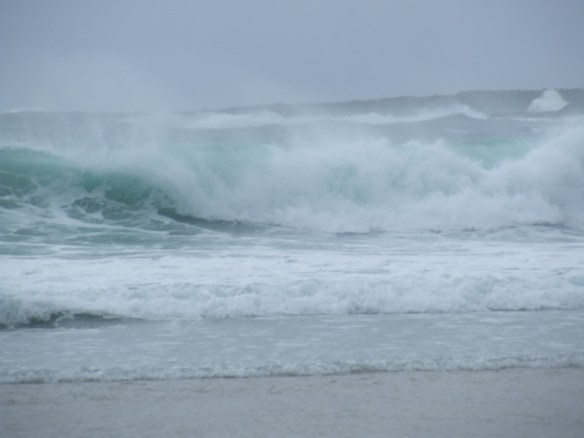
After two weeks of travel, 13 different islands a holiday cottage, a posh hotel and a few campsites. We had sun, rain, wind and glorious sunsets. Waves crashed and then the water stilled to become a green blue mirror…

It was a great holiday, but it is always good to be back home.

We had an eventful last few days. The wind bent a tent pole on one of the tents, hence the posh hotel, which was a real treat (we stayed at the Isle of Barra hotel– quite a place!)

So, a few more photos, and then the let the memories linger…

off camping…

Right, we now leave luxury and head off down to the Uists, Benbecula and Barra- camping on beaches in small tents.

We expect very mixed weather, and very strong wind, but this kind of camping is the very best (as well as perhaps potentially the very worst!)

No internet- so the blogging will cease for a while!

postcards from the western fringe 8- beaches bikes and peat fires…

DSCF4527

Emily and I cycled to the beautiful Bosta beach.

There is a recreated Iron Age house there, and white sands, and clear blue green sea.

It was so lovely, we took Michaela and Will in the evening.

Some photos…

Postcards from the western fringe 7- fishing for souls…

DSCF4472

Had a lovely day today- touring the north of the island with Emily. The weather was mixed, but we even sat on a beach for a while today, before the wind and rain drove us back to the car.

Talking of wind- there was a tornado in Stornoway last night! The school that Will and Michaela are doing classes in as part of the Feis was damaged.

This afternoon we really enjoyed meeting up with Gayle Findlay for a cuppa. She moved up here from Bristol about a year ago, and has a great blog recording some of the transition.

One subject that is hard to escape – both as a visitor to Lewis, and for incomers- is the central importance of a particular kind of rigid faith to just about everything that happens here. It seems to shape the very landscape, or perhaps is a response to the savage environment.

The dominance of the Free Church of Scotland with its severe, Calvinistic and (at least to outsiders) legalistic approach to the life of faith has been the driving force for communities here for much of the last 100 years. The church casts a shadow that I confess (as an outsider) I find oppressive.

In saying this, I do not mean to be offensive to fellow Christians. Their context and journey is so very different from mine. I have been stirred by stories of transformation during the Hebridean revival. It is a story that has been retold to inspire us to eagerly chase after revival. Check out this American video-

I once heard revival described as being like a volcano- all fire, smoke and hot flowing lava. Soon the smoke and fire lessens, but the lava still flows, even if the outer core crusts hard over. Eventually however, the crust is all that is left. It is from this solid rock that the walls of churches are built from.

I took two photographs today that kind of summed things up for me. The first was this one-

DSCF4471

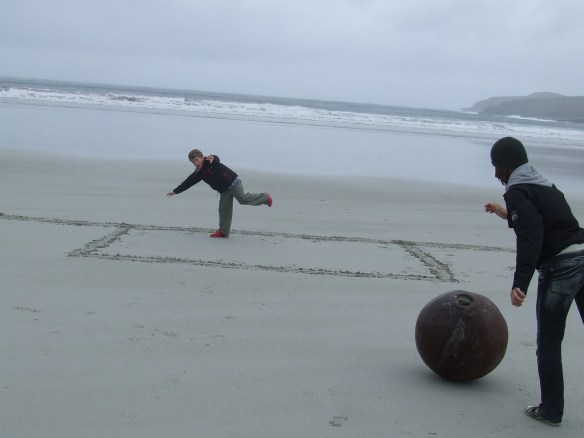
In these parts, Children are not allowed to play on the Sabbath. Or not openly anyway.

I note the the Free Church youth magazine is called- Free.

The other photo was this one…

DSCF4450

DSCF4451

There was a river next to this graveyard, but the irony of the fishers for the souls of the dead needing a permit from the kirk made me chuckle.

Particularly as such frivolous practices were not to be indulged in on Sundays.

postcards from the western fringe 6- An Clisham…

DSCF4389

Today Emily and I climbed An Clisham, the highest mountain in the Western Isles, at 799 metres above sea level.

We almost did not go, as the wind and rain were rattling the windows this morning. However, it cleared up long enough for us to give it a go- but it was a VERY windy climb. We had to be very careful- taking small staggering steps for much of the last third of the climb.

Despite my recent post (Postcard 4) I was very grateful for the sketchy footpath to guide us stumbling down through the crags and bogs. Serves me right for over egging the argument I think…

I was messing around with some of the images on Picasa and put together this (not very creative!) you tube clip…

Postcards from the western fringe 4- footpaths…

DSCF4326

I took this walk out along the coast towards Bosta.

It was lovely. Wind coming in from the sea, sun shining through scudding clouds.

And I started thinking about footpaths. And theology.

It started with a boggy patch- you know the sort- a lush patch of green that looks all firm and supportive, but turns out to be a cunning thin skin over a foul boot sucking bog. Such things always remind me of Bunyan’s Pilgrim’s Progress. Christian wending his way on the journey of life, until he leaves the path again, and falls into the slough of despond.

It seemed to me that this way of understanding the walk of faith weighed on me for years. It is based on a view that God has proscribed paths for all of us, and should we step to the left or the right of it then well betide us. The best we could hope for, like Bunyan’s Christian, is to stumble back out of the wilderness back onto the golden path…

DSCF4324

Now paths are useful things, as long as

  • You know where you are going
  • The destination is the object of the journey
  • Others have been there before and marked the journey well

But what I found in my spiritual journeying was that the linear, proscribed paths I grew up with became no journey at all. What Bunyan’s followers handed down to me was a spirituality that mapped and measured the life out of each step. A Spirituality that had all the signposts, but had lost all the adventure. That became fixated on the destination, not the joy in the moment, and the companionship of the road.

Walking the mountains of Scotland, as opposed to England, means contending with a much wilder country. The few footpaths are faint, and easily confused with animal tracks. Making your way over rough land is hard work. But these landscapes are no mere backdrop to be drawn past the journey- they are the very place were we encounter the quickening that comes from being tested, inspired and humbled by real wilderness.

The old well trodden spiritual paths are falling out of use. People no longer appear to believe the old signposts, nor are attracted by the destination.

Perhaps the analogy of faith as footpath to be mapped and trod is a poor one. It certainly lacks something for me.

Perhaps the useful analogy should be less focussed on destination, and more on encounter, adventure and dependence. Of moving outwards, looking for the traces of Jesus and listening for the whisper of the Spirit in the wind and the waves.

DSCF4328

But in this wild country, we still need pioneers. We still need to connect with others who walk in the way…

DSCF4335

Postcards from the western fringe 3- now and then…

Lewisian Gneiss is the oldest exposed rock in the British Isles.

DSCF4330

2000 million years ago, massive forces twisted and melted this rocks into the crystalline shapes that became these islands.

It was another 1200 million years before multi cellular life forms crawled across the rocks.

Another 5oo million years passed, and along came the dinosaurs.

Mammals took another 430 million years.

And as for us, we humans- well we just got here yesterday. Well, around 6,000 years ago we found our way to these parts, and made a life on these rocks.

I took a walk today that kind of brought this home to me. We humans live lives as if we are important. As if we are significant. As if the world was made for us and owes us something.

But we walk in others footsteps… which like ours, are quickly fading…

Most of us have a folk memory of the scattering of people from these places during the clearances. All around the Highlands are the remains of old dwellings- the Blackhouses– built from the rock and earth, and slowly returning to the same.

DSCF4337

People left these houses around the turn of the 19th Century. Those who stayed- those who did not sail away to Canada or Australia- moved with the modern times into ‘modern’ houses. With fireplaces, and windows and solid floors.

But there is a new and unfolding diaspora from these islands.

As much as Highland culture and communities are being celebrated- they are still fragile. Traditional industries of crofting and fishing are all but gone. Young people still leave if they want to get ahead.

Old people, who still hold the old times in their stories and their songs. They too will soon be gone…

DSCF4317

DSCF4315

Old gramaphone

Old gramaphone

DSCF4302

Gaelic Bible, open on the Mantlepiece.