Del’s beautiful (but absolutely pointless) machine…

Time for something to lighten the mood I reckon- after all the discussion about pain and suffering and death and gas chambers.

Check out the clip.

This old guy must have spent countless hours making this lovely thing. It is a work of rough-handed, craftsman-genius.

It has no discernible purpose. It has no obvious meaning.

He is either slightly bonkers, or a backwoods savant who deserves international recognition. Or both.

But I love the fact that we humans can create such things. Perhaps there is no higher modern art form than this one…

It breaks the earth…

African sky
Brilliant blue
With clouds improbable
Puff balls from a child’s painting
And bright green hills
With warm grass
Worming in the wind
The garments of fertility
Fecund, but fragile.

But there a man scrapes back the bright colours
Exposes the hungry rust-red soil
And in the heat, moisture escapes
Giving the air the smell of blood
Then the pick arcs and thuds deep
Turning and piling high the spoil heap
The wastage.

And at the edge of Mbana’s mothers grave
A few people gather.
Here for the food and the warm weak beer
Sadness tempered by familiarity
Grief is now a thing for children
Tears can never turn back time.

AIDS
All Innocence Dies
It breaks the Earth
It breaks the Earth.

27.2.05. Children in need, South Africa.

What is God doing 3- Pain, testing

There is a book by Philip Yancey and Dr. Paul Brand, called ‘Pain, the gift nobody wants’.

Dr Brand was a world renowned authority on leprosy, and spent his whole life working amongst the untouchables of the Indian subcontinent. What he was able to show was that leprosy was not the direct cause of the damage to skin and tissue or the loss of extremities so common in this terrible disease. Instead, this was caused by the effect of living a life unable to feel pain. Leprosy damages the central nervous system, and suddenly our sensitivity to the world around us – its sharp edges, its heat and its pressure – is removed. The end result is terrible damage. What Dr. Brand was able to show was that pain, far from being a cosmic accident, was in fact a blessing. This was revealed most clearly in the absence of pain seen in sufferers of leprosy – normality in negative.

Could it be then, that at some level, suffering is good for us? It is how we learn about ourselves, and our relationship to objects around us, and helps us to learn essential things that ensure that we do not put our bodies at risk?

This led me to thinking about whether we could apply some of this logic to the more complex human emotions – what would life be like with no suffering?

What if there was no hate?

What if there was no grief?

What if there was no anxiety and fear?

How could we know about love if we had no understanding of what the alternative is like?

If we did not feel appalling loss at the death of a loved one, what would be the value of human life?

Lepers are seen as outcasts, less than human. I wonder what the effect of being impervious to emotional pain would be like. I have come to think that the ability to suffer is one of those defining characteristics of being human.

Perhaps lepers are in fact super-human.

What is light without shade?

But it is all easy for me to get philosophical about this stuff- my skin is clear…

Testing
Others have described suffering as a test from God: a process by which our faith is put to the heat and tempered. Some would even say that what does not kill you will only make you stronger.

There seems to be some truth in this as I look around me. We learn far more about our selves and our relationship to life’s big questions during difficult times than when all is calm and peaceful. It seems that we only really turn to God in those moments when all alternatives have been tried and failed. When there is no hope left, but Him. Strangely enough, many people report a strengthening of their faith through adverse circumstances. You must know people like this, and perhaps like me marvel at their fortitude. It is almost as if pain and suffering become a bridge to allow God into the centre of people’s lives – bringing a new kind of peace and joy and certainty. Suffering itself seems for some to have redemptive power – somehow it brings the best (and the worst) from us.

But it is only a small step from accepting that God would use these circumstances for our advantage to wondering if he sent them in the first place. Is there really no other way?

What is God doing 2- Job’s comforters

( a continuation of a thread of excerpts from an article. The previous one is here.)

Blake's Job

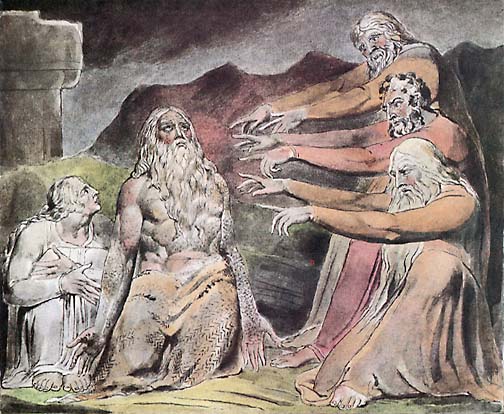
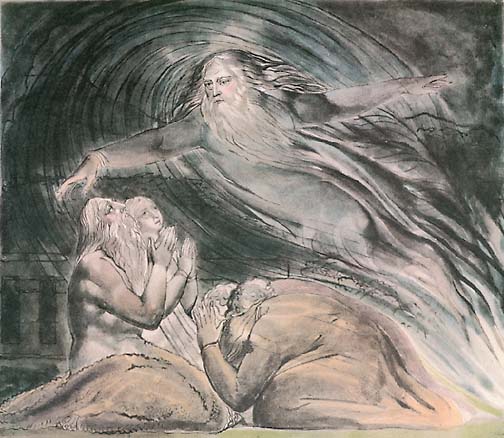
The pictures are all by that hoary old mystic, William Blake.

One book of the Bible tries to examine the issue of pain and suffering in the world issue more than any other – the book of Job. It is a difficult book, with many questions unanswered about its origins. Some say the book was written down around the time of Abraham, or Jacob, perhaps by Job himself. Other say the book is much later, perhaps written by a great poet, such as Isaiah. Some of the style of the writing may be in keeping with the time of David and Solomon.

There is also divided opinion as to whether there was an actual historical figure called Job, or whether this was rather a didactic poem, prophetically inspired to shine light on some truths about God. It is clearly a historic book from the outset, but Hebrew scholars have often seen the story as a parable.

What of the story?

Job was a good man – rich in family and possessions, and a benefactor to the poor and needy. He had it all, and had already lived a long and prosperous life before the tale begins. Then, for some reason, God allowed the Devil to test Job, so that the Devil could see that Job’s goodness was not dependent on God’s blessing. Firstly, the Devil was given power over Job’s property. He lost all his cattle, then his sheep, and finally his camels. Then a cruel desert wind blew on the house of his eldest son and it fell, killing all his sons and daughters who had gathered to eat together.

Job tore his clothes in grief, but had this to say,

“Naked I came out of my mother’s womb, and naked I will leave this world behind. The Lord gives, and the Lord takes away. Blessed be the name of the Lord.”

Next the Devil was given permission to attack Job directly, and Job contracted some dreadful skin disease. He sat in the ashes of his life, and was forced to scrape at his sores with a broken pot to try to get relief. In despair, his wife tells him to “curse God, and die.” But Job says, “We receive from God all that is good, why should he not also send trouble?”

Job then gets a visit from three old friends. They sat with Job in silence for seven days, pondering his fate, searching for wisdom. What was God doing?  Then, in turn, they spoke. First Job was accused of harbouring some secret sin – any man who had experienced the misfortune that he had must have done much to deserve it. Job should repent and throw himself on the mercy of God, who was correcting his ways. But Job can only protest that his punishment is more than his crime.
Job’s friends start to list the glories of God – who can fathom the mysteries of God? And Job’s replies become more and more bitter, and angry. Who can blame him?

“…so man wastes away like something rotten; like a garment eaten by moths. Man born of woman is of few days and full of trouble. He springs up like a flower and withers away; like a fleeting shadow, he does not endure. Will God fix his eye upon such a one? Will you bring him before you for judgment? Who can bring what is pure from what is impure? No-one! Man’s days are determined; you have decreed the number of his months and have set limits he cannot exceed. So look away from him and let him alone till he has put in his time like a hired hand.” (Ch. 14)

And from the comfort of respectability, Job’s friends continue to caution him against his rash words, but he becomes less tolerant of their self- righteousness. The whole story begins to read like a court room drama, with God being accused of crimes against humanity.
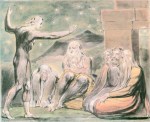
Then, step forward a younger man, Elihu, angry with Job for justifying himself against God, and angry at the others for their inability to bring Job to his senses. He speaks bravely about the wonders of God, and suggests that suffering might be put upon man to keep him from greater sin, and for moral betterment. Elihu speaks well and is obviously a good man, but his words ring just as hollow as mine seem to when I too try to explain human suffering.

Suddenly, into the story steps God. It is almost as if he can hold himself back no longer. God offers no explanations; rather he bursts out question after question;

“Where were you when I made the world?”
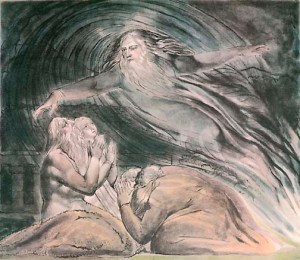
“Have you ever given orders to the morning or shown the dawn its place?”
“Can you raise yourself to the clouds and cover yourself with springs of water?”
“Will the one who contends with the Almighty correct him?”

And Job does what we all must do. He falls on his face and says, “I am unworthy. How can I reply to you?” “My ears had heard you, but now I have seen you. Therefore I despise myself, and repent in dust and ashes.” Job saw God, in all his glory, in all his power and splendour, and lived.

God corrects Job’s comforters (but Elihu is not mentioned) and restores Job. He lives for another 140 years, old enough to see his great-grandchildren prosper.

As I look back at this story – it is all there. Sin and the fall of man, greed and man’s injustice, the test that comes to us through pain. Writ large is an eternal perspective, and a God who through it all, still loves, still wants to be close to us. Also, however, is the God of mystery. He did not answer the why questions apart from using who questions of his own in reply. He is God.

At the end of my searching, reviewing and wrestling, I still can not answer the questions of why there is pain and suffering and starvation in this world. I have some clues, and perhaps like Elihu, I can gain some part of the truth. But ultimately, God is God. Who am I to presume to understand? Like Job, we live our lives in the shadow of the wings of the Almighty. We search for meaning and for significance, and many of us have found this in part through relationship and encounters with God – but ultimately, I think,  we all walk towards wonderful (and at times unfathomable) mystery.

All the wonderful images were pinched from here.

EBAY launches WorldofGood

I thought it was worth giving this new enterprise a plug. With ebay behind it, it should be successful!

Here’s the blurb;

WorldofGood.com by eBay is the world’s first online marketplace to convene thousands of People Positive and Eco Positive sellers and products all in one place, empowering you to shop in ways that align with your personal values. Respected, independent organizations verify the positive impact every product has on people and the planet. Our goal is to ensure that every choice you make here is a good one.

Check it out here.

Blogged with the Flock Browser

What is God doing? SIN

In response to the my recent post about the film ‘God on Trial’ I am going to post excerpts from an article I wrote called ‘What is God doing?’

This is the big question for all of us trying to stumble through life. What is it all about? If there IS a God, what is he doing? Does he not see all the pain and suffering in the world? Why does he allow the flowering of such evil in the lives of those created in his image? How about landslides and Tsunami’s and earthquakes? So many lives snuffed out casually and with no discernible heavenly distress. What is he doing?

Some members of my family, who I love, have looked at this God of ours, and come to the conclusion that religion is all smoke and mirrors, behind which lies emptiness. Evolution brought us here, they would say, and we will leave nothing behind but a DNA chain (if we are lucky) when we end. On the few occasions I have tried to talk about this a little more with them, we have rarely got beyond the spectre of starving children. No God of love could allow such a thing, ergo there is no God. I try to reply, but even to my ears, the words sound weak, and inadequate. Because I too want to ask Him, what are you doing?

The teachings of the church over millennia have had to grapple with these same problems, and some explanations have been offered. Some of these answers now seem shallow at best, and others downright repugnant. Perhaps we should not judge too harshly those who have carried the responsibility of interpreting such mysteries for others. A simple certainty can be very seductive.

I decided to try to gather together some of the main perspectives that had been handed down to me through my own tradition – a kind of review of the arguments- a view from the anthill.

Sin

Some would say that bad things happen to people for a reason, as judgement on those who have sinned and displeased God. We can justify this statement by following the story lines of the Old Testament – evidence of a punishing and wrathful God can be found. There have been those throughout the history of the church who have used this image of God to explain famine, flood and loss in battle. More recently, through high profile disasters, voices have again been raised proclaiming Gods judgement on those outside his laws. The attack on the twin towers in Manhattan was seen as just rewards on New York’s gay community. The Tsunami was proclaimed as an attack on the largely Moslem countries found around the Indian Ocean. Sure, many non-Moslems, and non-gay people died, but they were innocent victims killed by friendly fire. I am not making this up, honestly!

A powerful school of thought, which has gained dominance, particularly in evangelical and fundamentalist circles, has increasingly seen the course of history in terms of dispensations. The world as we know it is in decline- sliding towards its inevitable destruction. It has been so bad that first God decided to remove his Holy Spirit, and eventually will remove his Church, prior to the end times, when the world will be destroyed, and replaced with Planet Earth, mark 2. The end result is a world view that sees the sinful and faulty planet as a hopeless case. The sooner we all leave it, the better. The more we isolate ourselves and live as a people set apart, the better. When bad things happen, they will be an inevitable consequence of living in a world fragmenting and falling into destruction.

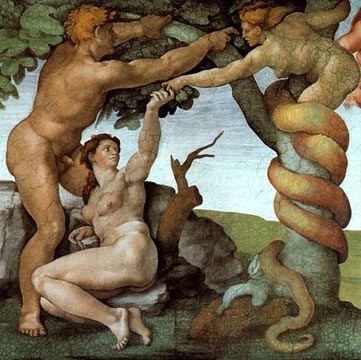
Other teachers who have studied the Bible describe a different version of the fall of man- going something like this. God made the world, and over all placed men (and women). He gave free will to his people, and when they turned from Him, all creation groaned. Everything became out of balance, distorted and discordant. From this process, rivers flood, volcanoes erupt and people fight, grab and lust- sin is let loose on all creation. God did not give up. Throughout history, he has tried to offer men and women redemption and the chance to participate with Him in a different way of being, but we live in a world untransformed and awaiting a final day when, according to the bible, Jesus will return. According to this view of history, our understanding of sin is still crucial to ideas of why bad things happen in the world, but it is about an unfolding process, not about individual guilt.

Powerful and biblical though this picture is, I still feel pangs of dissatisfaction. Does God sit next to some great cosmic scales of justice waiting for the sands to run out, watching us all running our little human races? Having the means to intervene and sort out this mess, but not the inclination?

This image of God troubles me greatly. This is a distortion of all that I have come to believe and hope for. I believe in a God who tempers anger with mercy, to such an extent that he sent his own Son to take on the sin of a fallen world. I believe in a gospel that proclaims the coming of a new Kingdom HERE and NOW, introducing the constant tension between our calling to work for good in our time, whilst living in hope for a future when all things will be made new.

Castles and boundaries…

We humans are so good at creating boundaries- in groups, and out groups. Nations states often seem to have a dependent relationship with their enemies.

We have seen the extremes of this- the walls around China, or Berlin, and now- Palestine.

This learning to love thing- it is tough.

I have commented before on how difficult living in community with others can be- how it peels you and then salts the sore bits. (See here.)

At times I think that anyone who tries to live like this is engaging in a foolish ritual, that is guaranteed to be fruitless and painful. Like squatting in spurs.

But then I see a flicker again of how things should be. A friend with an arm around another, seeming to generate warmth that is tangible. Or a relationship that has been bad, now made good… and the picture given to us in Acts 3 seems possible.

32All the believers were one in heart and mind. No one claimed that any of his possessions was his own, but they shared everything they had. 33With great power the apostles continued to testify to the resurrection of the Lord Jesus, and much grace was upon them all. 34There were no needy persons among them. For from time to time those who owned lands or houses sold them, brought the money from the sales 35and put it at the apostles’ feet, and it was distributed to anyone as he had need.

But lets never kid ourselves that this path of love is an easy one- or even an instinctive one.

our rambling old house

our rambling old house

We British people have been blessed with many good things- comparative peace, the rule of law, freedoms that others envy. Our experience of poverty and injustice is often second hand. But sometimes, our castles are seiged- just a little,,,

We live in a big old house in Dunoon, that we regard as God’s house. (Although, somewhat unfairly, the mortgage is ours!) We try to keep open doors, and offer respite to folk who need it. We use the many rooms for all sorts of different things, and for us, the house is a blessing through which we seek to bless others.

In our town there are many issues over boundaries and access to property. Our house is accessed over a rough track that goes over land owned by another property. This is no problem of itself- there are laws that deal with ‘kith and carriage’, and the requirement to maintain people’s rights of access. Our house was built in 1840, and used to be a hotel- so these are not new issues!

But there will always be some for whom this becomes a problem. We were unfortunate enough to have one of these people moving into the property over which we accessed our house. He decided that he did not like other people using his lane, and did everything he could to try to make it difficult for us, our visitors, and the other people who live up the lane.

He narrowed the entrance, and put in huge speed bumps that damaged cars. He refused to cut away obstructive trees. He blocked the lane with vehicles and refused to let our visitors in or out. He set his dog loose, and laughed when it attacked me.

Neighbours got involved in pitched battles with him, in which he threatened violence. Police and solicitors were involved. We tried our best to stay out of it all. We tried to build a relationship with him, and to speak to his wife and his young son, who would scurry on by. We worried about what sort of life they were leading in the midst of all this aggression and anger.

But living with this eats away at you. Finding a position of love and forgiveness in the shadow of such unpleasantness- this is hard.

It was a great relief to us when he moved away, to a more isolated location up country.

But this being a small town, I keep bumping into him, or his wife. He glares, and I seethe a little.

I need some Holy Spirit help… perhaps yet there will be an opportunity to show something of Jesus…

One thing that happened a couple of days ago though,was that we received a solicitors letter informing us that half of the house next door had been built on our land. It was asking us if we would give consent for the boundaries to be re-drawn.

It was an easy decision to make, and felt very good.

‘God on Trial’ film

god-on-trial.jpg (JPEG Image, 300×180 pixels)

I am sitting still stunned after watching a riveting piece of drama. The BBC has taken one of the most dreadful parts of human history and made something wonderful out of it.

God on trial‘ tells the story of jews, wrestling with God, like Jacob before them. If you missed it, you can watch again for the next 7days by visiting the BBC i player- here

This programme was a master class of writing and acting. It is centred around a group of Jews in Auchwitz who have just been selected for the gas chamber. And in angry outburst, some of them decide to put God on Trial.

The charge- breach of the contract with his Chosen People, the Jews. And the arguments went backwards and forwards. Some angry and rejecting, others clinging to faith with all of their might. Here are a selection of some of the arguments

Jews had suffered before. The point is to be a good Jew- we are being tested. Punished for sins. sons deserted faith- forgetting the scriptures.
But why punish children and old people, and good Jews because of the sins of the bad ones? Why not punish HITLER?
But this covenant is with the Jewish people- it is not personal.

In time, things become better? God is a purifying surgeon– not a punishment, but a purification? Like the flood, or the destruction of the temple by Nebuchadnezzar.  Painful, but beautiful.  A process necessary for the rebirth of Israel? A sacrifice? A Holocaust… you can hate the knife, but love the surgeon. there will be a holy remnant. they can finish the story.
Do not let them take your faith. Hitler will die but the TORAH will live. We must trust in God.

God gave us free will. We have to take responsibility for our own planet.
But there was the man who was forced to choose from one of his children- one to save. Free will? I do not want it.

“But he is here. I know he is here, even though I do not understand him. Snowdrops the first ray of sun. I felt him. That warmth. Maybe GOD is being gassed. He is suffering with us.
But who needs a god who suffers?
Maybe God needs us… maybe he is not strong after all without us
Were does all this evil come from, but where too does all this goodness come from?

The violent history of the Jewish people. God the avenging God. God who kills the first-born Egyptians, and destroyed the people of the promised land- to make room for the Israelites. Moabites, Amelakites- Is this God Just??? What was it like when God turned against these people? It was like THIS. God was not good- he was only on our side! Now he has made a new covenant with someone else!

WE cannot fathom the mind of GOd. THis will end…
BUt no no no no- this will not do- making predictions about the future. The covenant we have NOW- Psalm 81 the throne of david will last for all time and his descendants….

You have something in common with the Nazis! 100 thousand million stars. To count them 2500 years- just one galaxy! Yet all his focus is on ONE planet? One part of the planet- the Jews?? If he loved the jews so much- why did he make anything else?
It’s all about power and control. Each one with their own God.

Don’t let them take your God. He is your god, ‘even if he does not exist’.

And as brilliant minds chased ideas about God like lifelines thrown to drowning men, their appointment with the gas chambers drew closer. And in the end, they found God guilty as charged.

But then, at the end, one man cries ‘Now God is guilty- what do we do now?’

‘Now’ came the answer, ‘we pray’.

So did I.

Blogged with the Flock Browser

Rob Bell, ‘Breathe’

We have used quite a lot of Rob Bell’s ‘Nooma‘ DVDs in our group. There are about 20 of them at present- each one a little package of creative film making, Bell’s unique presentation style, and subtle reframings of things we thought we knew…

Bell’s high profile (his church is huge and his books and films are known the world over) has meant that he has also come in for a lot of criticism. For many, he is a heretic. For me, he is a man with something to say, who says it well.

I found a copy of one of the films on-line. They cost about £10 to buy, so this might be a way to enjoy one of them (in low quality, with the annoying subtitles) and find out what the fuss is about. Then you can save up and buy some for you and yours!

May it bring to you something new about the wonders of God.

Descartes, time, and God.

Time for some schoolbook philosophy!

I read something recently about the philosopher Rene Descartes – who was fascinated by what it meant to be, what it was possible to know and what could be described as truth?

Descartes decided to begin by doubting everything he possibly could – to see if he could reduce the knowable to an essential core. He found he could doubt everything – God, the existence of the world about us (which could be an elaborate deceit placed on our consciousness by some demon – a kind of precursor to The Matrix), the rules of science and gravity – all these were dependent on our perception, and perception was ultimately unreliable and subjective.

This led him to his ultimate point of truth – his own ability to ask these very questions – it was not possible to doubt this, as in order to doubt, then this too involved thought. Hence, his famous phrase, “I think, therefore, I am.

Descartes then turned his mind back to time. We live our lives in the passing of time – in a finite space. We have our beginning, and our ending, and find our existence in between. He was convinced that God was infinite – outside our understanding of time. However much we might think we know of God, we must equally realise that there is so much more. He concluded that as our experience is formed in our finite world, then the very fact that we could imagine the infinite must be proof in itself of the very existence of God – for no finite being could, of itself, think of the infinite.

Descartes thinking influenced an age. Whether or not you agree with his conclusions, the very questions he asked have dominated modernity. They are perhaps being asked again as we stand on the brink of a new age.

What am I?

What can I know, and how do I know it is true?

Perhaps for we Christians, there remains another set of questions – perhaps the greatest ones of all;

Who is God?

Can God be known?

Can God ever know me, in the vastness of this apparently infinite universe?

If so, what should be my response?

Are we all heading home anyway, one way or another?

Or is there a responsibility that we are called to – a way of life that is more vital, more blessed, more beautiful?

In the Bible, we read of generations of people of faith – from the nomadic wanderings of the people of Abraham, to the subjects of the mighty (but ultimately fragile) Roman Empire – asking these questions.

The amazing thing about all these stories was that apparently, God, as well as existing in infinite space, was also always there.

There he was, moving across the face of the waters when all was formless and void.
Walking in the garden in the quiet of the evening.
Speaking out of burning bushes (and resting on people with tongues of fire later.)
Even being willing to dwell inside a tent, or an unwanted temple building.
Ultimately, coming himself, in fragile human form. Walking amongst us, revealing something of his heart – inviting participation in a new way of being.

Then promising that the eternal will dwell within us.
That we would become temples of his Spirit – capsules containing something uncontainable, immeasurable, unfathomable.

Kind of amazing, ain’t it?