Good news in the news…

As part of our on-going study ‘Exilio’ we were encouraged to watch the media for stories about Christianity.

The point was to ask what the stories might tell us about the place of Christianity in our culture.

So, of the few examples I came across- here is a selection.

More than 10,000 Christians are living in refugee camps in the eastern Indian state of Orissa after anti-Christian violence in the area, officials say.

Govan Old Parish Church A study has been launched to find a new use for the oldest Christian settlement on the River Clyde.

Govan Old Parish Church in Glasgow will no longer be used for worship after the Church of Scotland decided to merge three local congregations.

The historic site has a burial ground dating back to the 5th Century and 31 early medieval sculptures.

Possible new uses include a museum, a performance venue and a visitor centre linked to local businesses.

Baltic

An art gallery is facing a trial at crown court over claims it displayed an indecent statue of Jesus Christ.

A private prosecution is being brought by Christian group member Emily Mapfuwa, 40, of Essex, on the grounds the statue outraged public decency.

The artwork was part of an exhibition at Gateshead’s Baltic Centre featuring several plaster figures with erections.

Terry Gilliam, Terry Jones, Graham Chapman, Eric Idle, Sue Jones-Davies (centre) , John Cleese and Michael Palin

A mayor’s plan to end her town’s ban on the 1979 Monty Python film Life of Brian are being opposed by the local vicar, who says it pokes fun at Jesus.

Sue Jones-Davies, who played Brian’s girlfriend in the movie, was amazed when she became mayor of Aberystwyth that it was still barred at the cinema.

But Reverend Canon Stuart Bell said Christians he spoke to in Ceredigion were still against it being shown.

The mayor declined to respond, but will still press for the ban to be lifted.

So what can we learn from this little collection of stories, all culled from a simple search of the BBC news pages at one particular time? The plight of the thousands of Indian Christians has made next to no impact. Other stories become ‘human interest’ titbits- included for their oddness, rather than anything of central importance.

Christendom is dead.

Which is not necessarily a bad thing.

The exciting thing is what God will do next…

The road from Colintraive

With all the optimism of the early spring
I turned the car from the road home and looked to the hill
Taking the camera more for motivation I head for the high point over the Kyle.
I feel the old excitement in the smell of wild places
All around I can almost hear the soil coming alive
The whisper of the wind in the larches sounds like blood flowing
Sap rising

And, unconcerned as my unsuitable shoes take on water,
I climb through heather and the old years dry grass
Up through ancient Gneiss outcrops
Still holding the shape of their birth in lava poured out in days so distant
That there seems no point calculating.

My feet cut into slow growing mossbanks
And scatter the stalks of bracken
And in the moment, I fear that I bring a human rhythm,
In this place unwelcome, discordant
Drowning out the stillness
Oil on water

I notice blackened heather stalks swept by fire
Perhaps lit by a smouldering cigarette last summer
And remember that this place is everywhere marked by men
Close cropped by the sheep, the land curves towards
The regimented contour crop of Spruce trees in the valley below
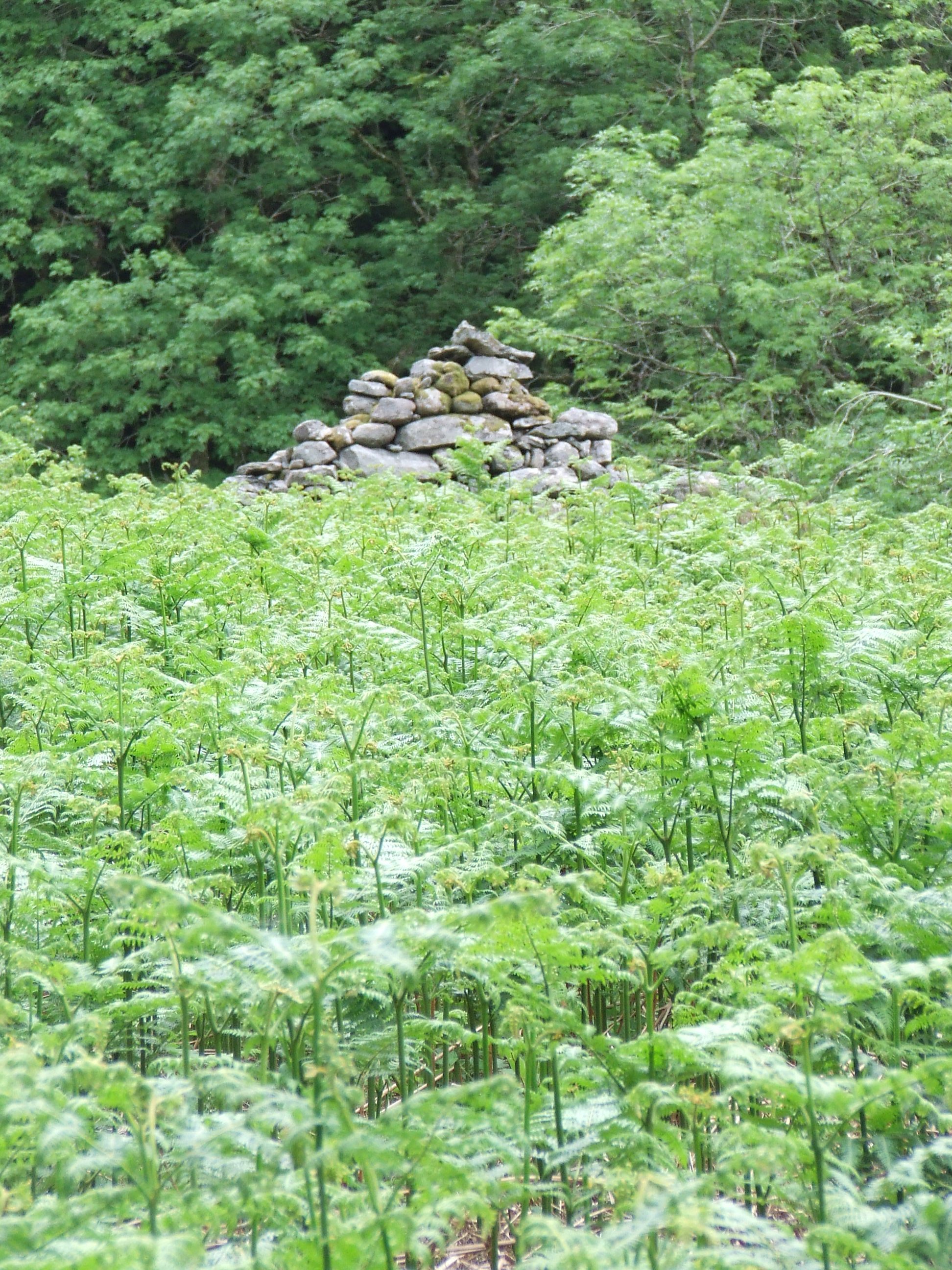
And half hidden, there is the evidence of older dwelling places
Now memories in the soil
Barcodes in bracken and dead nettle
Feeding on the residual richness
Leached from these poor houses
Whose people drained away.

Then perspective shifts again
To the far horizons
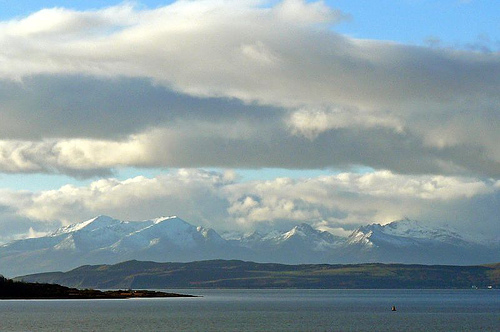
Across the sparkling Kyle lies Bute
Then beyond, Arran’s hills rise above Lochranza
Still wearing winter white against the blue sky

I stood and gloried.
Awed by things much bigger than I
By creative forces far beyond my understanding
But by Gods grace
Not beyond my reach

Blessing received, I take photographs recording only human spectral light
Then scramble back to shiny car, and head, too fast, for home
Anxious to see my loved ones
Eager for my own slice of civilisation.

2.3.05
© Chris Goan

Landmarks

A few weeks ago, we took the canoes out to Loch Striven, round the other side of the Cowal peninsular. We paddled for a while out along the loch, until we found a landing spot next to a raised beach of soft stones. A perfect spot for a picnic.

As with all our coast line, the tide had left its usual selection of plastic, old rope and broken fish boxes on the beach- but I do not think anyone had been there for years.

William and I saw what looked like some old walls in the distance, and went off exploring.

what we found used to be someone’s house. A crofter perhaps, or a fisherman- now long gone.

Much of our small crowded planet can no longer be regarded as true wilderness. As you walk to the hills, you will almost certainly walk over a landscape marked everywhere by man.

Fields and field boundaries – some new, some ancient, shaping the subsequent developments.

Hedgerows and dry stone walls.

Old signs of settlement, perhaps still in use, perhaps now redundant, abandoned, remaining only as a growth of bracken and nettles, rising in ground fertilised by the nitrates left behind in the passing.

The very paths we walk upon have been made by the passing of other feet walking their own walk, into their own unknown uncertain futures, now past and gone.

We humans have transformed the planet in the last few thousand years of our ascendancy. Forests gone, rivers diverted. Roads made straight across mountain and valley. Many of these marks are irreversible, at least in the foreseeable future. The land may clothe them in green, but the marks will remain for thousands of years to come.

As I write, the debate about how our patterns of living might have contributed to accelerating climate change continues to rage.

Humans have been of significant influence on my islands for a mere 5000 years or so. In some parts of the world, they can trace the mark of man further, in many, much less. What a legacy we inherit from our forebears – both great, and fearful.

Our lives have been shaped by this legacy too. We stand on the shoulders of those who gave the land its present shape.

Others will stand on ours.

Beautiful creatures

I have come to think that this beautiful creature that God made ‘…a little lower than the angels, crowned with glory and honour…’ has a special place in this wonderful world.

But we are such a small part of all the good things that he made.

The sweep of land from forest to crags peering through the shroud of mist.

The wild beauty of a summer storm as lightening splits the night.

The cold flickering of the northern lights in the dark winter.

The smell of spring on fresh April mornings, when all things seem possible.

These events will happen whether or not we observe them, whether or not we participate within them. But in experiencing them, perhaps we bear unique witness to the artistry of the Creator. Perhaps we alone can tell at least some of the story, some of the shape and size of what this thing called Earth really is.

Sometimes it seems to me that we overplay our place as the top of nature’s food chain. After all, we are so small, and other life-forms on this planet may yet outlast us.

But then it occurs to me yet again that we beautiful creatures are alone in our ability to understand, to measure, and ultimately to choose to raise our voices in concert with the angels in a unique song of praise…

Fragile

If blood will flow when flesh and steel are one
Drying in the colour of the evening sun
Tomorrows rain will wash the stains away
But something in our minds will always stay
Perhaps this final act was meant
To clinch a lifetimes argument
That nothing comes from violence and nothing ever could
For all those born beneath an angry star
Lest we forget how fragile we are

On and on the rain will fall
Like tears from a star like tears from a star
On and on the rain will say
How fragile we are how fragile we are

On and on the rain will fall
Like tears from a star like tears from a star
On and on the rain will say
How fragile we are how fragile we are

I heard this song again the other day for the first time in years- ‘Fragile’ by Sting. Thought it appropriate given the title of this blog…

The song takes me back to being a student, painfully shy, searching for some kind of shelf to hang from. For a while it seemed as though I would surely fall.

It was music, and passionate ideas that saved me.

Oh- and Michaela of course.

Life… is so fragile.

If you can cope with the aching beauty of another song about fragility and loss- check out this track by Martyn Joseph

Fragile circles of life

All around us, life is circling.

Some circles are big, some very small.

Insects that live a whole life in one of our days. Breakfast sees the end of childhood, lunch the weight of middle age responsibility, tea time the creaking of age, and with night, the sleep of the dead. Until the next generation comes into being.

Or consider the life of these tall trees.

Each slow forming ring of growth, evidence of their elevation over our own anxieties.

Each falling leaf layering the soil, laying down the food for the coming spring.

Each spreading branch offering the arm of shelter to a thousand lesser creatures. And me.

Seeding slowly and deliberately.

But even the tallest trees

Will one day

Fall.

And what of us?

What of our life time? We tend to see our journeys as linear. Even then, perhaps we are comfortable with the now, less so with the tomorrow, and the future is a foreign country, were be dragons.

Away we go, off into middle distance – always forward, but often acting as if we are standing still.

But we are born not to die,

But to live.

To trace our own arc through this space of ours –

To windmill wide and open,

To love this life

And let it love us back

Perhaps unlike any of these other circles, we humans have this gift (this curse) of knowing

Knowing and seeking to know more

Seeking to connect and to overlap these circles-

Seeing where they depend one on the other

Seeing where they smash into one another

Vulnerable to the sharp jagged things

But capable

Of such joy

Liberation theology, Capitalism and Communism.


For years I have heard stories about the Roman Catholic clerics who defied the worst despotic regimes of South America in the 1060’s and 70’s. Bishop Romero gunned down in his Cathedral, Priests and Nuns who chose to live alongside the poor and oppressed, and to try to be the hands and feet of Jesus. Out of this melting pot was born a new way of understanding the words of Jesus, known as ‘Liberation Theology.’

Pope John-Paul spoke out against this movement. He grew up in so-called Communist Poland, and liberation theology sounded too much like communism to him. As a social sciences graduate who was also a Christian, the critique offered to Western Capitalism by socialist writers, and even by old Marx himself always resonated with me. I think it was CS Lewis who called Communism a ‘Christian Heresy’.

The 1980’s and 90’s saw an end to the old ideological divides in Europe- everyone became a free marketeer it seems. The Labour party in Britain stopped talking about ‘poverty’, lest it scare off the middle class (Bourgeois!) vote. Instead we talked about educational attainment, and ‘social exclusion’.

But, as Jesus said, the poor are still with us. A recent WHO report has pointed to the growing health inequalities in the UK, and commentators have raised again the issue of inequality of income as the main causal factor.

And if we look broader than the boundaries of my own country we see global economics are managed by the ‘free market’- but in this system, as in all others, there are winners and losers. The system, say many, is rigged against those who have not, in favour of those who have.

Definitions

Liberation theology is a Christian movement of protest and support for the poor. They would point us to the words of Jesus – yes the poor may always be with us, but our best service to Jesus is to serve the least.

  • The call is to see people. And to see them as the beloved of God.
  • The cause might be varied – but as Mother Theresa put it, “We rob our brothers by all that we own”.
  • The solution is to learn how to love – and to live this out wherever you are – in the slums or in the boardroom.

Here is a definition culled from the good old BBC (from here.)

“Love for the poor must be preferential, but not exclusive.”Ecclesia in America, 1999

Liberation theology was a radical movement that grew up in South America as a response to the poverty and the ill-treatment of ordinary people. The movement was caricatured in the phrase If Jesus Christ were on Earth today, he would be a Marxist revolutionary, but it’s more accurately encapsulated in this paragraph from Leonardo and Clodovis Boff:

“Q: How are we to be Christians in a world of destitution and injustice?

A: There can be only one answer: we can be followers of Jesus and true Christians only by making common cause with the poor and working out the gospel of liberation.”
Leonardo and Clodovis Boff

Liberation theology said the church should derive its legitimacy and theology by growing out of the poor. The Bible should be read and experienced from the perspective of the poor.

The church should be a movement for those who were denied their rights and plunged into such poverty that they were deprived of their full status as human beings. The poor should take the example of Jesus and use it to bring about a just society.

Most controversially, the Liberationists said the church should act to bring about social change, and should ally itself with the working class to do so. Some radical priests became involved in politics and trades unions, others even aligned themselves with violent revolutionary movements.

A common way in which priests and nuns showed their solidarity with the poor was to move from religious houses into poverty stricken areas to share the living conditions of their flock.

I believe that Jesus always had a bias towards the weak and the poor. Any reading of the Sermon on the Mount has to twist theological somersaults to deny this. And I can not subscribe to the idea that International Capitalism, propagated with such enthusiasm by the ruling Christian west, will have much currency in the Kingdom of God.

But neither do I have any faith in a coming Marxist utopian revolution. I would rather hope for Christians who plant hope and beauty in the broken places.

Where the poor people are.

The challenge is for the rest of us to find out what that means for us.
Blogged with the Flock Browser

Church abuse 3

I have posted previously about abusive situations in churches (see Church abuse and church abuse 2.)

I felt justified in focusing on such negative aspects of the people of faith as I keep coming across people who used to go to church. When I ask them to tell me their stories, my heart breaks. I have had two conversations in the last week that trod the same path.

But lest it seem as though I just want to bash church- here is something that I hope will redress the balance…

Another film from America, called ‘Lord save us from your followers’ explores the image that Christians portray to the wider US nation and finds evidence that Jesus is at work…

For more info, and a download for the film- check out this link.

Here is another short trailer…