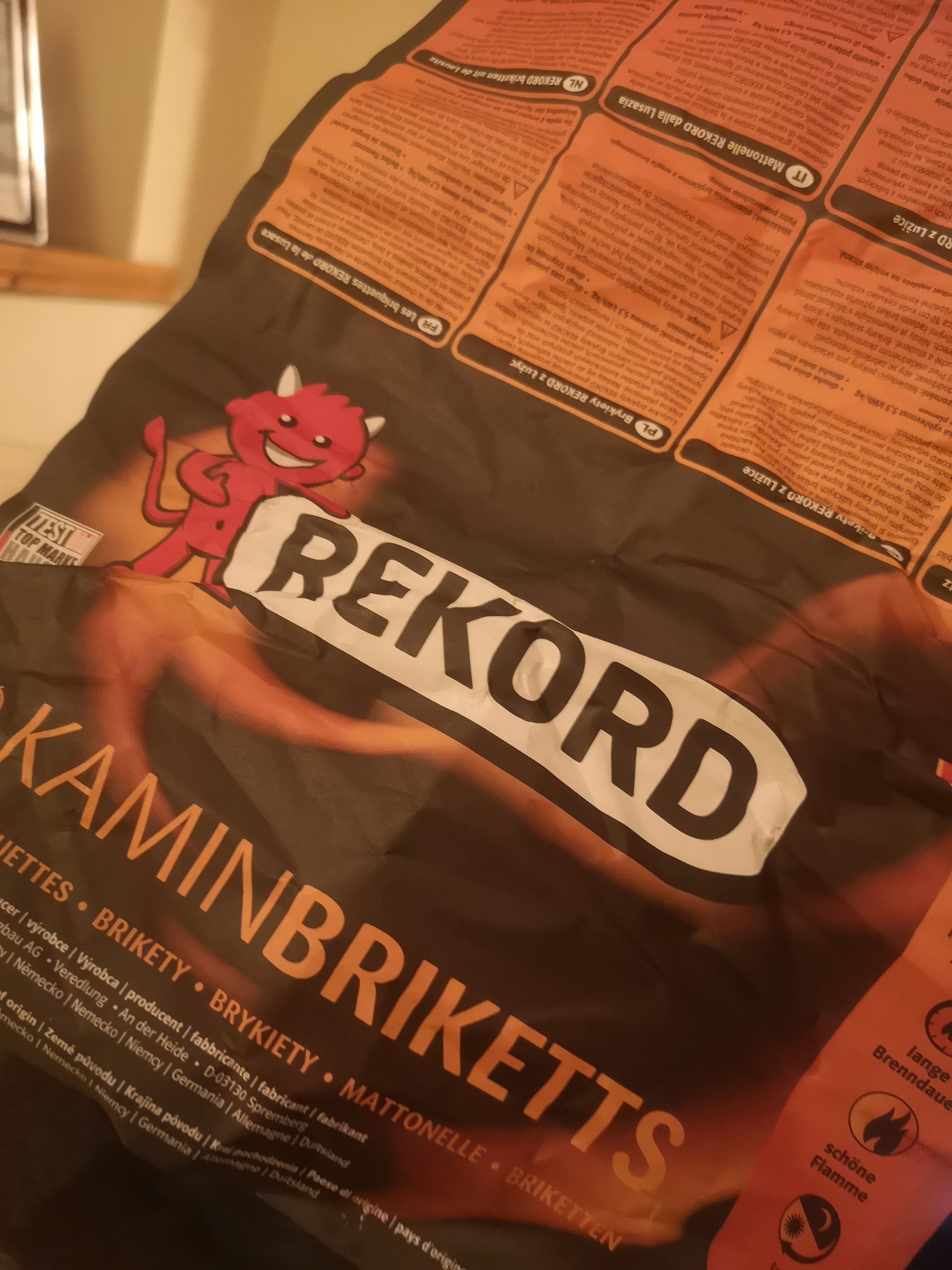
We are in Ireland at the moment, visiting family, staying over in the bog country, full of smell of burning peat. Imagine my surprise then when I saw this;
How is it possible that globalisation has meant that we are importing peat to Ireland- to the place famous the world over for its peat? There is madness to this, but also…
Firstly, I should not be surprised. Commodities are globalised. That is how it is. If there is a market for coals in Newcastle, then it does not matter where those coals come from. If a Canadian lumberjack needs wood for his fence, why should he not go down to his DIY store and buy wood that was grown in Sri Lanka?
Secondly, who am I to even complain? I am burning the stuff after all. I am sending up my pyre of ancient carbon. I drove here in my 10 year old diesel car which did more of the same, therefore I am a hypocrite and as such should be immediately silenced.
If we are to save the world some things need to change, that goes without saying, but one of the most obvious is the need to restore ‘local’ to be a primary consideration when trading and buying goods. There is good evidence that not only does this have a significant environmental benefit, it can actually restore communities.
Today we had a budget released that hardly mentioned climate change, by a party that recently voted NOT to enforce penalties against the privatised water companies whose systems are unable to protect our rivers from repeated discharges of raw sewage.
It seemed entirely right to re-post this poem today.
Dirty old river
.
Dirty old river all rusty and brown
Coughs out a ship from the dirty old town
Scavenging birds patrol overhead
Searching for things only recently dead
.
Last resort trawler hauls close up to shore
Scrapes the last scallop and the very last prawn
Flatiron-shaped tug smooths out towards sea
Like the impossible flight of the last bumble bee
.
Dirty old river that once was so pretty
Collects like a sewer from the arse of this city
Where once swam the salmon, the perch and brown trout
One of the great challenges, when seeking to make changes to the world, is how we might concieve of a different future. For this we need our prophetic visionaries. Monbiot is just such a feller.
Another poem of hope and connection, which suggests a world not ruled by the survival of the fittest, but rather by the eventual realisation of unification and interdependance.
This recording was made in the immediate wake of the death of my sister.
Following on from yesterdays post about the usefulness of spirituality as a means to turn us towards ideas that might save the world, here is a favourite poem(if it is OK to have a personal favourite of your own poems that is. It might be like favouring one child over the others.) I love this one because it says romething that feels true, whilst also leaving the mystery wide open.
I had a conversation with a dear friend recently. He is a Church of England priest, so although we share very similar world views our theology has points of divergence. In this conversation I was trying to describe what ‘spirituality’ still meant to me and how I seek adventure in new meaning. Because my friend is full of grace, he listened and talked it through with me, even though he found some of what I said troubling – I entirely umderstand why, but remain unrepentant.
My points went something like this. When trying to understand the spiritual path I am drawn towards, I use these tools;
What sings in my soul. I know this sounds like airy-fairy, self centred post-modernism, but I think at some level it has always been true, for all of us. I am just more at peace with letting go the doctrine and codified belief systems that no longer resonate. (I know too that the things that sing in my soul always resonate with the teachings of Jesus, but increasingly I am open to a wider set of reference points.)
Things that are to do with love, beauty or brokenness. This is hard to describe other than to say that when one or more of these things is communicated, my own broken humanity responds in a way that makes everything technicolour.
What I have recieved from people/sources I trust. You could use the word ‘apostle’ here. We learn tihngs from people who have already taken us along the way. The dangers of trusting the wrong voices are obvious – consider the way that social media shapes us by feeding us bias – but ideas and inspiration is often an external thing, offered by others.
What I have found to be useful. This last point relates to how spiritual ideas might be seen to shape both individuals and wider human communities towards good.
The last point is the one that I want to talk about a little more. It has been obvious throughout most of my life that mainstream religion, certainly in the West, has had far too little to say about social and economic justice. More recently, it has had little to say about climate change/justice either. It is not that individuals within faith traditions has not brought huge energy to bear in challenging these great injustices, but rather that mainstream theology has not offered a coherant story or an idea that has enabled the radical changes that I believe to be necessary. By and large, faith seems to have contributed to the status quo as determined by those powers that want things to stay the same.
For example (in case you needed it) I grew up within an evangelical Christian tradition that promoted individual salvation (after we die) above all else. They called this ‘the gospel’. It took me years to realise that this way of seeing the world/reading the Bible/understanding the mission of Jesus was full of subjectivity and distortions, and that there had always been other ways to approach the story. The story has more to teach us if we allow ourselves to be taught.
What still interests me (and keeps me returning, despite everything) is how faith motivates us to reach for something better, somthing deeper, more ‘true’, more loving, particularly in the context of a changing world facing huge challenges. To put it another way, what ways of seeing the world/reading the bible/understanding the mission (gospel) of Jesus might be USEFUL to us?
I think I have found some intriguing clues- not answers as such, but certainly ones that invite me to respond. A lot of this came to me in part through the writings of Fr Richard Rohr, particularly his most recent book ‘The Universal Christ’. I tried to describe some of this in a post a couple of years ago. You could say that Rohr has fulfilled that ‘apostle’ role I described previously, and also that as I read his worlds, something deep inside me said YES. There was great love and beauty in the whole story.
Also, his theological ideas seemed useful in a way that nothing else had for some time. He painted an idea of a unified, interdependent, interconnected world in which ‘The Christ’ was another word for everything. In this reading, God loves things by becoming them. These ideas came from Rohr’s Fransican tradition, and have been tested over time by deep theological thinkers, but it really feels to me that they are needed now, more than ever before.
In this reading, the purpose of faith is to shine light on the great goodness of all created things and the great interdpendence of all created things. It is also to note the brokeness within the nature of creation which we, as part of the whole, seek to heal and to ‘save’. This is not then restricted to saving the chosen frozen in a mythical and much feared afterlife, but rather about the here and now and what is within our grasp. How might such a reading change our relationship to the world?
I would argue that it changes everything.
Those of you who are travellers in a faith tradition will no doubt have all sorts of concerns and questions about my simplistic summary above and you would be right to do so. After all theological statements should allways be questioned and wrestled with. (Perhaps, however, you would be best to start with your own!)
Finally, if you have read this in bemusement that anyone might find motivation and inspiration in dead religion, then… well I have no desire to convince you otherwise. Find yours elsewhere and let that sing in your soul instead.
Marking the journey towards the the last chance for the continued survival of whole species and perhaps even our civilisation: a conference of world leaders, meeting just over the river from where I live.
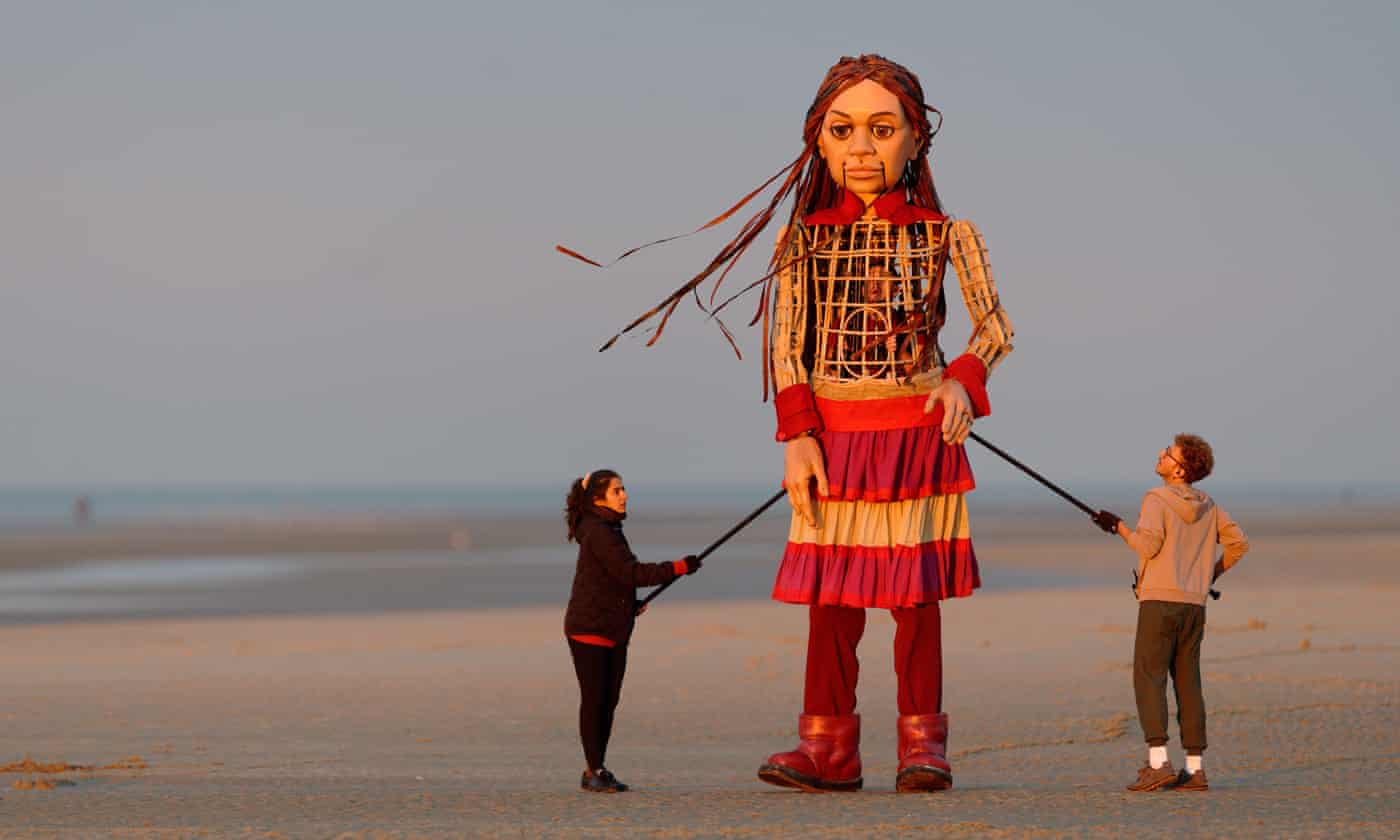
This image is of ‘Amal’, a three meter high puppet refugee who has been slowly making her way accross europe to her final destination of Manchester, along routes taken by other Syrian refugees. The full story is here.
I share this story not only because it is remarkable how an outsized animation has been able to humanise a human tragedy more than the humans themselves…
…but also because as we head towards COP26, it should be clear to us that the battle against global warming is inseperable from the issue of global social justice. The huge consumption gap between the haves and the have-nots is the problem here, The fear that keeps our borders high is the same fear that stops us from realising that it is we who have to change.



 this fragile tent