I heard someone say recently that the journey is often something we treasure more than the destination. This seems more true of advent than most things – not because I do not wish your Christmas to be full of beauty love (I most certainly do) but because this journey is about finding light, despite the darkness. Finding hope despite all evidence to the contrary. An invitation to faith not as destination but as process.
It is all there in the Christmas story. A nation longing for a different kind of Messiah than the one born in a stable. An on-going occupation. A despotic king. A clueless pair of parents who have only the slenderest hold on what they have brought in to being. Homelessness. Refugees fleeing violence. Rich men who promise solutions but merely reveal the vast inequality gap.
This year, let’s try to remember that we are not the first generation of Advent travellers to fear the way things are going. The journey is not over though, even if the destination remains so very far away. Let’s keep walking.
Thanks to all of you who have walked with me. May we make more miles together yet.
This year’s poem was written on the shortest day of the year, that time when our ancestors marked the turning point towards light. I stand in their shadows.
Comes a time
.
Comes a time when dark seems darkest
When things can fall no further
Comes a time when the day is shortest
When everything that might break has already been broken
When I reach out into the darkness
For I need you more than ever
.
Comes a time when we can again conspire
Towards the rediscovery of kindness
Comes a time when we hold each other close
When we can stitch our common thread into
Hoods that hold the warmth from its retreating
When we hang lights
.
Comes a time when the daylights must be brighter
Turning dusk to reluctant amber
When the embers of this fire seem to linger longer
Following the tradition of calling in favours from family, Chris asked his son Will to record himself singing this re-written version of everyone’s old favourite carol ‘In the bleak midwinter’… Will (who is a trad music player in various bands) had sung this version previously and does a simply stunning version here, somehow more powerful in its stark urban simplicity.
He recorded it on his phone inside a Glasgow tenement flat which he and his girlfriend Rachel are in the middle of renovating. It has no kitchen or bathroom, but it does have a piano.
The words are below…
Bleak midwinter
.
What can I give him, wealthy as I am?
Does he need an i-phone or a well-aged Parma ham?
Should I bring him trainers, a pair of brand-new jeans?
Or Halo for the X-box (whatever the hell that means)
.
In a tower block in Camden, a woman breaks her heart
Her credit score is hopeless, her marriage fell apart
Her cupboards all lie empty, her clothes are wafer thin
Her kids can thank the food bank for turkey from a tin
.
If I were a kind man, I would bring good cheer
I would house the homeless, if for only once a year
I’d buy my cards from Oxfam, for virtue is no sin
I’d send some Christmas pudding to poor old Tiny Tim
.
In the bleak midwinter, frosty winds still moan
And Mr Wilson’s waited ages to get the council on the phone
He’s worried cos his boiler has given up the ghost
And since Mabel got dementia, she feels cold more than most
.
If I were a wise man, I would do my part
I’d sell that gold and incense and invest it for a start
In gilt-edged annuities and solid pension schemes
For without good fiscal planning, what can ever be redeemed?
.
In a lock-up by the roadside a bastard-child is born
To another teenage mother whose future looks forlorn
A host of heavenly angels up high in star-strewn sky
The picture postcard version of Christmas never happens – we don’t have snow or Victorian choirs. (We do have robins, and the recent arrival of a small baby though.)
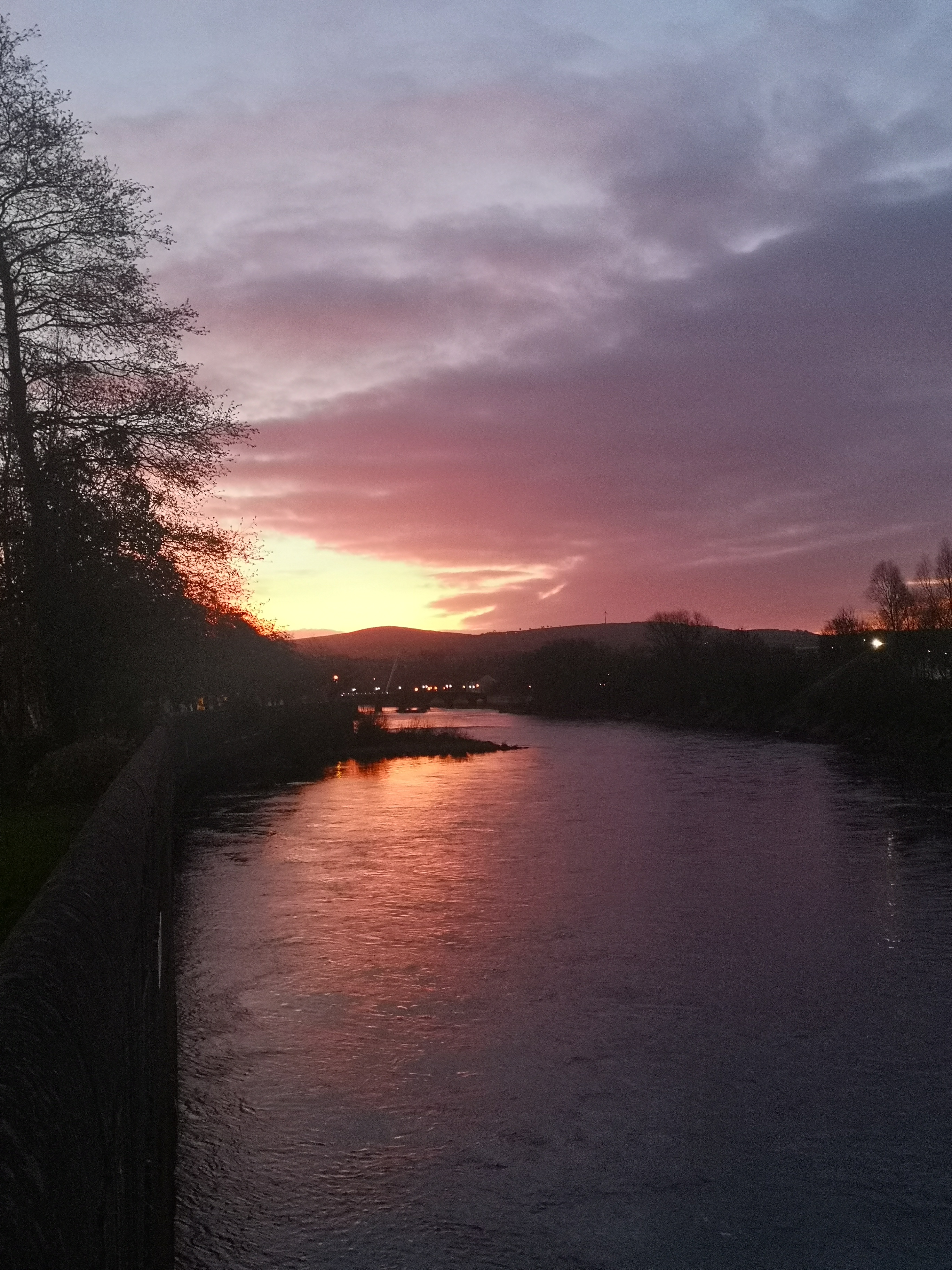
Here we have been lashed and slashed by storm after storm and it is unnaturally warm. The darkness lasts even longer, before the hooded light bleeds in with a yellow hue, making the day seem reluctant, forboding.
The shadow behind this advent has been Gaza. I have mentioned it in passing during the course of these meditations but it has been there all along. How can we seek the truth of a story set in a place of such current brutality and violence? How can we seek justice through this story when the opposite of justice is so current? How can we seek peace in this story when children lie under the rubble of a building so recently collapsed? How can we talk of love when industrial slaughter is justified by hate and vengence right there in plain sight on our screens day-by-advent-day?
But then the answer comes. What else should we do, if not this?
What else is Christmas about?
I know, we can easily coorie in, behind our storm lashed window panes and make it all about us and those closest to us. We can hide in our own interior spaces and consume.
Like I am doing right now.
But Christmas eve is not for guilt, it is for wonder.
It is for being open to the possibility of goodness, in spite of all the evidence to the contrary.
It is about Emmanuel, God with us, promising peace on earth, if we will heed his call to make it, one house at a time.
It is about love, for family yes, but also spilling out wider to embrace as many as we can.
So, dear friends, may your home be warm this winter. May the lights be bright. May the table be loaded with goodness and may you be loved, not because you have earned it, but just because you are beautiful.
May whatever you have be enough.
If threre is an anthem to this Christmas eve, perhaps it is this one. Glen Hansard and Lisa O’Neil, performing Shane MaGowan’s old party song with such tenderness and joy at his funeral…
As advent unfolds I have been allowing myself to look forward towards hope… to imagine the coming of a new kingdom/insurection/revolution in which goodness and compassion are central. In other words, I am trying to rest again in the spirit of the Magnificat as sung by Mary and recorded in just one of the Gospels…
46-55 And Mary said,
I’m bursting with God-news; I’m dancing the song of my Savior God. God took one good look at me, and look what happened— I’m the most fortunate woman on earth! What God has done for me will never be forgotten, the God whose very name is holy, set apart from all others. His mercy flows in wave after wave on those who are in awe before him. He bared his arm and showed his strength, scattered the bluffing braggarts. He knocked tyrants off their high horses, pulled victims out of the mud. The starving poor sat down to a banquet; the callous rich were left out in the cold. He embraced his chosen child, Israel; he remembered and piled on the mercies, piled them high. It’s exactly what he promised, beginning with Abraham and right up to now.
Luke 1 46-55 (the message translaiton)
I have been over in Northern Ireland for a few days to see my father, immersed in the usual chaos of old age – medication, money and care. I went with my brother, and we spent a little while exploring a place that he knew better than me, as he had spent a lot of his childhood over there. (Our family circumstances are complicated.) Here is the grave of my grandparents, both of whom died before I was born, having worked in the flax mill that took such toll on the health of local people.
My family were all born into a town called Strabane, right over on what now is the border with the Irish state in Tyrone. It is a bustling booming town now, because of cross-border trade, but until very recently was a place with one of the highest unemployment rates in all of Europe. Strabane was the most bombed town during the troubles, with the highest proportion of it’s citizens killed. It is overwhelmingly Catholic (91%) and as such was an epicentre of republicanism. There are many of these dotted about;
Until recently, many of the streets would have kerbs painted in sectarian colours across the province, but I was surprised to see that most of this has been removed. However, the tribalism remains firmly in place, seen in many subtle ways. One of the more obvious at present is that in republican areas you will see many flags and banners supporting the Palestinian cause in Gaza, whilst in unionist areas, lamposts are flying the Israeli flag. The currency and apparent group-think of this division are shocking to outsiders, but not to those who live with it day-by-day.
In Strabane town centre there is quite a lot of public art, most notably around the lovely Alley Theatre, but also this piece, which lists a number of famous people born in the town, including former president of the USA, Woodrow Wilson, Musician Paul Brady and writer Flann O’Brien. It does not mention other illuminaries such as William Burke, the 18th Century serial killer, but does give a shout out to a woman called Cecil Francis Alexander who wrote many favourite hymns from my childhood- ‘There is a green hill far away’, ‘Once in Royal David’s City’ and the ubiqiotous ‘All things bright and beautiful’…
… which takes us back to the root of all this.
The violence and trouble unleashed on Ireland has been blamed on many things; religion (of course), politics, the British, ignorance – all of these things may have played a part, but Cecil Fancis Alexander’s hymn gives us another clue, containing as it does (in original form at least) this verse;
The rich man in his castle, The poor man at his gate, God made them high or lowly, And ordered their estate.
For much of the last centuries, the Irish were considered as the lowest of all. Alexander, from a wealthy background, was part of a ruling class, married to an Archbishop. She spent her time on charitable pursuits amongst the deserving poor. She lived at the time when around one million people starved to death in what came to be known as the Irish Potato Famine but seemed unable to see the injustice right in front of her nose.
Perhaps you think me unfair to someone living in such a different time and place, but I will not sing this hymn, even with the verse above ommitted. Instead I will thrill once again to young Mary as she sings those words of the magnificat; The starving poor sat down to a banquet; the callous rich were left out in the cold.
I took a morning walk alongside the border river Foyle, which runs through the middle of Strabane thinking about an old concept suggested by the author Phillip Yancey. In his book ‘What’s so amazing about Grace’, he painted a picture of what he called ‘ungrace’, or the opposite of grace. Families, communites and societies who are characterised ungrace seem to experience it in almost like toxic waste or poisoned water.
Ungrace leaves a legacy that can only be overcome by one thing.
The Advent waiting is a framing of looking forward in hope towards a time of peace, but it is not a magical peace, brought about by a Messiah who creates peace by the slaying of enemies – this was one of the things that got Jesus in so much trouble. Rather it is a peace that is won by peacemakers, one small step at a time. Here is a statement that I am wrestling with this morning;
There is no peace without justice.
I think this is true. Making peace must involve at some level, the rebalancing of manifest unfairness, partiularly in relation to those who hold power, because power has this way of padding itself at the expense of others – not just materially, but in the way it feeds egos. By the same token, powerlessness debilitates.
This takes us towards another element of this peacemaking- the inevitability of conflict. At first this seems paradoxical, until you remember that as the advent story unfolded, it was full of conflict. Making peace involves challenging injustice.
The way we do this is key. The great protest movements – the marches, the mass demonstrations – championed by Ghandi and MLK give us heroic templates, but hindsight tends to gloss over the messy painful nature of the personal interactions, even when faced with injustice that (at least from our current perspective) is so transparent. Currently we see other mass protests on the streets demanding a cease-fire in Gaza, a cause which seems so right, despite the fact that some seem to think this protest is not ‘British’.
If you callenge power, you should expect it to get ugly.
Most injustices however are not on this scale. They are small, grubby ones that we encounter in the mess of daily life. I am struggling with one just now. I hate conflict but have found myself making a complaint to a community employer because of serious problems in the ways they are treating their staff. I now need to see this through, but today, I am taking pause, and asking these questions;
Is my cause just, or have I got things out of perspective?
If my cause is just, how do I seek peace alongside justice? How do I hold on to integrity?
It is easy to make war in the name of peace, so how can I treat my ‘enemy’ with compassion, whilst still seeking a just outcome?
Our advent collaboration, inspired and curated by Si Smith, and involving Photographer Steve Broadway, Ian Adam’s meditations and poems by me is now available!
You can get hold of it here in dowload for now, but hopefully you can order it in actual paper soon too. (It would make a lovely Christmas present I reckon, in fact some of you might be getting just that!)
Any help with the social media spreading the word thing would be appreciated as ever…
Here is the blurb from the Proost website;
This beautiful Advent product evokes the sense of waiting and watching at this season. Its available here as a download for £3.50.
Expect beautiful poems, challenging punchy prayers and thoughts and some beautiful photography in this devotion resource aimed at taking you through the 25 days of December up to Christmas Day.
From the book, this is from Elizabeth:
They say every flapping scrapping life is
A brand new miracle
– I see them all in the street
Displayed there by their miracle makers
For the rest of us to worship.
Four great artists have come together to make this book happen. Chris Goan, Ian Adams, Steve Broadway and Si Smith have brought their collective creative wisdom together to shape a wonderful book and it’s one we’re very excited about here at Proost.
In addition to this version there is also a Bonus Edition available which includes all of Steve’s original photographs for personal use. That edition is £5.
A hard copy of the book is currently being created and will be made available shortly.
We are all caught up in the Christmas madness again. Over the last few years I have railed and moaned about all the wasted money and fake snowflaking. I will not do that this year- partly because it has been said, but also because it is better to start closer to home.
However, I always find myself conscious of those who are outside the plastic bubble we make out of Christmas. I suspect that Jesus would be too. That is what this poem is about;
Ad vent
Who can ever expect the unexpected?
For what is hope to those from whom hope has been taken?
Perhaps our mistake is thinking
that love will always come
in the shape we have known it:
a happy ending
a new beginning
a christ-child.
In this pregnant pause
while the earth holds its breath
waiting for what
it does not know,
let us have the faith
that even we,
with all our wise
and cynical
knowing,
would not imagine
the shape that love
will take
and instead just
have the faith
that it will come.







 this fragile tent