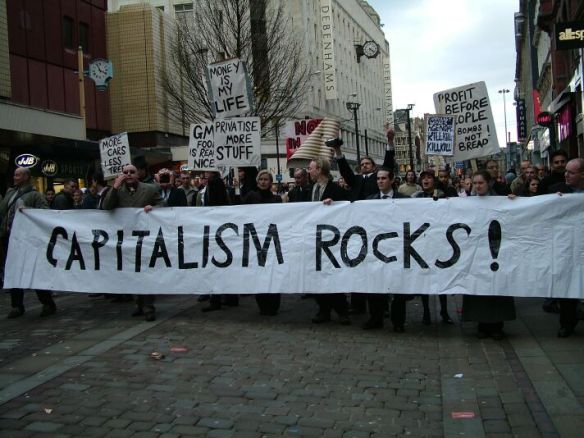
BBC Reith Lecture- the free market and morality…

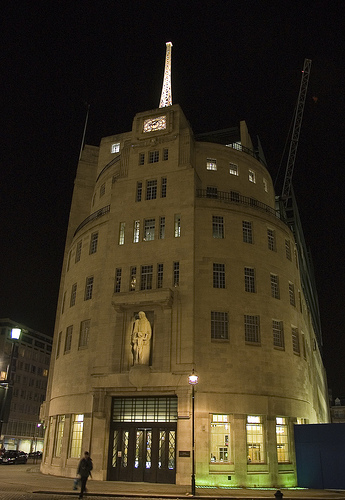
bbc broadcasting house

I managed to catch most of the first of the new series of Reith Lectures on Radio 4 this morning as I drove round to Helensburgh.

For those who have not come across the Reith Lectures before,  they are a British institutuion- or perhaps an English institution- despite their connection with the Scottish John Charles Reith, the force behind the creation of an independant BBC.

This is what the Lectures are tagged with-

a series of annual radio lectures on significant contemporary issues, delivered by leading figures from the relevant fields

The current series features political philosophy Professor Michael Sandel– and digs into some of the primary issues facing our political and economic system.

This first one concerned itself with the nature of the free market, and it’s relationship with moral choices.

It chews on the nonsense of carbon trading, and the potential free market responses to the ‘problem’ of refugees.

It was a great piece of radio- of a non-sound bite kind, a rare commodity.

You can listen again here, or it is repeated on Saturday.

The series will continue…

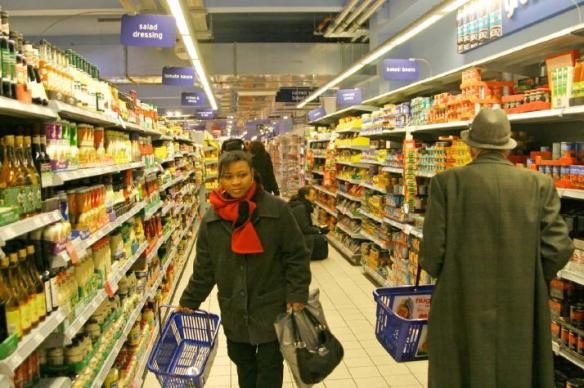
Capitalism, and Church as supermarket…

super_market

In a recent post on his Missional Tribe blog ‘beyond missional’ Frank Viola asked some questions about the effect of the current financial global crisis on Churches, and indeed the Kingdom of God. You can read his post here.

It has been a regular theme of my pondering, and of course, my blogging! See here and here.

It seems that many Church groups and organisations, built as they are on a financial platform that depends on a stable prosperous Western capitalist economy, are beginning to feel the pinch. Church, in this form, is embedded within the dominant economic realities of the day. In it’s organisation at least, it is no different from any other business or institution- it has mortgages, profit and loss, staffing costs and maintenance costs.

Some suggest that the Western world is undergoing a massive shift. Capitalism is reforming, in the face of a crisis as big as it has ever faced before. Some are even asking again whether a system based entirely on expanding the ways in which people can be made to want MORE is sustainable. Particularly as the system also depends on huge inequalities between the consuming countries (in the West) and sweatshops and mines of the South,

Crisis has this way of holding up a mirror through which we can see ourselves from a different perspective. Some Christians are starting to ask again whether this really is the only way to live- and how this reflects our calling as agents of the Kingdom of God.

Perhaps this challenge also falls on our institutions. Has the way that we have done church easily become based on a consumer choice?

Church, becomes a shiny supermarket, at which we buy spirituality- packaged to be portable within our context.prosperity0909

In my country (Scotland) this is less and less relevant, as people simply no longer visit our spiritual supermarkets. For some this is because they have lost their market appeal. I wonder if this is also time for people of faith to stop stacking product, and hoping customers will come to buy. It is time to remember that the church that Jesus loves is built of flesh, and has no steeple…

And to remember again the words of Jesus from Matthew chapter 5, where he calls us to a radically different way of living…

Lest I descend any further into polemic, I am forced to confess my own dependence on this context- my mortgage, my car, my gadgets. And buildings- they have their uses, particularly in our climate!

But I no longer feel the need to put my resources (money time and energy) to sustaining an earthly institution.

Frank Viola quotes Beuchner;

“I also believe that what goes on in them [support groups] is far closer to what Christ meant his Church to be, and what it originally was, than much of what goes on in most churches I know. These groups have no
buildings or official leadership or money. They have no rummage sales, no altar guilds, no every-member canvases. They have no preachers, no choirs, no liturgy, no real estate. They have no creeds. They have no program. They make you wonder if the best thing that could happen to many a church might not be to have its building burned down and to lose all its money. Then all the people would have left is God and each other.”
~ Frederick Buechner, Quoted on pg. 277 of Reimagining Church.

I have found myself part of such as small group as described above, called aoradh. We meet in houses, or village halls, or pubs. We have no paid staff, and things can be pretty chaotic, as we do not have any leaders either. We look for partnerships and create spaces where we can, seeking to be a community who are faced outwards.

This way of being is strangely credit-crunch proof I find!

Consumption

shopping

Consumption.

Not the coughing theatrically into a stained handkerchief kind- but rather the acquisition of stuff.

We took a day out today to do a whole load of consuming. We went Christmas shopping. Michaela has this list that she does on the computer, complete with reference information and tick boxes. I go along as the bag man really. But hey, I get a day out with my wife.

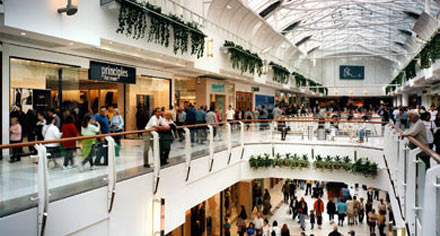
Today we decided to brave a large ‘mall’ at Braehead near Glasgow. I have been there once before, and Michaela reminded me that I swore I would never ever go there again. But as I could not remember having said it, away we went.

What a place.

It has two polished levels of shopping- lines of every shop you would expect to be there, and not a single surprise. Each shop seems to be selling almost identical items, at almost identical prices. There is a ‘food hall’, in which awful food is sold, at very high prices. The place has not originality, no sense of place- as you walk through it, you could be in anywhere in the UK, or even anywhere in Europe.

What is it about these places that makes me so uncomfortable?

I think it comes from a constant feeling that I am being manipulated.

And that awareness of this manipulation does not help me avoid it.

I find myself a participant in a system that would convince me that it is normal to fill my life with all of this stuff- which as soon as I remove from it’s box will be worthless.

A system that depends on me buying ever more stuff, because any measurable change in the numbers of us who buy it, or the frequency by which we buy it, will send ripples through the economic systems of the world.

And should any caution or fear produce a slight reluctance to continue with this in enough of us, then stock market values plummet, financiers get nervous and banks start to tighten their credit lines. After all most of us depend on this thing called credit to buy our stuff…

Then businesses start to find that there is less need for their goods, and so they in turn slow their production, and people lose their jobs. And these people are no longer earning money, and so can buy less stuff.

And the whole thing starts to wind down into… recession!

So I had better spend more in this mall right? It is my duty to the world…

Oh but every year we say the same. Christmas is defined by this round of acquisition every year. Don’t get me wrong, I like to give stuff to my friends and family, but it seems that what I give them is so… useless, for the most part.

Is there no other way?

Well, not for us this year. We have spent the day consuming after all. But there is always next year…

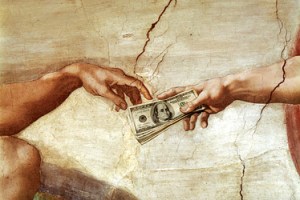
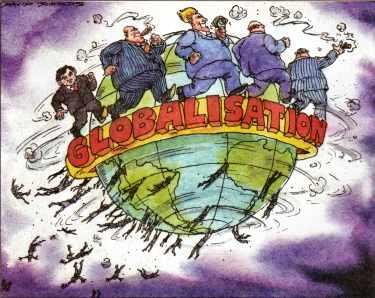
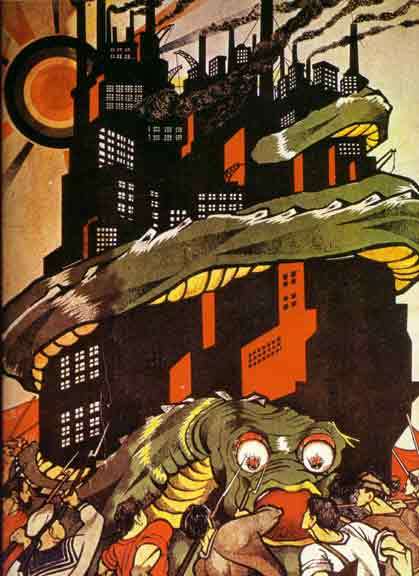
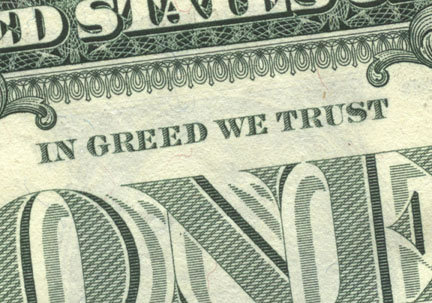
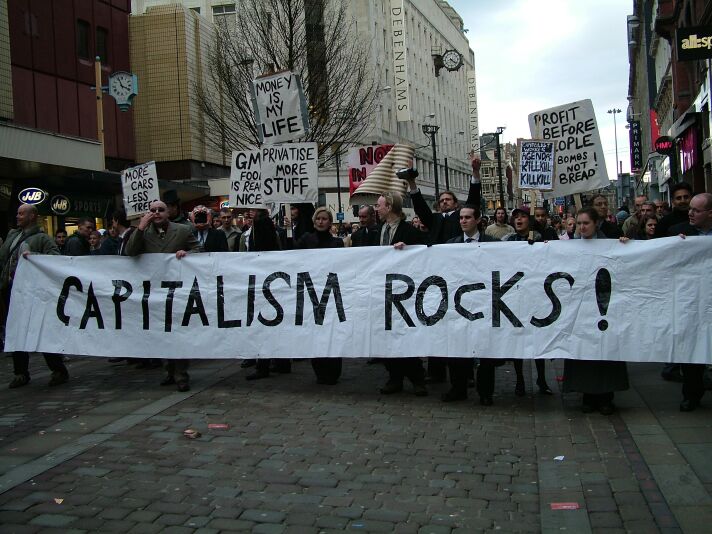
I think these make the point quite well…

(You can see more of this, and some suggestions as to alternatives here.)

Ideological shifts for the free marketeers?

_

What is happening in the economic world? The news is full of competing ‘expert’ voices- some seeking to reassure and proclaim business as usual, others taking on the role of doom mongers, proclaiming the end of the world as we know it. If the later group are to be believed, then pretty soon we will have to throw away our plastic and start bartering with chickens and baskets of logs…

Whoever we believe, it seems clear that there are huge changes afoot. Here is a quote from this article from The Independent newspaper…

The Western world is in an economic crisis similar in scale to the oil shock of 1973. What we are seeing is nothing less than the unravelling of neo-liberalism – the dominant economic and ideological model of the last 30 years.

The disintegration of Anglo-Saxon-inspired markets has come about largely because of the confluence of two tendencies of the “free market”: speculation and monopoly capitalism. Contrary to received opinion, free markets – unless subject to civil regulation, asset distribution and persistent intervention – always tend to monopoly.

Similarly, there is nothing inherently efficient about free markets – they do not of themselves promote sound investment or wise management. Rather, when markets are conceived wholly in terms of price and return, and when asset wealth and the leverage that this provides becomes as concentrated as it was in the 19th century (which is a scenario we are approaching), then markets encourage nothing other than gambling masking itself as sound investment.

Regulation?

In the free market? What would Thatcher say?

Is this finally the time when the stranglehold that neoliberal thinking has had on the economic world for the last 30 years is broken?

Will the IMF and the World Bank stop deifying the free market?

There seems to be a resurgence of confidence in the old leftist politicians- check out this article from the Guardian newspaper- and the quotes taken from is below;

Sadly, I don’t think this will be the end of capitalism. But there is going to have to be a return to a much, much more interventionist state. As a system for the distribution and exchange of goods, you can’t beat the market. But the mistake a lot of politicians have made is to think that because the market was good at that, it could be good at everything: it could train workers, create infrastructure, protect the environment, regulate itself. Quite obviously, it can’t.

Ken Livingstone, former mayor of London.

I remember the 1930s. What the Depression did then was to stimulate antisemitism. I met Oswald Mosley in 1928 when he was a Labour MP. The next time I met him he was wearing a blackshirt. Where there is fear, there is scapegoating, and that is very dangerous.

Blair and Brown based their politics on a belief in the market: the market answered all your needs and the state had to be kept out. That confidence has now collapsed and New Labour is seen for what it is. You can’t, as New Labour believed, nurse capitalism.

Tony Benn

What next then? Is Tony Benn right, and we live in a time when fear could stimulate the rise of hate politics, where we look again for scapegoats, and we retreat into our tribal enclosures and look with loathing at those outside? History warns us of our tendency look for messiah figures who appeal to the base instincts of the human animal.

Time will tell…

But as for me, the uncertainty and fear that such change brings into our lives is combined with an excitement over the dawning of something new. Capitalism is not dead- but it will not be the same.


Capitalism, Durkheim and Rev. Billy.

Laurie Taylor on Radio 4 has set me thinking again, on his programme ‘Thinking allowed’- which looks at social scientific research. You can listen again here.

This time, he took me back to my ‘A’ level sociology days, and to the French 19th C philosopher Emile Durkheim, and his great work ‘Suicide’.

Durkheim wrote about a kind of existential crisis that people could experience in a time of economic crisis- when the norms and structures people have been used to living by break down, and people find themselves in a state that he called ‘anomie’.

Durkeim suggested that people need to be part of something bigger- to be integrated and linked, and when this begins to break down, the end result is anomie, which in turn, leads to a time when the anchors and moorings that hold us together are gone.

Durkheim thought that this was one of the three main reasons why people committed suicide- a breakdown of what made them human, and held them in community.

He suggested that the way to overcome this was through ‘moral education’, or ‘moral regulation’- and these things would be managed through the function of the institutions of society.

So, how does this relate to the current economic crisis?

Taylor made these fascinating comments. He sited a review of 2300 major research papers- looking at business research and training. The study concluded that the focus had been almost exclusively on minor techincal problems to do with the operation of markets, rather than the larger political and ethical considerations. Here is a quote from the researcher;

‘We have failed to teach our students the kind of social conscience and ethics and concern for the world and the environment and the poor that might have had an effect on the selfish exuberance of the finance markets’ Dr Harni.

I have heard a lot of economic ‘experts’ being interviewed giving opinion an comments as the economic crisis unfolds. They are often made to look fools by the events of the next day. It has often occurred to me that these are the same movers and shakers who moved and shook us into the current predicament, now being wise after the event…

But even from them, you hear some talk of ethics, and regulation. REGULATION- in the free market?

Almost like Dr Frankenstein wanting to cage the beast.

So is it too late? Will anomie, or whatever, result in a change to the way that we are? It remains to be seen. But the system we have in not sustainable.

Check this out, it made me smile.

Global crisis and local Christianity…

We live in an age of perceived crisis.

Not necessarily real ones you understand in the way that our grandparents may have known- in the age of Hitler’s (anf Churchill’s) bombs falling on cities, of concentration camps, and nuclear proliferation.

Instead we have the perceived crises of;

Terrorism– the so called war on ‘global terror’- which we fight using as a weapon, global terror. International policy is formed out of the elevation of fear in a general population- fear of an unknown evil, mixed in with a dose of racism, and religion…

The credit crunch– do you get the impression that there is some kind of hidden hand holding economic strings that we are powerless to influence? Almost as if the burst in the artificial credit bubble was a natural disaster? Meanwhile stock brokers ‘feel the pinch’ and lose the odd sports car, whilst in more marginal places where debt has become a the only option, survival is harder. (Check out this post for more discussion on this issue)

Knife crime- reported as an ‘epidemic’ in the UK, despite at best marginal rises within particular demographic groups in our cities. Anyone would think we did not live in one of the safest societies in one of the safest country in the world!

Energy crisis- oil prices soaring, leading to uncertainty and fear all over the world’s economy. Suddenly oil fields previously politically unacceptable are opened up. And people buy cars with smaller engines, to sit in the same traffic jams…

And so on- house prices, food prices, natural disasters, global warming, etc etc…

I am not a conspiracy theorist. I am always much more prepared to believe in a certain kind of chaos that results in some opportunist winners, and some unfortunate victims.

However, I am more and more convinced that our system of free market capitalism should not stand uncriticised. That far from being the answer to the complex problem of human economic organisation, instead it has become an animal that, once fed, is as likely to bite off the hands of the zoo keeper as it is to pull his cart.

My friend Ali sent me this link today. He tends towards relish of a good conspiracy, but I agree that this critique makes interesting watching…

This is propaganda, but propaganda when used by the powerless can become protest- if not a check on the actions of the powerful, perhaps at least it can lead to a reformulation of their strategy. It reminded me again of Thatcher, the most unpopular British prime minister ever, until the Falklands war. Then she was the unassailable economic saviour of western capitalism…

And also of Moazzim Begg, and his experience at Guantanamo bay.

Which brings me to the point of this post. I am a Christian. I am part of a small local community. What should be the local response to all this stuff that fills the airwaves? Which voices should I listen to that are beautiful and true?

Global communication networks allow us to connect with people thousands of miles away, but there is so much information out there, how would you ever make anything heard, or know that what you hear is good?

The old adage of think globally, act locally often just seems like an empty statement. A bit like ‘global village’. For some the world may have shrunk- but the gap between those who have, and those who have not is larger than ever.

But I think that we Christians do recognise truth when it hits us between the eyes. It comes at us when we see one person who transcends the times, and speaks up for beauty and peace, and love.

I remember reading an open letter that Brian McLaren wrote to George Bush just after the attack on the World Trade Centre. Warning against vengeful and angry responses that will result in more victims, more broken lives and families.

Check this out for more discussion about how we might respond to crisis.

The other way that we encounter truth, is through the words and stories of Jesus.

Blessed are the peacemakers.

And blessed are those for whom crisis (perceived or real) commands compassion, and love.

(link here to beatitudes)

Greed, Capitalism and Gordon Gekko…

I had an early start this morning- leaving the house at 7.30 am for a two hour drive. As ever, BBC radio 4 was my faithful companion on the road…

And of course, the morning news was full of the current world financial crisis, brought about by the so-called ‘credit crunch’ and the collapse of an American bank sending shock waves round the world’s stock markets.

We await to see whether the giant insurance firm AIG, responsible for trillions of dollars investments, will topple and fall over also.

We are finding out that when a butterfly flaps in the windows of a wall street office, then not even a post office account in sleepy Argyll is unaffected by the resultant tidal waves of monetary insecurity.

And no-one seems to have any clear idea of what happens next. It is almost as if the animal that we created now has a will of its own, and a malevolent will at that… The radio carried interviews of doom mongers, and other folk seeming to suggest that the worst was over, and we just needed to stop the panic, which was the cause of the whole thing in the first place.

And then there was this other discussion- about the nature of the capitalist system itself, and the greed at the heart of it all.
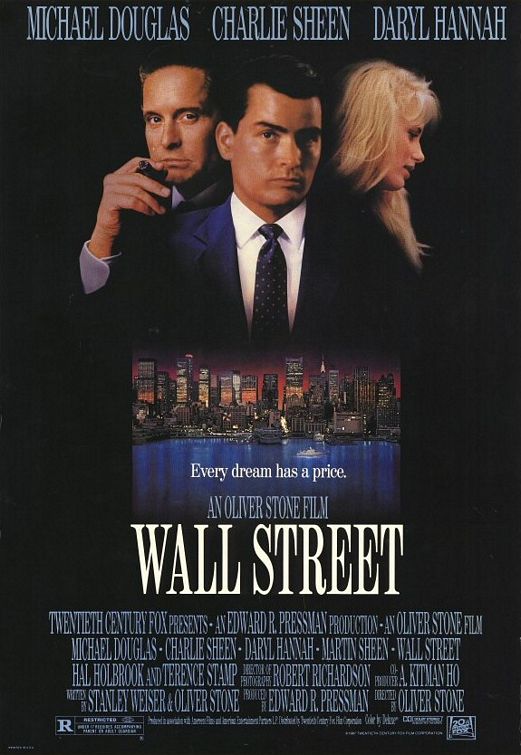
And we remember again the words uttered by the fictional stock broker Gordon Gekko in the 1987 film ‘Wall Street’ (played brilliantly by Michael Douglas)- Greed is good…

Gekko has become an iconic figure, acting as an archetypal capitalist, but in the process asking questions about the meaning and nature of a culture built on the pursuit of MORE, always MORE. Capitalism, and neo-liberal economics rule the economic roost at the moment, and no-one seems to be able to challenge the ideological truth of ‘trickle-down’ benefits of the creation of wealth, and the release of entrepreneurial aspiration, red in tooth and claw.

This morning, world renowned economists were asked whether they thought that this crisis had been brought about by greed. Both replied that they thought that it had. They thought that some greed was needed- but there had been too much!

They described how a long period (16 years) of economic growth had resulted in complacency and increased risk taking on the part of bankers, stock brokers and financiers. And how ‘rocket scientists’ (a euphemism for people who design ever more complicated financial products in order to seek out profit) have designed complicated financial processed that are not understood by most of the people whose companies are selling them.

Many of the huge profits generated by the banks have been made by selling and buying products with borrowed money. Sometimes, the borrowing ratio to the assets of banks can be 30-40-even 50 to 1. This is fine as long as there is lots of money sloshing around the system, but it only takes a few variables to change- interest rates, commodity and fuel prices, economic slow down, the rise of the Far East, etc etc, and suddenly, apparently impregnable banks are dreadfully exposed and vulnerable.

These are, after all, human institutions, made after our own image.

But we are made in the image of God are we not? And as a Christian, I find myself experiencing dissonance with any system that depends on greed and grasping as the engine of its very survival. Is there really no other way? Do I have to be complicit with this way of living?

I have a mortgage and a car loan from the Bank of Scotland. This bank has lost 40% of it’s share price in the last two days. Who knows what the future is for the BOS, and for my accounts?

But, is this the most pressing economic reality pressing in on our culture? Is Capitalism really working? Or is it serving only the narrow interests of people like me, who experience many of its benefits at the expense of those who do not?

Is the real economic crisis to be found in a world in which things like this are ever present;
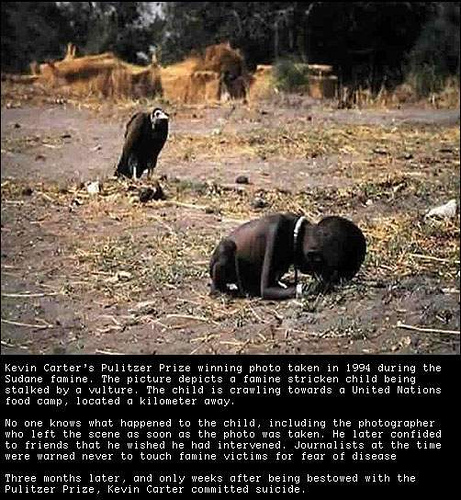
So what on earth can be, or should be our response?

I am humbled again. Reminded that my storehouse is not on earth, but in heaven.

And that when I serve the least of these, I serve Jesus.

Liberation theology, Capitalism and Communism.


For years I have heard stories about the Roman Catholic clerics who defied the worst despotic regimes of South America in the 1060’s and 70’s. Bishop Romero gunned down in his Cathedral, Priests and Nuns who chose to live alongside the poor and oppressed, and to try to be the hands and feet of Jesus. Out of this melting pot was born a new way of understanding the words of Jesus, known as ‘Liberation Theology.’

Pope John-Paul spoke out against this movement. He grew up in so-called Communist Poland, and liberation theology sounded too much like communism to him. As a social sciences graduate who was also a Christian, the critique offered to Western Capitalism by socialist writers, and even by old Marx himself always resonated with me. I think it was CS Lewis who called Communism a ‘Christian Heresy’.

The 1980’s and 90’s saw an end to the old ideological divides in Europe- everyone became a free marketeer it seems. The Labour party in Britain stopped talking about ‘poverty’, lest it scare off the middle class (Bourgeois!) vote. Instead we talked about educational attainment, and ‘social exclusion’.

But, as Jesus said, the poor are still with us. A recent WHO report has pointed to the growing health inequalities in the UK, and commentators have raised again the issue of inequality of income as the main causal factor.

And if we look broader than the boundaries of my own country we see global economics are managed by the ‘free market’- but in this system, as in all others, there are winners and losers. The system, say many, is rigged against those who have not, in favour of those who have.

Definitions

Liberation theology is a Christian movement of protest and support for the poor. They would point us to the words of Jesus – yes the poor may always be with us, but our best service to Jesus is to serve the least.

  • The call is to see people. And to see them as the beloved of God.
  • The cause might be varied – but as Mother Theresa put it, “We rob our brothers by all that we own”.
  • The solution is to learn how to love – and to live this out wherever you are – in the slums or in the boardroom.

Here is a definition culled from the good old BBC (from here.)

“Love for the poor must be preferential, but not exclusive.”Ecclesia in America, 1999

Liberation theology was a radical movement that grew up in South America as a response to the poverty and the ill-treatment of ordinary people. The movement was caricatured in the phrase If Jesus Christ were on Earth today, he would be a Marxist revolutionary, but it’s more accurately encapsulated in this paragraph from Leonardo and Clodovis Boff:

“Q: How are we to be Christians in a world of destitution and injustice?

A: There can be only one answer: we can be followers of Jesus and true Christians only by making common cause with the poor and working out the gospel of liberation.”
Leonardo and Clodovis Boff

Liberation theology said the church should derive its legitimacy and theology by growing out of the poor. The Bible should be read and experienced from the perspective of the poor.

The church should be a movement for those who were denied their rights and plunged into such poverty that they were deprived of their full status as human beings. The poor should take the example of Jesus and use it to bring about a just society.

Most controversially, the Liberationists said the church should act to bring about social change, and should ally itself with the working class to do so. Some radical priests became involved in politics and trades unions, others even aligned themselves with violent revolutionary movements.

A common way in which priests and nuns showed their solidarity with the poor was to move from religious houses into poverty stricken areas to share the living conditions of their flock.

I believe that Jesus always had a bias towards the weak and the poor. Any reading of the Sermon on the Mount has to twist theological somersaults to deny this. And I can not subscribe to the idea that International Capitalism, propagated with such enthusiasm by the ruling Christian west, will have much currency in the Kingdom of God.

But neither do I have any faith in a coming Marxist utopian revolution. I would rather hope for Christians who plant hope and beauty in the broken places.

Where the poor people are.

The challenge is for the rest of us to find out what that means for us.

Blogged with the Flock Browser