Scientists are developing their own story of life. At present, it goes something like this;
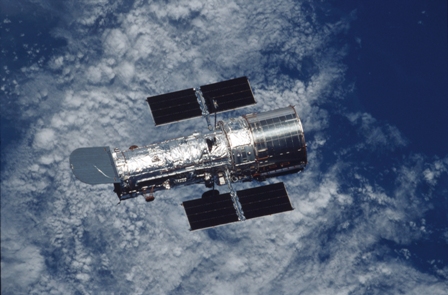
 Some of the most exciting areas of scientific discovery today are thought to be in the field of Astro-physics. The Hubble telescope, now in orbit around the earth, out from the obstruction of our atmosphere, has been able to see much further into space, and in doing so, to see light coming to us from further back in time. Through examination of what are thought to be the oldest stars, and by measuring the apparent rate that the universe is expanding, scientists have suggested a new age for our universe, of between 13 and 14 billion years old. This means, according to the predominant (physical) theory of the origin of the universe that around 13 billion years ago, out of nothing, something happened, and in a mighty explosion of unimaginable force, time as we know it began. Particles of cosmic dust formed globules, some burning bright as stars, others taking their orbit around these stellar objects and forming planets. The universe continued to expand – to get bigger.
EVERYTHING that we see around us is made up from molecules and elements that were spewed out into the universe by this one event- what scientists have somewhat unimaginatively called “The big bang”. More than this- look at your hand. It too is made of star dust. because, about 4.6 billion years ago, a small planet was formed, on the edge of one of the spiral arms of a small galaxy of stars- as a swirling mass of debris accreted and took on spherical form. We have come to see this planet as Earth, our home.
The conditions on this planet eventually became just right for the beginning of another process – life. For about a billion years, the earth was ‘without form and void’. But from around 3.4 billion years ago, we can find evidence in the rocks of microbes. Nobody knows WHY these primitive forms of life began. Some early research suggested that the right chemical reactions happened to allow for the production of amino acids, perhaps through the characteristics of the chemistry on early Earth, or maybe in the deep sea vents where volcanic heat stirred the seas. Others have suggested that organic matter was deposited on earth by comets, although it is not clear where the comets came from. We do not know whether it was ONLY on our planet that these conditions existed. We still wait to see if early forms of life developed on our neighbouring planet, Mars.
It was not until about 600 million years ago that we see the first evidence of multi-cellular life on Earth in the fossil record. However, diversity seems to have remained constant, perhaps even declining, until approximately 200 million years ago. Then there was an explosion of diversity- all the marine invertebrates, 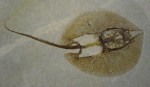 including many that no longer exist, plus plant life on the land. No-one knows why this diversity suddenly appears in the fossil record, although there are many theories- from levels of oxygen in the atmosphere, to more complex theories about cell structures. All subsequent forms of life on earth are substantially similar to the animals that came to be from this period- vertebrates, invertebrates, arthropods and so on.
The carboniferous period, from about 360 million years ago appears to have been hot and humid. Huge trees forested the land, but there were no flowers yet, and no grasses. Bony fish were found in the ocean, and somehow, some of these fish formed the ability to become amphibian. In the air were seen huge insects, including one with a 14 inch wingspan!
The Permian period, from around 286 million years ago, was typified by cooler climates- and many land animals began to take their place on our planet. However, at the end of this period, and for no clear reason, many of these animals became extinct. It took another 100 million years for this diversity to recover.
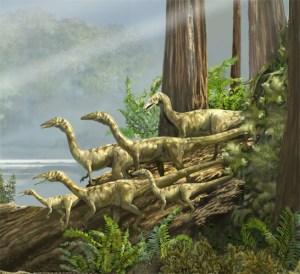
The next age, often called the Age of Reptiles was from around 245 million years ago. This period includes time of the Triassic and the Jurassic dinosaurs. They dominated the animal life of the planet for 150 million years, then disappeared, again for no clear reason. Giant meteor strikes have been suggested, but no-one knows for sure.
Next, the age of mammals – from around 65 million years. Mammals had been around for much longer of course, but during this period, they (and eventually, we) dominated the planet. Different species ebbed and flowed, some displaced by others as land masses move and reform, others varying hugely in size and shape as time places different demands on their adaptability. And we mammals were extremely adaptable.
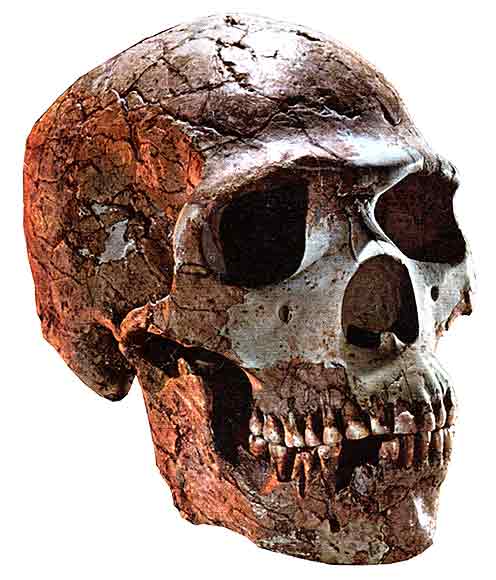
The first hominids (Apes closer to human form than to that of the ape) lived in Africa about 7 million years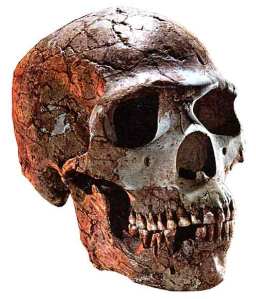 ago. Around 2.5 million years ago, Homo Erectus appeared in Africa, with a brain almost as large as ours, and began to make use of tools and perhaps, fire. The first recognisably human remains date back to around 250,000 years ago, and have been called Neanderthals. They had, if anything, slightly larger brains than us, and evidence of their communities, and the residue of their lives, can be found in caves in a northern climate ravaged by advancing and receding ice sheets.
From about 50,000 years ago, there has been a mass extinction of animals in many different parts of the world. All herbivores of over 1000kg disappeared in Europe and America, and 75% of all animals between 100-1000kg. The rise of mankind, with our hunting skill, and communal organisation is the only logical explanation.
Around 30 million years ago, Neanderthals disappeared. They had been replaced, over some time, by what we now know as Modern Humans, who had first left records of their existence about 100,000 years ago in Africa. Palaeontologists have speculated that Neanderthals, despite their big brains, lacked something that the moderns had.
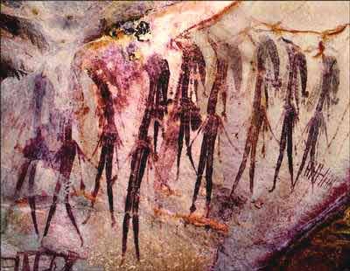
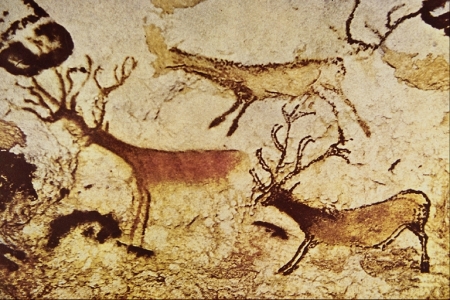
Their tools appeared primitive and poorly designed, and although they lived in social groups, there was little evidence of that oh-so human thing, abstract thought. The modern humans, on the other hand, from around 40,000 years ago, left cave art, jewellery, sophisticated tools. It was almost as if, by a freak genetic mutation, ‘humanity’ was switched on! Evidence has emerged recently however that suggested that this modern human behaviour started at least 30,000 years earlier in South Africa, where geometric carved pieces of Ochre and impressive tools were discovered from an earlier period. Human thought and abstraction seems to have been unfolding- emerging- for some time.

We stand as evidence of all that is amazing about the story told by scientists- of an unfolding story of life, beginning from nothing then gathering a fragile foothold, until at the very end of history, humans appear and make the world their own. We conquer mighty rivers, remake the building blocks of our planet into new composites and use the facts of our understanding to travel through the air, to communicate and to destroy one another. And some say that we are at the edge of destroying our planet because of our headlong rush to accumulate more and more.
This is the story given to us by the best scientific study and theorising.





 this fragile tent
