
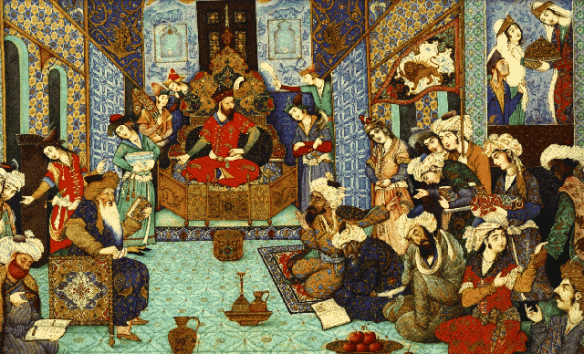
I have been reading some Persian poetry.
My reason for doing this was simply because I knew nothing about Persian poetry- and in these times when the Western world is increasingly at war with most of the Eastern world, it seemed important to understand a little more the rich cultural subsoil that Middle Eastern Islamic civilisations grew within.
I post these bits and pieces like bit of a beautiful mosaic found in a river bed. I do not understand the whole picture- and never will, but I am starting to appreciate it some of its quality.
Beauty, humanity, truth, humour, a search for meaning and a longing for God.
And to encounter the culture through poetry seems to me right somehow. I suppose this is because I write poetry, but also I think this is because these poems are still alive. They have none of the dust of history.
The first poet I want to quote is Sanai.
We know little about him. He died around 1150, and was a subject of Bahramshah, one of the rulers of the Ghaznavids– whose empire covered much of the middle East- and was centred around Garzna, in what is now Afghanistan. He is thought to have been a court poet, who became dissatisfied with the shallow life of court and left to follow Hajj to Mecca.
So here are three poems of Sanai. Let them rest on you for a while-
Streaming (excerpt)
When the path ignites the soul,
there is no remaining in place
The foot touches the ground,
but not for long
The way where love tells its secret
Stays always in motion
And there is no you there, and no reason
The rider urges his horse to gallop
and so doing, throws himself
under the flying hooves
In love-unity there’s no old or new
Everything is nothing
God alone is
The puzzle
Someone who keeps aloof from suffering
is not a lover. I choose your love
above all else. As for wealth
if that comes, or goes, so be it.
Wealth and love inhabit seperate worlds.
But as long as you live here inside me
I can not say that I am suffering.
The time needed
Years are needed before the sun working on
a Yemini rock can make a bloodstone
Months must pass before cotton seed
can provide a seamless shroud
Days go by before a handful of wool
Becomes a Hater rope
Decades it takes a child
To change into a poet
And civilisations fall and are ploughed under
To grow a garden on the ruins
The true mystic
 this fragile tent
