Regular readers of this blog may remember previous articles and even podcast interviews with Dr. Katy Cross, who has been undertaking research trying to understand paths taken by people who leave church- the meaning they make and find, the connections they still seek and so on.
Katy is now towards the end of her research, and is entering a ‘creative response’ stage. There are a few ways you can be involved, but the first meeting on-line is Tuesday the 29th at 6PM. If you are on your own journey beyond church, but feel like understanding this better in community then this might be just the place for you.
There are two ways folk can take part:
By attending online workshops to discuss prompts and reflect together. You can sign up here to join in.
By writing up your own reflections in your own time, and emailing these to Katie here.
As above, the first group is meeting on Tuesday 29th July at 6pm on MS Teams.
We hope that Katie will be able to join us on the Proost podcast soon to collect together some thoughts and conclusions about this very important research.
Why do I think this chat is so important? As with this post, there is lots of chat just now about what is emerging in terms of organised religion in the UK. After a long decline, some say (on currently very limited evidence) that there is a ‘quiet revival’ taking place here, with young people, and young men in particular, flocking back into Churches. If this is true – if we are seeing a reversal of the decades-long social trend away from organised religion – then it seems important to understand this and the social forces that might be at work.
On the other hand (and at present I remain in this camp) if this research turns out to be flawed, we also need to understand why so many people within the Church have siezed on it with such uncritical enthusiasm.
Meanwhile there is another conversation that is taking place – for example in Katy’s research – with those who have been activists, leaders and pioneers within the church, but no longer feel able to be part of formal religious structures. What happened ot these people? Where are they finding meaning? How might they shape and influence what happens next?
Even as I write this, I think too of dear friends who continue to work WITHIN the Church, to carry forward acts of grace and mercy, to serve an aging population with critical needs, to run food banks and toddler groups, to set up refugee support groups and to make simple beautiful acts of worship that enable people to deepen their spiritual experience. I think how exhausted some of them are, and how abandoned the conversation above makes them feel…
Things are changing, shifting, shinking and unfolding at the same time. This has always been the case, but it does feel like we are standing on anther threshold. Whilst we mourn what is lost, we can also be excited about what will come.
A few months ago, I started a conversation with some people about indiginous spirituality. I had this itch that I wanted to scratch to do with how the Celtic tradition that I had found so deeply compelling might have some things in common with other indigenous spiritualities, so I reached out, looking for others who had connections and knowledge that I lacked.
Celtic idigenous traditions
My quest faced lots of problems. Firstly, reaching a definitive understanding of my own tradition is far from easy. The indigenous religion of the Celts stretches back thousands of years into myth and legend so it is hard enough to say much that is certain, and even harder to understand meanings that belong to a former culture and time. What little is known about the pre-Christian Celts mostly comes to us through highly questionable records of an occupying Roman Empire. Christianity came to these islands and first assimilated, then colonised the tradition, burying it under layers of ‘progress’. Some have tried to tell the Celtic story anew in order to make it meaningful – to me and others – but it can be hard to tease apart the facts from the fancy.
Perhaps this is part of the appeal to spiritual nomads and outsiders to institution like me. What we know as ‘the Celtic wisdom traditoin’ has a malleability that allows us to make it fit into whatever we want it to fit. It has subjective utility, but might be seen to lack authentic objectivity. In acknowledging this reality, it is then for each of us to decide whether the benefits outweigh the disadvantages.
For me, they most certainly do. Perhaps this is because I am a poet, more driven by spirituality of the mystical kind. Travelling in this tradition connects me with something visceral deep inside. It is a ‘feeling’ as much as an intellectual acceptance. I quite understand why friends of mine, more driven by systematic interpretation of scriptures might take a more cautious view.
Like all religious technologies, we must travel with a certain caution, looking around for other perspectives- paying particular attention to those that Empire has marginalised.
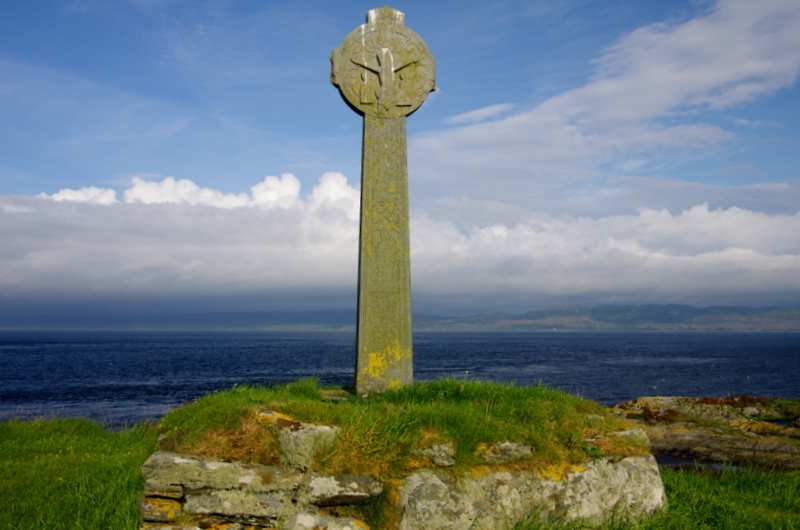
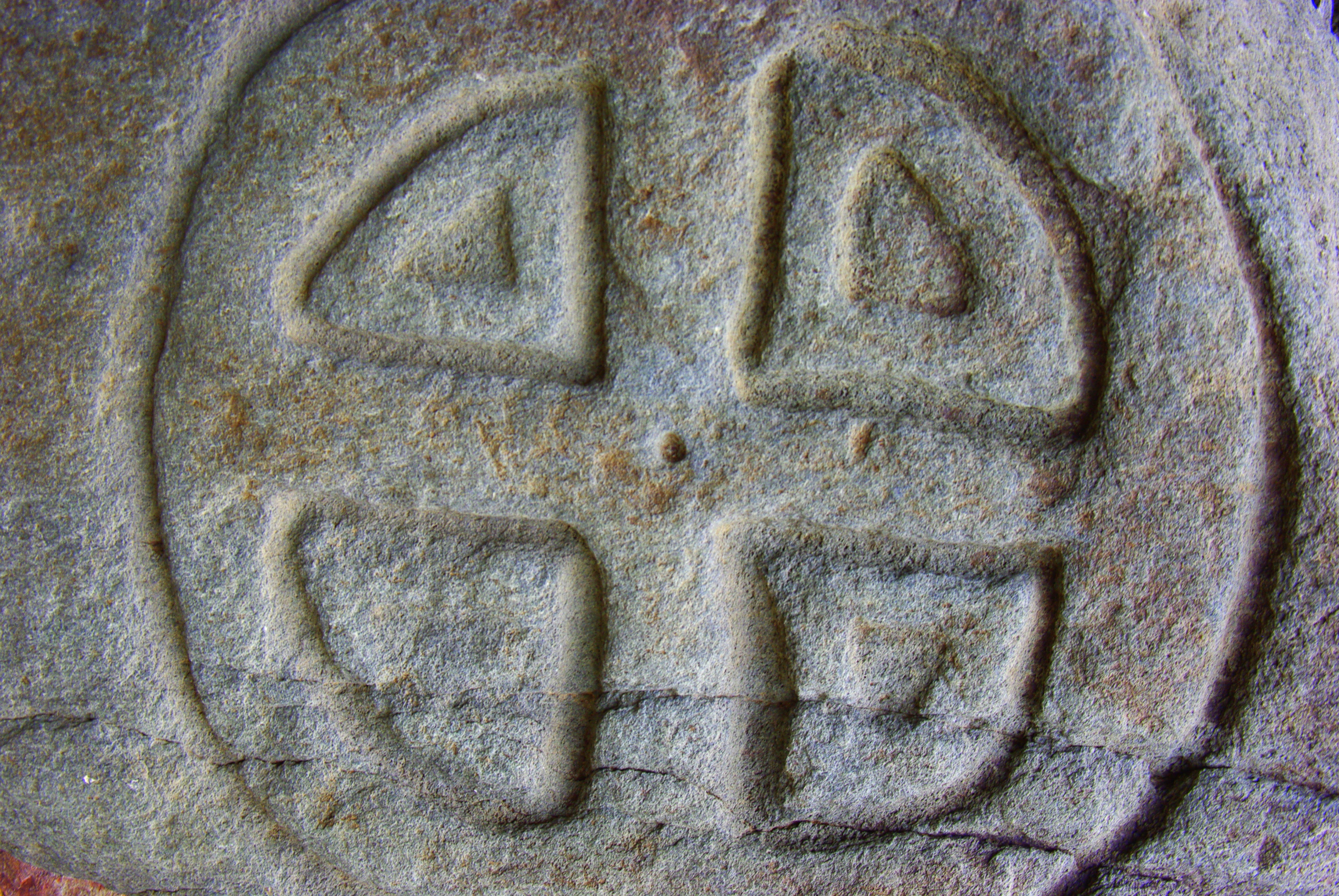
Celtic cross, Inner Hebrides, West Scotland
What do we mean when we talk about the ‘Celtic wisdom tradition’ then?
We have some tantalising clues in the form of stories and legends. Mostly these are survival traditions out on the fringes of the Celtic world- which like all cultures colonised by empire, retreated to the distant edge of its former hearlands – Atlantic coasts and islands or to rural Ireland and Wales.
We can also have some clues about the nature of this tradition from what is absent and outcast from mainstream religion. By this, I mean things that have been suppressed and persecuted that once belonged to ordinary believers. I have said more of this before, here for example. Many others have described and lamented what happened when indigenous, authentic and local spiritualities become subject to the priorities of institution and Empire.
Finally we know it as a deep ‘yes’ that we feel in our souls when we hear about ideas like ‘original goodness’ and hear how all things are connected and held together.
Colonialism and Christianity
Across the world, almost all indigenous cultures have been subjected to our colonial expansion – from St Kilda to Sarawak, through Australia and the Americas and so on. The Celtic experience might have begun earlier, but in many ways it was the same. Religion was an essential part of the ‘civilision’ of ‘native’ cultures – a conquest of the spirit alongside economic or geographical.
There is a problem here for followers of Jesus, in that Christianity has often been the religion of the worst and most oppressive forms of colonialism. I think however that the Celtic experience might heip us to decolonise Jesus from the religion that was made in his name. If we are right to describe Celtic Christianity as an assimilation of a the teachings of Jesus with pre-existing ideas, in such a way as to deepen and give further shape to the connections to earth and spirit, then we might conclude that this version of Christianity did not have at least some of the oppressive overtones that came later. Perhaps colonialism was done to Christianity as much as facilitated by it.
This does not get Chrsitianity off the hook. It remains a religion of the middle east, defined and propogated by the West, that grew and expanded because of the pursuit of Empire and profit.
Perhaps we should burn it all down and start again… but where do we start? How far back do we need to go? Whose teachings and example might be most helpful? Is there really a purer, less compromised, older and more true indigenous spirituality that we can still encounter?
This is still my quest, and it led to me reaching out towards some other people who were trying to make sense of the spirituality they were encountering via indigenous people in their parts of the world- two very different parts of Australis, Canada and Middle England. It has been an interesting journey so far… five white people, trying to make sense of black, brown and red religion.
Can we make connections with other indigenous cultures?
Part of my motivation fot this journey has been a desire to remake/rediscover a religious story that was more earth-connected, more able to provide us with a mass movement away from the damage we are doing to eco-systems. It was this ‘earth connectedness’ I felt in my Celtic roots that seemed to find echoes in other indigenous traditions – connections to land and place, to animals and holy mountains, to the spirit in other things. At least, this is what I had heard glimmerings of in films and books.
Perhaps there was more than this. I started to wonder if all the condemnation of ‘primative’ religion I had grown up with – which was characterised as animistic, or pagan, or pantheistic – had lost some things that really mattered. We were told of the foolishness of a belief that trees or rocks or lizards have spirits. How backwards to worship simple totems or forest spirits. After all, we have the wisdom of the Bible. Look where that got us.
I remembered well the simple goodness of Bob Randall’s Kanyini;
I first encountered Bob as a commentator on cultural breakdown, whilst I was working as a social worker amongst men and women in mental health services, within broken communities in the UK, not Australia. Back then, any implications for religion seemed secondary. Now they seem inseperable.
But in the face of so much variety, so much diversity, is it really possible to make any general statements about indigenous spirituality? Can we claim that it is more ‘earth connected’ or more authentically human? Is it ‘better’ than what we have have experienced in our religious institutions?
This is the conversation I have been having with my four friends from far away – more of this to come.
I will leave you with a quote from the First Nations Version New Testament. This is a book written in English by a first nations pastor in America, working first with prisoners, later with others trying to reconcile the words of the Bible with their own culture and it’s colonial history. Here are the beatitudes, through first nations eyes.
It is the same, but also very different.
BLESSINGS OF THE GOOD ROAD Matthew chapter 5
3“Creator’s blessing rests on the poor, the ones with broken spirits. The good road from above is theirs to walk.
4“Creator’s blessing rests on the ones who walk a trail of tears, for he will wipe the tears from their eyes and comfort them.
5“Creator’s blessing rests on the ones who walk softly and in a humble manner. The earth, land, and sky will welcome them and always be their home.
6“Creator’s blessing rests on the ones who hunger and thirst for wrongs to be made right again. They will eat and drink until they are full.
7“Creator’s blessing rests on the ones who are merciful and kind to others. Their kindness will find its way back to them—full circle.
8“Creator’s blessing rests on the pure of heart. They are the ones who will see the Great Spirit.
9“Creator’s blessing rests on the ones who make peace. It will be said of them, ‘They are the children of the Great Spirit!’
10“Creator’s blessing rests on the ones who are hunted down and mistreated for doing what is right, for they are walking the good road from above.
11“Others will lie about you, speak against you, and look down on you with scorn and contempt, all because you walk the road with me. This is a sign that Creator’s blessing is resting on you. 12So let your hearts be glad and jump for joy, for you will be honored in the spirit-world above. You are like the prophets of old, who were treated in the same way by your ancestors.
SALT AND LIGHT
13“As you walk the good road with me, you are the salt of the earth, bringing cleansing and healingto all. Salt is a good thing, but if it loses its saltiness, how will it get its flavor back? That kind of salt has no worth and is thrown out.
14“As you walk the road with me, you are a light shining in this dark world. A village built on a hill cannot be hidden. 15No one hides a torch under a basket. Instead it is lifted up high on a pole, so all who are in the house can see it. 16In the same way, let your light shine by doing what is good and right. When others see, they will give honor to your Father—the One Above Us All.
FULFILLING THE SACRED TEACHINGS
17“When you hear my words, you may think I have come to undo the Law given by Drawn from the Water (Moses) and the words of the prophets. But I have come to honor them and show everyone their true meaning. 18I speak from my heart, as long as there is a sky above and an earth below, not even the smallest thing they have said will fade away, until everything they have said has found its full meaning and purpose.
You may be aware that Rob and I have been podcasting as a means of making connections relevant to the revival of an old publishing platform called Proost. What this might look like is starting to take place- we are determined that whatever Proost is will depend on the community that comes together to make it happen. Our committment is to provide spaces for this community to happen. If you are interested in knowing more about this, feel free to drop me a message, or join our facebook group– it is a closed group, but this is simply to keep it a safe supportive place for those who need it.
This advent, we will be inviting artists to contribute to a collaborative daily offering
Some of these will be live poetry readings.
We would genuinely love to connect as many of you who want ot be part of this embryonic movement. There is a possibility here of the development of a very different kind of space for spirituality and creativity. It may be chaotic, but Rob and I are determined to make sure that it will be kind, supportive and fun.
Rob is a lovely man. He is so encouraging and enthusiastic about other people’s work – mine included. He had been following the long form ponderings on this blog about the renewal of religion (spool back through the feed – we are up to 7 posts in the series now) so he asked if we could chat through some of this on the Proost podcast.
Iniitialy I was reluctant, for these reasons;
I was not sure I could articulate my thinking in a chat. I tend to think by writing. In the end though, I decided I did not need to post it if it did not go well!
Was the Proost format an appropriate place for this discussion? As I thought about this though, it seemed to me that the Proost project is driven by the same thoughts and feelings
Finally, I am conscious that so many friends – including some who areninvolved in Proost – are still very much involved in organised religion. But then again, most of these have similar frustrations with elements of the old religion.
So we had the chat. In the end I enjoyed it – perhaps too much, as Rob had to slow me down! Being interviewed rather than being the interviewer is an interesting experience, and I was surprised how far the themes and issues unfolded. We will probably do one more as well. I will leave it to you to decide whether the podcast format helps to explore these complex issues more helpfully than written words…
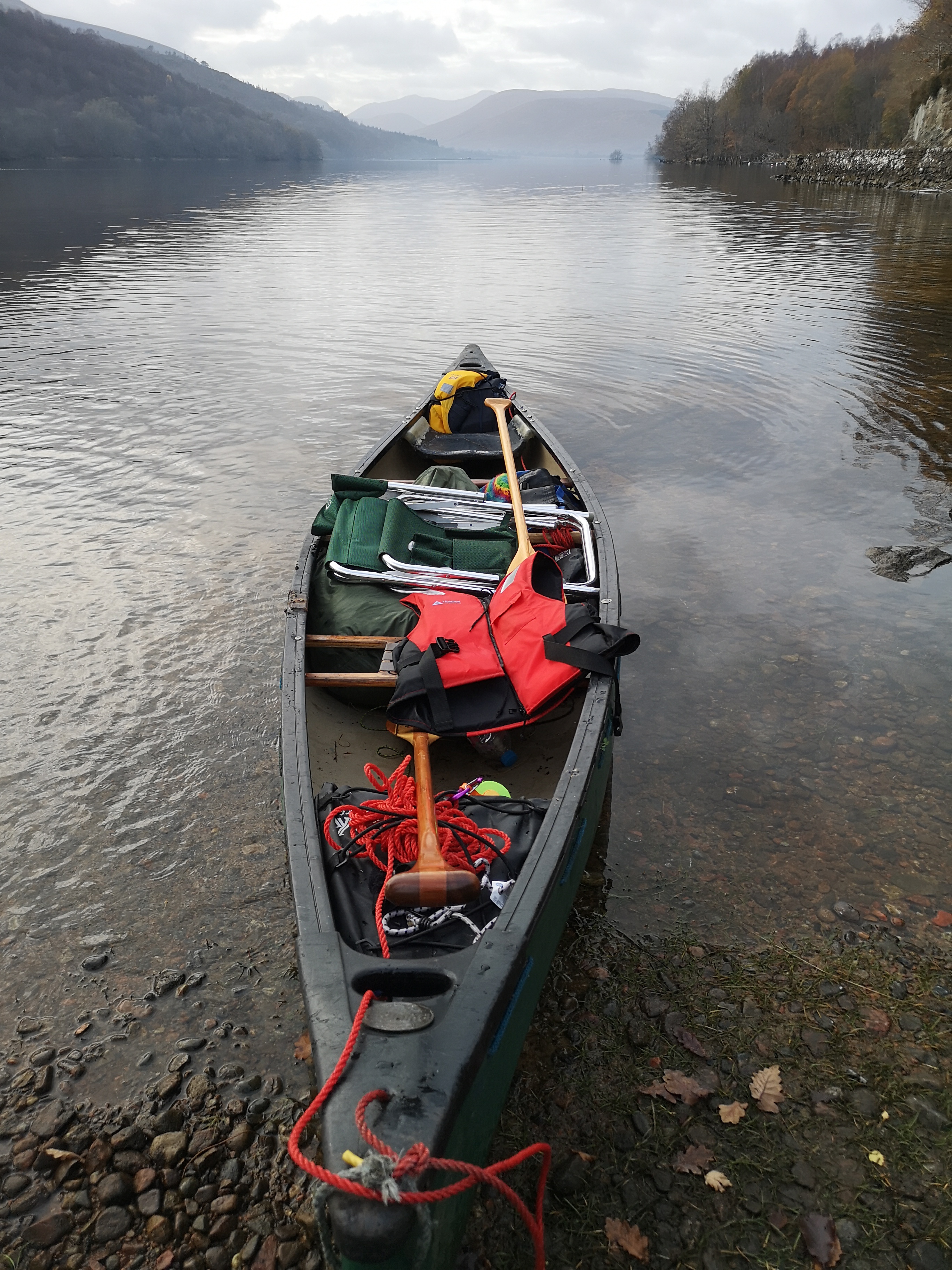
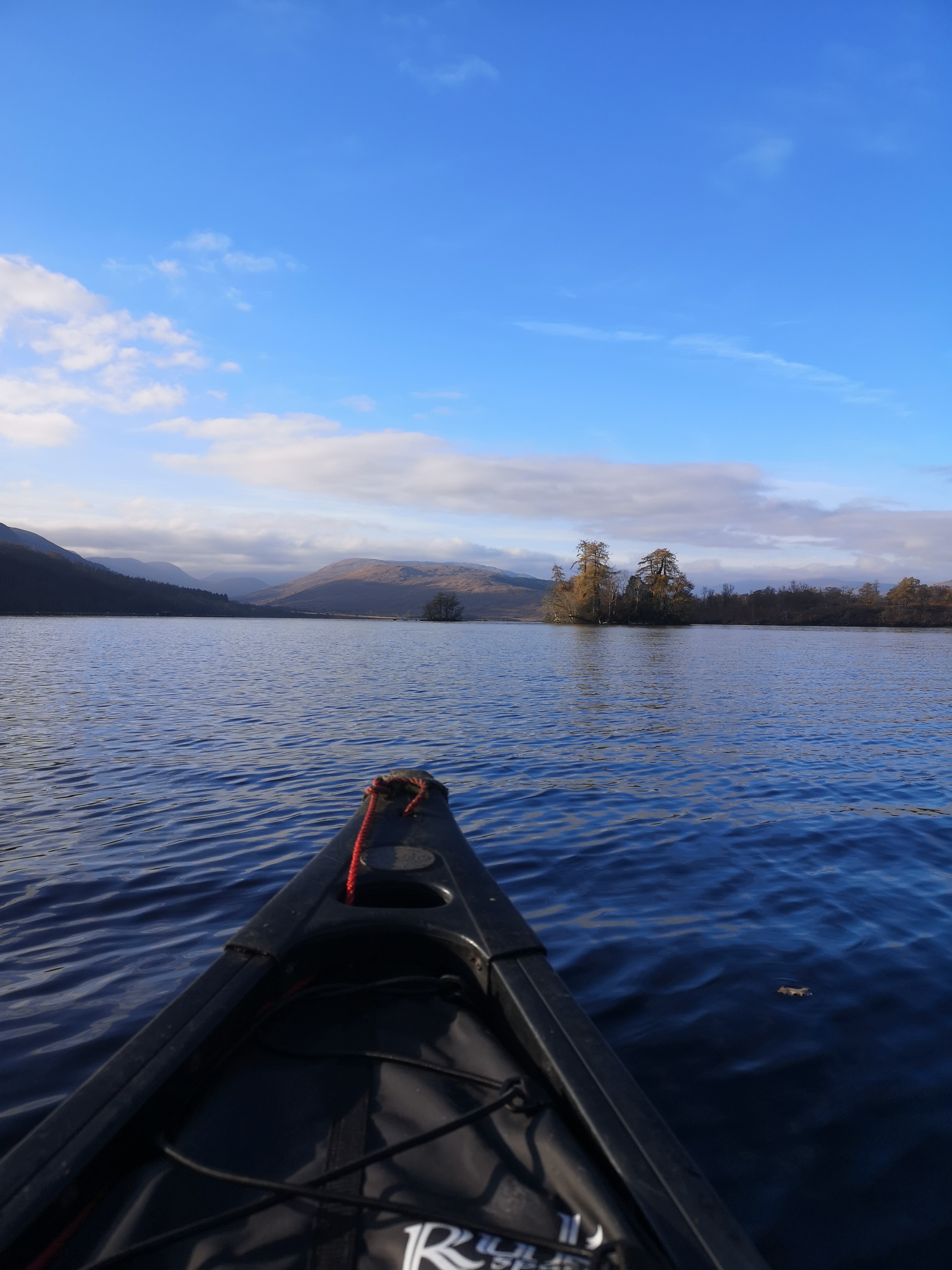
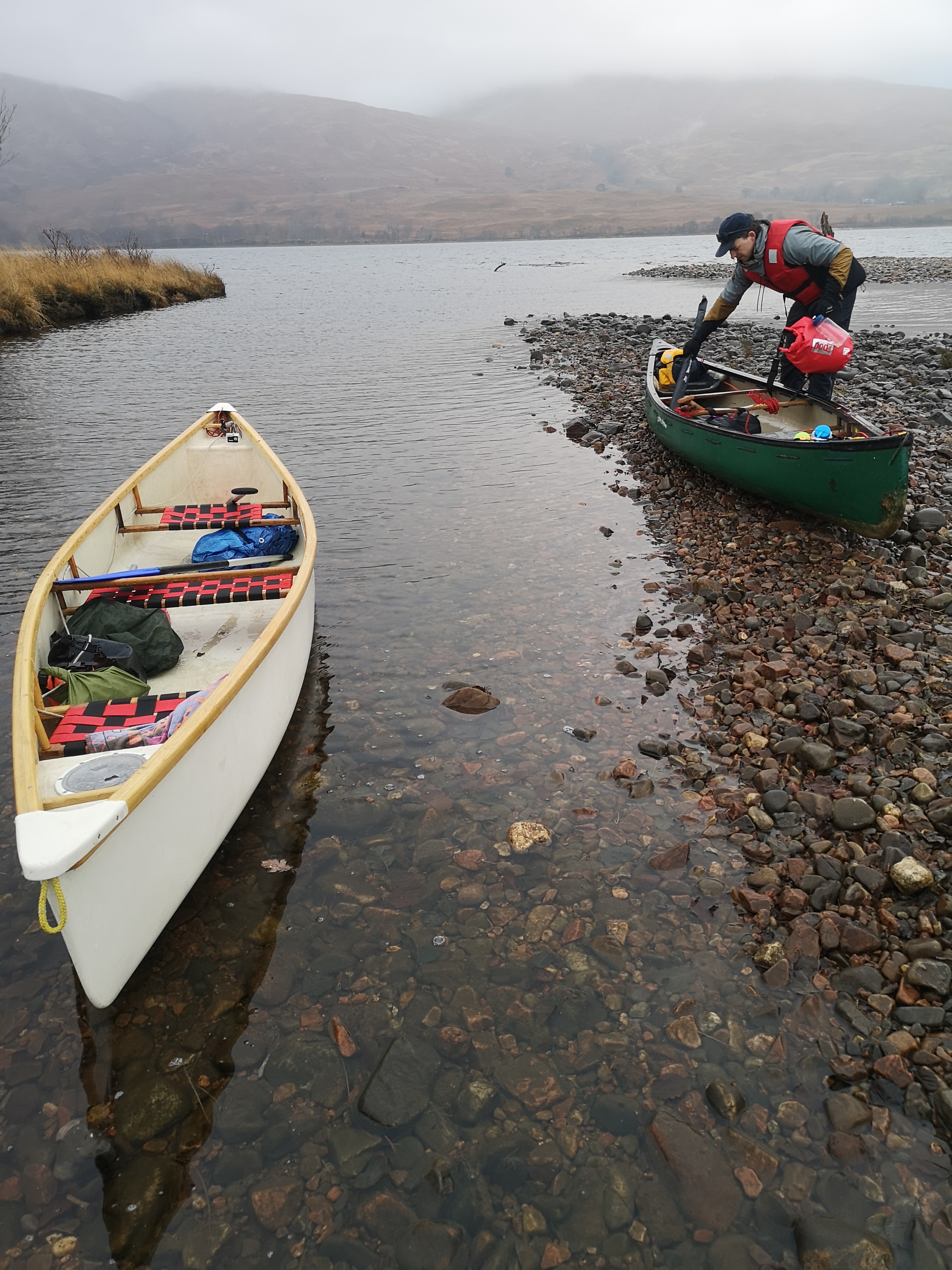
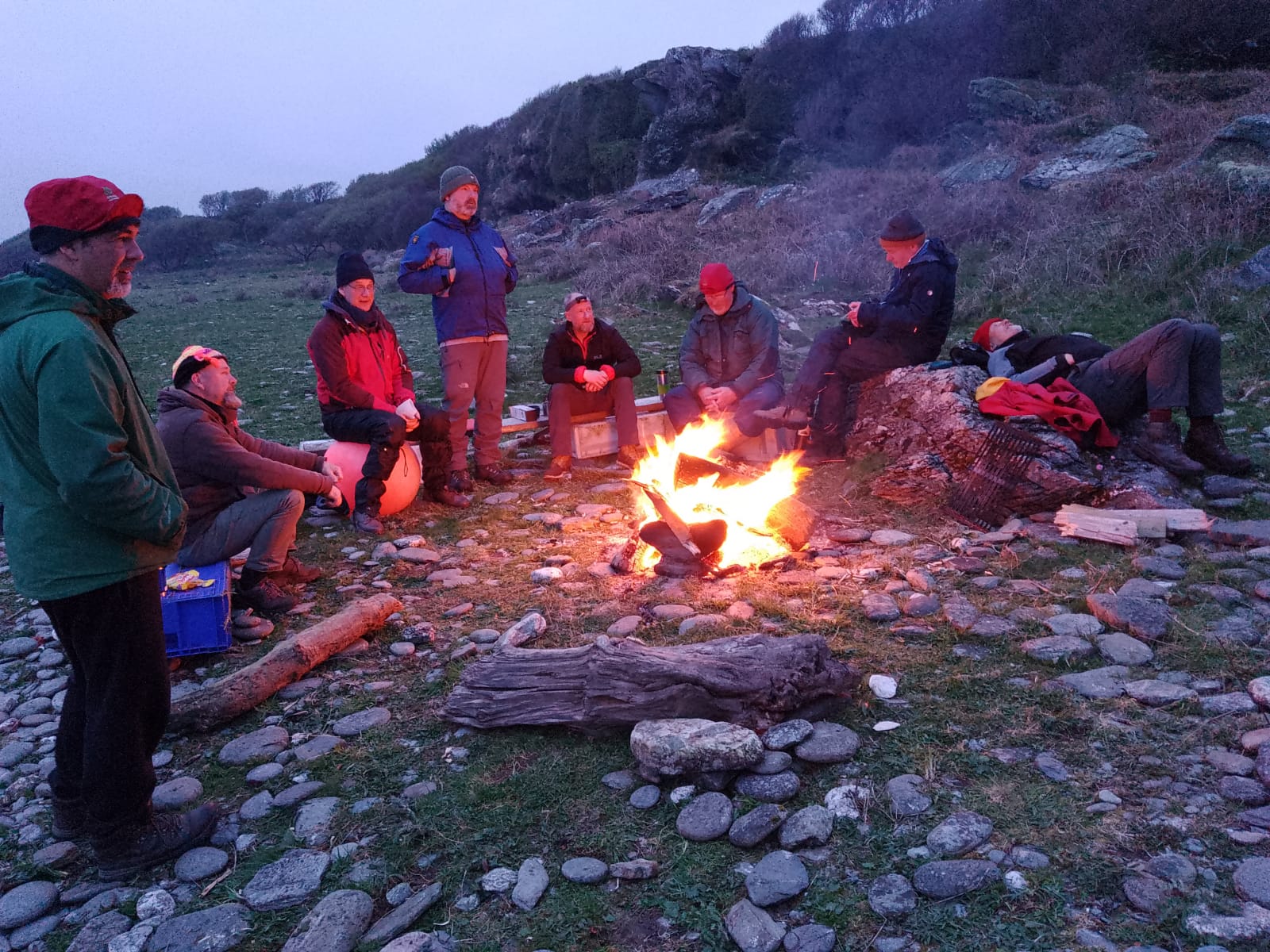
I am just back from a late Autumn canoe trip on Loch Arkaig, a place of sublime beauty, lined with ancient woodland and high mountains. We stayed in a bothy maintained by the Mountain Bothy Association, who make it freely available to the wide community of walkers, climbers and paddlers. There were four of us, and amidst the usual profanity and age-related moans and grouns we spent a lot of time talking about things that mattered. (I made a short video about the woods, here.)
In many ways, this landscape captures the best of what the Scottish landscape and history has to offer. The huge expanse of the mountains around a twelve mile long loch. Wild boar, deer, eagles, Ospreys (who had left for warmer places when we were there.) The Caledonian pine forest there feels holy, in the way it demonstrates connectedness, but also what being there does to me deep inside my chest.
Approaching St Columba’s isle – Island Columbkill or Chalum Cille – Loch Arkaig
Out in the loch is a very small island with the remains of a chapel so old that no-one knows when it was built. It is known as St Columba’s chapel, and the island as St Columba’s island – who knows, it may well have a connection to one of the saint’s missionary journeys.
I always find myself wondering about what motivated Columba and his fellow Irish missionary monks. What problems were they trying to solve? Was it always about saving souls? Did they see themselves as right and the pagan world they set off towards as wrong? The assumption in the old stories always seems to be that these questions had obvious answers. Of course they were ‘right’, and of course those who had not encountered the Christian story needed to hear it. In a black and white world, colour is confusing. Better not to see it.
But perhaps I judge Columba (and his generation) too harshly, because their mission was not the same as those that came later – or at least I don’t think so. Theirs was a mission of peace to a world of tribal/clan conflict. What came later was much worse. Celtic Christianity developed and flowed amongst the culture and traditions of its time – perhaps even sitting alongside older spiritualities rather than replacing them. There is a much longer conversation to be had about this, but my point here is to wonder what might be the mission that religion would/could send us on now. What problems might/must we engage with? What cultural context might/must shape our mission?
It is worth saying right now that the religion we are largely leaving behind continues to make mission. I have been (rightly) critical of some – the legacy of which has left toxic stains across the world. Those kinds of missions had as much to do with cultural and economic conquest as they did with religion. They were a product of empire, a means of colonisation and subjugation. But despite this dark legacy, there have always been people motivated by their faith who have become activists of a different kind- peace makers, feeders of strangers, animal lovers, adventurers. Even now, if you look to the workforce of charities around the world – from our city streets to the furthest flung war zones – you will find that an outsized proportion who are there because of their religion. We should celebrate these people, and the way that faith has sent them on missions of healing and goodness.
My strong feeling is that people of faith have a duty – we might even say a religious obligation – to engage hopefully and critically with the context in which we are living. This means bringing as much passion, integrity and energy to bear as we can, illuminated by a set of principles not of this world (not of empire) but of another, sometimes known as ‘the Kingdom of God’.
This might mean opening our eyes to the spirit of our age, and exposing it to a different story- to the considerations of the Kingdom of God. At a time of widening inequlaity, of climate breakdown and mass extinction, of war-by-drone waged on defenseless children, we surely do not have to look very far…
This Kingdom of God always had a different set of priorities – above all, it was a call towards living in compassionate community with each other and with the beautiful world we are part of. In so many ways this simple, radical message was always at odds with the logic of empire, and as such, the counter-cultural part of the message was often reduced to a far less problematic priority of personal individual sins – particularly sexual sins.
Furthermore, the dualistic message that the old story was bound up in (saved/unsaved, evil/holy, sacred/profane) was never a good fit with the Jesus story, let alone the indigenous religion of the Jews. It was, however, a good fit with the logic of Roman exceptionalism (or all the other empire exceptionalisms that have followed since.) It has been so easy to forget this inside the small rooms we have made out of our personal religion – to imagine ourselves as special, and anyone outside our ‘chosen-ness’ as dwelling in darkness.
But this takes me back to the first post in this series, which is to wonder how a (religious) story might inspire action – or mission.
If we embraced that part of our tradition that calls us back towards connection to the earth – with our non human brothers and sisters – what missions might this inspire?
If we embraced that part of our tradition that calls us back towards radical inclusion of the outcast and outsiders, how might we use our homes and communal spaces?
If we embraced that part of our tradition that calls us back towards honouring the poor what will that mean for our comfort and our bank balances? When will we have enough? What will we share with those who have less and how will we share it?
If we embrace that part of our tradition that calls us to make peace with our enemies, then how will be relate to those around us? How will we hold the war-mongers to account?
And if these are the priorities of our religion as it seeks to make a mission in our broken and hurting world, then what collective rituals and practices might assist us, encourage us and inspire us? Where will we make our church, and what will it look like?
Mostly the mission this might send us on will be human-scale. Those who get to influence great events or act as major change agents have a rare and precious opportunity.
The rest of us use what power we can within our arms reach – and this is not a small thing. A mass movement of individuals can be more powerful than a King, but what might create this mass movement in an age of a million divisive voices screaming at us through all those little screens?
If not a religious story, committed to action that is as loving and truth-centred as we can make it.
Last night, I watched this series. All of it. I was transfixed, wide awake through the whole thing, so that I only went to bed in the small hours. It concerns itself with the dreadful story of the Magdelene Laundries, which were Catholic run institutions for ‘fallen women’, in which pregnant young girls or those regarded as promiscuous outside of marriage, were abused and incarcerated, forced to work long hours. All lost their children, many of whom were ‘sold’ for adoption in Ireland and across the world. Yet here I am in the middle of a series in which I am advocating for a new religious engagement.
Perhaps you think that unfair – and want ot defend all those fine Jesus-inspired ways that people try to serve and work towards good, but I would counter by asking this. When religion is given official status within society or culture – as arbiter, as moral ajudicator – has it ever gone well?
I find myself immediately thinking of how Christianity has given cover for so much brutality and exploitation within the British Empire, or how the Americans have made the same idolotrous mistakes with their version of Christian nationalism. Then we have to remember Hindu nationalism in India and Islamic state. I honestly can’t think of one positive example of what happens when religion is given power in an of itself, or perhaps more when it compromises with the power of empire.
This kind of religion seems to traffic in fear more than almost anything else. Fear of hell, fear of being ‘outside’, fear of getting things wrong, fear of saying the wrong thing, wearing the wrong clothes, being the wrong gender/race/sexuality. This from a religion whose holy book tells us not to fear at least 365 times.
Is the problem here religion, or power mongering? Is there an intrinsic problem with the way we humans ascribe control to a distant God, or do the problems start when religious institutions take on power for themselves, then foster and bolster it within the context of greedy and godless empire.
I would contend that religion has always struggled with this problem. Depending on where you look, it is both reactionary or revolutionary. It is a force of oppression, but also a force for liberation. Arguably, this was the whole Jesus project in a nutshell. He proposed a different kind of empire making, which he called ‘the kingdom of God’, with an upside-down, inside-out power structure that is very inconvenient for empire, so has mostly been tidied away ever since.
Having got that off my chest, what activities should a renewed and evolved church engage in?
How should it worship? How should it congregate? How would it share life? Would it evangelise – ever? How would it pray? How would it teach itself and share ideas and inspiration?
(The next image comes with a trigger warning for some of you!)
I should come clean right away and say that I am not going to try to answer these questions in any depth, rather just (tentatively) suggest broad areas of enquiry. The task has to be to work these things out in your own small community – bringing as much integrity, passion and creativity as possible. Have fun, make mistakes, learn from them, but in order to set out on this adventure, we have to be free. We have to give ourselves/be given permission to start afresh, letting go of the chains we inherited.
After all Jesus came to set us free did he not? Where the spirit of the Lord is, there is freedom, and it is for freedom that you have been set free. What then shall we do with this beautiful freedom of ours – with this wild living we have been given? Shall we get back in bed with the Pharasees, or sell ourselves to the Empire? Surely we can do better.
Many of us feel the need for a clean break from these aspects of our history but at the same time want to embrace the best examples we can find in our heritage, in turn forming them into new expressions, new collective gatherings. Our context and the overarching crises we are grappling with in our age demands this of us, because the alternative is despair. Which is another way of saying that (almost) anything goes – as long as our practices flow from the freedom we have embraced, grounded in love.
In this new landscape, concerns about correctness and orthodoxy have little currency. Instead I sense a deep longing for authenticity and compassion – towards others, towards our broken natural world and even to ourselves.
Worship installation, Greenbelt festival
Making (small) authentic community
There has been so much said (not least on this blog over the years) about the nature – formation, maintenance, leadership, challenges etc. – of community. It is something I have often idealised, but rarely experienced in truest form. It can also strip us bare and can even be a dangerous place- I have experienced both. But I would argue that community remains the place of encounter for humans.
What is certain is this- community and Church are not/have never been synonymous. Certainly we can experience communality in Church, but I would argue that we mostly experience what Peck calls ‘pseudo community’. We also carry the traditions of sharing ‘Communion’, which we have understood to be primarily about heaven and hell, not about the actual communing…
…and yet the writings about Church that we have inherited, and the forms it has taken since those early days, have (almost) always been collective over individual. Certainly there have been hermits, anchorites and pillar saints, but these have been exceptions to the norm- a fact that should offer a challenge to our modernist individualist westernist mindset. We are not islands alone and in through connections we make shared meaning.
Community deepens, validates, challenges, uplifts and celebrates. At best, it includes, gives us a home and allows us to become better versions of ourselves. Without community, humans sicken. In community, we flourish.
Community reflects our nature – as upright apes, as creatures of interdependence.
Community reflects our nature – as containers of one spirt, as part of the network of all living things. (We might also seek ways to reflect this broader non-human community within our human gatherings.)
Community allows small bands ordinary people to become more than the sum of their parts. Together, we can create an generative environment. We can conspire. We can collaborate, we can mix and match skills and abilities.
Community honours the traditions and practices of followers of Jesus from the very start. It is no surprise that the words of Jesus in that most profound sermon he gave as recorded in Matthew chapter 5 concern themselves overwhelmingly with rules for how to make loving community. It is almost as if, for Jesus, community was an end in itself.
Likewise, Paul’s great list of ‘fuits of the spirit’, as recorded in Galatians chapter 5 (love, joy, peace, forbearance, kindness, goodness, faithfulness, gentleness and self-control) are above all the gifts of good community.
Community is counter-cultural, particularly in an age which over-values individualism and forgets the collective.
Then we can rip each other apart, because community can be the best of us, but also the worst. After the trauma of the abuse of power within community settings, or an experience of divisive, exclusive and toxic community, it is tempting to recoil and go it alone, but we soon realise that this is not a long term solution. These experiences mean that we must eventually cautiously try to make safer, more healthy and whole forms of community, because this is the nature of our humanity.
So far, an argument for gathering together – but what has this to do with faith? Surely we humans gather in all sorts of ways, for all sorts of purposes? I am part of a cricket club for instance, and I love to blunder around at ceilidhs. I have also run therapeautic groups of different kinds in my past work as a mental health social worker. All of these things are good – in fact I would go as far as to argue that they contain things that might even be called sacred – so why do we need religion?
Perhaps we first need to concede the fact that we do not have a monopoly on meaningful, profound community making. Having said that though, not all communities are equal.
Not all communities come together around the guiding principles of love, peace and justice-making.
Not all communities seek to align themselves to – to celebrate, to conspire, to agitate, to protest and to demonstrate – the priorities of what Jesus called ‘the kingdom of God’. (Whatever that means!)
Not all are able to harness the power of ritual and season-celebrating. Not all offer means to hold each other in prayer through the glory and pain of life, sickness and death.
Not all communities are deliberately inclusive, particularly of those who have been marginalised and otherwise excluded.
Not all communities seek to confound the logic of empire by declaring the sacredness of all people.
Not all communities seek to break the logic of consumption by declaring the sacredness of the ‘first incarnation’ – the created world which holds us in communion with our non-human brothers and sisters.
Not all communities offer radical alternative ways to live life – collective, sustainable, deeply connected to the earth and the love that holds it all together.
Perhaps NO communities exist that are like this. But if not, then how we need them! Or we need to keep trying to make them… imperfect though they will surely be.
What is community, in this context? How is it different from those that have gone before? Perhaps it is not. There is nothing new under the sun, it has all been done before.
The key words here is authenticity. The community that it made has to belong to those who make it – it has to fit who they are are and what they stand for. How, where and when is then up for grabs. Uniquely in history, there is even an open question as to whether community has to locate itself within the same location.
Being big is hard. To paraphrase Jesus, it is harder for a large group of people to make community than for a camel to fit through the eye of a needle. Bigger groups require organisation which easily becomes unconvivial. As Illitch puts it, large institutions make it much harder for us to develop autonomous, creative intercourse among persons and between individuals and their environment.
Big requires big leaders, and this tends to bring in the power hungry.
Small is human, it is portable, it is resource-light and capable of mighty things.
Small can belong to a network – one that facilliatates rather than dictates. One that can cope with diversity and supports broad orthodoxy, mostly around principles rather than narrow rules or requirements. But even this is harder than just being… small.
Cross from Hermits cave, west of Scotland
Community practices
I set out on this journey by longing for a different kind of religion- one that was a lover of the earth and a seeker after justice and peace. These would be the priorites of a community that I would belong to, but you would have to work those things out for yourself.
As a lovers of the earth, we might seek ways to connect, to dwell within, to appreciate the wild. We might make a practice that includes nature within the way that we worship or meditate. We might seek to make the connection we sense towards all living things – through our shared am-ness, grounded in the god who loves things by becoming them – a lived, present reality.
This might inlfuence the rituals we make together in my community, the liturgy we might use, the songs we might sing. The poetry we will write, or the art we make together.
As people with awareness of climate injustice and of the harm we are doing to our ecosystems – our community might seek to live more simply, to consume less and grow more, to share what we have with others who need it more. We might look to the fields and woods around where we live and notice the lack of diversity and the unbalance. This might lead us to try to use our resources differently, and to use our collective voices to demand better economic and agriculural practices from our politicians and local businesses.
This might influence the way we shop, the way we travel, the places we go to on holiday, but it might also mean that we use our collective power to support local activism, or to work on local nature conservation projects. We will probably need help with this, so we might seek connection with others on the same path.
As people who appreciate the way that all people carry within the spirit of god, we might appreciate the dignity and beauty of all people. This might lead us towards concern for those who have been marginalised, dehumanised or excluded.
This might influence the way we seek to make friends, or the way we look to include people in our gatherings who are different – even if this means doing the difficult work of decolonising ourselves from the empire that has privileged us. We will probably need help with this, so we might seek connection with others on the same path.
The rest of it, we will make up as we go along. Perhaps we will share tables, make community art, attend protests, write to politicians, invite others to feasts.
The point of this series of post is simple- renewal of a whole religious tradition to make it fit for purpose. For many, this is heresy of the kind that previously would have earned me a bloody end, but revolutionary reformulation is needed more urgently than ever.
After all, despite the grand proclaimations, what current use is western religion as a means of healing and restoration in our current broken world? I would argue that this is not just a minor issue requiring a slight shift of focus. Rather we need to remake our religion at source.
In this post, I attempt to reconsider our origin story, but first we have to consider the one that is still firmly in place.
When considering the stories told about the life of Jesus – those that have come to us through the inspired/historically accurate/mythological/unreliable (delete words as appropriate) written record – this thought occured to me;
If, by some strange circumstance, we lost all the scriptural records apart from the death and resurection story, would modern Christianity be any different? If we knew nothing of the teachings of Jesus – which we have ignored in large part anyway – could modern Christianity still stand?
Then there is a subsiduary thought.
If we only had the records of his teaching, and how he lived his life, WITHOUT the death and resurection story how might Christianity have developed- if it had been allowed to develop at all?
I think this is a significant question because (arguably) the religion Paul made – and was later adopted as the official religion of Empire – concerned itself to a large degree with the next life, not this one.
The origin story of this religion went something like this.
God is a divine judge who can bear no sinfulness, but because of his great love, he sent his only son into the world to be tortured and killed, taking on the rightful punishment of the rest of us, so that those who practice correct belief might be saved from eternal hellfire.
The degree to which ALL followers of the Christian relgion understood the origin story to be like this is, of course, debateable, but perhaps we can agree that this became the dominant Christian ‘good news’ story (or Gospel) fairly early, particularly in Rome, centre of the new Holy Christian Empire.
Meanwhile, those inconvenient teachings of Jesus slipped quietly down the list of priorities. For example, just off the top of my head;
The first shall be last and the last shall be first stuff
You don’t need two shirts on you back
Blessed are the poor (in spirit) and his recognition of the beauty and dignity of all people
Harder for a rich man to entire the kingdom than a camel through the eye of a needle
The band of malcontents, failure and low-lifes he spent his time with, who he saw as his disciples
Non-violence, offering the other cheek
The ‘new kingdom’ (perhaps better understood as ‘anti-Empire’)
Breaking national /ethical morality codes by speaking to women and Samaritans, lepers and Roman soldiers
The radical inclusion of outcasts and outsiders
The call to love for all and everything, even enemies
That question again- to what extent are these sorts of teachings central to our practice of the Christian religion?
Is it possible that we have made them at best ‘optional’ matters, much less important than saving souls from hell? We might hear preaching about them, but I think we can see clearly how Empire is always more important than the Kingdom of God’s anti-Empire messge. The dominance of American Evangelicalism is only the latest version of the same.
The goggles we have been given to look back at Jesus through make it very difficult to look afresh at the religion we have inherited, but if we were to invite an uninformed alien to read the gospels then visit one of our cathedrals, or attend one of our evangelical worship services, surely they would be very confused?
How did we end up here?
If the story of Jesus is the origin story not just of our religion but of our whole culture, it is hard to deny that this story does not seem to have been adopted whole. Rather it has all-too-often been interpreted in such a way as to protect the powerful and ignore the needs of the weak and oppressed. (One of the key ways that this replacement trick seems to have been wrought is by the deployment of a theological construct called ‘original sin’ but we will return to this later.)
Do we need a new origin story? Might we yet redeem our religion from the clutches of Empire? More than this, might there be somethng in this new origin story that might be useful to us as we grapple with the world that has been made in the shadow of the old one?
My answer to this is yes – and no.
Yes because the story as laid out above is not fit for purpose so we have to replace it. I say this because it fails to challenge the fundamental economically over-reaching, socially unjust and environmentally unsustainable problems created by the western culture it has sustained and developed within.
No because (many would argue) this was never the real story in the first place. The religion named after Jesus lost itself along the way. It became corrupted by those very things he spent so much time warning us against. Therefore, the task is not to make a new story, but to strive to find the one that was always there.
No also because rather than inventing anything new, perhaps the better strategy is to go back and examine what other followers of Jesus found most persuasive. We are not the first generation to grapple with these issues and perhaps others had a better story in the first place, engaging better with the problems described above?
This is difficult work, even for those of us who have been through painful deconstruction of the religion we previously knew. Where should we start? Who can we trust to guide and inspire us? After all, the Christian religion – particularly in Protestant form – sometimes seems like one long argument in which successions of men (it is always men) think they have a better grip on Truth than those before, and where did all of that get us?
One lesson we might take from the Protestant project is the failure of attempts to create correct belief based on ever more narrow readings of scripture, as if an ascendant Christian tradition would eventually reach a final ‘true’ position on all things – because the Bible says so. This approach has so many problems, but perhaps the more obvious one is that it is based on an unexamined and unacknowledged set of assumptions about the nature of scripture itself and the blind spots deployed to protect those asssumptions. I have written a lot about this – if you are interested, perhaps here is a good place to start.
If this approach was always flawed, and even worse has failed to deliver a religious framework that can engage with the crisis facing our society, perhaps we must instead find ways to prioritise practicalities and praxis – the efficacy and usefulness of religion. After all, what is belief for?
Or to put this another way – who cares what you believe if it does not change you/the world towards better? The saving souls business has too often been a distraction convenient to vested interests opposed to any real change.
It might be worth mentioning here my own process as I grapple with what might be described as ‘reconstruction’, along these lines;
I acknowledge those whose teaching/writing/leadership has inspired me, consciously holding on to the things I inherited that are ‘good’. These act like signposts or filters or channels through which I measure and encounter the new
I pay attention to what sings in my soul. I have decided to trust my own embodied reaction as a guide for accepting and adventuring. If I read something or encounter something and it lights me up emotionally/physically/spirituality (even intelluctually) then I follow this down and let it lead me to new places. are
What is useful? By which I mean the degree to which ideas contribute towards my understanding of peace love and justice. If they do not seem immediately useful in this regard, I am not necessarily rejecting them as ‘wrong’, rather I am far less interested.
Enough with picking over the old story, what about a new/old one?
If you are reading this (after glimpsing the title) then I am going to make an assumption that, like me, you think that religion can be/might become/sometimes is part of the solution to some of the difficulties that assail the world we live in. Sure, you might (like me) be deeply frustrated by the fact that it has failed to be this so regularly and in so many ways, but (like me) you perhaps still have this feeling that ideas matter, and that ideas of the spirit perhaps matter even more…
Crisis of the planet – the planet not being able to cope with the amount humans take nor absorb the amount of waste we give it back
Crisis of the economy – Our economic survival seems to be based on continuing to consume more and more
Crisis of our politics – Our political systems seem incapable of envisioning or implimenting alternative solutions, even when offered a pathway by science
Crisis of our religion – our religious institutions are not able to bring to us a deep conviction of our responsibility or connection to the living world we are part of.
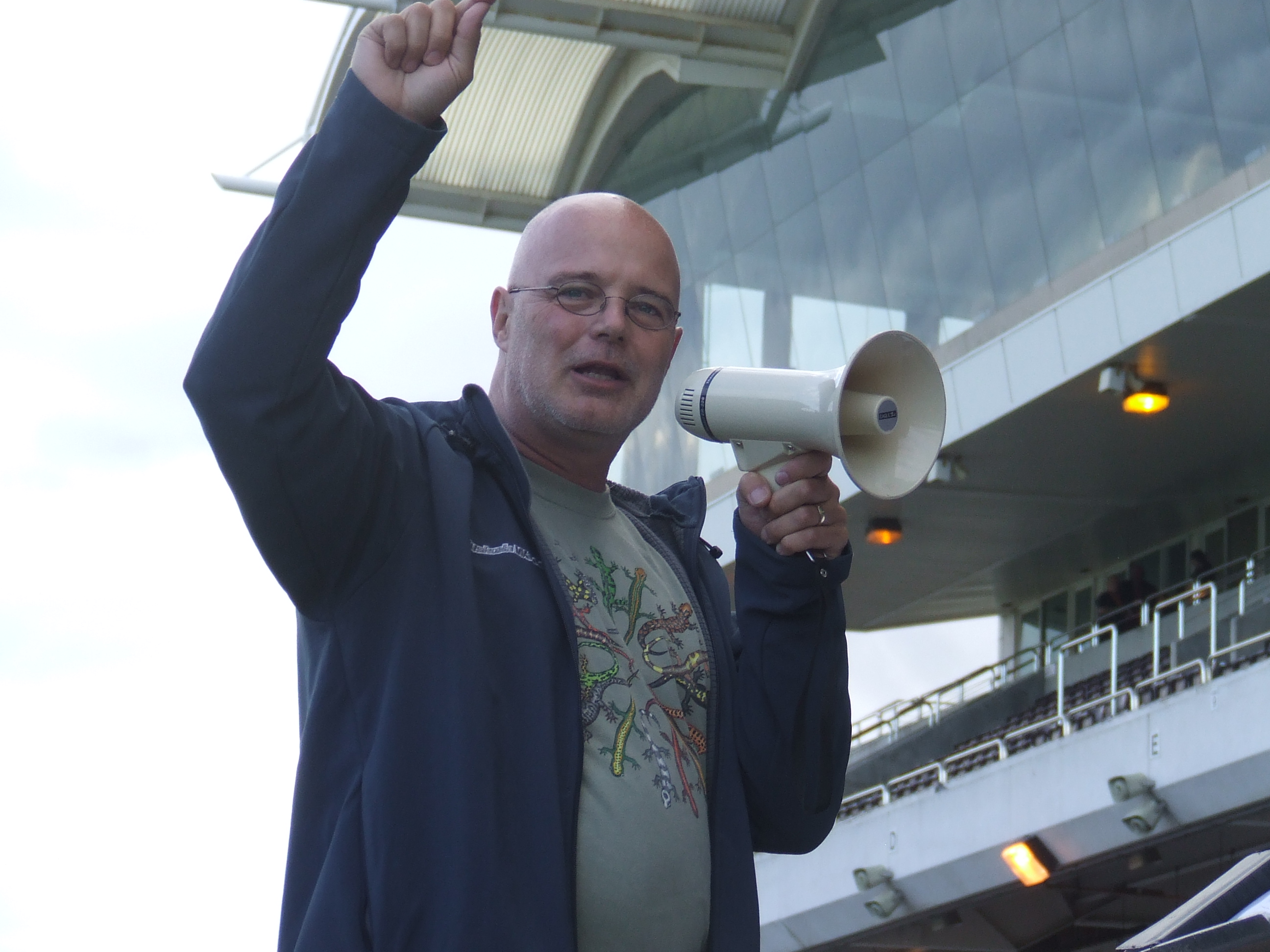
Brian McLaren makes do with a bullhorn after power failure at Greenbelt festival a few years ago..
I have written about all of these issues on this blog,but it is the last of the four crises that I have been thinking about of late. In fact, it has been a long term conversation with many of my friends too.
There is a similar-sounding issue that we might easily confuse this conversation with, aound CHURCH. I have spent too long on that journey… so much time has been spent trying to preserve the institution by making stylistic superficial changes in the hope that the centre can hold. I no longer think it can, but even if it does, how might Church inspire real change by doing business as usual? What dynamic ideas might be embraced without letting go of the old ones? The question I have begun to consider is whether it might be time to re-examine not just the flavours of religious institutions, but the fundamentals of the religion itself.
I should start by saying that I am NOT talking about inventing a brand new religion – I’ll leave that to the Scientologists. Neither am I able to comment on the reform needed in other faith traditions other than my own.
The religion that I both reject but also want to re-invent is the one named (perhaps despite his best warnings) after Jesus Christ, a historical figure whose teachings (I would argue) we have largely ignored.
Here is the thing – I don’t think I am alone. Back to those conversations with my friends. Most , like me, have left the institution of Church behind, but some are very much still within, working hard for change. The commonality between all of us is that we all long for something else, something better, but we all struggle to conceptualise what that is, and what it might look like.
I am going to try. It may take me a while. If you have thoughts or ideas that are triggered by my ponderings I would love to hear them- as long as you are kind.
It is perhaps worth reminding ourselves of the reality of declining church attendance in the UK. It is not always a straightforward picture in the short term, for instance, some hard line conservative churches have actually grown in recent years- including the Free Church of Scotland and many Pentecostal or funamentalist gatherings – even though the long term trend is still downwards, some have seen significant increase in attendees.
But this brand of religion stays firmly within the ‘crisis’ territory outlined by McLaren above. The solutions they are offering – moral certainty in relation to homosexuality, gay marriage and the fear of Hell – do little to address the problems facing our age. In fact, given the dominance of American right-wing faith models across the whole world, we might argue that this religion is the problem, not the solution. It is at best a distraction, at worst, one that has fully accommodated itself with the same capitalist economics and politics that are throwing us towards destruction.
You know what I am referring to. The news, your Facetwitter feed, even good old fashioned communication- it is full of the desperate events that unfolded in Paris over the last couple of days. Violence and murder done in the name of religion. Violence that grew like poisonous funghi in the shadow cast by other violence.
Events like this have the capacity to shape our age, for good or ill. Our response to it should be to preach caution, to encourage a sense of proportion and to remind people of history, so we might learn from it.
People of faith have a particular role to play here, given the centrality of theology as both framing narrative and ideological justification for unspeakable barbarity. The meaning of ancient texts has become so mixed up with tribal identity and weight of injustice that perhaps it is only from within religion that violence can be challenged. I know this as the hard, unyielding condemning religion I grew up with was transformed through thoughtful engagement with a different kind of belief.
Giles Fraser had this to say about the relationship between iconography and religion;
But, of course, these terrorists weren’t really interested in theology. They thought that Charlie Hebdo’s cartoonists were insulting their human tribe, a tribe they called fellow Muslims. And maybe they were. But whatever else was happening, it was the atheist cartoonists who were performing the religious function and the apparently believing Muslims who had forgotten their deepest religious insights. For any representation of the divine that leads people to murder each other deserves the maximum possible disrespect.
But back to the point- what should be our response?
I mentioned attempting to retain some perspective. It is so hard to do this when bombarded with so much infotainment/news coverage. Meanwhile extremes are shouted from the margins by those who have a different tribal agenda- Muslims are all evil, as is their religion; we are all under attack from immigrants in our midst; all religion is bad; Christians were right all along etc etc.
Let us remember in this white/anglo-saxon/protestant centric world we inhabit that across much of the planet human life is cheap. The deaths in Paris were tragic, dreadful, appalling. But Yesterday in Nigeria around 2000 people were killed in a different Islamic extremist attack that Amnesty International described as the “deadliest massacre” in the history of Boko Haram. Be honest now- did you know about this? How do you emotionally and intellectually respond?
Then there are the lessons of even recent history (let us not even mention the dreadful colonial legacy that has far more to do with the creation of terrorism than religion ever could have).
Although we have to start there in a way. At the end of Empire, Britain had lived with terrorism for at least 100 years. The transition from colonial territory to autonomous nation has rarely been peaceful; too many artificial borders imposed on disparate peoples, with a history of being on different sides of the many colonially sponsored conflicts. Britain learned the hard way that conventional warfare is never the long term solution to insurgency and terror. Or rather we had to re learn this again and again, treading a path that is remarkably familiar; concentration camps, secret police, propaganda campaigns that leave no room for dissidents, and along the way many a blood bath; Kenya, Zimbabwe, India, Iraq, Afghanistan, Ireland etc etc. Eventually we had to talk to people. We had to turn away from violence and try to make peace in the face of all sorts of provocations.
Ah- but these conflicts were largely about geography, not about ideology, I hear you cry; modern terrorism has no obvious negotiation point; we can not walk away, because it is coming to us- our homes, our streets. It arises internally from our own ethnic minority communities.
I would suggest that there are more similarities than would first appear, it is just that like all post modern movements, terror has globalised. It has worldwide franchises, but power and motivation are still generated in the conflict zones.
After the attack on the World Trade Centre, America declared a war of vengeance. They were quite open about it at the time. Someone had to pay. First Afghanistan was invaded, with a narrative about evil regimes, then on far shakier evidence (later almost entirely discredited) Iraq. Hundreds of thousands died. The bulging prison camps became training grounds for new terror movements. Surveillance and a suspension of the rule of law was seen as justifiable and expedient. To support the war effort successive governments incited fear in a wider public who, in general terms, had probably never been so safe. Has it worked? Can we really regard the world, even the USA as a safer place, a better place?
Three and a half years ago, the far-right Norwegian terrorist Anders Breivik bombed Oslo, and then gunned down dozens of young people on the island of Utøya. His rationalisation for the atrocity was to stop the “Islamisation” of Norway: that the Norwegian left had opened the country’s doors to Muslims and diluted its Christian heritage. But Norway’s response was not retribution, revenge, clampdowns. “Our response is more democracy, more openness, and more humanity,” declared the prime minister Jens Stoltenberg. When Breivik was put on trial, Norway played it by the book. The backlash he surely craved never came.
Here’s how the murderers who despicably gunned down the journalists and cartoonists of Charlie Hebdo do not want us to respond. Vengeance and hatred directed at Muslims as a whole serves Islamic fundamentalists well. They want Muslims to feel hated, targeted and discriminated against, because it increases the potential well of support for their cause. Already, there are multiple reports of attacks in France against mosques, and even a “criminal explosion” in a kebab shop. These are not just disgraceful, hateful acts. Those responsible are sticking to the script of the perpetrators. They are themselves de facto recruiting sergeants for terrorists.
As a nation we are vulnerable to many things in these changing and rootless times. Our chances of early death at the hands of an Islamic terrorist are absolutely tiny. Lots of other things that we live with every day will kill thousands of us; our lifestyles, our motor cars. There is a chance that our over consuming will be the end of our kind.
So let us pause, remember with respect those souls who passed and then try to make peace with ourselves and then with our neighbours.
I was reading today how the Iranian President, Hassan Rouhani, has accused the west of creating the conditions which allowed the development of the extreme militant fundamentalist group that is the current enemy number one of the US and her allies- ISIS. It is a sign of how much things have changed in international relations that an Iranian president could say things like this and anyone would be listening. Even more than most of us would listen and think that he is absolutely right.
Anyone ever heard someone say this?-
“More wars are created by religion than just about any other cause.”
It is one of those truisms that, even though very easily challenged by a cursory look at history (witness both world wars in the last C) is remarkably persistent in our culture. Religion creates fervently held divergent ideas and fanatics who would defend these ideas at any cost.
Karen Armstrong (she of the Charter for Compassion initiative) has written a new book entitled Religion and the history of violence. She deals with this subject in a remarkable article in The Guardian today, which is really worth reading in full. In the article, she deals with the co-existence of violence and religion throughout history, arguing that in most cases, religious violence is intermingled with political expediency in such a way that it is almost impossible to describe the cause of the violence as being the religion itself.
She next deals with the rise of this thing called ‘secularism’, which was the West’s answer to perceptions of the danger of allowing religion to mix with politics.
When dealing with more recent religious conflicts, she had this to say;
When secularisation was implemented in the developing world, it was experienced as a profound disruption – just as it had originally been in Europe. Because it usually came with colonial rule, it was seen as a foreign import and rejected as profoundly unnatural. In almost every region of the world where secular governments have been established with a goal of separating religion and politics, a counter-cultural movement has developed in response, determined to bring religion back into public life. What we call “fundamentalism” has always existed in a symbiotic relationship with a secularisation that is experienced as cruel, violent and invasive. All too often an aggressive secularism has pushed religion into a violent riposte.
Every fundamentalist movement that I have studied in Judaism, Christianity and Islam is rooted in a profound fear of annihilation, convinced that the liberal or secular establishment is determined to destroy their way of life. This has been tragically apparent in the Middle East.
Fundamentalism as reaction, not as consequence of faith itself. Pretty much what the Iranian President is saying. Armstrong goes on to say this;
Many secular thinkers now regard “religion” as inherently belligerent and intolerant, and an irrational, backward and violent “other” to the peaceable and humane liberal state – an attitude with an unfortunate echo of the colonialist view of indigenous peoples as hopelessly “primitive”, mired in their benighted religious beliefs. There are consequences to our failure to understand that our secularism, and its understanding of the role of religion, is exceptional.
When secularisation has been applied by force, it has provoked a fundamentalist reaction – and history shows that fundamentalist movements which come under attack invariably grow even more extreme.
The fruits of this error are on display across the Middle East: when we look with horror upon the travesty of Isis, we would be wise to acknowledge that its barbaric violence may be, at least in part, the offspring of policies guided by our disdain.
It feels to me there is great wisdom in these words. Contrast them with the rising cry of violence that our government is rushing to join. The answer to violent groups like ISIS appears to be, more violence- as if this will ever put out the flames. As if this will remove the circumstances that led to the violence in the first place.
The counter cry will arise- evil can not be allowed to stand. Men of violence must be opposed. Justice should flow like a river.
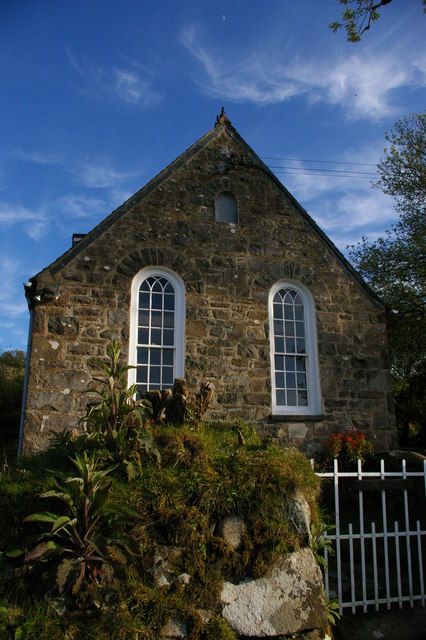
I love old church buildings, so what else would I do to fill my solitary evenings but to go and find one? I took a drive out over the Black Isle to Cromarty, a lovely old town overshadowed slightly by looming oil rigs being repaired out in the firth. There I discovered Cromarty East Church.
The East Church, the former Parish Church of Cromarty is a remarkable building of national importance, not only for its architecture but also for its representation of ecclesiastical and social change. The physical additions, alterations and remodellings carried out at the church bear witness to specific periods in the history of Cromarty and of Scotland with times of prosperity, rises in population, the influence of individuals and changes in liturgical practice.
It is principally the events of the 18th century that have given the East Church the outward appearance we see today. The survival of the interior in such an unaltered fashion has led to the East Church’s reputation as ‘unquestionably one of the finest 18th century parish churches in Scotland, the epitome of the development of Presbyterian worship during that century. There is something satisfying about its long, low form with its simple clear-glazed windows and its intimate interior, bringing preacher and congregation together in a very direct way.’ [John Hume, former Principal Inspector of Historic Buildings for Historic Scotland, describing the East Church in 1999.]
The origins of the church, however, are more ancient and complex than might at first be apparent and recent excavations have confirmed that it stands on the site of the medieval parish church. A large number of burials were uncovered beneath the floor of the church, together with a 15th century grave slab which had been re-used as a step or kerb within the pre-Reformation church to demarcate the approach to the altar. The post-Reformation church was significantly enlarged in 1739 when Alexander Mitchell and Donald Robson, masons, and David Sandieson and John Keith, wrights, added a north aisle to create a T-plan church. Further alterations followed in 1756 and 1798-9, the latter being carried out by Andrew Hossack who added porches to each of the three gable ends and the birdcage bellcote on the east gable.
The interior dates principally from the 18th century, with galleries or lofts added to the north (Poors Loft), west and east (Laird’s Loft) to accommodate the growing congregation. The most elaborate of these is the Laird’s Loft dating from1756 with its paired Ionic columns and Doric frieze. The loft also contains a fine funeral hatchment on the ceiling, painted with the arms of George Ross of Pitkerrie and Cromarty.
Also of note are a series of wooden panels, re-used and incorporated into a number of pews, most notably at the front of the north loft with a sunburst motif and Mackenzie coat of arms.
It is not a Church any more- it is redundant, but better preserved than many that are still in use as it has been restored by the Scottish Redundant Churches Trust. It stands as a museum to religious observance.
The early rituals of the mass, mixed in with the colour and patronage of the rich, which was then replaced by a focus on the pulpit. More pews and galleries were added in to accommodate the sinners now saved, before the numbers dwindled away again.
Along the way the walls took on monuments to men who died in distant colonial wars- Afghanistan, or at sea fighting the French. Their stone tablets sit at ease with those commemorating faithful long serving ministers of religion.
Faith is not contained by buildings, but they come to be like fossils of what once was. Beautiful fossils they are but new life takes on new shapes…


















 this fragile tent