
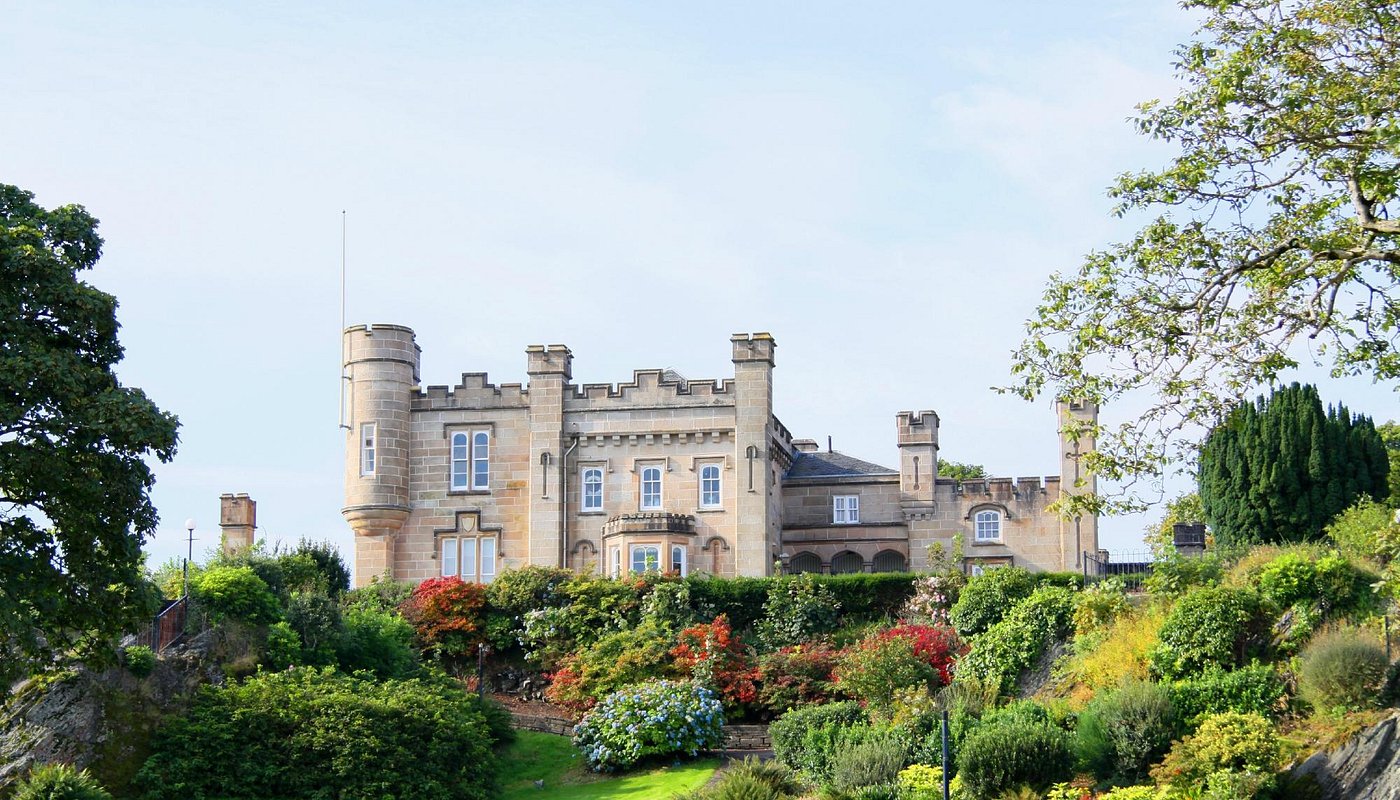
This is Castle House, the large holiday home built by James Ewing, Lord Provost of Glasgow, as a holiday home in 1822. It put Dunoon on the map, literally, and became the start of a move to Cowal peninsula (where I now live) by many of Glasgow’s great and good, who built their versions of the Castle all along the shorelines in every direction.
A few months ago, Michaela and I went to a talk given in Castle house – which is now a museum – by Dr Stephen Mullen, on the subject ot the aforementioned James Ewing. In this talk, Ewing was revealed as a particularly unpleasant figure, whose power and influence was built on vast wealth built from slavery in Jamaica. More than this, through his political activities, clubs and networks, he was able to delay the abolition of slavery for decades, as well as being part of the negotiaton that led to compensation being paid by the government to slave owners.
His ancestors still own plantations in Jamaica to this day.
This is a version of some of the chat from Stephen Mullen- he is a very engaging speaker.
In the wake of this inglorious wealth building, Ewing then turned to philanthropy. He became the benefactor to many good causes, including Glasgow University, who have been through a very painful process in 2018 (assisted by Mullen) of attempting to divest and compensate enslaved people for the wealth that it still owned from their brutal enslavement.
It has taken Edinburgh University longer- today, the role of leading figures in promoting racist and zenophobic ‘science’. This from today’s Guardian;
The University of Edinburgh, one of the UK’s oldest and most prestigious educational institutions, played an “outsized” role in the creation of racist scientific theories and greatly profited from transatlantic slavery, a landmark inquiry into its history has found.
The university raised the equivalent of at least £30m from former students and donors who had links to the enslavement of African peoples, the plantation economy and exploitative wealth-gathering throughout the British empire, according to the findings of an official investigation seen by the Guardian.
The inquiry found that Edinburgh became a “haven” for professors who developed theories of white supremacism in the 18th and 19th centuries, and who played a pivotal role in the creation of discredited “racial pseudo-sciences” that placed Africans at the bottom of a racial hierarchy.
It reveals the ancient university – which was established in the 16th century – still had bequests worth £9.4m that came directly from donors linked to enslavement, colonial conquests and those pseudo-sciences, and which funded lectures, medals and fellowships that continue today.
Does any of this matter? Is it not just ancient history, from different, less ‘woke’ times? Of course, there are many voices – historical, political, journalistic – that would loudly proclaim processes of revisionism such as those undertaken by the two universities above as political correctness gone mad.
Some of this argument has polarised around the renaming of streets, or the removal of statues. The issue has become totemic in the culture war that is raging in our politics – a convenient way to create outrage, and to appeal to a kind of empire nostalgia for Great Britain and her glorious history.
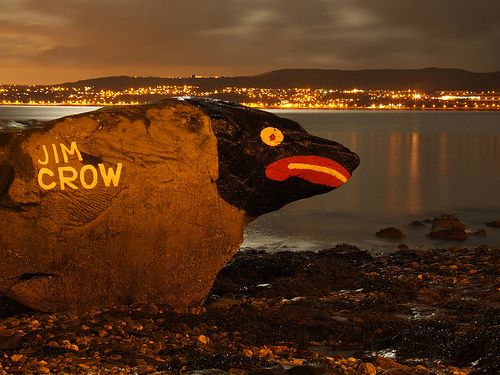
Dunoon had its own battle, over this racist Victorian grafiti which survived until only a few years ago. Some here will still insist it was harmless fun (including local historians!)
Presently it feels as though the anti-woke warriors might be winning the culture wars. Views that might once have been politically radioactive are now seen as vote winners. Trump and all his imitators compete to say ever more outrageous things, and point to any attempt to understand the darkness that we unleashed on the world through the Empire as ‘the problem’ not the solution.
I am weary of culture wars. I wish we can just agree that some things are good (compassion, justice, peace) and some things are bad (conquest, slavery, exploitation.) Once we do this we also have to acknowledge that the privileges we enjoy in this country- despite the perception of decline – were built on the bad things more than the good.
What we do with this conclusion marks us for generations.
 this fragile tent