Land ownership and climate justice here in the UK…

If you are UK based, you can not have missed the dominance of one story in the news of late- the (re)imposition of inheritance tax on farming land by the new Labour government. This has led to a howl of protest from farmers who say that this will be the end of their family farms. There has been a lot of discussion about how this works- the way that farms below 250 acres are almost unviable economically, and how farmers are often ‘asset rich and cash poor’.

The story that comes through strongest in these discussions is how hard working farmers, who often trace their linage back many generations, are being forced off the land by city lefties, or venture capitalists who are driving up land prices, both of whom have no understanding of what the countryside is or needs. Farmers, in this story, are the heroes of nature. Their toil is what preserves the brightest and best of our heritage and out nationhood. Many do this with very little recompense other than a love of the soil and a deep abiding relationship with the land that they live upon. Whilst this story is one we should pay heed to – there are real people whose lives and ways of living are at stake here – this is another story that I have heard almost nothing about during this debate, and that is the issue of land ownership in this country.

1 percent of this country owns half of the land in England. Mostly this ownership has not changed for a thousand years. The same elites have continued their lines of ownership which has preserved their hold of wealth and power for generation after generation.

If you want to find out more, then I very much suggest watching this vid;

In Scotland, this is unequal division of land ownership is even more pronounced. 432 private land owners own 50% of the private land in rural Scotland. The latest estimate of Scotland’s population is 5,327,000 , so this means that half of a fundamental resource for the country is owned by just 0.008% of the population.

Given that the baseline for so much of our nations widening inequality is not about income so much as wealth – particularly property wealth – then land ownership matters.

Ownership of land is in itself a problem that sooner or later we will have to grapple with, given the fact that the current ownership patterns have continued to oversee a catastrophic decline in biodiversity.
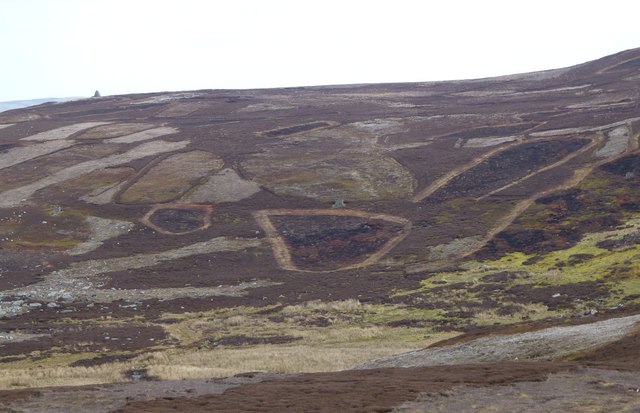
Grouse moor with butts by Russel Wills is licensed under CC-BY-SA 2.0

Grouse moors, as discussed in the video above, are an illustration of how bad things have become. Half a million acres in England, two and a half million acres in Scotland. Vast amounts of land, covering the most sensitive parts of our uplands, are kept in a state of dessecration simply for the entertainment of a wealthy elite. We have ceded ownership of a vital carbon store to people who have demonstrated very clearly that they are not safe or responsible stewards. Everything that affect the sport is killed- even at the potential threat of imprisonment- goshawks, mountain hares, weasels. Everything that should live in our uplands is gone. The once-vibrant ecosystem has been degraded to the point where it is invisible, and what is worse is that we have been so blinded by the power structures that keep these abominations in place that we think that these places are ‘wild’.

The weight of pheasants released into the wild – non native invasive species – as shotgun fodder (50 million birds) is greater than the mass of all native birdlife in the UK. Think about that!
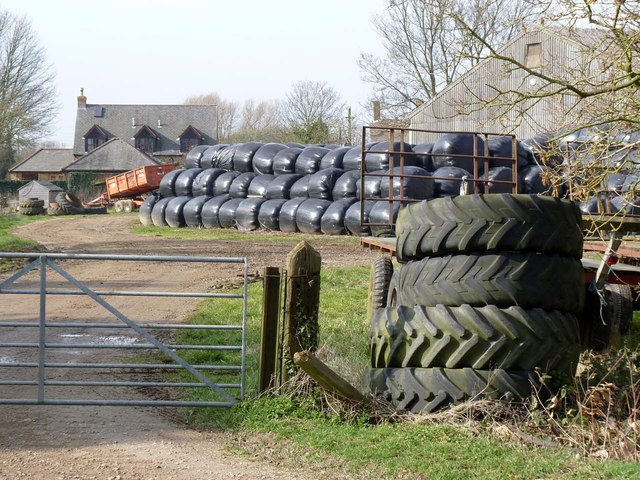
Modern farmyard by Alan Murray-Rust is licensed under CC-BY-SA 2.0

So let’s retuen to the family farm. People who work harder than most of us can imagine and deeply love what they do. If changes to inheritance tax are really going to impact them so severely, then surely this can’t be right?

The problem is that we are highlighting the wrong problem.

Farming in this country is in crisis. It is uneconomic because of a whole set of global and local fiscal rules.

It does not constitute a safe and secure food chain.

It is unsustainable.

Rather than safeguarding our land, it has destroyed almost everything that once lived on it.

If there was just one ‘brexit benefit’ that I have been able to identify it is the end of the common agricultural policy subsidies. For the first time, we have an opportunity to pay farmers (and land owners who have never farmed in thier lives) to change entirely the way they use the land. To grow food in sustainable ways. To increase wild land, to make room for biodiversity recovery which we need so desperately.

I think this should be done by government action. We should pay farmers from taxation where it is needed, because this is needed not just to save family farms, but to save our land itself – not least, from the farmers.

But what do I know- I’m just a lefty townie.
To succeed is to destroy ourselves; economic growth and fossil fuels…

economic_growth_3

We all kind of know that the system of economic growth we are hooked on is not sustainable. However, it is so pervasive in how we understand the world that envisioning life without it is almost impossible. Take the concept of ‘economic growth’. Put simply, without growth we stagnate. Without an overall increase in the stuff we consume, own, or waste year on year, quarter by quarter, our economy is seen to be failing. In fact our politics dwells in the ever present fear of the spectre of of this terrible thing called recession. So much so that we allow them to sacrifice support to the poorest and weakest of our number by cutting social supports in the name of ‘stimulating growth.’

There was a brilliant article by George Monbiot in The Guardian yesterday in which he said this;

Let us imagine that in 3030BC the total possessions of the people of Egypt filled one cubic metre. Let us propose that these possessions grew by 4.5% a year. How big would that stash have been by the Battle of Actium in 30BC? This is the calculation performed by the investment banker Jeremy Grantham.


Go on, take a guess. Ten times the size of the pyramids? All the sand in the Sahara? The Atlantic ocean? The volume of the planet? A little more? It’s 2.5 billion billion solar systems. It does not take you long, pondering this outcome, to reach the paradoxical position that salvation lies in collapse.


To succeed is to destroy ourselves. To fail is to destroy ourselves. That is the bind we have created. Ignore if you must climate change, biodiversity collapse, the depletion of water, soil, minerals, oil; even if all these issues miraculously vanished, the mathematics of compound growth make continuity impossible.

Put like that, the whole pursuit of economic growth is madness right? Monbiot says more than this however, he points out this kind of economic growth was only ever possible because of the fossil fuels that we have been burning for the last 300 years or so;

Economic growth is an artefact of the use of fossil fuels. Before large amounts of coal were extracted, every upswing in industrial production would be met with a downswing in agricultural production, as the charcoal or horse power required by industry reduced the land available for growing food. Every prior industrial revolution collapsed, as growth could not be sustained. But coal broke this cycle and enabled – for a few hundred years – the phenomenon we now call sustained growth.


It was neither capitalism nor communism that made possible the progress and pathologies (total war, the unprecedented concentration of global wealth, planetary destruction) of the modern age. It was coal, followed by oil and gas. The meta-trend, the mother narrative, is carbon-fuelled expansion. Our ideologies are mere subplots. Now, with the accessible reserves exhausted, we must ransack the hidden corners of the planet to sustain our impossible proposition.

How do we stop this? Monbiot thinks that first of all we have to SEE it, but most of us simply do not;

The inescapable failure of a society built upon growth and its destruction of the Earth’s living systems are the overwhelming facts of our existence. As a result, they are mentioned almost nowhere. They are the 21st century’s great taboo, the subjects guaranteed to alienate your friends and neighbours. We live as if trapped inside a Sunday supplement: obsessed with fame, fashion and the three dreary staples of middle-class conversation: recipes, renovations and resorts. Anything but the topic that demands our attention.


Statements of the bleeding obvious, the outcomes of basic arithmetic, are treated as exotic and unpardonable distractions, while the impossible proposition by which we live is regarded as so sane and normal and unremarkable that it isn’t worthy of mention. That’s how you measure the depth of this problem: by our inability even to discuss it.

Step forward then the politician who is prepared to say that economic growth is no longer desirable nor advisable, and that we need to learn to love what we have, to mend stuff, to share stuff and to live within our localities.

Who is going to vote for such heresy?

Or shall we just blame it all on the immigrants?

17 rules for a sustainable economy….

Wendell Berry is a prolific author, activist, poet and also a farmer in Kentucky, USA. He is also a life long Baptist Christian.

He came up with a list of what he saw as the best way to change our destructive Capitalist global economy into something more human scale, more sustainable and in tune with our environment, where ever this might be on the planet.

See what you think- might such a set of rules actually work in the real world?

A community economy is not an economy in which well-placed persons can make a ‘killing’. It is an economy whose aim is generosity and a well-distributed and safeguarded abundance.

Wendell Berry is a strong defender of family, rural communities, and traditional family farms. These underlying principles could be described as ‘the preservation of ecological diversity and integrity, and the renewal, on sound cultural and ecological principles, of local economies and local communities:

1. Always ask of any proposed change or innovation: What will this do to our community? How will this affect our common wealth.

2. Always include local nature – the land, the water, the air, the native creatures – within the membership of the community.

3. Always ask how local needs might be supplied from local sources, including the mutual help of neighbors.

4. Always supply local needs first (and only then think of exporting products – first to nearby cities, then to others).

5. Understand the ultimate unsoundness of the industrial doctrine of ‘labor saving’ if that implies poor work, unemployment, or any kind of pollution or contamination.

6. Develop properly scaled value-adding industries for local products to ensure that the community does not become merely a colony of national or global economy.

7. Develop small-scale industries and businesses to support the local farm and/or forest economy.

8. Strive to supply as much of the community’s own energy as possible.

9. Strive to increase earnings (in whatever form) within the community for as long as possible before they are paid out.

10. Make sure that money paid into the local economy circulates within the community and decrease expenditures outside the community.

11. Make the community able to invest in itself by maintaining its properties, keeping itself clean (without dirtying some other place), caring for its old people, and teaching its children.

12. See that the old and young take care of one another. The young must learn from the old, not necessarily, and not always in school. There must be no institutionalized childcare and no homes for the aged. The community knows and remembers itself by the association of old and young.

13. Account for costs now conventionally hidden or externalized. Whenever possible, these must be debited against monetary income.

14. Look into the possible uses of local currency, community-funded loan programs, systems of barter, and the like.

15. Always be aware of the economic value of neighborly acts. In our time, the costs of living are greatly increased by the loss of neighborhood, which leaves people to face their calamities alone.

16. A rural community should always be acquainted and interconnected with community-minded people in nearby towns and cities.

17. A sustainable rural economy will depend on urban consumers loyal to local products. Therefore, we are talking about an economy that will always be more cooperative than competitive.

Conflict minerals and the coming gadget fest…

Just saw this on Brian McLaren’s blog-

Gadgetmass is almost upon us, and so it might be a good time to remind ourselves that our electronic consumables have a hidden cost to people who will never get to use them.

I was rooting in some cupboards the other day in our house, and came across a graveyard for gadgets- sad scratched plastic in amongst a tangle of chargers for devices long lost or discarded.

A kind of monument to over-consumption, waste and our unsustainable lifestyle.

That was bad enough- but the clip above made me think about what these things are actually made from.

There are more details, and a chance to respond directly to technology companies on this website.

Or you could just keep the mobile you already have. It still works doesn’t it?

Starting a new thing and then sustaining it…

I have been thinking about several new beginnings. All of them are at that stage where they are just a shapeless mixture of excitement, optimism and possibility, mixed in with…

Fear that I will fail

Worry about the consequences for my family and my friendships

A growing realisation of all the hard work to come

On the whole though, I love this period in a project. When ideas crackle and spark, and things just seem to take on a life of their own, with you following through the doorways that open up. It is a time of great creativity and imagination.

But I am very aware that some of my co-conspirators find this process much more alarming. My tendency to allow an idea to grow legs and run off over the horizon is particularly disconcerting. You should ask my wife!

This tension in groups is pretty inevitable. And it always seems to require good communication, deliberate pauses to reflect and check out where we are up to, and the application of minds more driven by detail than mine ever is. Which tends to be the point that I can become frustrated and stressed. Things that seem so clear in my mind (but I have not communicated very well) suddenly are filtered through several different perspectives…

But after all this forming and storming, there is the issue of dealing with the longer haul…

As I have got older, I find myself less and less satisfied with repetition. Which is strange as I think I was a bit of a plodder in early adulthood- happy to build credibility by showing myself to be reliable and dependable over a longer time frame. I suppose this is reflected in my career- I have worked for only two employers (albeit in several different roles) over my 20 years in social work.

So the other issue about any new project is this word sustainability

It is a word that implies the long haul. And also increasingly means something about the way we use resources (finance, raw materials, energy, time.)

For me too, sustainability is mingled in with relationships. This is perhaps the way my mind is wired- but also it is a thing that Jesus has set loose in me. Enterprise becomes social enterprise, activity becomes group activity. This is always more complicated, and potentially fraught with difficulties- but it seems to me to be the way we humans were meant to live and work and have our being…

This is what I feel myself to be in the long way of- commitment to living, working and being in the Jesus way. Compromises are so wearing…

More on this to come…