
As advent unfolds I have been allowing myself to look forward towards hope… to imagine the coming of a new kingdom/insurection/revolution in which goodness and compassion are central. In other words, I am trying to rest again in the spirit of the Magnificat as sung by Mary and recorded in just one of the Gospels…
46-55 And Mary said,
I’m bursting with God-news;
Luke 1 46-55 (the message translaiton)
I’m dancing the song of my Savior God.
God took one good look at me, and look what happened—
I’m the most fortunate woman on earth!
What God has done for me will never be forgotten,
the God whose very name is holy, set apart from all others.
His mercy flows in wave after wave
on those who are in awe before him.
He bared his arm and showed his strength,
scattered the bluffing braggarts.
He knocked tyrants off their high horses,
pulled victims out of the mud.
The starving poor sat down to a banquet;
the callous rich were left out in the cold.
He embraced his chosen child, Israel;
he remembered and piled on the mercies, piled them high.
It’s exactly what he promised,
beginning with Abraham and right up to now.

I have been over in Northern Ireland for a few days to see my father, immersed in the usual chaos of old age – medication, money and care. I went with my brother, and we spent a little while exploring a place that he knew better than me, as he had spent a lot of his childhood over there. (Our family circumstances are complicated.) Here is the grave of my grandparents, both of whom died before I was born, having worked in the flax mill that took such toll on the health of local people.
My family were all born into a town called Strabane, right over on what now is the border with the Irish state in Tyrone. It is a bustling booming town now, because of cross-border trade, but until very recently was a place with one of the highest unemployment rates in all of Europe. Strabane was the most bombed town during the troubles, with the highest proportion of it’s citizens killed. It is overwhelmingly Catholic (91%) and as such was an epicentre of republicanism. There are many of these dotted about;

Until recently, many of the streets would have kerbs painted in sectarian colours across the province, but I was surprised to see that most of this has been removed. However, the tribalism remains firmly in place, seen in many subtle ways. One of the more obvious at present is that in republican areas you will see many flags and banners supporting the Palestinian cause in Gaza, whilst in unionist areas, lamposts are flying the Israeli flag. The currency and apparent group-think of this division are shocking to outsiders, but not to those who live with it day-by-day.

In Strabane town centre there is quite a lot of public art, most notably around the lovely Alley Theatre, but also this piece, which lists a number of famous people born in the town, including former president of the USA, Woodrow Wilson, Musician Paul Brady and writer Flann O’Brien. It does not mention other illuminaries such as William Burke, the 18th Century serial killer, but does give a shout out to a woman called Cecil Francis Alexander who wrote many favourite hymns from my childhood- ‘There is a green hill far away’, ‘Once in Royal David’s City’ and the ubiqiotous ‘All things bright and beautiful’…
… which takes us back to the root of all this.
The violence and trouble unleashed on Ireland has been blamed on many things; religion (of course), politics, the British, ignorance – all of these things may have played a part, but Cecil Fancis Alexander’s hymn gives us another clue, containing as it does (in original form at least) this verse;
The rich man in his castle,
The poor man at his gate,
God made them high or lowly,
And ordered their estate.
For much of the last centuries, the Irish were considered as the lowest of all. Alexander, from a wealthy background, was part of a ruling class, married to an Archbishop. She spent her time on charitable pursuits amongst the deserving poor. She lived at the time when around one million people starved to death in what came to be known as the Irish Potato Famine but seemed unable to see the injustice right in front of her nose.
Perhaps you think me unfair to someone living in such a different time and place, but I will not sing this hymn, even with the verse above ommitted. Instead I will thrill once again to young Mary as she sings those words of the magnificat; The starving poor sat down to a banquet; the callous rich were left out in the cold.
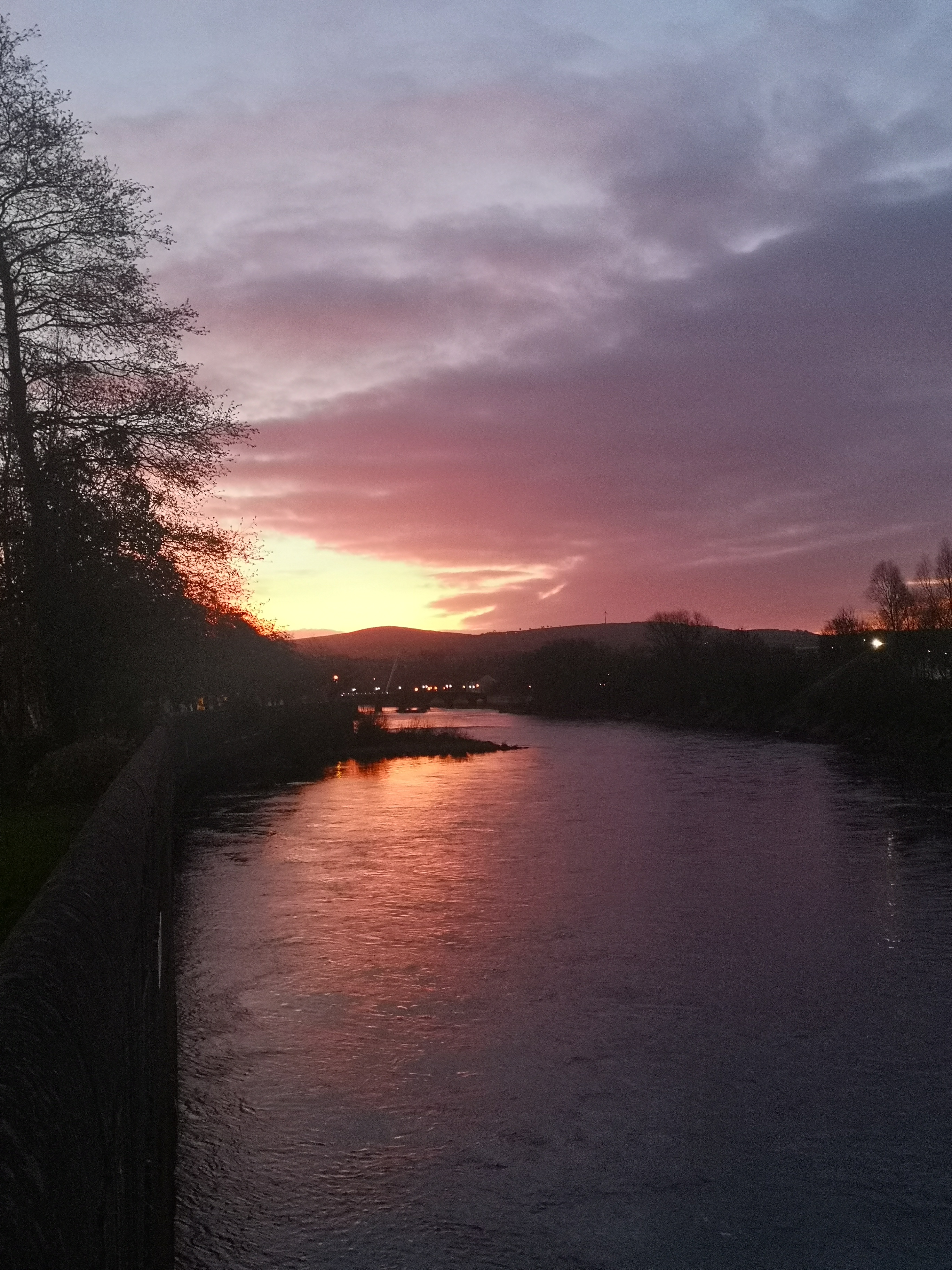
I took a morning walk alongside the border river Foyle, which runs through the middle of Strabane thinking about an old concept suggested by the author Phillip Yancey. In his book ‘What’s so amazing about Grace’, he painted a picture of what he called ‘ungrace’, or the opposite of grace. Families, communites and societies who are characterised ungrace seem to experience it in almost like toxic waste or poisoned water.
Ungrace leaves a legacy that can only be overcome by one thing.
Grace.

 this fragile tent