Christmas films…

Now is the season of bad TV.

(That is perhaps unfair I suppose- bad TV may well be open-season!)

But pretty soon the airwaves will be full of those dreadful ‘Christmas Special’ programmesl. I hate that saccharine, mawkish way that the media folk make TV-about- TV. A slice of self referencing that assumes that the whole world is contained within our viewing tubes…

And of course, Jesus will not be mentioned in any of this. There will be all the other cliches- snowmen, santa’s, robins and sleighbells. There will be dancers in red fish net stockings, and the occasional oblique reference to ‘Goodwill to all men’.

But lest this descend even further into rant central, let me make a slight confession. I am a sucker for a certain kind of sentimental Christmas film.

Not the blockbuster kind- the ones that are made for the mass market. I avoid them like the plague ( and I suspect they would give me a nasty rash!) Rather, those American B movies, made somewhere in the snowy midwest, with a family (or an orphan, or a single mother…) in crisis, then goes through a trial, only to be redeemed about 5 mins before the end, which gives time for them to gather around a fireside and sing Carols.

Curiously, John Denver is in a lot of them…

They make me cry. In a good way.

I think I like them because they are an antidote to some of the Christmas madness, and have at heart something simple and wholesome- if totally manufactured.

One film that is almost guaranteed to start the waterworks is this one;

a_hobos_christmas
This film takes the story of a man who abandoned his family, but 25 years later, after a life as a tramp, decides he has to see his son again before he dies. Cue cute grandson, trim loving daughter in law, and bitter, but essentially good son, who when he realises who the odd-job man really is, kicks him out. But of course, it does not end there.

You know where it is heading don’t you? Back to that fireside and the singing of carols…

Lovely.

But recently I came across the ultimate antidote to those Christmas blockbusters I mentioned earlier- you know the type, Miracle on elf street, or one in which Rudolf learns to fly after accidentally crashing Santa’s sleigh into the toy workshop…

I have confessed before to a love of the Coen Brothers films. Almost every one is brilliant. When I realised that they had made a Christmas film then I had to see it

200px-bad_santa_film

This film is extremely funny, but it also takes the genre, and subverts it wonderfully. Here is a drunk, a thief, a womaniser and a gambler (played brilliantly by Billy Bob Thornton) who somehow makes us all root for him. it is full of profane one liners, and slap stick humour.

There is a kid in there- but cute he ain’t, and although it has a happy-ish ending, it is a Coen brothers happy ending, so it leaves you chuckling…

If you share a house with anyone who might wish to fill Christmas with Strictly-come-dancing-x-factor-big-brother-I-am-so-not-a-celebrity-but-I-do-try-so-hard kind of programmes, take some time out.

Get yourself one of these DVD’s.

And if you think they are rubbish, well there is always the Coronation Street pantomime special. Probably.

Imagine theres no heaven. Above us only sky…

WARNING- sweary-words to be heard in the following clip.

Avoid if of a sensitive disposition- or if you are under/over the age at which knowledge of profanity should not be encouraged…

If like me, your tolerance for such things hints at your backslidden sinful state, then click on…

I stumbled across this whilst wasting time when I should have been DIYing (I now have water coming through the ceiling beneath where I recently installed a new shower. AGHHH!)

It set me thinking again about heaven, and hell, and what we might encounter when we die…

Oh, and I liked the accents too.

So what do we think about heaven and hell?

It seems that we Christians have two options to choose from-

Option 1- lots of soft clouds, harps and gold- HEAVEN

Option 1- lots of soft clouds, harps and gold- HEAVEN

Option 2- fire, smoke, eternal torment- HELL

Option 2- fire, smoke, eternal torment- HELL

Hmmmm- which one do you fancy?

This, I suppose has been the evangelical strategy of church for a long time. Even though it has always troubled me- (back to those old Chick cartoons again I suppose!) It was not really that this narrow view of our impending fate was questionable within the theological understanding I was part of, but more that it was usually played down by most, and perhaps OVERPLAYED by some others.

But questions about the essential truth of this equation were never encouraged. Some of this was about Biblical truth, and the unassailable network that had been constructed around particular meanings, and some of it was about POWER- and the in-out stuff that allows us to decide who is OK, and who is not.

My concerns have always been for the following reasons-

  1. Is it OK to SCARE people into the Kingdom? Or are we just telling it like it is?
  2. Will a God of love REALLY throw all these people- good and bad, kids and those who have learning disabilities- any who died without a profession of faith- into a lake of fire to burn in agony for eternity?
  3. What about Jesus? What did he have to say about this? These words are often quoted– And if your foot causes you to sin, cut it off. It is better for you to enter life crippled than to have two feet and be thrown into hell. And if your eye causes you to sin, pluck it out. It is better for you to enter the kingdom of God with one eye than to have two eyes and be thrown into hell, where “their worm does not die, and the fire is not quenched. (Mark 9:45-45)
  4. And what about heaven? Does it not just sound slightly boring? A church service that never ends? (I have been in a few of those- or it seemed like it at the time!) Is this just the least-worse option?
  5. Then there is the ‘your-reward-will-be-in-heaven’ business. Do lots of good, as you will get a nice big mansion, with a throne view.

So where am I up to now?

Well I realised that lots of Christian traditions have different views about heaven and hell. Some people have always had the concerns above, and even dared to express them.

To give McLaren another plug, I read his book ‘The last word and the word after that‘ a few years51ez759rekl_bo2204203200_pisitb-sticker-arrow-clicktopright35-76_aa240_sh20_ou02_ ago, and it was another one of those painful experiences, where I found myself confronting things I had avoided for fear of losing faith altogether.

But the end result was a deepening of the sense of who God might be, and how he might engage with us all.

In particular I was amazed to discover that the view of heaven and hell I had accepted as a fixed Biblical position appeared to have its origins outside the Bible, and perhaps even outside the Judeo-Christian world (this is not an idea original to McLaren, it seems, but is well understood by many Theologians, but ignored as irrelevant by others.)

A quote from Brian (pinched from an interesting blog post here)

One of the discoveries that led to the book came to me several years ago, but I don’t remember exactly how. I remember noticing that a number of Old Testament writers didn’t seem to believe in an afterlife. It was obvious in Ecclesiastes, but you know – that whole book seems odd. It struck me in some of the Psalms especially. Then I noticed this lack of belief in afterlife in other places, and I realized that Sheol wasn’t the same as hell.

Then I began to notice that Jesus talked about hell a lot, which let me know that something must have happened between the end of the Old Testament and the beginning of the New. I was curious about what happened during that time.

What appears to have happened is that some Jewish sects/denominations (but not all) adopted ideas of heaven and hell from other religions- such as the Zoroastrians, and this synthesis of belief systems became the understanding through which the Jewish people engaged with God.

There were apparently significant differences in for example, the Pharisees understanding of heaven and hell, and that of the Saducees. The former believed in the resurrection of the dead and the latter did not. Interestingly, it seems that the Saducees rejected the Pharisaical views on an afterlife on the basis of a literalistic interpretation of the Bible, rejecting the exegesis and oral traditions of the Pharisees. Truth wars were raging then too!

It seems that these grouping effectively became political parties too- so religion was definitely mixed with politics!

Does this matter?

Well when you read again the questions put to Jesus in the form of tests by these groups, it seems at least possible that they were attempting to either bring Jesus within their own fold, or expose his theology to be outside their understanding of truth, and so reject him.

The wonderful thing about Jesus is that these attempts failed, because he saw the trap coming a mile away, and neatly stepped around it. He seemed to have no time for this way of seeing faith.

Is it possible then that at least some of the words of Jesus in relation to heaven and hell can be read in the light of the context in which he was engaging? Does this change our understanding of what he was saying, or how it was recorded?

STOP! I hear you cry. This is going too far- it is a liberal re-interpretation of the Bible that will end in heresy!

In my defense, I offer no fixed positions to invite you to join me onto, and thereby defend.

But I dare to believe that the life that goes on when we are done here will always remain to us a wonderful mystery.

And I dare to hope that Jesus may yet find a way to save those who we have lost.

Hell may or may not be the place that burns up that part of us that is unworthy and unwelcome in the presence of the Living God.

And I pray that by his mercy, I will fall into the arms of a loving God.

Advent unexpected

cimg1099

A storm rattled the old house through the night, and the skirl and howl of the winter wind took away sleep. Or perhaps it was rather the swirl of stuff in my head- but either way, the grey of the dawn brought a headache and a developing awareness of the inevitable head cold gifted no doubt by William, who has been stretched out on the sofa for a few days.

But today is a Saturday, and Saturdays are special.

They offer the possibility of all sorts of meeting and greeting and adventuring. But above all, they offer time away from the worries of work and school, and I can share them with my wife and kids. There is nothing better in this life I reckon.

Having said that, perhaps because of the fallen nature of this wonderful but flawed world, things are rarely as easy as this. Saturdays are often stolen by a thousand obligations.

Michaela, bless her, will often introduce the subject of another ‘task’ obliquely. Or perhaps it just seems that way as I was not listening properly. But she knows that every second filled with tasks, no matter how blessed, I easily resent…

Today was a case in point. A day filled with DIY, trips to the tip and the collecting of kids and then a trip to fetch a Christmas tree… which turned out to be an absolute joy.

It began with a drive in the early winter dusk as the mingling air misted at the level of the lower branches.

Past Loch Eck, a glassy smooth reflector of the mountains lined with bones of snow.

And a friendly man at the Glenbranter forest station who helped us pick out a tree with humour and a genuine warmth with the kids.

Crunching over the muddy ground half concreted still by insulated ice.

Then a tea and mince pie in the ranger station, whilst the kids were drawn like iron filings to the magnet of the piles of ploughed surviving snow- too hard now to compact into balls, but magical just the same.

And I walk out on my own for a moment, in the middle of Argyll Forest in the gathering dark. Mist still hanging in the trees, but just enough light to make out the white of the mountain tops beyond.

And rejoice.

A suitable advent moment- all the better for being unexpected, in the press of a curmudgeonly day.

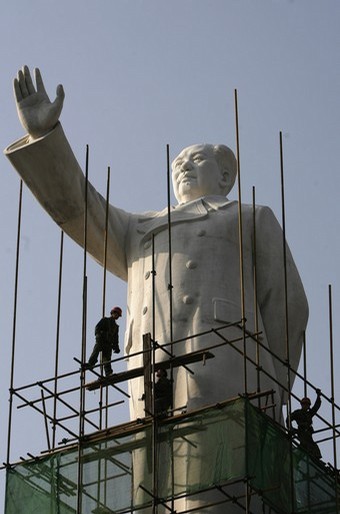
Monument

CHINA/

I once knew a man who drew me.
Impressive like a monument
His lighthouse lit the horizon
And I paddled his way, shipping water.

I liked his cant
The slant of marbled arch
Burnished bronze
Banners in the breeze

And I threw out an anchor
But found no hold.
Rather, the bones of others wrecked on these rocks
Sirens silent, cannons cold.

And the monument was unmoved
Like an unblitzed cathedral in a ruined city
This man could rise above and
Point heavenward, uncomprehending.

Fool that I am, and blind from logs in my own eyes
I know that men are clay
From the feet upwards.
And the closer we come, the more we see the cracks.

But what then is the measure of a man?
I hope one day to stand before my God
Having loved indecently, unchaste
Always poured out love in haste
And death to dignity.

So I claw across sea green rocks and crawl towards
The monument.
Insecure, teetering on foundations brittled by salt brine
And I wonder how to save it.

How not to replace it.

The universal declaration of human rights, and Jesus…

udhr_colour

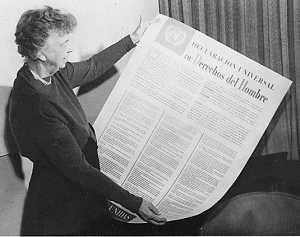
On December 10, 1948 (60 years ago today) the General Assembly of the United Nations adopted and proclaimed the Universal Declaration of Human Rights.

This incredible document was written as a response to the horrors of the second world war, and brought the hope of a

Eleanor Roosevelt with a Spanish Language version of the UNDHR, 1949

Eleanor Roosevelt with a Spanish Language version of the UNDHR, 1949

council of nations who would regulate the governance of the people of the world by a new, commonly agreed yardstick.

I have heard and read several discussions about whether this document has really made any difference to the people of the world. After all, the imperative to support and to enforce it remains the prerogative of the superpower of the age- and at present, we have only one- the United States of America.

For the past 60 years, the tradition of convenient alliances and an acceptance of all sorts of injustices for the sake of political expediency has continued in a way that seems indistinguishable from the preceding 60 years.

And even if the world was willing to unite behind a military solution to uprooting a despotic regime- and after all there are still plenty of these around, even if only a few ever make the media front pages- do we think that violence is the answer?

Does violence not only ever bring legitimacy to more violence?

And then, of course, the lawyers get involved. The UN declaration found it’s place alongside other other national and federated law- the European Convention on Human Rights for example. A huge machinery of sophistry was the inevitable, if necessary, outcome.

So, is this anniversary to be celebrated?

outlawed_guantanamo

One discussion I listened to brought me up sharp. A commentator said something like this;sermon-on-the-mount
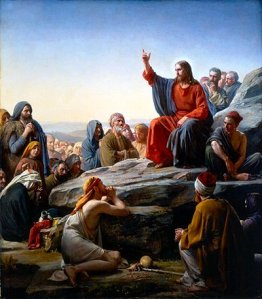
…of course, the declaration is a bit like the sermon on the mount- it is aspirational. No-one ever expects that it will work in the real world.

Of course, I beg to differ on the sermon on the mount.

I think the words that Jesus left us with from Matthew 5 are far more than aspirational, they define for humanity the very best of what we are, and could ever be. They set a direction of travel and a yearning for better things. And they start from a heart to heart connection with something blessed and eternal. Something undefinably GOOD.

And in that moment a Kingdom like no other finds it’s foundations.

Of course, we fail. And the systems that try to organise a response to these words in the form of church and state- well they fail too.

They fail because of legalism, and because of indifference. They fail because of the idolatry of accommodation and compromise.

They are very different documents- the words of Jesus as quoted by Matthew, and the great humanistic declaration drafted by Canadian Lawyer John Peters Humphrey .

But perhaps their application might find some commonality.

Here are the words in full- you decide!

Article 1.

All human beings are born free and equal in dignity and rights.They are endowed with reason and conscience and should act towards one another in a spirit of brotherhood.

Article 2.

Everyone is entitled to all the rights and freedoms set forth in this Declaration, without distinction of any kind, such as race, colour, sex, language, religion, political or other opinion, national or social origin, property, birth or other status. Furthermore, no distinction shall be made on the basis of the political, jurisdictional or international status of the country or territory to which a person belongs, whether it be independent, trust, non-self-governing or under any other limitation of sovereignty.

Article 3.

Everyone has the right to life, liberty and security of person.

Article 4.

No one shall be held in slavery or servitude; slavery and the slave trade shall be prohibited in all their forms.

Article 5.

No one shall be subjected to torture or to cruel, inhuman or degrading treatment or punishment.

Article 6.

Everyone has the right to recognition everywhere as a person before the law.

Article 7.

All are equal before the law and are entitled without any discrimination to equal protection of the law. All are entitled to equal protection against any discrimination in violation of this Declaration and against any incitement to such discrimination.

Article 8.

Everyone has the right to an effective remedy by the competent national tribunals for acts violating the fundamental rights granted him by the constitution or by law.

Article 9.

No one shall be subjected to arbitrary arrest, detention or exile.

Article 10.

Everyone is entitled in full equality to a fair and public hearing by an independent and impartial tribunal, in the determination of his rights and obligations and of any criminal charge against him.

Article 11.

(1) Everyone charged with a penal offence has the right to be presumed innocent until proved guilty according to law in a public trial at which he has had all the guarantees necessary for his defence.

(2) No one shall be held guilty of any penal offence on account of any act or omission which did not constitute a penal offence, under national or international law, at the time when it was committed. Nor shall a heavier penalty be imposed than the one that was applicable at the time the penal offence was committed.

Article 12.

No one shall be subjected to arbitrary interference with his privacy, family, home or correspondence, nor to attacks upon his honour and reputation. Everyone has the right to the protection of the law against such interference or attacks.

Article 13.

(1) Everyone has the right to freedom of movement and residence within the borders of each state.

(2) Everyone has the right to leave any country, including his own, and to return to his country.

Article 14.

(1) Everyone has the right to seek and to enjoy in other countries asylum from persecution.

(2) This right may not be invoked in the case of prosecutions genuinely arising from non-political crimes or from acts contrary to the purposes and principles of the United Nations.

Article 15.

(1) Everyone has the right to a nationality.

(2) No one shall be arbitrarily deprived of his nationality nor denied the right to change his nationality.

Article 16.

(1) Men and women of full age, without any limitation due to race, nationality or religion, have the right to marry and to found a family. They are entitled to equal rights as to marriage, during marriage and at its dissolution.

(2) Marriage shall be entered into only with the free and full consent of the intending spouses.

(3) The family is the natural and fundamental group unit of society and is entitled to protection by society and the State.

Article 17.

(1) Everyone has the right to own property alone as well as in association with others.

(2) No one shall be arbitrarily deprived of his property.

Article 18.

Everyone has the right to freedom of thought, conscience and religion; this right includes freedom to change his religion or belief, and freedom, either alone or in community with others and in public or private, to manifest his religion or belief in teaching, practice, worship and observance.

Article 19.

Everyone has the right to freedom of opinion and expression; this right includes freedom to hold opinions without interference and to seek, receive and impart information and ideas through any media and regardless of frontiers.

Article 20.

(1) Everyone has the right to freedom of peaceful assembly and association.

(2) No one may be compelled to belong to an association.

Article 21.

(1) Everyone has the right to take part in the government of his country, directly or through freely chosen representatives.

(2) Everyone has the right of equal access to public service in his country.

(3) The will of the people shall be the basis of the authority of government; this will shall be expressed in periodic and genuine elections which shall be by universal and equal suffrage and shall be held by secret vote or by equivalent free voting procedures.

Article 22.

Everyone, as a member of society, has the right to social security and is entitled to realization, through national effort and international co-operation and in accordance with the organization and resources of each State, of the economic, social and cultural rights indispensable for his dignity and the free development of his personality.

Article 23.

(1) Everyone has the right to work, to free choice of employment, to just and favourable conditions of work and to protection against unemployment.

(2) Everyone, without any discrimination, has the right to equal pay for equal work.

(3) Everyone who works has the right to just and favourable remuneration ensuring for himself and his family an existence worthy of human dignity, and supplemented, if necessary, by other means of social protection.

(4) Everyone has the right to form and to join trade unions for the protection of his interests.

Article 24.

Everyone has the right to rest and leisure, including reasonable limitation of working hours and periodic holidays with pay.

Article 25.

(1) Everyone has the right to a standard of living adequate for the health and well-being of himself and of his family, including food, clothing, housing and medical care and necessary social services, and the right to security in the event of unemployment, sickness, disability, widowhood, old age or other lack of livelihood in circumstances beyond his control.

(2) Motherhood and childhood are entitled to special care and assistance. All children, whether born in or out of wedlock, shall enjoy the same social protection.

Article 26.

(1) Everyone has the right to education. Education shall be free, at least in the elementary and fundamental stages. Elementary education shall be compulsory. Technical and professional education shall be made generally available and higher education shall be equally accessible to all on the basis of merit.

(2) Education shall be directed to the full development of the human personality and to the strengthening of respect for human rights and fundamental freedoms. It shall promote understanding, tolerance and friendship among all nations, racial or religious groups, and shall further the activities of the United Nations for the maintenance of peace.

(3) Parents have a prior right to choose the kind of education that shall be given to their children.

Article 27.

(1) Everyone has the right freely to participate in the cultural life of the community, to enjoy the arts and to share in scientific advancement and its benefits.

(2) Everyone has the right to the protection of the moral and material interests resulting from any scientific, literary or artistic production of which he is the author.

Article 28.

Everyone is entitled to a social and international order in which the rights and freedoms set forth in this Declaration can be fully realized.

Article 29.

(1) Everyone has duties to the community in which alone the free and full development of his personality is possible.

(2) In the exercise of his rights and freedoms, everyone shall be subject only to such limitations as are determined by law solely for the purpose of securing due recognition and respect for the rights and freedoms of others and of meeting the just requirements of morality, public order and the general welfare in a democratic society.

(3) These rights and freedoms may in no case be exercised contrary to the purposes and principles of the United Nations.

Article 30.

Nothing in this Declaration may be interpreted as implying for any State, group or person any right to engage in any activity or to perform any act aimed at the destruction of any of the rights and freedoms set forth herein.


The Underground Railway…

In response to Brian McLaren’s event in Glasgow (mentioned in my previous post- here), here is an excerpt from part of a book called ‘Blue-dark’, available here.

I reproduce it as a kind of mission statement- a reminder of what I set myself towards.

I have a feeling I may have posted this before, but for my own sake at least, I think it is worth saying again!

The term ‘underground railroad’ was first used in relation to an organisation of people who helped slaves escape from the American south to the northern states who had declared against slavery.

80906515CJ001_AUSHWITZ_BIRK

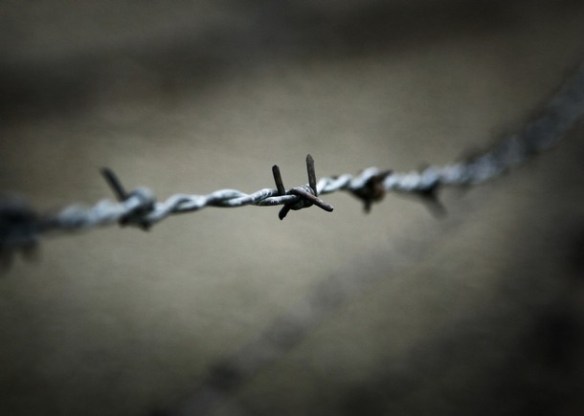
In the dark days of the Third Reich, when the whole of Europe was under the heel of dictatorship, still there was a remnant. There were men and women who were uncontaminated by circumstance, and emboldened by passions born of a different Kingdom. Sleeping now like spring in winter were memories of better times now gone. And with the sleep came dreams of justice for the oppressed, liberation for captives, and ministry to the sick and the lame and the alien in a conquered land.

Ordinary people – just like you and me, in an extraordinary situation, performing simple acts of heroism, in the face of certain prosecution and possible death. At first they were loud in their outrage, but hard lessons taught caution and subterfuge, and so they went underground.

And quietly, in the shadows, they grew bolder, and found that they were not alone. Many people opened up their lives and their homes, and began to gather the unlovely and the unloved, to give food, and warmth and shelter. They found others who still kept the light alive. And so they formed a network. No-one knew the whole of this network – the overall plan was less important than the simplicity of saving those immediately at risk. But almost by some hidden hand, Jews, gypsies, gentiles, escaped soldiers, political undesirables – all were passed down the line – closer to freedom, closer to the other Kingdom.

So was born a time of heroes.

And the Underground Railway…

I think that we are called to live what we believe.

And to believe in how we live.

It sounds simple, but so few do. Jesus said that when we are born again in him, we become new creations. The old parts of us are dead and gone, and the new person is made in His image. This means that we become more like him.

More passionate
More compassionate
More holy
More real
More loving
More merciful
More open
More hungry for justice
More whole
More like a child
More willing to go for it!

Less selfish
Less concerned about earthly security
Less proud
Less jealous of what others have
Less carnal
Less judging of others
Less earthbound
Less empty.

So what gets in the way? Why is it that the old habits drag me down? It is almost as if the old man, who is dead, rises in me like a corpse and fills me with the smell of death.

And somehow this becomes normal. It becomes culturally acceptable. We see it all around us, in both the secular and the so-called sacred. Jesus told us to enter through the narrow gate, because the alternative is broad and easy, but leads to destruction. Narrow is the way to life, and only a few find it (Matt 7: 13-14).

He was never much into going with the flow.

What would it be like to live what we believe? It would mean loving God, and loving others. Simple.

Unlearning lots of layers of stuff that get between us and Him, between us and people.

I believe it is possible. Because I have seen it. I have seen men changed. I have felt it. I am not the same.

And I am not my own – I belong to a different kingdom. This kingdom has different rules and has a different culture.

So I decided to set myself again to live what I believe. I became less tolerant of the smell of death, and instead went for life, and laughter, and freedom. Like Lazarus, I walked to the mouth of the tomb, and looked out.

And I began to see a world full of different colours. It brought me to tears, but still I wanted to sing praise songs, redemption songs, songs of freedom.

But also, I saw again the people all about me through new eyes. Some were broken almost beyond repair, at least in this world. Others were hungry, others were homeless. And here and there were people captured by addictions and close to death. Many of them had been inoculated against God by their experience of religion. It was almost as if he was giving me a window into their souls. And my heart broke open.

I decided that it was wrong, and something needed to be done. But it is hard to go against the culture, to swim against the tide.

What is needed, I thought, is an underground railway…

(From ‘Blue Dark, 2006, by Chris Goan)

Lessons on Kingdom from Brian McLaren…

brian-mclaren

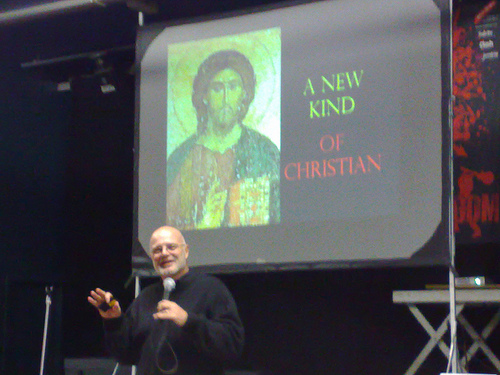
I took a trip into Glasgow last night to hear Brian McLaren speak at Strathclyde university. His writing has been hugely influential on my spiritual life and my understandings of faith, and so I felt a bit like a groupie!

I went with a couple of friends from Dunoon, Simon and Ali, and had a chance to meet up with a couple of on-line buddies too- Stewart and Thomas. In fact, the picture above is Stewart’s- who had the technology (royalty check in t’post!)

It was a great night. Finished off by a lovely drive home over the Rest and be Thankful pass under a clear starry sky. Oh and a good take-away in Balloch…

Brian McLaren was profound in what he said- and although not much of it was new to me, the words were like food to the soul. Lots of people seem to have this experience of listening to him almost telling their story- allowing them to ask questions, and permitting them to start a new journey with God. I am reluctant to build him up with labels that will later become millstones around his neck, but he has something of the Apostle about him that is not taken, but rests as a result of who he is.

Yesterday is a case in point- it was not just what he said, but the way he said it. There was a kindness to his words- a respect for all things, but always a gentle invitation for as all to aim for something better.

Highlights? For me there were many. He got into a lot of discussion about the Kingdom of God- and old theme for me, which has been the subject of much discussion in our housegroup. We had previously playfully tried to find new names for the Kingdom of God, and I was delighted to see McLaren taking this to a whole new level.

The suggestion is, that Jesus was using the term ‘Kingdom of God’ as a way to engage with the people of his time in words they would understand. If he was here today- he would do the same, but would not necessarily use the same words.

‘Kingdom’ today ( suggested McLaren) is a word that has lost it’s potency- it is embedded in an ancient understanding of power and authority. What Jesus was doing was suggesting that there was a new way of doing Kingdom.

He then went on to list a whole series of words that Jesus might use if he was here today (Stewart gives a list of these on his blog- The Dream of God, The Peace Revolution of God, The Mission of God, The Party of God, Network of God, Ecosystem of God, God’s New Planet, Beloved Community, God’s Economy, The democracy of God.)

But there were two that I really liked.

One was

The dance of God

The idea that we learn to take part in a dance, in which we are part of an interrelated, dependent cycle of life and love- moving in response to divine music…

And perhaps most of all, I liked

The non-terror cell of God, or The insurgency of God

These seemed redolent with an idea that has been buzzing about my head for a while about a subversive group of Christians modeled loosely on the underground railway- I’ll post it soon I reckon.

Last resort

trident

Whilst continuing with our project to finally have a bedroom that it is possible to enjoy being in, I was listening to Radio 4. Highly recommended for entertainment whilst grouting tiles…

Todays offering was a programme called The human button.

It was all about the people whose job it is, either as politicians or members of the armed services, to potentially bring death to millions. They interviewed men who flew Vulcan bombers in the 1960’s, signing a receipt for their Blue Streak Nuclear missiles before take off. Unimaginable destruction in the hands of a 24 year old man.

But the most fascinating bit of all concerned a little known bit of British Armageddon etiquette, called ‘Letters of last resort’.

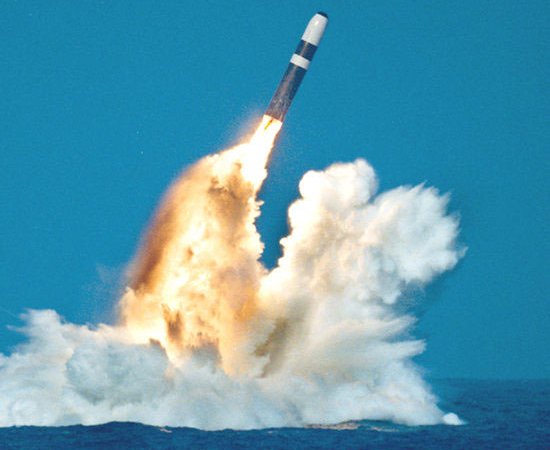
It seems that one of the first jobs each incoming Prime Minister is to be given instruction about the operation of Britain’s 4 Trident nuclear submarines- one of which is kept at sea at any one time, as a so-called ‘deterrent’ to any other nuclear power that should have itchy fingers over their own big red buttons.

And one of the things they have to do, is to write a letter, in their own handwriting, to each of the 4 submarine Captains. These ‘letters of last resort’ give final instruction to the Captains, should it’s line of command have been destroyed by a nuclear attack- in other words, if all of us (and our Prime Minister) are dead.

The options that the Prime Ministers have are;

  1. Retaliate
  2. Do not retaliate
  3. Place yourself under the command of the USA or Australian Governments

Few Politicians have ever revealed what instructions their letter contained. The letters are destroyed, unopened, at the change of an administration. One Prime Minister however, Jim Callaghan, revealed that he would have retaliated. Another Labour politician, Dennis Healey suggested he would not have done, as at that point the primary purpose of a nuclear deterrent would already have failed.

I find it comforting and terrifying in equal measure that even this potential last act of the human race is so… human.

The shadow cast by the cold war passes by our house every couple of months as the black menacing shapes of the Trident submarines leave the Clyde and head out on their dreadful patrols.

If we have no politician who would stop this madness, let us at least hope for people whose last resort is not to rain down death on other people’s children.

2007_01162007ireland0001

Starbucks, learning from church??

Terry sent me a link to this- which raised a few painful chuckles.

Painful as it was very familiar!

Not quite sure what point they are making though. Is the issue about image and presentation? Do we just need to be hipper and more trendy? I thought this had been tried, and had not worked, at least in the UK. Perhaps we are just not trendy enough? Perhaps we aimed at Starbucks but got stuck somewhere in a 1950’s milk bar?

Perhaps too the church in America is a bit different- they can still count on large numbers of folk who go every Sunday, even though numbers are going down there also.

For my part, I think that church as an institution does need change. But perhaps the real issue is that we Christians need to change the way we live out faith, rather than the way we institutionalise it…

The clip above seems to be challenging the church to market itself better. Is this what we should be about? Sure, I can see the wisdom of being creative and relevant in how engage with the world around us, but I still feel uncomfortable with the idea of ‘church marketing’.

I think this relates to a certain extent to New Labour, and ‘spin’. In 1997, I was euphoric along with many others as the Labour government swept aside the Tories and finally came into government. They had finally found themselves a winning formula that was eminently marketable, just as the Conservatives seemed to degenerate into a sleeze jelly.

But ideology, passion, reality- all seems to have been subordinated to spin. The message was lost in the marketing.

But I also feel a bit uncomfortable with the idea of church as ‘corporation’.

Church is (or I think SHOULD be) a collective of activists, whose rules of engagement are counter cultural, as well as intra cultural. We are called out, to seek and to save. To liberate captives and bring sight where there is blindness.

Marketing techniques, whose aim is to attract more people in, to build up the corporation- nope, not for me I think…

Beaches were made for contemplation…

kearvaig-beach-img_0813

We step out of the car into a wind whipped in from the arctic
Unconstrained by obstacle
And walk the soft sand towards the music of the sea.
Passing the strandline of shells left by the high spring tide
Grateful when feet find the firm sand squeezed by the kettledrum roll
Of the wonderful waves
As they spit out sparkling pebbles
Left in the sunlight like gifts from God

Inside our hats and scarves we are alone in inner space
Apart from the occasional sentence shouted into the salt air
To bring the kids away from a wave that reaches further towards
The tops of wellies

Beaches, I think, were made for contemplation
Just the place for poets
So I lift my watering eyes to the wind
And stand before a sea going out for ever
But also keeping on coming in
Offering to all the far horizon
And the longing for landfall
At the mercy of a friendly wind
And the fall of the tide

I watch the waves in the distance, hoping for a glimpse of a sea monster
And ponder all that life down deep
All those colours invisible in indigo darkness
Alive in creations overflow
And it is all too big
Unfathomable

Cuttlefish
Alien flashing transparency
Reduced somehow to parrot food
In another world

Whale
So big that movement seems tectonic
Impossible

So with faces numb
But senses alive
We walk on towards the reward
Of the seaside town
Offering some out of season hospitality
To poets and all