Emerging church- the debate continues…

There has been some more chat on various sites about EC. The usual questions are being examined again- is the term useful? Did the ’emerging conversation’ promise much and deliver little? Does it still have any use or relevance?

emerging church

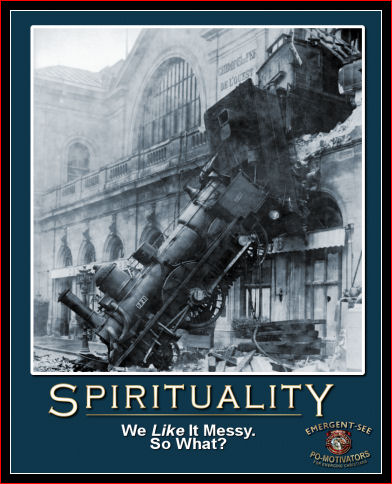
Creative (if rather unsympathetic) posters from here!

Followers of this blog will know that this has been a recurrent theme-

Back in September, I posted another review from the blogosphere- here.

Then in January, I spoke about the fact that our group had decided to stick with the word ’emerging’ for now.

Then in February, I asked what is emerging?

Then Jonny Baker pointed us to this post a week or so ago, which he responded to in a great post entitled

if you are disillusioned you’d better ask yourself…

Then there is a really good post from the Emergent village website- here, that responds to some of these discussions. As ever, it is useful to remember that Emergent Village (often foreshortened as ‘Emergent’) is one of the conduits for conversation about emerging church- but does not claim to represent, or even lead, the conversation. It is worth re-stating this, as some of the key figures in Emergent- Doug Pagitt, Brian McLaren, for example- have attracted much criticism, and controversy. I have an awful lot of respect for both, but neither would claim to lead anything called ‘the emerging church’.

mssnl

I spent some time thinking about where I am up to with the ’emerging church conversation’ (I always feel I have to use parenthesis around the phrase!)

I realised that I feel really quite comfortable with the label now. For me, it has brought me into contact with greatly positive and inspirational people, ideas and resources.  I do not see myself as a member of ‘The emerging church’, because I still think that ’emerging church’ is a verb, not a noun.

Neither does the small church group I am part of call itself an ’emerging church’, although we might continue to hope that we are being drawn forward into new things by the Spirit of God.

Over on the Emerging Scotland ning site, Vicki Allen asked the question- ‘what does emerging mean to you?’ and encouraged people to list three things that were meaningful to them. I thought about it for a while- and then settled on these three-

1. The freedom to re-imagine and re-discover COMMUNITY.

2. The freedom to re-imagine and re-discover THEOLOGY- particular ‘small’ theology (by this I mean theology that is respectful of our inheritance, but interested in it’s application to our own locality and community.)Add New Post ‹ this fragile tent — WordPress

3. The freedom to re-imagine and re-discover the MISSION of the Kingdom of God.

I remain grateful for Emergent, and the emergence of rich ways of understanding the nature of our engagement with Jesus in our post modern context.

The rest, well that is up to Him.
sprtlty

opnnss

BBC Reith Lecture- the free market and morality…

bbc broadcasting house

I managed to catch most of the first of the new series of Reith Lectures on Radio 4 this morning as I drove round to Helensburgh.

For those who have not come across the Reith Lectures before,  they are a British institutuion- or perhaps an English institution- despite their connection with the Scottish John Charles Reith, the force behind the creation of an independant BBC.

This is what the Lectures are tagged with-

a series of annual radio lectures on significant contemporary issues, delivered by leading figures from the relevant fields

The current series features political philosophy Professor Michael Sandel– and digs into some of the primary issues facing our political and economic system.

This first one concerned itself with the nature of the free market, and it’s relationship with moral choices.

It chews on the nonsense of carbon trading, and the potential free market responses to the ‘problem’ of refugees.

It was a great piece of radio- of a non-sound bite kind, a rare commodity.

You can listen again here, or it is repeated on Saturday.

The series will continue…

Earth Abbey, and Grow Zones…

Thanks to Si Smith for the link to this project which looks really great…

The guys behind this initiative have combined their faith and passions into a collective called ‘Earth Abbey’- their website is well worth checking out.

This is what they are about…

  • A rich relational life between human beings
  • A compassion toward the earth and its creatures
  • A sense of interconnectedness of all life
  • Wisdom and justice in relationships
  • Human fulfilment and the nurture of the inner life
  • A way of living that leaves the earth better than we found it

Sounds great.

I wonder whether we can gather something similar in Dunoon?

Further dispatch from ‘the swine flu capital of Scotland’…

Dunoon Grammar School

Dunoon Grammar School

One more post about living in ‘the swine flu capital of Scotland’ (a title bestowed by the Times newspaper- here.)

Although there are now cases on the Island of Bute, and in Oban, Dunoon still remains the centre of the largest out break of the H1N1 virus in Scotland. As of Friday, there were almost 70 confirmed cases. Fortunately, most cases seem to have had mild effects on those infected- vomiting, aches and pains, dry cough- but two people have required hospital treatment. One person suggested that a recent hangover was worse!

The official response to this has been changing too. Initially the hope was that we could contain the spread of the virus by keeping those who had direct contact with infected people separate, and using prophylactic medication. It is safe to say that this does not appear to have worked very well! The concern of those of us that work for essential services is that if enough staff are infected, then we will not be able to maintain essential care to vulnerable people. However, at present, this has not been a problem. Services are managing fine.

The service under most pressure is the local hospital- and this seems to be at least in part because of the very many ‘worried well’ who are turning up for tests and seeking medication.

The current advice is that if infected, keep away from work and people. If in contact with those infected, but you are not symptomatic, then carry on as normal.

Community services (Social Work and Education) have been given clear instruction to ‘carry on as normal’, and not to get into a pattern of canceling things, and therefore increasing the sense of crisis in the locality.

I was surprised then to hear that Dunoon Grammar School is now closed for a week. My daughter, who is in year three, was already off all last week in an attempt to control the spread amongst people who had contact with a confirmed case of infection. I wonder whether the decision to close the school was more in response to the fact that so many people were simply not sending their kids to school. I heard that on one day last week, there were only 35 kids in the school (the normal intake is more than a thousand.)

The effect on the community has been interesting. Some are fearful and withdrawn- suspicious of sniffles and sneezes. But mostly the effect seems to be rather positive on peoples relating and interacting. After all, communication in small towns can often be very incestuous and gossippy- and swine flu gives us such great material. The chance to compare notes on who-knows-who, and to inquire after the wellbeing of the new local celebrities- those infected. I have found people to be almost universally good humoured about the whole thing.

Perhaps the ultimate expression of this is that I heard yesterday that some of those who had been infected were gathering together at a ‘Swine flu barbecue’- a social event for those who had been quarantined from others.

A hog roast you could say.

Where the swine flu ham is fully roasted.

Good for them!

The new book is out!

Forgive the conceit, because here is a plug for my new book!

listingcover

‘Listing’ is a collection of poetry and meditations mostly inspired by some of those great lists in the Bible- the fruit of the Spirit, the Beatitudes, the ‘love’ passage in Corinthians and the ‘seasons’ passage in Ecclesiastes 3.

It is published by Proost- and available by clicking here.

Here is the Proost blurb from Jonny Baker;

Listing is a little gem, a surprise that came Proost’s way over the horizon from Chris Goan. He loves crafting words, playing with words, chewing over words, creating and re-creating worlds with words. His poems and meditations are a delight, spinning off from and opening up new takes on familiar verses of ancient wisdom from the scriptures. It’s the second book from Chris on proost. The first is the wonderful meditation he wrote to go along with Si Smith’s images of Christ’s journey into the wilderness ‘40’. The books is available as both hard copy or to download as pdf.

Thanks Jonny!

Go on- Buy two and give one away…

Dunoon, twinned with Eyam?

The swine flu outbreak in Dunoon continues- more cases confirmed today. The Dunoon rumour mill has had a field day. I have really enjoyed hearing all the different versions of the same stories- you hear them in the queues at supermarkets, in the street, and in offices.

It is difficult to know whether we are over reacting, or under reacting. The school kids who have been told to go home, and not to associate with others are clearly ignoring this advice en masse- apart from my daughter, much to her disgust! I even heard about one girl in her year working as a waitress! I kid you not! Although, this being Dunoon, this story may well not be true.

The jokes have started too- the obvious ones are football related- the judgement of God on all Rangers fans, or the fact that God is a Celtic supporter, and has contaminated Ibrox to ensure that they win something next year. ( The link here, in case you missed it, is the fact that the outbreak here is linked to a bus full of Rangers supporters who travelled together from Dunoon.)

Then there have been the rather more pompous jokes about links to other plagues through history-

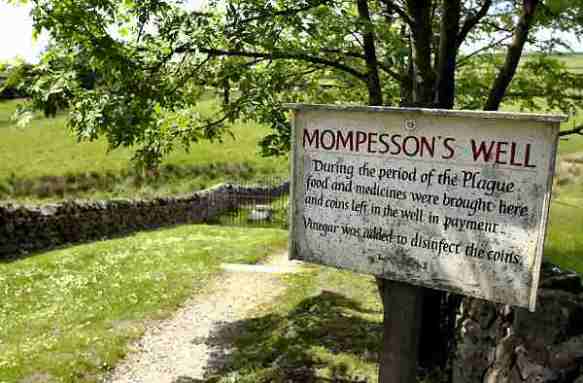
It did remind me of the story of the village of Eyam in Derbyshire close to where Michaela and I grew up. The story of the sacrifice made by the villagers there had entered into folklore to such an extent that it was the destination of many a school trip.

Eyam 5W

Here is the story as told here.

Eyam, a village in Derbyshire, was also badly affected by the great plauge of 1665 even though the disease is most associated with its impact on London. The sacrifices made by the villages of Eyam may well have saved cities in northern England from the worst of the plague.

At the time of the plague, the village had a population of about 350. The most important person in the village was the church leader – William Mompesson.

In the summer of 1665, the village tailor received a parcel of material from his supplier in London. This parcel contained the fleas that caused the plague. The tailor was dead from the plague within one week of receiving his parcel. By the end of September, five more villagers had died. Twenty three died in October.

Some of the villagers suggested that they should flee the village for the nearby city of Sheffield. Mompesson persuaded them not to do this as he feared that they would spread the plague into the north of England that had more or less escaped the worst of it. In fact, the village decided to cut itself off from the outside would. They effectively agreed to quarantine themselves even though it would mean death for many of them.

The village was supplied with food by those who lived outside of the village. People brought supplies and left them at the parish stones that marked the start of Eyam. The villages left money in a water trough filled with vinegar to steralise the coins left in them. In this way, Eyam was not left to starve to death. Those who supplied the food did not come into contact with the villagers.

Eyam continued to be hit by the plague in 1666. The rector, Mompesson, had to bury his own family in the churchyard of Eyam. His wife died in August 1666. He decided to hold his services outside to reduce the chances of people catching the disease.

Eyam Church where plague victims are buried

By November 1666, the plague was considered at an end. 260 out of 350 had died in the village but their sacrifice may well have saved many thousands of lives in the north of England. Mompesson did survive. He wrote towards the end of the village’s ordeal:

Now, blessed be God, all our fears are over for none have died of the plague since the eleventh of October and the pest-houses have long been empty.

How would Mompesson fare if he tried to persuade we Dunoon folk to close up the borders and sit out the infection, burying our dead as we went?

Not very well I suspect. But then again- who knows, we Brits tend to be at out best at times of adversity, or so we like to think.

In celebration of the poetry of Edwin Morgan…

I may be wrong, but it seems to me that poetry is making a comeback!

I heard recently that the scary concept of the poetry slam is taking a hold in trendy urban settings of the UK.

So I thought it worth spending some time celebrating someone else’s poetry.

I was just watching another one of the BBC’s poetry films on BBC 4- this time on Lynnette Roberts– the fabulously talented Welsh poet whose creativity was cut short by her experience of mental illness. You can watch it again here.

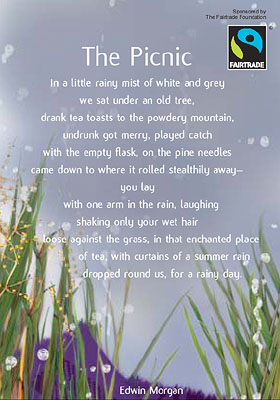
Something of her style reminded me of a card I have on my wall at work- the one below- by another wonderful poet, this time a Scot, Edwin Morgan.

in a little rainy mist

The picnic

In a little rainy mist of white and grey
we sat under an old tree,
drank tea toasts to the powdery mountain,
undrunk got merry, played catch
with the empty flask, on the pine needles
came down to where it rolled stealthily away –
you lay
with one arm in the rain, laughing
shaking only your wet hair
loose against the grass, in that enchanted place
of tea, with curtains of a summer rain
dropped round us, for a rainy day.

Edwin Morgan

I love this poem.

It takes me to a happy place. Scotland. Michaela and me finding space to fill with each other. The sense of place strong on us, and the changing weather welcome and wonderful.

So here are more of his poems- read by some good folk of Glasgow, filmed by the Late Show. They made me cry good tears- so have a hanky to hand…

Swine flu hits Dunoon…

swine flu

So, Dunoon is famous. Infectious even.

As of today, there are 18 suspected cases of swine flu in our little town. Emily’s year have been sent home from school and told not to associate with people for a week. Two of my workers are off because one of their families is suspected of having the virus too.

The hospital is just about at meltdown, testing and chasing down folk who have had sustained contact with those infected. The good news is that those who are suffering seem to be OK, and the Tamiflu vaccine is said to be effective.

Of course, Emily is very pleased to be off school however!

There is some footage from the news here.