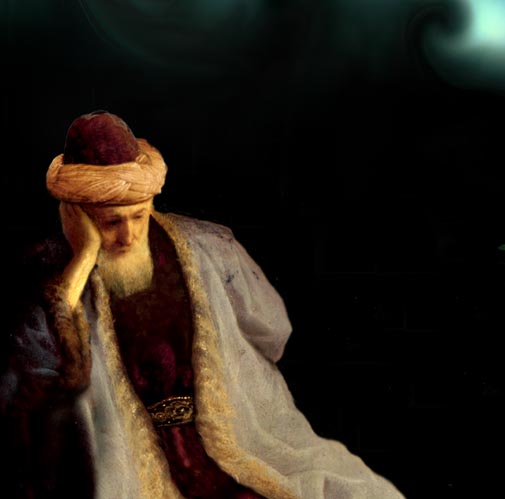
So, we come to Rumi.
He was the only poet I had sort of heard of when I began reading this wonderful old poetry. I knew of him as an almost alien mystic, but once again, the beauty of his words seem to reach over the centuries, and become a bridge over the religious/cultural divides that we still build up high. There is such depth of humanity in this poetry that it deserves to be so much better known in the West.
So who was this man Rumi?
His full name was Jalāl ad-Dīn Muḥammad Balkhi and it seems we know a lot about his life, despite the 800 year odd years that have passed since he was born. Many of his letters have survived (as many as 147 personal letters) and he was revered in his own lifetime, and so people recorded his words and wisdom.
We know that he had a famous father, who was a poet and learned man in his own right. We also know he was born around 1207 during turbulent times, as the Mongol hordes where slashing and burning their way across the known world, and pushing back the edges of what had been the great Seljuq empire which split into small Emerates.
Rumi was thought to have been born in Balkh, an ancient city in what is now Afghanistan- previously a melting pot of religious ideas- first a centre for Zoroastrian thought, later Buddhism but by the time of Rumi, Islam was in the ascendant.
Rumi’s family fled the advancing Mongols in the nick of time, traveling west, first performing the Hajj and eventually settling in the Anatolian city Konya (capital of the Seljuk Sultanate of Rum, now located in Turkey.
The story of his life goes something like this-
Rumi follows in his fathers footsteps- becoming a scholar at the University in Konya, and eventually his fame as a poet and learned man spread.
At the height of his success, he encountered a Sufi called Shams-e-Tabrīzī. This meeting changed his life. Everything that he counted as worthwhile- success, wealth, position- all this was suddenly called into question by what he saw in the poverty and simplicity of the life of the wandering Sufi.
He started neglecting his public duties and following after his new friend. The association brought him ridicule and so he was forced to resign his job, and then began a 4 year friendship with Shams.
Then one day, as suddenly as he came into Rumi’s life, his friend disappeared. Some say he was murdered by one of Rumi’s sons, perhaps embarrassed and resentful of the hold this raggedy man had over his father. Others said that he traveled East for new adventures. Rumi spent years looking for him.
Rumi’s life from this time was dedicated to a deep spirituality. For him, the human condition was empty, like a reed plucked from the bank of a river, and cut to form a flute. Life might make holes in the flute through to its hollow centre, but unless the reed was filled with the breath of the Beloved, then it would be for ever empty. So the purpose of life was to journey back to union with Beloved, from whom we have been cut off.
A craftsman pulled a reed from the reedbed
cut holes in it, and called it a human being.
Since then it has been wailing a tender agony
of parting, never mentioning the skill
that gave it life as a flute.
Although a devout Muslim, the journey of the Sufi according to Rumi, was to be encountered in personal experience- not in abstract doctrine and creed. Some of his ideas would seem to sit well within universalist ideas of faith. For example-
I searched for God among the Christians and on the Cross and therein I found Him not.
I went into the ancient temples of idolatry; no trace of Him was there.
I entered the mountain cave of Hira and then went as far as Qandhar but God I found not.
With set purpose I fared to the summit of Mount Caucasus and found there only ‘anqa’s habitation.
Then I directed my search to the Kaaba, the resort of old and young; God was not there even.
Turning to philosophy I inquired about him from ibn Sina but found Him not within his range.
I fared then to the scene of the Prophet’s experience of a great divine manifestation only a “two bow-lengths’ distance from him” but God was not there even in that exalted court.
Finally, I looked into my own heart and there I saw Him; He was nowhere else.
Rumi believed that we could encounter the Beloved through dance, music, art and of course- poetry. After his death others formed an order of Sufi’s that came to be known as the Whirling Dervishes, because of their wild ecstatic dancing, and regarded him as their spiritual father.
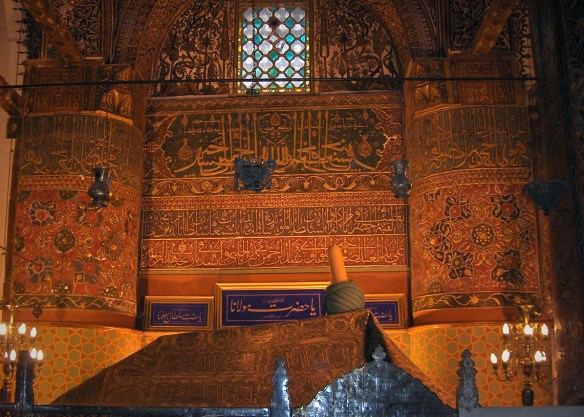
He died in 1273 and a shrine still stands over his grave in Konya-
Time for some more poetry-
The first one is thought to relate to friendship. It makes me think of campfire on dark nights on island trips with friends-
We point to the new moon
This time when you and I sit here, two figures
with one soul. we’re a garden,
with plants and birdsong moving through us
Like rain
The stars come out. We’re out
of ourselves, but collected. We point
to the new moon, its discipline and slender joy.
We don’t listen to stories
full of frustrated anger. We feed
On laughter and tenderness
we hear around us
when we are together.
And even more incredible, sitting here in Konya
we’re this moment in Khorasan and Iraq.
We have these forms in time
and another in the elsewhere
that’s made of this closeness
Say who I am
I am dust particles in sunlight
I am the round sun.
To the bits of dust I say, stay.
To the sun, keep moving.
I am morning mist,
And the breathing of evening.
I amwind in the top of a grove
and surf on the cliff.
Mast, rudder, helmsman and keel.
I am also the coral reef they founder on.
I am a tree with a trained parot in its branches.
Silence, thought and voice.
The musical air coming through a flute
A spark off a stone, a flickering
in metal. Both candle
and the moth crazy around it.
Rose and the nightingale
lost in the fragrance.
I am all orders of being, the circling galaxy,
the evolutionary intelligence, the lift
and the falling away. What is
and what isn’t.

 origin. ‘


 this fragile tent