Here it is again- the old EC term. Given one more airing…
I was a little sad about the demise of Stewart’s ‘Emerging Scotland’ Ning site-
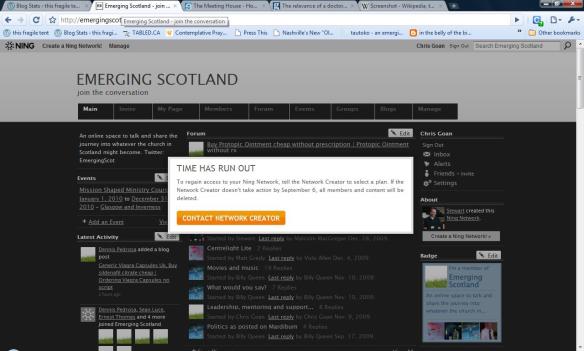
And so I thought that it might be time to consider again where we are up to North of the border, and throw out a bit of a challenge to others in Scotland who have used the term to do the same…
In many ways this is a continuation of thoughts begun here.
I think we up here were a bit slower to use the term than elsewhere, but there is no doubt that the ‘conversation’ has been transformative in many ways. The questions however remains as to how this might have played out in the specific Scottish context- as opposed to down south.
I will divide my response into two different parts- firstly my personal experience, and then my imperfect impressions of the wider context.
The latter comes with a warning- I am not a professional minister, nor at the centre of faith based organisations in Scotland. I do feel slightly qualified to express an opinion however as I have been thinking, talking, reading and seeking connections on these issues for several years now. I have met a lot of wonderful people, and felt an equal measure of hope and pessimism for the future of our churches. What I offer then, is the view of a knowledgeable and sympathetic outsider.
Firstly then, my own experience.
I arrived in Scotland in 2002, eager and enthusiastic to belong to a church up here, and to continue to find worshipful expression through music and community. My background previously was Evangelical/charismatic left-of-centre traditional church. I joined a local church, but increasingly found it difficult to stay in that context. I will not tell that story here, but it will be a familiar experience to many of you.
In an attempt to break out of the narrow spaces I found myself in and to seek a way of living out my faith that offered a real connection to my context and an honest engagement with my faith, I left formal church in 2006. This was not an easy decision- rather it was taken over a long period, with much pain and many sleepless nights.
So, with some friends, Michaela and I set out on something new. We started a housegroup, and Aoradh grew and changed- initially it was a group of people who wanted to do evangelism through art, but increasingly became less driven by grand plans to win converts, instead seeking partnerships and creating spaces to contain our own worship, and to host others.
In all this, I had discovered the ’emerging church conversation’. My theology was first destroyed, then renewed and lit up by new questions and new/old perspectives of God. I felt again a thrill about the life that Jesus calls us to for the first time in years.
But our little group was isolated and desperate for connection, mentoring and encouragement, so I spent some time looking around for similar things in Scotland- things we could learn from and lend support to. And I found very little. Sure the language of emergence was being used by some of the institutions- the Church of Scotland, and the International Christian College for example, but this did not seem to be converting to any kind of grass roots activism, or mutual support that we could plug into.
Neither did the established churches seem to have resources or energy that they could apply to supporting the embryonic groups that may have been emerging. They were caught up in a survival battle of their own.
In the absence of other networks sympathetic to the new ground we now found ourselves treading, I started a Facebook group, which very quickly picked up around 100 members. I also set up a couple of meets in Glasgow, and was keen to ask questions about whether people wanted more and closer contacts. Stewart then started the Ning site, and some meets took place in other places too.
The on line stuff flared up then died down like most on line networking. It has a short shelf life, easily becomes contentious and repetitive and the theological arguments become wearing very quickly.
I was still hungry for more- a network of people who were prepared to stand with one another- share resources and ideas, encourage fragile new developments and be committed to the kind of openness and generosity that is supposed to be the watchword of church.
I have made some good contacts, and still hope that out of these, more of the above may yet flow, but there is still no formal, or even less formal network in Scotland through which new groups can find encouragement and support. Our group has less need of this perhaps now- partly because we are further down the road, and have made a lot of our mistakes already, but also because we have made more connections with English based organisations.
What is left to me, is a desire to live an authentic, open, generous Christian life- looking outwards, not inwards, and seeking relationship and partnership with other individuals and groups wherever possible. Sometimes I think I am walking this path. Other times I feel lost in a tartan wilderness.
I have stumbled into conflict along the way too. I do not like conflict, and do not always handle it well. It tends to make me retreat and localise- which becomes then an obstacle for the very networking I believe is called for…
Along the way it has been difficult not to constantly make evaluations and judgements about the wider Scottish context. This is not easy, as we first need to ask whether there is ONE context. Our West of Scotland semi rural small town Highland context is very different to Glasgow, which is different from Edinburgh or Inverness.
However, I am committed to using a broad brush with careless abandon, so at risk of causing offence, here are my impressions-
- ‘Emerging Church’ are words used in Scotland in the academy and the conference/general assembly. They have less relevance at the grass roots here than they do elsewhere.
- Churches who use the language of emergence are driven most by desperation. They are looking for a new way to evangelise- to fill the pews and mend the leaking roofs.
- The sectarian nature of religious development in Scotland still imposes rigid walls of suspicion between different faith groupings- not just the Catholic/Protestant divide, but between Protestant groupings too. This means that finding commonality through which ideas and support can be channelled is that bit more difficult up here.
- No denomination has stepped forward to deliberately offer support emerging fledgling para church groups, as the C of E (and others) have done in England.
- And the English stuff stops short of the border, as there is still this weary anti English stuff even in the church where we really should know better.
- The dominant activism in Scottish church looks towards American models of Evangelism and as such is still fighting the old truth wars. This is a regressive force in our faith- the pressure this thinking brings to our ways of doing church is to call our dwindling population to greater fervour, purer understanding of the Bible and to pray for Revival in order to shake the population from their wicked ways, and some how take us back to the 1950’s.
- Distances are greater, and population numbers and low density tends to make finding peers and like minds more difficult.
- There are some new developments- Solas festival for example. But these do not yet seem to me to be associated with the fostering and development of new forms of church. Rather they are a new things done by people who are part of existing institutions. They are none the worst for that of course and it is early days for Solas (the first festival was this year) but perhaps this could be described as new wine skins for old wine. We need the fine old wine, but we also need sparkling new stuff, and new wine skins.
- Then there is the class issue. Working class, underclass, middle class. Inner cities with huge problems with worklessness and addiction. Places where theological debate has no relevance, unless it stimulates action. Action not from the outside- parachuted missionaries- but more from the faith that finds new relevance in the broken places. Emerging church conversations have not shown themselves to be well equipped for this in Scotland.
Finally then- the challenge.
I have been quite negative above. And this is not fair, because I do not feel negative about the future of the people of faith in Scotland.
But I do feel that we have an opportunity that might just slip away.
An opportunity to forge an underground railway, along which we pass down the agents of the New Kingdom.
The challenge is to ask those of you who have a more complete view than me where my blind spots are. What am I not seeing? Where do my generalisations miss things that are happening? Where are the networks of support that transcend the old boundaries and carry genuine new hope?
And if I am more or less right, what should we do about this?




 this fragile tent