
Catwalk for mermaids…
1

I watched some of this film the other day-
It is impossible to watch this and not think that there is something bonkers- something rather sick- at the root of our media machine (and therefore at the root of our society.)
We hunger for significance
And the primary way we demonstrate this is through the media machine
Which for its part will chase after any train wreck or celebrity breakdown in order to make a splash of attention, which will then convert into a splash of cash
And because train wrecks and celebrity breakdowns are unpredictable, then the machine manufactures them-
And we play the game- even though we understand that it is a game. Even though we know that it is all fake and phoney. Because what else is there?
How else might we aspire to significance?
How else might life be lifted from the humdrum but by the exposure of some soft subcutaneous celebrity flesh? (Apologies for the Dylan Thomas-esque excessive use of sibilance!)
And how, my friends, do we begin to do things differently? Because each one of our areas of expansion- even the Church- falls into similar traps. We elevate our celebrities, feed on them, then watch them fall.
The TFT counter culture anti-tabloid manifesto!
So, here it is. Time to push back!
Lets be like fat men who walk past Macdonalds- at least some of the time…
- Stop buying tabloid newspapers. I know- they are entertaining, and you only buy them for the sport, but the ink is toxic- and it will stain all sorts of things that you are not immediately aware of.
- Let’s stop caring what celebrities think. Rather let’s look for other voices- those at the margins. Particularly those who are poor and weak.
- Let us focus on the small scale, not the big scale- let us hope to find our place in small communities as we set ourself towards simple missions.
- And as for the interweb- useful though it is- it is not democratic. It is not a means of levelling the playing field. That dream is dead. It reflects all the mess of wider society. So let us sometimes deliberately SWITCH OFF (Scary as it might be to those of us addicted to laptops and smart phones) and so something simple, and hospitable. Go for a walk with a friend. Visit someone who is lonely. Write a letter. Go to a pub and buy someone a drink.
- Value the small things. Celebrate them in verse and song.
- Cultivate individuality, not image.
- Create for the joy of it- not for the relationship to what is cool.
- And as for Christian celebrities- well lets make a rule that they can only be seen in public wearing clothes from Oxfam- one size too small. Or if that is too cruel, lets just have an open on going discussion about human frailties and how we measure the wisdom and worth of an individual.
- Gossip about goodness. Try to tell stories of people’s secret success and hidden kindnesses.
- All that is broken in you, all that is beautiful on others- these things are eternal.
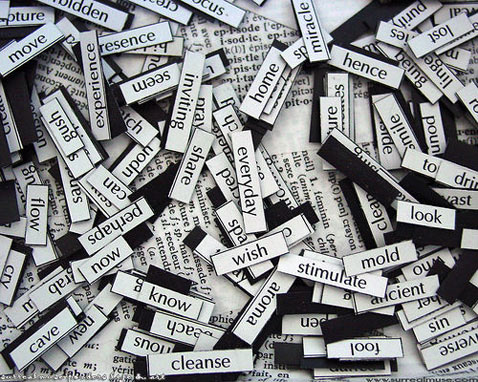
I ran a poetry workshop today under the umbrella of Michaela and Pauline’s ‘Blue Sky Craft Workshops‘. We spent the morning talking about/reading/writing poetry, and this afternoon people are creating art from words.
I very much enjoyed my bit this morning- it is a real indulgence to immerse myself in words, in good company. The food was good too!
It reminded me of how important it is to create- but also to create together- sharing our stories and experiencing the vulnerability of exposing our skills to the scrutiny of others.
I asked people to write three lines, then talk about them, and they wrote some lovely things- which I will not recreate without permission.
I wrote this, sat for a quiet moment in the mess of our music room/study-
Kind clutter gathers
All dusty
In this mess
Called love

I liked this post (via TSK), which had some interesting things to say about the old EC words…
I rarely hear the words ’emerging church’ used any more. I had just about got used to using them myself without cringing a little (it always felt slightly pompous to describe my association using this kind of label) and then it seemed to be out of fashion. And despite myself, I do miss it slightly. It is always good to think of yourself as part of something hip and happening- on the pioneering edge of something new.
Over the last few years there has been a lot of discussion (some of it here, or here for example) about the end of EC as a movement. I never agreed with these obituaries- it always depended what you looked for and how you asked the questions. However, it did seem that a lot of the radicalism that went under the banner was cooling, and perhaps being ‘tamed’ by institutional connection.
What was refreshing about the article mentioned above was the generous description of the breadth of the ‘movement’ defined as follows-
A movement has a center without boundaries. The center is a set of common interests and ideals. People who make up the movement are more or less committed to those ideals, but all share the interests. When a movement develops boundaries it is no longer a movement but an organization…
…Movements are notoriously difficult to pin down and describe–except by their common interests, ideals and commitments (although it must be remembered that within any movement, insofar as it is truly a movement and not an organization, levels of commitment to the ideals varies.) That’s what makes them so interesting and what gives rise to so much discussion and debate about them.
Roger E. Olson (what is it about those initials that always makes it clear that Roger comes from the USA?) who wrote the article compares the EC with the Charismatic movement in the early to mid 1960’s-
Throughout the 1960s and 1970s people debated the nature of the charismatic movement and its boundaries. Much of that discussion was misguided and misleading because there never was a headquarters or magisterium or universal spokesperson or group for the whole movement. But a cottage industry arose around attempts to define it and describe it and gain influence over it. Some organizations tried hard to harness the movement’s energy and control it for their own purposes. During the 1970s and 1980s Oral Roberts tried desperately to do that with little success. Eventually the movement died out as charismatics stopped networking with each other and settled into competing organizations. The charismatic ethos (it’s center) gradually blended into the religious mainstream as demonstrated in, for example, “praise and worship” chorus singing during Sunday morning worship services (something virtually unheard of before the charismatic movement).
Every movement takes up the old in a new way and adds to it as well as subtracts from it. Every movement includes some diversity and is dynamic–flexible and changing. Every movement has its founders and its “Johnny-come-latelies” and its exploiters. And every movement has its would-be popes, its prophets and its critics (both internal and external). AND, every movement has its adherents who refuse to be identified with it.
Olson goes on to try to define what he thinks are some of the unifying features of the movement. I think this part is a little weaker- most dry lists like this tend to feel rather artificial- particularly when one of the defining characteristics of the movements seem to have been a resistance to restrictive definitions!
Perhaps too the UK perspective is rather different. In many ways the UK EC movement was fostered within the mainstream- particularly by Anglican and Methodist leadership. Sure there were radicals who flared bright and largely burned out, but on the whole the movement here has often been an adventure from and within establishment. Perhaps there was also the ‘desperation factor’ in the UK- churches declined to such a remnant that something had to be done- we needed a new gig.
I found myself wondering about Olson’s description of the end of the Charismatic movement however. The end of networking and the settling into competing organisations. This sounds sad- but is inevitable I think.
The issue is, however, the degree to which a movement ‘moves’ things- how much things change. I think that the EC has brought about significant changes, both subtle and obvious, to the Christian landscape of the UK. I would mention specifically some of these-

Someone tweeted this today- which I think is a rather wonderful piece.
It tells the story of a Chaplain Hayley Matthews on her way home, suddenly ‘Kettled’ along with a group of looters and rioters- and their strange reaction to the presence of a dog collar.
In his piece, she said this- which I really liked…
The trouble is, we do have a two tier society without a doubt, and while bankers have been allowed their bonuses having stitched us up every which way, we will continue to pay for this in more ways than one, and tonight is just one of them. With the cuts aimed primarily at the poor and the needy and the disenfranchised, things can only get worse.
And what will we do? Continue to promulgate the values that have created this deadly cocktail of haves and have-nots, faithless, hopeless people who have been taught that consumerism is a recreational right and all moral and religious education completely nonsensical? Surely THIS is nonsensical?!
Please God that we wake up and smell the coffee, before we condemn yet another generation (no pun intended).

A friend told a story tonight that had me in stitches.
She had been surfing the glorious interweb and checking out some Christian sites. You could say, indulging in a bit of religious surfing. Now this activity is not without it’s risks. One might be able to cope with the madness that you will encounter by trying to laugh at it all- some of it is pretty darned funny after all. Check out Ship of fools if you do not believe me.
But aiming for a bit of superior oh-isn’t-this-funny-but-I-am-above-all-this-madness is only likely to take you so far. Because it usually starts to get rather painful. You start to realise that some of this hysterical ranting is being done in the name of Jesus. Or even worse, you realise that you are starting to laugh at- yourself. Some of the madness starts to sound a little too familiar.
But back to my friend. She came across a site promising a free Bible, if you completed their online quiz. Well, she was up for that. A nice leather bound black Bible to replace her rather tatty paperback one.
She is not daft though- she e-mailed to ask if the organisation would then use/abuse her e-mail address in future- but was assured that this would not be the case. So she went ahead and submitted her details.
A few day later, she was having a duvet day- you know the sort of thing, getting up late, mooching around and watching crap day time TV, snacking and leaving the pots for a while- all the time wearing clothes that really should never see the light of the public day. We all need the odd day like this. Then came a knock on the door.
She lifted the net curtain, and there stood an African Pastor and his wife.
Holding a big black Bible.
I like museums.
When we go to them as a family, I find myself falling into a trance like state. I stand and read all those pieces of writing and little bitty labels. I do not bother with most of the gimmicky interactive stuff- I just like to encounter things that carry with them meaning from the past.
The weekend was a case in point. We went to the stunning new Transport Museum on the banks of the Clyde in Partick, Glasgow. It was full of cars and motorbikes and trains. Everyone else soon gravitated towards the cafe but I wandered- intrigued by a model of a battleship or a 1932 Argyll motor car. I enjoyed it all.
And it occurred to me how we humans love to organise things- to place them in some kind of category and shelve them all away so we can make sense of it all. It is the very life blood of those who curate museums.
And perhaps too those who curate our experience of religion.
So here is a picture for you- you can make your own analogous links…

Today I had dinner with my father and brother.
It still seems a strange sentence, as it was not able to be said a short time ago. Here we are-

I never knew my father until three years ago, when aged 40, I decided it was time to try to track him down. I discovered in the process a whole new family, including a half brother who lives in Scotland.
There is a long story about how all this fits together, but for now, I will say this- I am grateful.

We have just had a road trip down to Leyland for an overnight visit to some old friends. Cue lots of laughter and appreciation of shared stories. Things are rarely better than this- friendship, food and mirth all mingled. Andy and I have been making some kind of music together on and off for almost 20 years.
Our other reason for going down south was to do some recording- Andy has a studio in his garage. The idea was to simply record some poetry- which is to be used for a Greenbelt ‘Silent Pilgrimage’. However we got a bit carried away- using music, soundscapes and all sorts of things to weave some things together.
If you are at GB this year, pick up some headphones at the Angels Lounge and I hope you enjoy!
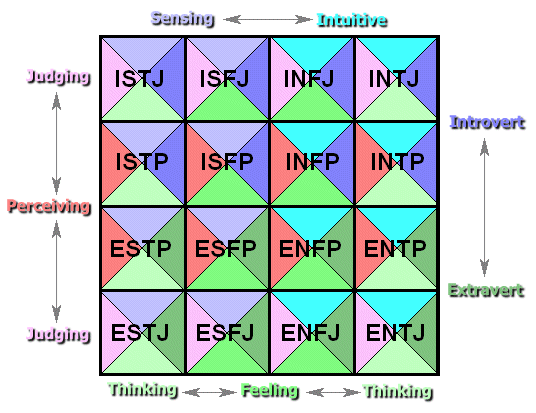
I know, I know- it is here to stay. It will increasingly be used to support appointments to employment, and to put together teams in all sorts of industrial/Managerial situations.
All those carefully developed questionnaires- testable, measurable, repeatable-giving pithy truisms that can then become the means to understand the mess of humanity. As a psychology student I had to understand something of the ‘science’ behind all this- enough to understand the strengths and weaknesses of the approach.
The arguments for such testing are powerful- enabling understanding oneself in a new and clear way- and suggesting the basis of likely conflict with others in the performance of joint tasks, thereby allowing teamwork to be better understood.
But that is not to say I have to like it.
Some of this is because everything in me hates the idea of easy categorisations- as if what we are is reducible to a simple set of generalisations. In the name of individualisation, we strip people of their individuality and replace it with a letter, or a position against two axes.
It has always seemed to me too that some kinds of personalities are pre-disposed to loving personality testing. Ah the irony- those who love to organise, to place everything in order, to control- both themselves and their immediate environment- they will fall upon personality testing in all its different forms like a starving man on a bag of chips.
And it can become a real danger- to both them and to others around them.
Let me give you an example of a typical description from Myers Briggs, one of the most common types of personality test.
ISTPs excel at analyzing situations to reach the heart of a problem so that they can swiftly implement a functional repair, making them ideally suited to the field of engineering. Naturally quiet people, they are interested in understanding how systems operate, focusing on efficient operation and structure. They are open to new information and approaches. But contrary to their seemingly detached natures, ISTPs are often capable of humorously insightful observations about the world around them. They can also be closet daredevils who gravitate toward fast-moving or risky hobbies (such as bungee jumping, hang gliding, racing, motorcycling, andparachuting), recreational sports (such as downhill skiing, paintball, ice hockey, and scuba diving), and careers (such as aviation and firefighting).
ISTPs may sometimes seem to act without regard for procedures, directions, protocol, or even their own safety. But while their approach may seem haphazard, it is in fact based on a broad store of knowledge developed over time through action and keen observation. ISTPs enjoy self-sufficiency and take pride in developing their own solutions to problems.
ISTPs are content to let others live according to their own rules, as long as the favor is reciprocated. ISTPs endure reasonable impositions without complaint—but if their “territory” is encroached upon, eroded, or violated, they defend what they view as rightfully theirs.
This category is thought to describe 4-6% of the population of the world.
There are twin dangers here- the first is that, presented with this truism (and these categorisations always read a little like astrological predictions to me) we might actually come to believe that this is who we are– and this effectively becomes a self fulfilling prophecy- it becomes formational in terms of our self image. There is some evidence that we are often too quick to identify personality traits in others, and despite the fact that all the personality types identified in Myers-Briggs are deliberately positive, we tend to reject and condemn those that we see as different to ours.
The likely result here is that those positive attributes of personality we find ourselves labelled with, become enhanced, but the less positive ones we are able to excuse as they are not who we are.
Secondly, it ignores the possibility of development, change, encounter and growth. Sure, I know that some would describe these personality traits as fixed and immovable- stable through our life time, but there is a chorus of psychologists that would entirely disagree with this too. Some of this debate can be seen here.
I would add one more objection however- and I think that this perhaps the greater part of my concern- I believe that personality tests are dangerous in the hands of powerful people- in the same way that machine guns should never be given to despots. They are too often used as means of achieving the opposite of their stated intention. It is a way of manipulating and shaping a workforce to achieve efficiencies, redundancies or restructuring.
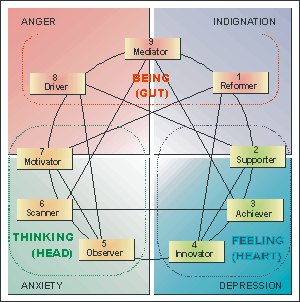
There is another area in which these methods are forcing their way- self help methods, and even spiritual practices. People are being encouraged to buy into a method of success and self fulfilment that starts with insights gained from measurement and categorisation. Typical of this approach is the Enneagram. Whilst some people have clearly found these approaches useful- they can also become a kind of cult- like a successful slimming programme or a pyramid sales system. And the whole thing is based on an intuition, with no evidence that any of the nine types of personality actually exist.
So- after my little rant, time for a few soft conclusions…
 this fragile tent