I would have joined in (with the singing that is!)
The Beatles- bigger than God (or Jones’ God anyway)
Reply
I would have joined in (with the singing that is!)
I read this today (courtesy of Minimergent)
Askesis
Spirituality requires context. Always. Boundaries, borders, limits. ‘The Word became flesh and dwelt among us.’ No one becomes exalted by ascending in a gloriously colored hot-air balloon. Mature spirituality requires askesis, a training program custom-designed for each individual-in-community, and then continuously monitored and adapted as development takes place and conditions vary. It can never be mechanically imposed from without; it must be organically grown in locale. Askesis must be context sensitive.
Eugene Peterson
I have been asking myself whether I agree with this- whether it is only possible to make a spiritual journey within defined boundaries. Because I suppose that defined boundaries in this case could also be described as ‘religion’.
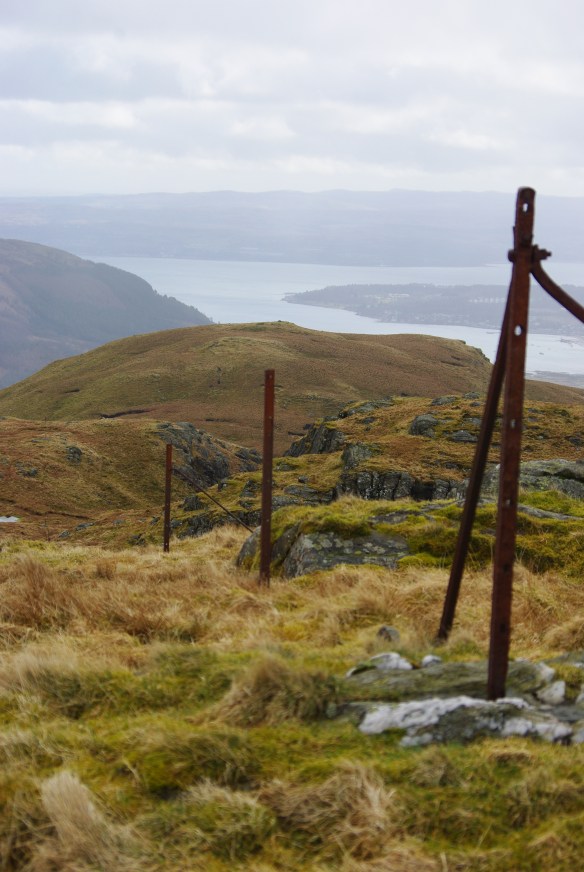
My thought so far is that Peterson is probably right- it is just that I prefer my boundary fences to be like the one above- present in symbolic form mostly, used as a guide when the mist comes down but for the most part a set of posts that I can meander in and out of whilst looking towards the big picture beyond.

I was thinking about the world Lament the other day.
‘Laments’ are one of the oldest forms of poetry, for example the Mesopotamian city laments such as the Lament for Ur. These bear a striking similarity with many of the psalms in our oldest hymn book (pinched from the ancient Hebrews) otherwise known as the book of Psalms. Here are few;
You have taken my companions and loved ones from me; the darkness is my closest friend.
Psalm 87/88: 18
And even now that I am old and grey, do not forsake me, O God…
Psalm 70/71: 18
The LORD is close to the brokenhearted; he rescues those who are crushed in spirit.
Psalm 33/34: 18
My days are vanishing like smoke … my heart is withered like the grass. I forget to eat my bread…
Psalm 101/102: 3-4
Out of the depths I cry to you, O LORD; O Lord, hear my voice. Let your ears be attentive to my cry for mercy…
My soul waits for the Lord. More than watchmen wait for the morning.
Psalm 129/130: 1, 6
Around one third of the Book of Psalms is written in the form of poetic lament- a cry to God for help in times of distress- help for individuals, but particularly help for the Nation. And, it is recorded, sometimes he listened. At other times he turned his face and watched his chosen people be destroyed by internal wrongdoing and external invasion.
What can we learn from these Laments? How is it that we tend to ignore them in our readings of the Bible- in our claims on a God who gives good things to we his new Chosen People?
I think we can take the idea that it is OK to cry to God in desperation, in anger, in brokenness- that these are part of all of our human journeys.
I also think that we can not believe that God is any kind of talisman for us to wear against the winds of misfortune. It is not whether hard times come, but how we learn to live with love as we move through them.
Finally I think that our approach to the Bible as a set of heavenly testable propositions is severely challenged by the poetry of lament. If the Bible gives all the answers that we need (as long as we apply the correct theological set of goggles) then how come it is written by people who seemed so bereft of answers themselves?
Many (but not all) the poems of Lament in the book of Psalms take a deliberate turn at their end. In spite of all the evidence to the contrary; in spite of the pain, the defeat, the failure of plans and the death of dreams; in spite of all of this- I will worship. I will put myself in the place of trust.
In Emmanuel. God with us. God in us. God through us and God beyond us calling us on.
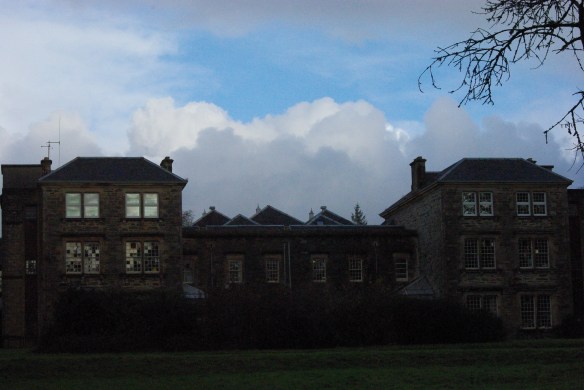
Something I wrote for a Greenbelt event a couple of years ago- which came back to me recently when discussing brokenness. Originally it was written to make comparisons between organised church and psychiatric care.
There was a concern in the land
In every town the roads were lined with beggars
There were homeless orphans and widows cast out onto the streets
Lunatics were stoned by children
And melancholics drowned their sorrows with gin
The pain of it all was in the middle of us
The Jesus in the least of these
Was weeping
So the good people gathered
“What is needed” they said “Is asylum.”
A safe home where broken people can live out their lives in care-
Protected from all of the mess of life,
Fed and warm and watered.
So money was gathered
Stones were shaped and raised
Staff were retained and clothed in starched clothing
-The heavy doors were opened wide in welcome
And so they came- the halt, the sick, the lame
The motherless and the pregnant child
All those broken by worry and grief
The shakers and the mutterers
All the awkward squad
The outsiders now came inside
They were home at last
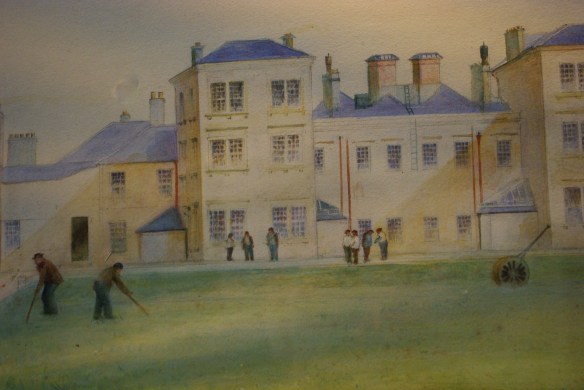
It went well for a while
All was orderly and planned
Starved frames filled out
Songs were sung again in the entertainment hall
Gardens were laid and tended
Sheets danced in the evening sunlight
And a bell rang out to warn of the dowsing of night candles
But time passed, and shadows fell
Budgets were tight, and the paint peeled on windows
The good folk who had once been so generous had other calls on their coin
A few still visited on feast days but for the most part
Out of sight became out of mind.
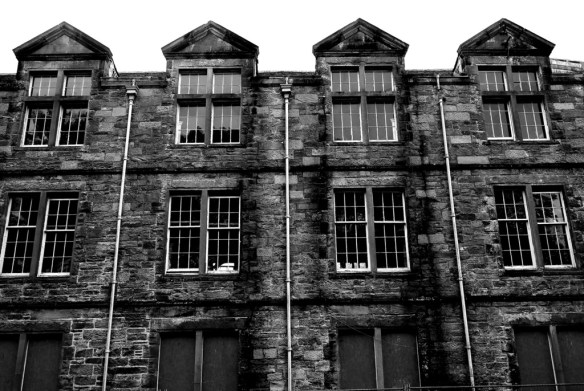
And there was trouble
The awkward squad was still awkward
The asylum split into ‘us’ and ‘them’
‘We’ had roles- uniforms and clipboards, rotas and registers
Big bunches of keys danced at our belts
We had dreams- of advancement, romance and families
We had homes away from this home
‘They’ stood the other side of our desks
Dirty and lacking in motivation
Ungrateful and manipulative
Un co-operative with our assessments
Lacking insight into the nature of their dysfunction.
They had ceased to be like us
Rather, they lived out regulated half-lives
They ceased to be flesh
And became instead a collection of paper
In manila folders
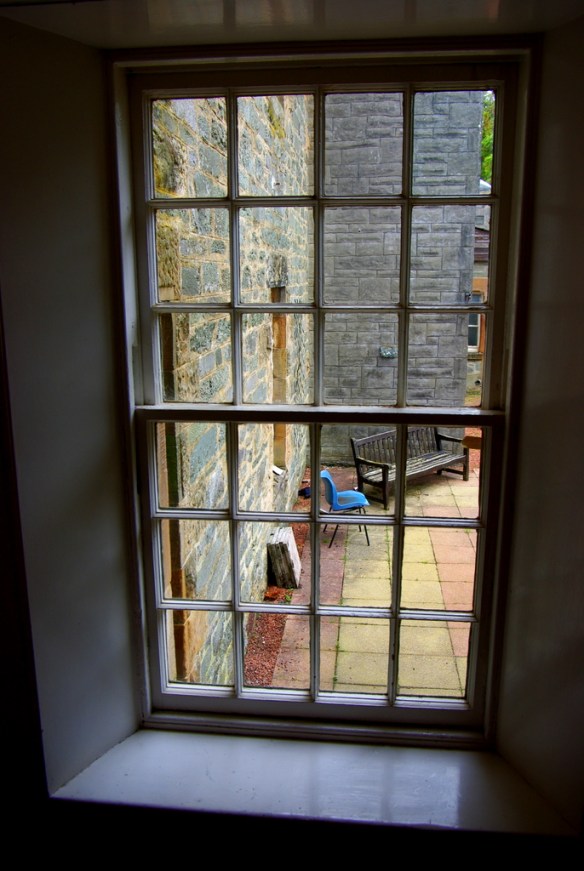
Despite all the material provision- something was missing
Despite all the person centred plans, the person was not at the centre
Despite the close press of humanity, there was no family
Despite all the risk assessments, there was no adventure
Despite all the planned activity, there is no purpose
Despite the safety of the high walls, I am still destroyed
So it was that care became captivity
Individuals became invisible
And home became hollow
And toxic
While Jesus in the least of these
Was weeping
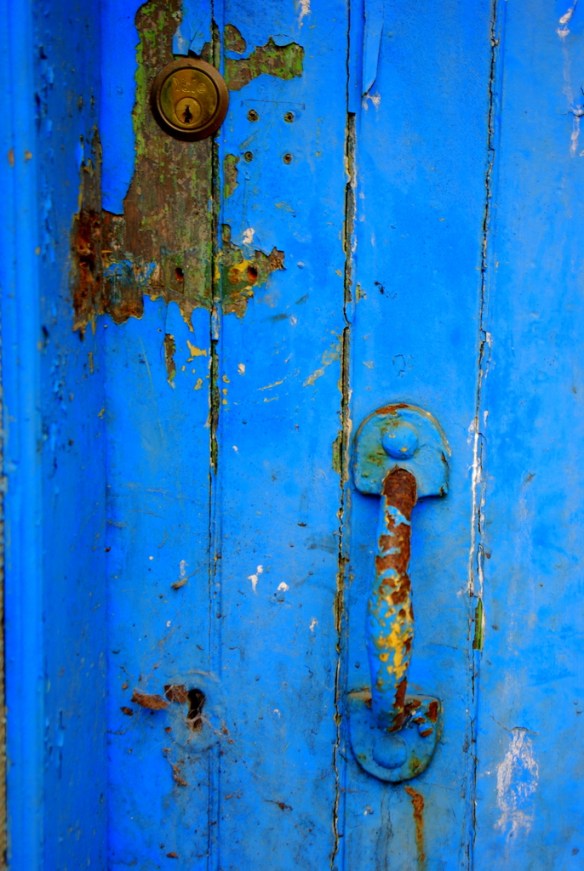

Soren Kierkegaard had this way of throwing stories into the middle of his philosophising. Here is one of them;
What is a poet?
An unhappy man who in his heart harbours a deep anguish, but whose lips are so fashioned that the moans and cries which pass over them are transformed into ravishing music.
His fate is like that of the unfortunate victims whom the tyrant Phalaris imprisoned in a brazen bull, and slowly tortured over a steady fire; their cries could not reach the tyrant’s ears so as to strike terror into his heart; when they reached his ears they sounded like sweet music.
And men crowd around the poet and say to him, “Sing for us soon again”—which is as much as to say, “May new sufferings torment your soul, but may your lips be fashioned as before; for the cries would only distress us, but the music, the music, is delightful.
Kierkegaard is describing something that most familiar- art arising from introspection, sensitivity, dysfunction, hurt. Art that does not heal, but rather is a plaster over an open wound.
Poetry like this has no choice but to be written. You might as well tell a cut to stop bleeding.
Hmmm.

Work is progressing on our second B and B room (although this is a photo of the first!) Just carpets and curtains to sort out now, and then we can get everything put together.
We are hoping to offer some weekends of themed ‘creative breaks’ over the next few months. These will be a chance to escape to lovely Dunoon and make something beautiful. It is amazing what we can achieve when given space to do so. This bowl was made by Issy in our pottery a couple of weeks ago, on her second ever attempt at moulding clay;

The idea is that we will be setting out a list of creative weekends people can book in for, but also guests in the B and B, or our holiday cottage, will be able to get creative too- making some pots, or a range of other activities.
More info to come!

Details of the 2011 UK Census are filtering out of the Office for National Statistics. The Guardian is teasing out some of the headliners- here are a selected few;
• The population of England and Wales on 27 March 2011 was 56.1 million. This is a 7% increase (3.7 million) from 2001, and 55% of that is due to immigration.
• The number identifying themselves as Christians is down 13 percentage points. In 2001, 72% (37.3 million) called themselves Christians. In 2011 that had dropped to 59% (33.2 million).
• Interestingly, Christianity is not down everywhere. Newham, Haringey, Brent, Boston and Lambeth have all shown increases in the Christian population.
• The number identifying themselves as having no religion has increased by 10 percentage points from 15% (7.7 million) in 2001 to 25% (14.1 million) last year.
• 13% of residents were born outside the UK (7.5 million). Just over half of these (3.8 million) arrived in the last 10 years.
• The census shows 2 million households in England and Wales where partners or other household members are of different ethnic groups, 47% more than in 2001.
• India, Poland and Pakistan are the top three countries foreign-born people in England and Wales come from.
• The Muslim population was up from 1.55 million to 2.7 million, an increase of 1.15m from 2001 to 2011. Muslims now make up 5% of the population, compared to 3% in 2001.
So we are seeing a picture of an increasingly ethnically diverse nation, which intermarries more and increasingly sees itself as not needing organised religion.
However we also see a rise in people who view themselves as Muslim, probably through immigration rather than conversion.
The British Humanist Association have already commented on this change;
In spite of a biased question that positively encourages religious responses, to see such an increase in the non-religious and such a decrease in those reporting themselves as Christian is astounding. Of course these figures still exaggerate the number of Christians overall – the number of believing, practising Christians is much lower than this and the number of those leading their lives with no reference to religion much higher.
Religious practice, identity, belonging and belief are all in decline in this country, and non-religious identities are on the rise. It is time that public policy caught up with this mass turning away from religious identities and stopped privileging religious bodies with ever increasing numbers of state-funded religious schools and other faith-based initiatives. They are decreasingly relevant to British life and identity and governments should catch up and accept that fact.
Andrew Copson, quoted in The Guardian.
I have some sympathy with Copson’s comments. The age of Christendom is over.
But the Kingdom of God is near.

I want to laugh at this.
Huibers, a Christian, used books 6-9 of Genesis as his inspiration, following the instructions God gives Noah down to the last cubit.
Translating to modern measurements, Huibers came up with a vessel that works out to a whopping 427 feet (130 meters) long, 95 feet (29 meters) across and 75 feet (23 meters) high. Perhaps not big enough to fit every species on Earth, two by two, as described in the Bible, but plenty of space, for instance, for a pair elephants to dance a tango.
Johan’s Ark towers across the flat Dutch landscape and is easily visible from a nearby highway where it lies moored in the city of Dordrecht, just south of Rotterdam.
Gazing across the ark’s main hold, a huge space of stalls supported by a forest of pine trees, visitors gaze upon an array of stuffed and plastic animals, such as buffalo, zebra, gorillas, lions, tigers, bears, you name it. Elsewhere on the ark is a petting zoo with actual live animals that are less dangerous or easier to care for — such as ponies, dogs, sheep, and rabbits — and an impressive aviary of exotic birds.
Silly Dutch bloke- who had a dream and decided to build an ark- based on the original Biblical measurements (or as near as we can get to them.) It is unclear whether the lenient Dutch drug laws had anything to do with the enterprise. At least he appears to prefer his Tigers to be made of plastic.
I believe he intended to sail it up the Thames during the Olympics- not sure if he was refused permission or if the animals were tardy in their arrival.
I say want to laugh, but actually, what an amazing object Huibers has made:
I could turn all theological and ask questions about the God who was so angry with us all that he decided to wipe out the world apart from a couple of each and the odd pious family.
But lets leave that for now shall we. If the ark visits the Clyde I will visit arm in arm with Michaela. Two by two…

I read this in The Guardian today;
The late philosopher and psychologist Erich Fromm wrote in the 50s that if prevailing trends that put economic production before human engagement continued, we would all eventually occupy a dangerously unbalanced society, peopled by alienated individuals living atomised existences, lacking in empathy, quick to judge because judgment by others is always anticipated, equipped with “the greatest material power without the wisdom to use it”. What might halt the march to misery, he argued idealistically in The Sane Society, was sharing experience, living by “love, reason and faith”.
Very prescient. In the UK our morally bankrupt government is attempting to buy it’s way out of a triple dip recession using a combination of benefits cuts to the poorest and tax cuts to the Corporations whose greed led us into this mess in the first place.
Fromm was a Jew who grew up in Germany, before the rise of Nazism forced him to flee. His writings often struggle with the reality of what world war and genocide can teach us about the development of humanity. He proposed a list of eight basic needs that we all have in order to live a fulfilled life;
Relatedness Relationships with others, care, respect, knowledge.
Transcendence Being thrown into the world without their consent, humans have to transcend their nature by destroying or creating people or things. Humans can destroy through malignant aggression, or killing for reasons other than survival, but they can also create and care about their creations.
Rootedness Rootedness is the need to establish roots and to feel at home again in the world. Productively, rootedness enables us to grow beyond the security of our mother and establish ties with the outside world. With the nonproductive strategy, we become fixated and afraid to move beyond the security and safety of our mother or a mother substitute.
Sense of Identity The drive for a sense of identity is expressed nonproductively as conformity to a group and productively as individuality.
Frame of orientation Understanding the world and our place in it.
Excitation and Stimulation Actively striving for a goal rather than simply responding.
Unity A sense of oneness between one person and the “natural and human world outside.”
Effectiveness The need to feel accomplished.
If he is right, how do we achieve these things in a society captured by commercialism and disembodied lifestyles?
Fromm was a Socialist humanist who nevertheless also said this;
In the nineteenth century the problem was that God is dead; in the twentieth century the problem is that man is dead.
 this fragile tent