William is back at school today- the summer holidays are over up here in Scotland.
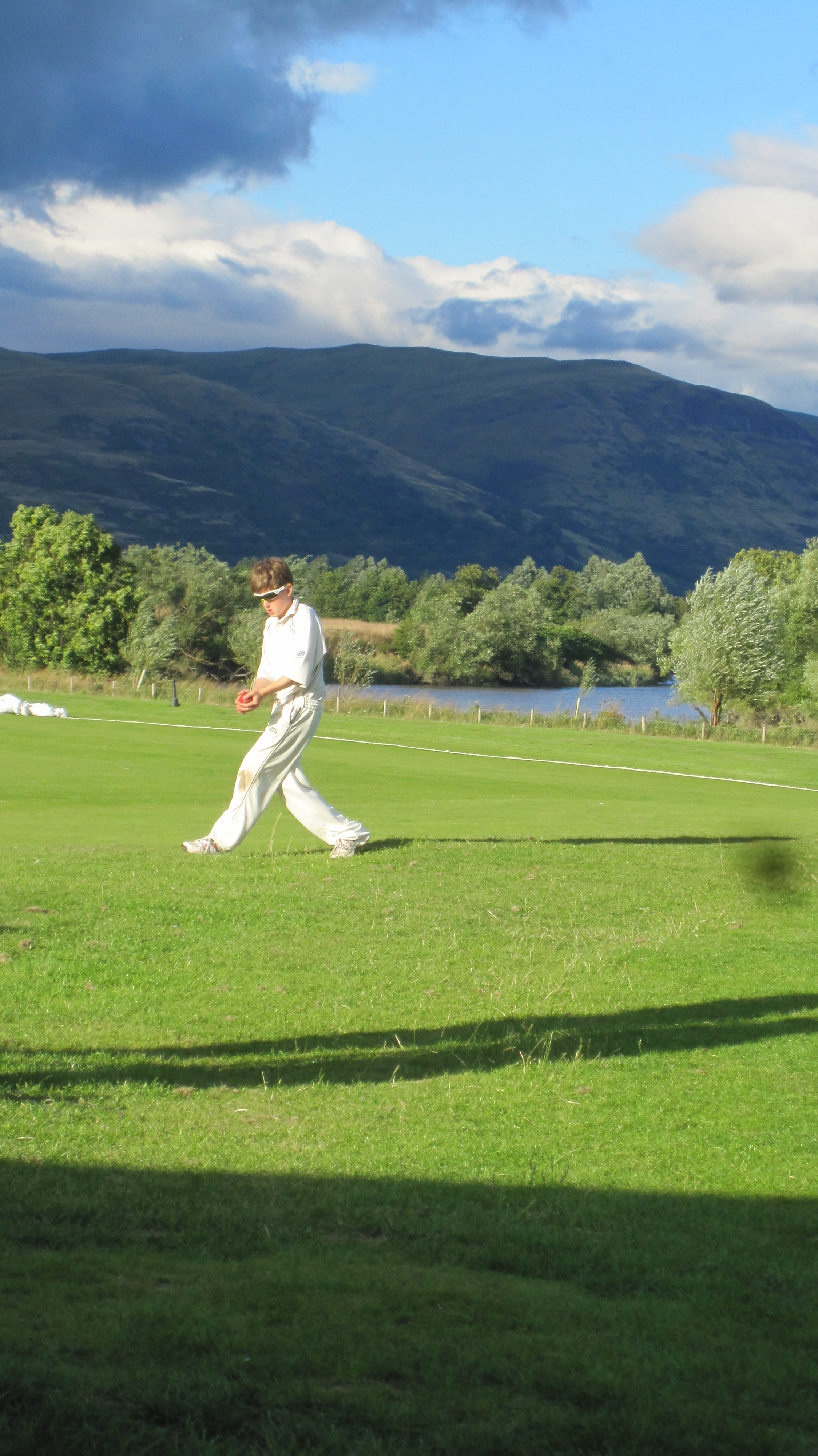
A bit of a shock really- but it has been such an amazing summer here, full of hot long sunny days. We have not had a family holiday this year as everyone has been so busy with other things, and money is rather tight, but what I will remember this year as ‘the year of cricket’. All this sunshine has given opportunities to be out playing the beautiful game like never before up here in Scotland- in fact (much to Emily’s disgust) it has almost taken over our lives for the past couple of months…
Last week was a case in point. William played games of cricket on Friday, Sunday, Monday (one in Ayr, one in Stirling,) Tuesday (Ayr again) and has another match this evening in Galsgow. The Ayr matches were for the under 15’s regional side, in which he got wickets against very high quality opposition.
This blog has featured a lot of discussions about mental health. This is because I have served my time as one of societies psychiatric policeman- an Approved Social Worker in England, and a Mental Health Officer in Scotland.
I started out 25 years ago with a clear idea about mental illness- people who were ill did not always realise that they needed help. It was my job to try to make sure they got help. I had all sorts of different ideas about what this help should look like, and lots of frustrations with the psychiatric machine that I had to deal with, but fundamentally, the idea of mental illness itself was a stable reality within what I did.
Sure, we challenged the medical model (Illness-diagnosis-treatment (maintenance)) as this failed to take into account the social context in which some ones illness develops, but the dominant paradigm that affected work with people with ‘severe and enduring’ mental illness remained firmly medicalised. It was the only way to make sense of the psychic chaos we were faced with – hospitalise, medicate and sanitise it out of our immediate circle.
Increasingly I became a skeptic- not just of the machine, but the actual underlying concepts of ‘mental illness’.
It started many years ago when faced with young men and women who, once diagnosed with schizophrenia, were condemned to half-life at best. The medication we gave them to control their symptoms (particularly the ‘voices’) often did not work, and had such destructive side effects that everything would slowly slide downwards into a kind of suppressed humanity. Is this really the best that we could do?
Alongside this other movements were emerging. They were dangerous and threatening. One of these grew up in and around Manchester, where I was working, and was called ‘The Hearing Voices Network‘. It dared to suggest that hearing voices was a NORMAL human experience- not a symptom of ‘illness’. Rather it was a way of coping with trauma for the most part.
Rather than pushing the voices away, suppressing and chemicalising them, the HVN suggested we needed to embrace them, engage with them, understand them- even the destructive aggressive ones.
More recently we have has another movement- around the idea of ‘recovery’- living fully in the presence (or absence) of the ‘symptoms’ of mental illness.
None of these are easy concepts- they are really stories of life long journeys for people experiencing one of those ‘psychic civil wars’ that all of us go through to some extent.
What convinces me most about these revolutionary ideas in relation to mental health issues is the HOPE that they bring. The best that psychiatry can offer to many is ‘maintenance’. All the so called break-through s of the pharmacological machine that spend millions convincing doctors to use their new wonder drug have done little to change this. Suddenly however, people are saying clearly- The treatment you are offering me is NOT WORKING. I want something better for my life.
That is not to say that there are not people in the system who see it this way too. I heard this wonderful TED talk the other day. It is saturated with hope, and the raw joy of life…
A friend pointed me to this clip- a speech made by a professor to young students. It resonated with me as in just a few short weeks my daughter is off to university. We sat and drank champagne last night to congratulate her on her exam results, and I wondered what lay ahead, and how we got here so quickly…
A few years ago I wrote a post in which I suggested that kindness was perhaps the best measure we had of ‘spiritual maturity’. Let us hope that our children see it the same way…
Thanks to all of you who have sent in poems for this collection! We will now formally close the submission gateway on SUNDAY THE 18th AUGUST 2013- so if you are going to submit something, get on with it!
We now have poems from about 100 poets from all over the world and I have had a quick scan of most that have come in, and there are some great poems. Some have reduced me to tears- in a good way.
The next task is to break this down with the dreaded yes/no, then categorise it all to see what chapters need more material. We will then possibly need to go back to the people who have written poems we have chosen and ask them if they want to write something else for the categories that need more stuff.
So, we will be getting in touch over the next few weeks.
Just a word again to those whose poems we will not be including in this collection. Please remember that this is not a vote of no confidence in your writing- far from it- please write more! It is simply that we did not feel that your work quite fitted in with the collection. As we said previously we are simply not able to give any more feedback than this about work submitted- for obvious reasons of time, but also because we are not poetry critics – just fellow writers, with all the subjectivity that this brings to bear.
My friend Andrew Hill posted this on FB today, and it made me laugh out loud. Given the rather worthy tone of this blog of late, I thought it worth re-posting!
Also seemed relevant following a conversation yesterday with another friend who told me he had been at a wedding recently which featured an unhealthy smattering of 80’s worship songs, including the one about the trees of the field clapping their hands. He bet £5 that someone would shout ‘HOY’ at the end (if you do not know what I am talking about then be grateful.)
A bit of fun this- although laboured and rather too worthy.
I am still trying to write what I am calling ‘poetry of protest’ as mentioned here. This one might be more or less within the rules I set for myself then, but only just. Here it is anyway;







 this fragile tent