Is it time to change our whole approach towards mental distress?

In May, the American Psychiatric Association will publish the fifth edition of the Dignostic and Statistical Manual of Psychiatric Disorders, otherwise known as DSM 5. Although originating in the USA, this publication is immensely influential, and is likely to form the basis for Psychiatric diagnosis the world over, as with the out going DSM 4.

Does it matter?

Well, the answer to this is YES. It matters on an individual level because all of us will be affected by mental disorder. One in four of us will be diagnosed according to one of the classifications above, so even if this is not you it will be someone you love or someone you work with. Lots of us feel a strange relief when distress is given a name – it suggests understanding, companionship, a removal of uncertainty and the possibility of treatment. However, for many these can easily become self perpetuating and destructive as they may have the effect removing responsibility, ownership and even hope, which some never find again.

It matters too on a sociological level. Our societies are increasingly regulated by psychiatry. We medicalise, medicate and plan ‘evidence based interventions’ into all sorts of human variation. This may simply amount to the application of science and knowledge to the alleviation of mental illness, but the question is whether this is ‘healthy’? Are we seeking to make a world in which the mess and gristle of life is edited out, tidied away, chemically suppressed? And is it working?

Psychiatric classification almost always demands treatment, so step forward the drug companies, with another product to push by fair means or foul. All those countless drug rep funded lunches, gadgets, even holidays, in the name of publicity for the next wonder drug. Even if the drugs do half of what they promise there is no doubt that our population is increasingly medicated. This from here;

Prescription Pricing Authority data shows that more than 30 million prescriptions for SSRIs (selective serotonin reuptake inhibitors) such as Prozac and Seroxat, are now issued per year, twice as many as the early 1990s. Researchers at the University of Southampton found 90 per cent of people diagnosed with depression are now taking SSRIs either continuously or as repeated courses over several years.

Professor Kendrick adds: “Our previous research found that although these drugs are said not to be addictive, many patients found it difficult to come off them, due to withdrawal symptoms including anxiety. Many wanted more help from their GP to come off the drugs. We don’t know how many really need them and whether long-term use is harmful. This has similarities to the situation with Valium in the past.”

Unsurprisingly, there is evidence that the current economic recession is also having an effect. This from the Telegraph;

The number of prescriptions for drugs such as Prozac has risen from 16 million to 23 million since 2006 with many GPs saying patients are increasingly expressing concern about the recession.

Figures obtained by the BBC under the Freedom of Information Act found the number of prescriptions for the most common group of antidepressants rose by 43 per cent during the period covering the banking crisis and housing crash.

If we can agree that in terms of practice, prescription and intervention psychiatry is increasingly involved in our lives, then the emergence of a new set of diagnostic criteria must be a considerable significance to all of us. We should also know then that this classification process, already controversial, is in the middle of a storm of criticism following the release of advance details of the new DSM 5.

Firstly, what could be regarded as the ‘tabloid headlines’. This from here;

Bereavement, which has always been excluded from the mood disorders, will become a mental disorder. Mild forgetfulness will become a mental disorder (“mild neurocognitive disorder”). Your child’s temper tantrums will become a mental disorder (“disruptive mood dysregulation disorder”). Even preferring one of your parents to the other will become a mental disorder! (Yes, really: “parental alienation disorder”).

You will need to display fewer and fewer symptoms to get labeled with certain disorders, for exampleAttention Deficit Disorder and Generalized Anxiety Disorder. Children will have more and more mental disorder labels available to pin on them.  These are clearly boons to the mental health industry but are they legitimate additions to the manual that mental health professionals use to diagnose their clients?

You can listen to a short Radio 4 Today Programme debate on some of these issues between David Kupfer who chairs the DSM 5 committee for the American Psychiatric Association, and Peter Kinderman, professor and honorary Consultant Clinical Psychologist with Mersey Care NHS Trust about this between on this link.

Then there is the murky world of classification of ‘personality disorders’. Many people regard these as the ultimate examples of how abstract description of patterns of behaviour can become viewed as some kind of unassailable concrete ‘illness’, which then take on a reality in the same way as we might understand influenza or cancer.

DSM 5 complicates this further by adding more categories, for example “Apathy Syndrome,” “Internet Addiction Disorder,” and “Parental Alienation Syndrome”. This has raised so much concern that the American Psychological Association has begun an on line petition to allow people to express their concerns. This from here;

It is particularly concerning that a member of the Personality Disorders Workgroup has publicly described the proposals as “a disappointing and confusing mixture of innovation and preservation of the status quo that is inconsistent, lacks coherence, is impractical, and, in places, is incompatible with empirical facts” (Livesley, 2010), and that, similarly, Chair of DSM-III Task Force Robert Spitzer has stated that, of all of the problematic proposals, “Probably the most problematic is the revision of personality disorders, where they’ve made major changes; and the changes are not all supported by any empirical basis.”

How about this side of the Atlantic? This from the British Psychological Society (not renowned as a radical organisation) response to the consultation;

The Society is concerned that clients and the general public are negatively affected by the continued and continuous medicalisation of their natural and normal responses to their experiences; responses which undoubtedly have distressing consequences which demand helping responses, but which do not reflect illnesses so much as normal individual variation. (p.1)

We believe that classifying these problems as ‘illnesses’ misses the relational context of problems and the undeniable social causation of many such problems. For psychologists, our well-being and mental health stem from our frameworks of understanding of the world, frameworks which are themselves the product of the experiences and learning through our lives. (p.4)

These comments go to the very heart of how we approach mental distress.

The Hearing Voices Network have been making a case for change for many years. Psychiatrist Marius Romme for example claimed that many people who hallucinate “are like homosexuals in the 1950s — in need of liberation, not cure.”

There is a change underway, akin to that of other great liberation movements and I believe that when we see chains on people it should be the intention and hope of the followers of Jesus to seek to break them. What is unfortunate is that the classification found in DSM5 do little to break chains. If anything DSM5 might yet forge new ones and as such, we should resist…

How might they be broken then? Here is my reading of (and my hope for) some of the changes;

Away from ‘illness’ towards ‘distress’

Away from ‘symptoms’ towards understanding that we develop different  means of coping with this distress.

Away from restrictive labels towards listening to individual experience.

Away from medicalised interventions, towards encouragement and support of individual recovery.

Away from simplistic distinctions between ‘psychosis’ and ‘neurosis’ towards a greater interest and understanding of the effect of trauma.

Away from segregation and ‘otherness’ towards seeing mental distress as an essential part of the human experience and as such, part of all of our experiences.

Away from ‘maintenance’ towards, hope.

Psalms for the downshifter…

So, this Sunday morning, we rested.

We ate fried egg sandwiches and drank deep from the tea pot

And we were grateful; for the company, for the sounds of the morning kitchen, for the warmth of the stove. For a day uncommitted and time owed to no-one.

And we talked again of dreams for living better. Living more openly, more lovingly, more sustainably. Not because this is some kind of right that we can demand, but because grace is to be found in most things. Not because life should be easy, but because direction should not be determined by the ruts made by other peoples wheels.

I do not often quote Scripture here, but I came across this- and offer it as a Psalm for all of us who are looking to live more simply;

Psalm 62 (from the Message)

5-6 God, the one and only—
I’ll wait as long as he says.
Everything I hope for comes from him,
so why not?
He’s solid rock under my feet,
breathing room for my soul,
An impregnable castle:
I’m set for life.

7-8 My help and glory are in God
—granite-strength and safe-harbor-God—
So trust him absolutely, people;
lay your lives on the line for him.
God is a safe place to be.

9 Man as such is smoke,
woman as such, a mirage.
Put them together, they’re nothing;
two times nothing is nothing.

10 And a windfall, if it comes—
don’t make too much of it.

11 God said this once and for all;
how many times
Have I heard it repeated?
“Strength comes
Straight from God.”

12 Love to you, Lord God!
You pay a fair wage for a good day’s work!

House for an art lover…

Ahhhhhh, home.

Today I rose at 7.00am after around 4 hours sleep, and drove to Glasgow to take Will to a Gaelic drama event. We then went to buy a car (always one of my least favourite activities) as the long Argyll roads are taking their toll on our current one. Later we watched William’s play, then (another of my least favourite activities) went to the dreaded IKEA to buy bedroom furniture.

Apart from being a very expensive day, it was also an exhausting one.

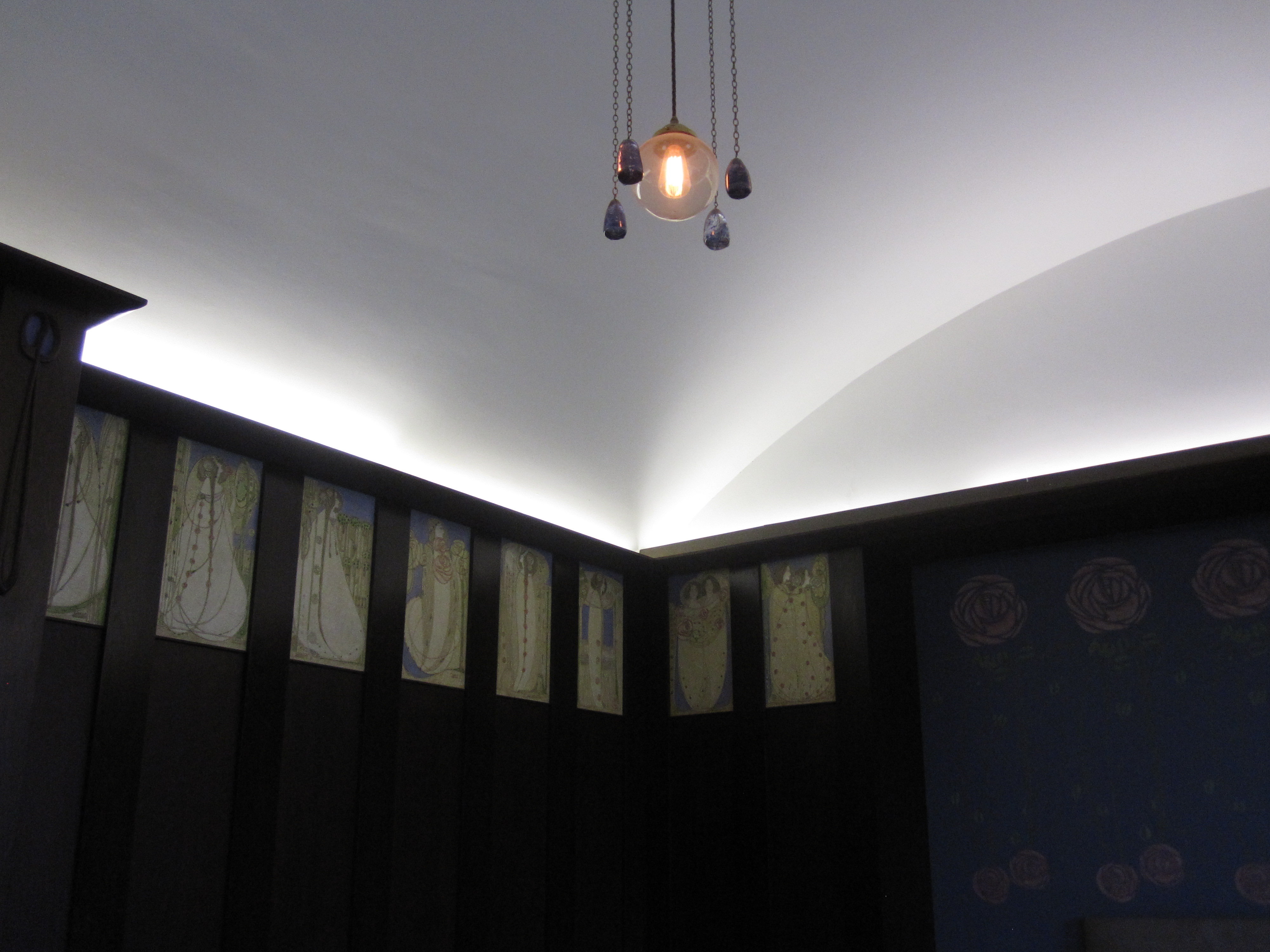
However, in the middle of all this, Michaela and I had a a couple of hours to kill in the middle of Glasgow, so we took the time to visit this place, which M had been wanting to go to for years. She is a lover of the interior designs of Charles Rennie Mackintosh and was in her element. The house was not actually built by Mackintosh, but was finished only around 10 years ago, to designs that Mackintosh entered in to a competition.

There is even a piano incorporated into his design- which I sat playing for a while, until I realised that I had attracted an audience.

The spaces that Mackintosh designed has been faithfully created without the need to pander to the domestic requirements of real live clients (unlike the other CRM house that has been preserved intact, the Hill House.) He wanted no ‘art’ on the walls, no clutter on the mantelpieces- in fact, he designed the fireplaces deliberately without any kind of shelving. He wanted the house itself to be the art to be loved. If you wanted other kinds of art, then it should be tidied away afterwards into cupboards.

I am not sure how I feel about this place. The spaces are undeniably lovely. The light falls through the illuminated panes, and finds all those lovely organic shapes. But there is an esoteric exclusivity about it too. Like lots of the art that we inherit,  it depends on the excessive wealth of the minority who could afford to indulge their own interests and tastes. What do you do if you have more than you could ever want or need, several times over- after you have done a bit of philanthropic giving to assuage the conscience?

You commission some art of course.

I am being unfair I think, as without these people lots of art that moves millions would never have come into existence.

And I like to think that my house too is for art lovers (note the plural) but let’s not lock it away. Let it be the oil between us.

Still, after all it is lovely and if Michaela likes it that is good enough for me…

Square world…

I went for a meeting today in a posh new hospital. Everything squeaked as if in disapproval of my polluting presence.

I was there to chair a meeting about one of the patients, who had been transferred there recently to receive more specialist care. She had previously spent most of the last 40 years of her life as a resident of the local psychiatric hospital. Things went wrong after the death of her husband, and she somehow lost herself in the grief of it all. The whole range of psychiatric science was rolled out for her benefit – drugs that greyed her vision, Electric Shock Therapy that blew holes in her memory then finally psycho surgery in an attempt to cut grief out of her brain with a scalpel.

And here she remains – toothless, but given to scratching. Occasionally abusive but still with sense of humour intact.

She used to be a worker, a wife, a mother. She used to go on picnics and loved to dance. She enjoyed holidays and gossiped with her friends about the comings and goings of the village.

But that was 40 years ago.

Today we met to discuss her future care – a likely move to a specialist nursing home, and the legal issues around that given her lack of capacity to understand or to give consent.

But in the middle of this, she looked at the ceiling and said;

I hate those squares. Everything is square in here. Put me outside next to the beech hedge. Just put me outside.

And I looked out at the brown beech hedge, with dry leaves still rattling on the close cropped branches.

Through the square window.

And I wanted to wheel her out there, and sit her under the winter sky, wind waving her long grey hair in a curve of protest against all those bloody awful squares.

Eco Warrior…

I need a new project, so have decided to do some little poetry sketches inspired by people I pass in the street, or on trains, or in café’s.   It is a bit of fun but as with all things on this blog it is intended too as a spiritual exercise- a way of looking with hope and love. A way of seeking after blessing and offering prayer.

The first one is a bit of fun, meant kindly, poked in part at a younger version of me that I saw in someone else.

The Apple Mac smacked his side

Like some kind of pouched weapon of

Mass salvation

His right hand permanently Action Man clawed

From fairly traded coffee cups.

Battle is joined

In the blogosphere-

It’s a jungle out there.

Friend of furry things everywhere

He just might yet

Save the world

The gift of ambiguity…

Jonny Baker posted a batch of quotes from Walter Brueggermann, mostly from this book (which I promptly ordered.) They lit me up, as they would most people who write poetry. Here they are (thanks Jonny);

The overriding reality of the prophets is that they are characteristically poets. Poets have no advice to give people. They only want people to see differently to re-vision life.

Everything depends on the poem and the poet for our worlds come from our words. Our life is fed and shaped by our metaphors.

The enemies of the poem are the managers of the status quo.

The poets want us to re-experience the present world under a different set of metaphors and they want us to entertain and alternative world not yet visible.

These poets not only discerned the new actions of God that others did not discern but they wrought the new actions of God by the power of their imagination, their tongues, their words. New poetic imagination evoke new realities in the community.

We lose vitality in our ministry when our language of God is domesticated and our relation with God is made narrow and predictable… Predictable language is a measure of a deadened relationship in which address is reduced to slogan and cliché.

It is always a practice of prophetic poetry to break the conventions in which we habituate God.

Every centre of power fears poets because poets never fight fair… only a poem

I was also reading something on the blogosphere about the latest Mars Hill spat – Mark Driscoll throwing his weight around and playing power doctrine games. From the perspective of post post Christendom UK it all seems a but like a Tom and Jerry cartoon.

But this is a kind of muscular, dogmatic, controlling Christianity that exists here too. Some of the abusive manipulative religion mentioned here is sadly very familiar to me.

It is that truth thing again. All the effort put into right belief (as defined by our powerful leader.) I hate it because it is such a destructive, corrosive form of belief that may attract followers, but then tools them up with weapons of mass distraction.

Because it is all so un-Jesus like.

Jesus who taught in parables, so that people would find the kind of truth that sets us free, rather than chains our souls.

Who infuriated the religious leaders of his day because he broke all the rules – but broke them in relation to a higher, more loving way of being. Not rules, but principles. The greatest of all being LOVE.

Who constantly talked to people about some kind of mysterious ‘New Kingdom’.

All of which brings be back to poetry. Poetry as spiritual practice, as prayer, as celebration, as anger, as doubt, as mission, as worship and above all, as question.

At it’s best, poetry opens up, it does not close down. It wraps itself around questions, and rests within them, allowing the possibility of mystery, uncertainty and encounter.

So here are a couple more of Jonny’s quotes;

Poets speak porously. They use the kind of language that is not exhausted at first hearing. They leave many things open, ambiguous, still to be discerned after more reflection.

Very often people who hear poets want an explanation, which means to slot the words into categories already predetermined and controlled. Such an act however is the death of the poem… Good porous language does not permit itself to be so easily dismissed. It intends to violate and shatter the categories in which the listener operates.

Amen.

Worship music remix 3- transcendence…

The first two pieces in this series are here and here.

We are just back from our monthly Aoradh ‘family day’. This is the closest we come to a ‘church service’ that we do regularly within Aoradh. It usually involves filling up one of our houses with people, then one of us will co-ordinate a period during which a selection of folk – kids and adults – will take turns to lead others through a song, a prayer, some meditation, a poem, a clip from you tube. It is simple, messy and lovely.

Then we eat together.

Today I was thinking about the distance I have travelled within the scope of what ‘church’ might mean. I was playing my guitar along with William and Rachel, and really enjoying it, because this is something I do fairly rarely these days.

There was a time when it was my whole life.

I was a ‘worship leader’ – one of those blokes (and they usually are blokes) who stand in front of people and whip up some spiritual fervour by the application of soft rock love songs to Jesus. I lived for those moments when the music took flight, and something kind of opened up. At such times, music was more than just notes. Performance became less about technique, and more about an attitude of humility and receptiveness.

But in the course of my journey from ‘organised’ church, other principles started to dominate the way I thought about worship. Primarily, I was convinced that the culture of ‘church’, with all its big and small liturgies, assumptions and traditions, easily came to be a black hole that swallowed people whole. It left us with no room for the other. It became about us, not about them. They were only important if they were willing to become like us. I was convinced that church should exist to send and to serve, not endlessly feed itself.

Our corporate worship was the same. It was all about music and preaching. Other ways if worshipping were not necessarily wrong (although some were guilty by association) but they were just not our thing. We knew what we liked and this was enough.

As I think about this now it is like a rainbow of only one colour. Still impressive, but monochrome.

It can also be so selfish, so self centred. Worship like this exists to make us feel good. The end we aim for is a spiritual/emotional high for us, dressed up in the clothes of adoration of the God that we make in our own image.

But I overstate my case. A monochrome rainbow can still be beautiful.

The word that came to sum up the change I was finding in my own aspirations in worship was this one;

Transcendence.

By which I mean the experience of God in the ordinary. The incarnation of the maker of the universe within the temporal, messy world in which we live and love.

Transcendent moments fill our lives if we look for them. And the more we attune ourselves to the looking the more we see.

They are everywhere in the natural world; sunsets, new leaves, mushrooms in caves, the lick of new born fur, the light of the moon on still water, the smell of rain on dry earth, the sea that goes on for ever. All these things will happen whether or not we are there as witnesses. But when we look in a certain kind of way a hollow space opens up in the middle of them into which we can meet with something transcendent. Into which we can invite/be invited by the living God.

They are everywhere too where humans also are. In conversations, in touch, in the longing for justice, in the decision to forgive, in the deciding to repay hurt with love, in the listening and in the laughing. Because God is a God of communion. God commands love, and love requires direction. Perhaps above all, the transcendent God is immanent when we come together in community.

They are encountered in art, because art can become a bridge to something beyond our business. Films, books, poems, paintings, sculptures, music.

They can even be encountered in church – for me, especially when we sing, when the chordal voices find the vault of the building and make it vibrate.

I had become so trapped in a view of God that was limited to one colour of the huge spectrum from ultaviolet to infra red and beyond, that I needed to go cold turkey. The guitar needed to go away for a while so I could hear the birds sing.

So I had some time to speak to people, with no agenda other than love.

So I could be creative, and make art in service of the Creator.

How about you? Where might your ordinary space become pregnant with the extraordinary, capricious, magnificent Living God?