Worship music remix 2- what is so special about singing anyway?

Continuing a series begun here.

OK, people have sung to worship God since the earliest times of church. The Hebrew Bible gives a whole book over to songs of praise, otherwise known as Psalms. Does that mean that we should follow their example?

There are lots of other traditional forms of worship that we no longer practice as a norm (certainly in the non-conformist tradition that I come from anyway.) We are not much into sacrificing animals, or washing feet, or burning incense, or flagellation, or dancing (particularly the naked Dancing that King David was known for.)

Then there is are lots of others that are fashionable, but still relatively rare- pilgrimage, silent meditation.

So- why sing?

Some people would point to the passages in the Bible that would seem to instruct it- ‘Sing unto the Lord a new song’. Clearly early followers of Jesus sang together-

1 Corinthians 14:26
[ Good Order in Worship ] What then shall we say, brothers and sisters? When you come together, each of you has a hymn, or a word of instruction, a revelation, a tongue or an interpretation.

I have to say however that my times of direct literal application of words like this without any wider questioning are gone. There are lots of other passages that we do not apply in this way. The question of how much is social/cultural/historical, and how much is expected conduct for all subsequent followers is always a point of debate. In this instance- the practice seems to me to be less important than the purpose and the meaning of the practice.

However.

There are some things about singing that are special. I will divide these into three areas- physiological, communal and spiritual.

Physiological

There is plenty of evidence of the health benefits of singing.

  • Singing releases endorphins into your system and makes you feel energized and uplifted.  People who sing are healthier than people who don’t.
  • Singing gives the lungs a workout,
  • Singing tones abdominal and intercostal muscles and the diaphragm, and stimulates circulation.
  • Singing makes us breathe more deeply than many forms of strenuous exercise, so we take in more oxygen, improve aerobic capacity and experience a release of muscle tension as well.” — Professor Graham Welch, Director of Educational Research, University of Surrey, Roehampton, UK- from here.

Other claims made are that singing can increase your life span, can reduce depression, improve your posture. If half of this is true then perhaps every hospital should have its own choir. GP’s should prescribe barber shop.

We do not worship for our own benefit of course- and I suppose you could argue that worship music has already become too centred on ‘us’- our needs for a ‘high’, not to mention the egos of we worship leaders. However, we might argue that things that carry a simple wholesomeness about them always seem to draw us towards God.

Communal

Everywhere, in all cultures, through all time, when people come together, we sing.

In these times when individualism tends to dominate our western culture, very few things still collectivise our activities. There are very few semi-ritual activities that bring us together. Communal singing is one of the few things that achieves this- whether on the football terraces, or our national anthems, or in churches.

When we come together like this, interesting things happen. We humans are above all things, social creatures. Our sense of wellbeing is very dependent on our connection with people around us. The stronger- more harmonious- that these are, then the better we tend to feel.

Perhaps the most developed example of this is the choir. Choirs come together to rehearse, with an overarching mission- the performance. Fairly ordinary voices are combined with other fairly ordinary voices, and the sound that is made collectively can be extraordianry- even sublime. And along the way, we learn together, laugh together, form relationships with people from other walks of life. There is much of the ways of the Kingdom of God in this I think.

And then there is the high of performing together. Like this, for example.

Spiritual

If our culture skews us towards individuality, then perhaps our means of worship have taken a similar course? Our spirituality is ‘personal’ and ‘private’, and newer forms of worship may have underlined this too- for example, ‘alternative worship’ spaces (which I love) which owe more to art installations may tend to make individuals of all of us even within a communal space.

Singing is one of the few spiritual practices that can be totally shared. When done together it requires us to align ourselves entirely with our fellow singers- to find the same rhythm and chordal structure, to feel the ebb and flow of the emotional content of what sing and to depend on others to fill out the polyphonic diversity.

There is more however- many of us who have sung in groups would describe transcendent experiences whilst singing. These things are extremely difficult to define- but perhaps the shared intensity, allied to deep breathing and exposure to rich lovely sounds will always open us wide to deeper experiences.

Of course, you might experience similar things from exposure to all sorts of art/beauty- from a rock concerts, to films, or beauty in nature. But singing is slightly different- in its democratic accessibility.

It is also a means of making worship deliberate and directional. It combines something abstract- music, with something concrete- words.

In many ways, these words are the carries of our faith- the ones that we remember more vividly and use to encapsulate beliefs. Some of these words rest on our souls- we never forget them. They come to us in moments of significance almost unbidden- either in times of adversity or ecstasy. Somehow their allegiance to music makes them spiritually more three dimensional.


So perhaps the arguments for singing remain strong?

The issues of what and how remain however…


Church closes it’s doors to radicals shock!

So, in the light of my recent ponderings about capitalist excess and consumerism- this story caught my attention…

The protest – modelled on earlier such events in Spain and, more famously, New York – descended on London’s financial district last Saturday with the intention of setting up a permanent camp in Paternoster Square, the private commercial and retail plaza housing the Stock Exchange headquarters.

However, the square’s owners won a court order preventing this, and police blocked access. Several thousand activists, who eventually coalesced into an encampment of around 200 tents, instead based themselves on the western edge of St Paul’s. There, they set up an increasingly entrenched camp, featuring a food marquee, a media tent and a “university”.

Relations with the church began well, especially when its canon chancellor, the Rev Dr Giles Fraser, delighted protesters on Saturday by saying he supported the right of the “good-natured” crowd to remain.

Since then, however, cathedral officials have repeatedly raised concerns about the size and scope of the camp, warning that it was impeding access for both worshippers and tourists, especially ahead of next week’s busy half term. This is a particular issue for a cathedral that relies heavily on entrance fees for its income.

Hmmm- I wonder if they Dean is concerned that some radical might start turning over the money collecting tables?

To be fair, the closing of the doors of the Cathedral does seem to be at odds with his earlier statements-

He said: “We are delighted that the London protests have been peaceful, and indeed there has been a good atmosphere generally between cathedral staff and those dwelling in the tents around St Paul’s.

“There is something profound about protest being made and heard in front of this most holy place – a gathering together of those concerned about poverty and inequality facing the great dome of this cathedral church.”

I wonder though- is this perhaps the beginning of a real movement for change in our rather sclerotic socio-economic system? Might these few hundred tents be far more in touch with the zeitgeist than the health and safety constrained Cathedral managers?

Over in America, a recent survey suggested that only a slight majority of American adults believe capitalism is better than socialism, according to the latest Rasmussen Reports national telephone survey. Asked whether capitalism or socialism is a better system, 53% of American adults cited capitalism, 20% said socialism and 27% said they weren’t sure.

The question remains- what next?


Reverend Billy on ‘What would Jesus buy?’

Screenshot-2_0

I love people who create a holy row.

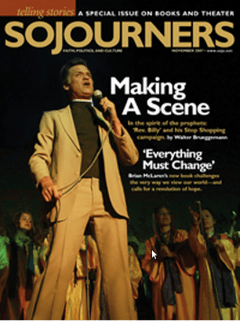
Such a man is Reverend Billy, the alter ego of Bill Talen. Check out this article in Sojourners magazine- I have pinched a few quotes as below…

Reverend Billy, also known as Bill Talen, has gotten the strange idea that the Big Corporations, notably Disney, Starbucks, Nike, and Wal-Mart—and their shameless commitment to profit at the expense of human infrastructure—constitute a destructive force in our society. He has, moreover, reached the critical judgment that such a negative ideological force in our society must be resisted, and can best be resisted from a self-aware theological perspective that operates with parody and irony. The purpose of such parody and irony is to expose what seems like an economic operation as an ideological force of totalizing scope in our society. This force seeks to situate U.S. consumers in an uncritical way in the “life world” of consumer capitalism.

Rev. Billy began to take his preaching into the Disney Store, and later into Starbucks, often joined by supporters who would help him stage “shopping interventions,” during which he might, for example, perform an “exorcism” of the cash register. In the process, the Church of Stop Shopping was born, a performance activism nonprofit staffed almost entirely by volunteers, including many professional musicians, singers, and actors who turn up as they’re able at actions and rallies promoting free speech, local communities, and anti-consumerism; tour with Rev. Billy as the Stop Shopping Choir; and help lead periodic “revival” productions.

For a flavour of his ‘preaching’-

Or check out this ‘choir raid’ on a shopping centre…

Preach it brother. 

Christmas is free…

It is you know-

It is not owned by Hallmark, or Tescos, or Amazon.

You do not have to fill your house with expensive tat for it to be special. Or cover your house with flashing lights.

You do not have to eat your way through Marks and Spencer nor drink your way through Asda to feel as though it has been worth while.

In order to share it with family and friends, you do not need to load your credit card.

Gifts are not expensive mutual obligations- and they can be of huge value whilst still costing nothing.

Last year, we decided we wanted to do things differently at Christmas.

So we sent this letter to our friends and family-


Dear friends

Last year many of you bought us so many lovely things for Christmas. We are so grateful that you think so much of us that you would take the time to buy gifts.

We know that it is good to receive, and even better to give, but the most important thing to us is your friendship, and in this we are blessed.

But this year, we want to try to make Christmas a little bit different- for these reasons-

We have so much, and others so little

We think that the meaning of Christmas as a festival has been lost under all the commercial madness

Christmas can be so stressful for people- the pressure to shop and spend money at a time when things are very tight

We have talked about wanting to do something different, but have decided that it is now time to actually time to do something

So we would like to humbly suggest that you do not buy us gifts this year.

Some of you are very organised (and very kind,) so may already have bought things with us in mind. If so, it might be possible to give these things to other people, or if not- give them to us anyway!

If some of you would still like to give some kind of gift, then we are intending to make a collection for Oxfam- purchasing some ‘Oxfam unwrapped‘ gifts in the new year.

We really hope to find a way back to a more simple way of doing Christmas- and so most of the gifts we give this year will be things we have made, or commitments/promises. Please know that we think very highly of you, and hope that this Christmas is your best yet.


Love


Chris and Michaela


And our friends respected our decision. We had a lovely time, and ended up gathering some money that might have made a difference to some people whose relationship to the earth is more immediate.

It felt like a start.

Because our house was still full of stuff. Presents still loaded out our Christmas tree.

This was partialy because we have kids- and applying the above set of principles is a very different challenge when you are 9 years old.

It was also because it is so hard to step off the Christmas merry-go-round.

But this year, we are determined to try again. And in discussion with friends, it seems we are not alone.

The current state of the economy might push us in this direction- but this is not really about tightening belts because of macro economics- rather (for us least) it is about trying to find an alternative way to celebrate Christmas.

Because we really love Christmas- as a chance to share, laugh, love and wonder. But those words ‘the true meaning of Christmas’ are perhaps so over used that they are worn out. It is for you to decide what meaning the festival brings into your life, and the life of your friends and family, but the one thing that we might agree on is that Christmas is not about money. It is not about debt. It is not about over consumption.

To this end, I have been experimenting with a Posterous site, entitled ‘Christmas is free’- here.

I will be posting a few things on there over the next weeks- please give it a shout and the odd visit if you think this is a message worth spreading.

A new chicken…

We welcomed a new creature to our menagerie at the weekend- a Bantam chicken, courtesy of Freecycle. Chickens (like humans) are not good when isolated and alone- they need company, so the wonderful Freecycle in this instance acted as a kind of dating agency (in a platonic kind of way you understand.)

She came to us named Sugar, but we renamed her Bandit, as she proved to be rather tougher than our last surviving chicken. The first thing that chickens do when they meet each other (Also like we humans) is to jostle for position- to measure their worth in the pecking order of life.

Thankfully, after a few flying feathers and odd pecked eye, things have settled down to some kind of communality. Whether you could call it friendship I am not sure. I do not speak chicken.

Here she is, mid peck…

Left brain/right brain theology…

Great discussion today on Radio 4’s ‘Start the week’– a debate between scientist (Dawkins and Lisa Randall) and the Chief Rabbi, Johnathan Sachs. You can listen again here if you missed it.

The debate was predictable in subject material- Dawkins expressing his logic-first model, and exorting us all to let go of our superstitious addiction to the supernatural and Sachs talking about the why questions rather than the how, and the truth and beauty we humans experience that is not understandable in a scientific way.

However, there was a respectfulness about the debate that I really enjoyed.

Sachs at one point talked about the wonder of a creator who creates a creative universe- I liked that.

He also said something about the Greek filter that many biblical texts have been through- a familiar theme to anyone who has read any Brian McLaren (the ‘Greco-Roman narrative’ that he describes so well in ‘A New Kind of Christianity’.) However Sachs approached this from a different angle.

He suggested that the Greek Language was the first one to be written left to right, and to contain vowels. Previously, writing was mostly right to left (apart from Chinese which went down.)

This is significant not just because of the left brain (analytical) right brain (instinctive/feelings) split that tends to characterise how we understand the hemispherical nature of our brains. It also asks questions about our theological lens.

Because the older languages lacked vowels, they could only be understood in context- their meaning was only understandable in the paragraph as opposed to the individual words.

So what? Well, when these earlier understandings were translated into the Greek, and then onwards into our modern languages, they were forced to take on a more concrete form- one in which every word is individual in meaning and application. Words that defined and legalised. Sacred words.

Words that try to contain God.

Kind of reminds me of this post– and this picture.


Blog action day- land and food…

This is my contribution to Blog Action Day 2011…see here for more details.

The theme of this years action day is- food.

But I wanted to talk about land. And poverty. And I want to do this via a lesson from history, and using the voice of a dead poet. (What else would you expect?)

Because the land and food (and poverty) are rather linked- it is from the land that we are sustained.

Most of us have no connection to the land any longer. We westerners live in an artificial urbanised world, in which all provisions, all groceries, all produce, are available all year round no matter what the season- all courtesy of huge supermarket companies, and a fleet of containers, aircraft and road miles.

Increasingly, as the current economic dysentery is stirring the belly of capitalism, we are asking questions about how this insulation from the blood  and dirt of food production might be making fools of all of us. It is resulting in a kind of sickness- in which we are addicted to instant, processed imitation food, in which taste has to be added chemically. We are getting fatter and more sclerotic with each mouthful, and once hooked, kicking the habit is near impossible.

Sure, there are dissenting voices- like shiny red apples in a burger bar. The slow food campaigners and those wonderful allotmenteers and land sharers- but despite the rising food costs and increasing poverty gap in the West, for many of us, these choices are about lifestyle, not necessity.

Most of the people in world have a different connection to the land- one of absolute dependency. If this connection is broken- they have a choice- starve, or become refugees. Either way, communities are broken and culture is scattered. The very stories of these people are submerged and silent.

Most news reports focus on drought, or war, or corruption as the cause of these events- and all of these things play their part. Mostly as symptoms rather than the cause however. I am not one for oversimplifying things as a rule, but the issue is really about-land.

Ownership of the land

Stewardship of the land

Access to the common land

Use of the raw materials from the land

I mentioned a lesson from history- and it concerns our own diaspora- sent out from these shores as a result of the greed of land owners and the separation of a whole culture from the land.

As I write this, I expect that many of you will be thinking of the Highland clearances. Lamented in story and song, so much so that something of it has entered into the consciousness of not only modern Scotland, but also into the new cultures spawned from this exodus- in the USA or Canada or Australia.

But this is not the story I want to remember. Rather it is another one, forced on communities the length and breadth of these islands over a period of around 200 years and known collectively as ‘The Enclosures’.

Battle was joined around the Tudor times- land owners started to make ‘improvements’ to the land- enclosing common pasture in order to grow cash crops in fields. Stripping away the ancient rights of those who lived hand-in-soil.

There were riots, and for a while economic circumstances preserved the status quo. But progress was unstoppable. Money was to be made.

And so through the 18th and 19th centuries, a whole series of ‘Inclosure Acts’ were passed by Parliament. These enclosed the common land, often to the benefit of the landowners, and compensated other land users with parcels of inferior land- which they had to enclose, or lose. Many could not afford to enclose, so lost.

Between 1700 and 1890 over 20% of the total land area of England and Wales enclosed by Acts of Parliament- of which 2 million acres were common lands.

And so the connection was broken. And a new kind of slavery was born- to the machines. On the back of this removal from the land, working people found themselves working in the factories of the land owners- and a new industrial age was born, with all its black shadows and shiny new product, from mechanised spinning and tin soldiers to i-pads and sports cars.

This is our history- that of Great Britain. It is a history of an enforced removal from the land, and a replacement of this with something else. And in doing this, we have lost all respect for the place that holds us. Economic necessities govern our food production, and those who still seek to make a living from the land are under incredible pressure.

The rest of us know little about food- for us, land is only important in as much as having a large driveway is a good measure of personal success.

And it is happening anew.

In South Africa, in India, in Brazil, in Haiti.

This is not meant to be a rant against supermarkets, or the evils of capitalism. Rather it is an attempt to find again some connection to where we come from, and what still we look to feed, clothe and sustain us.

We might do this by planting some seeds, or finding out more about the origins of the food we eat. But I am a poet, so I look for connections through the stories and songs that emerge from who we were, and what we have become.

Has anyone heard of John Clare?

John Clare, our most remarkable poet of the English countryside, was born in the village of Helpston, Northamptonshire and raised as an agricultural labourer. Clare’s genius was his ability to observe and record the minutiae of English nature and every aspect rural life, at a time when enclosures were transforming the landscape and sweeping away centuries of traditional custom and labour. 

Following great success with his first published poems (outselling even John Keats) Clare quickly became unfashionable, falling quickly into literary obscurity. The magnitude of Clare’s achievement and poetic genius was not fully appreciated until the recent publication of a first complete edition of his poetry, much of which had remained neglected in manuscript archives for 150 years. Now scholars worldwide regard him as one of our leading poets gradually affording the same status as reputed poet contemporaries such as William Wordsworth and S.T.Coleridge. 

(from here.)

John Clare began as a poor labourer, cursed and blessed with the sensitivity of a poet- at a time when everything he knew was changing. He went mad, alienated by his gift and his broken connection with the land that he loved, living out his final years in an asylum.

And he wrote like this-

The Gipsy Camp

The snow falls deep; the Forest lies alone:
The boy goes hasty for his load of brakes,
Then thinks upon the fire and hurries back;
The Gipsy knocks his hands and tucks them up,
And seeks his squalid camp, half hid in snow,
Beneath the oak, which breaks away the wind,
And bushes close, with snow like hovel warm:
There stinking mutton roasts upon the coals,
And the half roasted dog squats close and rubs,
Then feels the heat too strong and goes aloof;
He watches well, but none a bit can spare,
And vainly waits the morsel thrown away:
‘Tis thus they live – a picture to the place;
A quiet, pilfering, unprotected race.

But, back to the enclosures- here is another of his poems

Accursed Wealth

Oh who could see my dear green willows fall
What feeling heart but dropt a tear for all
Accursed wealth o’er bounding human laws
Of every evil thou remainst the cause
Victims of want those wretches such as me
Too truly lay their wretchedness to thee
Thou art the bar that keeps from being fed
And thine our loss of labour and of bread
Thou art the cause that levels every tree
And woods bow down to clear a way for thee

I first came across John Clare thanks to hearing Chris Wood’s song, ‘Mad John’- from the Album ‘Trespasser’.

Here is the only version of the song I could find. May the spirit of John Clare call us back to the land, and remind us to listen to the voices of the dispossessed wherever they may be heard.

Worship music remix 1- introduction…

This is the first of a series of post on worship music. My current working titles for he others include ‘Authenticity/Creativity’, ‘Transcendence’ , ‘Songs of community’ and ‘What is so special about singing anyway?’- hopefully these will emerge over the next few weeks. But in the meantime, here is a bit about my own journey, in which I have to acknowledge some rather negative aspects to my experience…

I have written before about my own previous encounters with worship music- the practice of which has been extremely important to me.

I started out singing in a church choir. I had a high pure voice as a boy, and sang solos in church. I learned to play piano, and church organ- earning some pocket money playing at weddings and funerals.

Later we discovered simple choruses- and during the late 70’s and early 80’s I started playing guitar. We played simple songs such as ‘We have come into this house’ and ‘Freely’, and were indebted to the songs of the ‘Fisherfolk’, whose music became the soundtrack to the Charismatic revival that swept through the Church of England. I still feel a strange nostalgia for the simplicity and ‘wholesomeness’ I remember from this time- and the music was a huge part of this.

I then spent 15 years as part of a large independent church in the north of England- in which my major contribution was musical. I eventually became the leader of the music team. We made a journey through all the waves of new church music that emerged- at first it was all sourced via new songbooks- which would come out every now and then- but later the machine that poured out songs  (mostly from America) used many different portals- books, CD’s and increasingly, the internet. Vineyard soft rock worship was something we constantly imitated- although the shiny happy Hillsongs worship always left me a bit cold.

Following a move to Scotland, I continued to lead worship- now in a small Baptist church. Through connections there, I also became slightly itinerant- leading worship in the USA, Europe and for some different events in Scotland.

Then I stopped.

I found it increasingly difficult to sustain any kind of passion for this kind of worship. It had become so formulaic and anchored within a narrow world view- based on  set of core assumptions that were all-dominant even if rarely spoken. I was increasingly finding myself at odds with these assumptions, which were grounded in a particular American Evangelicalism.

Then there was the place of this kind of worship at the centre of all of our services. At first, worship music was all about FREEDOM- it was the means by which we escaped ritualistic liturgy and ‘made room for the Spirit.’ Except the longer we did this, the more liturgical and rigid we became. The formula went something like this-

Open service with a time of ‘praise’- 

Upbeat high energy praise songs. However, there were (and presumably still are) far fewer exuberant praise songs than quieter ones, so we tended to do the same 10-15 or so over and over, after which typically the kids will leave for Sunday School, and we hear notices.

Time of ‘worship’

We then have more singing- quieter songs now which worship leaders try to theme slightly, with a nod towards the coming sermon. In my experience, we often talked about worship being about a much broader thing than just music, but in practice other artistic forms of collective worship had little part in our services. The odd bit of drama, or music/power points. Possibly a bit of dance. The job of the worship leader here is to generate some intensity and expectancy as we prepared to hear the preaching of Gods word- mainly by singing songs.

The sermon

Teaching within this tradition is of paramount importance. We talk of being ‘fed’ by this teaching, and skillful preachers were the top of the tree in terms of status. The very best preaching has this goal of creating a climax– you could call it a spiritual/emotional crisis- during which the congregation is expected to ‘make a response’. This might mean coming forward for prayer for healing and deliverance. The public nature of these crises is valued as some kind of statement before man and God, but I have long wondered whether it might also serve the purpose of measurable ‘success’ of the peaching.

And while all this happens, the music has a vital role again- ecstatic, emotional love songs to Jesus. Matching/creating/heightening the emotion of the event. A benign manipulation of our emotions in the name of Jesus.

The sending out

The last part of the service was about commissioning the congregation to go out into the world, changed by their encounter with God in the service. Songs tend to be more martial, triumphalist and perhaps more hymn-like.

All of this can be energising and vibrant- it can also be very ego-centric for those of us on the stage.

That is not to say that all this has no value- but I think we greatly exaggerated it. People were challenged and even changed in these services, but most were not- they were just caught up in the weekly merry go round. I once heard these services described as like a weekly wedding with the same couple getting married each time. And me, the wedding singer.

About 5 years ago I decided that I could do it this no more. The ‘crisis point’ of services seemed to me increasingly to be manufactured and divorced from the reality of the lives of the people present. At worst it became a religious show- a pep-me-up for the dwindling faithful. The particular context I was part of did not make this easier as there was also a surface dishonesty about levels of conflict and political in fighting.

There were other reasons why I walked away- firstly, theological ones. I found myself adventuring into new ideas, questioning and rediscovering aspects of my faith- and the Evangelical assumptions of many of the songs I had previously used became very difficult to sing. They tended to be strange quasi-erotic love songs to Jesus, or triumphalist war songs for the army of God. They use the Bible as source material- but only parts of the Bible that come pre-packaged by Evangelical assumptions.

And they tend to be American, arising from the cult of the super worship leader- a strange cool guy (mostly male) who has an expensive guitar. His music only finds wider release if he is marketable, and hopefully photogenic. Then the music goes into a highly profitable (but not necessarily prophetable) machine, which spews out visuals, CD’s and sheet music for the whole band. All worship leaders have their favourite super worship leader. We aspire to be like them, and to make music that is a second rate version of their music.

Secondly, I was discovering other forms of worship that I could connect to in a different way- both older forms of worship (from a contemplative tradition) and also new forms of ‘alternative worship’, which had more in common with performance art that with praise and worship as I had used to understand it.

I am a few years down the line now though- and have been involved in many a prayer room, curated worship space or wilderness meditation event. These experiences are very precious to me, in my on going attempts to reach towards God, and to offer my worship.

But I still love to sing. Gatherings with friends still often involve getting out some of the range of instruments our family have accumulated. And within my community (Aoradh) we still sing when we gather from time to time. What I have however, are a set of open questions that I am still working through-

  • Where are the songs of lament, of thanksgiving, of hope, of brokenness, of joy, of doubt, that fit this new context?
  • What songs are counter cultural- challenging the idolatry of the consumer driven unsustainable way of life our churches are embedded within?
  • This new context- what songs might collectively release us towards a different kind of mission? Encourage us to seek after justice, truth, beauty- and when we find it, to sustain it?
  • If these songs are the cultural carriers of our theology- then what of our faith do we want to celebrate? How do we move towards songs that are more open, less reductionistic, more comfortable with mystery and less concerned with the promulgation of fake certainty?
  • Where are the songs of community- not of individuality- all of that personalised spirituality from the God of success?
  • Are there different kinds of songs needed for small community contexts?
  • Why do we need to sing the songs of the machine- how can we encourage local expressions emerging out of community?
  • What of the old is still usable? From the 1560s or the 1960s?
  • I long for poetry- deep and honest lyrics. I am sick of the same old sacred rhymes- grace/face, love/above, sing/bring. We can do so much better.
  • I long for music that carries emotion, not just a steady tune. Where are the solo instruments, and the complex rhythms and harmonies? I am so tired of soft rock.
  • Is all this just because I am looking for something new, something trendy? Am I overreacting?
So, the journey continues- think I will go and get my guitar…