The power behind power…

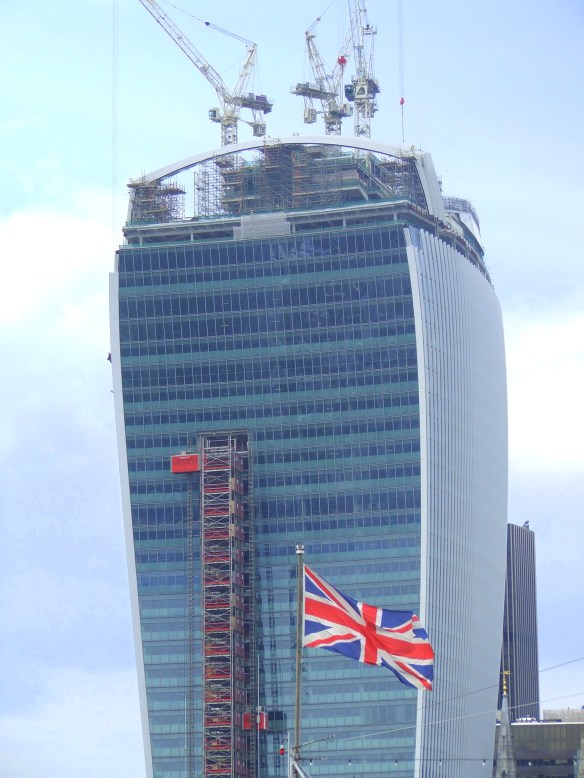
City of London, construction

I wrote a complaint to the BBC today. I have never done this before, so now can make proper claim to the term ‘grumpy old man’. This was the substance of my complaint;

On several programmes recently in which current affairs spokespersons have been invited to comment, the BBC has invited comment from right wing think tanks, such as the Adam Smith Institute. One example of this was a programme called ‘University Unchallenged’, on radio 4 on Monday the 12th of November, but this is a far from isolated example.

My concern is not that members of these think tanks are invited to comment, but rather that their bias is hidden behind a veil of independent expertise. If this bias is not announced before they comment then listeners/watchers are open to deception.

When we give a platform to someone who has a fixed opinion that is vested in political and ideological bias then this needs to be explained to listeners/viewers. This is particularly the case with right wing think tanks who often operate hand in hand with government and arguably act more like lobbyists than academic researchers.

If the BBC is to guard it’s hard won reputation for fairness, it can not ignore the fact that the Adam Smith Institute, and similar organisations (for example the Centre for Policy Studies) are funded by powerful organisations who have a narrow agenda. Not to make this clear when seeking comment from them is highly problematic.

Of course, this should also apply to left wing think tanks such as the Fabian society, the Centre for Social Justice, or the New Economics Foundation.

Why did I bother? Why does this matter?

Well, I think that we are entering time of profound change. The great disruptors have centre stage (Trump and Brexit). Old stabilities and orders are being destroyed. Into this vacuum will step a number of forces and vested interests, for good or ill. They will get a chance to shape the story of our nation for generations to come.

Think about this for a moment- what defined the story of the UK over the last fifty-sixty years? What makes you proudest? For me, it was our commitment to universal healthcare and a welfare state genuinely aimed at reducing poverty. There were failures and successes, but for the most part, there was political will.

But over the last twenty or thirty years, opposition to the institutions and principles of the welfare state has been hard at work. Money has been poured in to bodies whose sole purpose was to weaponise contrary stories and ideas.The nasty face of this was the right wing press, but beyond this, silky smooth and reeking of soft power, are the Think Tanks.

It worked. Austerity was sold to us as the only rational response to economic decline, and it was sold to us in such a way that we took it like a bitter pill, necessary to treat our own sickness. It was then logical to wind back all of the tools of the welfare state. Shrink public spending. Reduce taxation. Make more and more space in the public sphere for private profit.

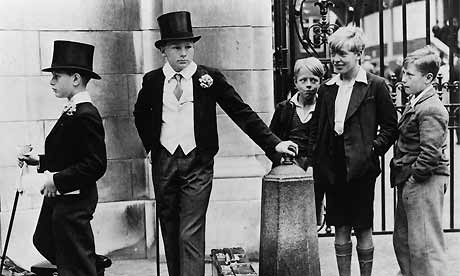
The effect in our society are clear to see. The rich richer, the poor ignored. Inequality is back to Edwardian levels.

Meanwhile, we see the UN special report into UK poverty saying things like this (my emphases.)

. British compassion for those who are suffering has been replaced by a punitive, mean-spirited, and often callous approach apparently designed to instill discipline where it is least useful, to impose a rigid order on the lives of those least capable of coping with today’s world, and elevating the goal of enforcing blind compliance over a genuine concern to improve the well-being of those at the lowest levels of British society…

… As I spoke with local authorities and the voluntary sector about their preparations for the future rollout of Universal Credit, I was struck by how much their mobilization resembled the sort of activity one might expect for an impending natural disaster or health epidemic. They have expended significant expense and energy to protect people from what is supposed to be a support system…

According to the National Audit Office, local governments in England have seen a 49% real-terms reduction in Government funding from 2010-11 to 2017-18 alongside a rise in demand for key social services….

…By emphasizing work as a panacea for poverty against all evidence and dismantling the community support, benefits, and public services on which so many rely, the government has created a highly combustible situation that will have dire consequences….

To address poverty systematically and effectively it is essential to know its extent and character.Yet the United Kingdom does not have an official measure of poverty. It produces four different measures of people who live on “below average income.” This allows it to pick and choose which numbers to use and to claim that “absolute poverty” is falling. Seen in context, however,other measures show that progress in reducing poverty has flat lined, child poverty is rising, and poverty is projected to rise in the coming years…

The government told me that there are 3.3 million more people in work than in 2010, that so called “absolute poverty” is falling, and that the social support system is working. An elected official added that there is no extreme poverty in the UK and nothing like the levels of destitution seen in other countries. But there is a striking and almost complete disconnect between what I heard from the government and what I consistently heard from many people directly, across the countryPeople I spoke with told me they have to choose between eating and heating their homes, or eating and feeding their children. One person said, “I would rather feed my kids than pay my rent, but that could get us all kicked out.” Children are showing up at school with empty stomachs, and schools are collecting food on an ad hoc basis and sending it home because teachers know that their students will otherwise go hungry…

…The costs of austerity have fallen disproportionately upon the poor, women, racial and ethnic minorities, children, single parents, and people with disabilities. The changes to taxes and benefits since 2010 have been highly regressive, and the policies have taken the highest toll on those least able to bear it. The government says everyone’s hard work has paid off, but according to the Equalities and Human Rights Commission, while the bottom 20% of earners will have lost on average 10% of their income by 2021/22 as a result of these changes, top earners have actually come out ahead…
The compassion and mutual concern that has long been part of the British tradition has been outsourced. At the same time many of the public places and institutions that previously brought communities together, such as libraries, community and recreation centers, and public parks, have been steadily dismantled or undermined…
.

…The experience of the United Kingdom, especially since 2010, underscores the conclusion that poverty is a political choice. Austerity could easily have spared the poor, if the political will had existed to do so. Resources were available to the Treasury at the last budget that could have transformed the situation of millions of people living in poverty, but the political choice was made to fund tax cuts for the wealthy instead…

None of this should surprise us. Austerity allowed the Government to implement policies that had been suggested by right wing Think Tanks decades ago.  Think about that. The rationale for austerity is that we had no choice- the country was ‘living beyond its means’. But the solution chosen was one allied to a political and economic dogma emerging from… Think Tanks like the Adam Smith Institute decade before.

So, whose interests are being served? As the old adage will say- follow the money.

Not that this is easy to do in relation to Think Tanks. They keep their funding secret.

Back in 2011, George Monbiot, writing in The Guardian, said this;

There are dozens of groups in the UK which call themselves free-market or conservative thinktanks, but they have a remarkably consistent agenda. They tend to oppose the laws which protect us from banks and corporations; to demand the privatisation of state assets; to argue that the rich should pay less tax; and to pour scorn on global warming. What the thinktanks call free-market economics looks more like a programme for corporate power.

Some of them have a turnover of several million pounds a year, but in most cases that’s about all we know. In the US, groups claiming to be free-market thinktanks have been exposed as sophisticated corporate lobbying outfits, acting in concert to promote the views of the people who fund them. In previous columns, I’ve shown how such groups, funded by the billionaire Koch brothers, built and directed the Tea Party movement…

…For the sake of democracy, we should know who funds the organisations that call themselves thinktanks. To this end I contacted 15 groups. Eleven of them could be described as free-market or conservative; four as progressive. I asked them all a simple question: “Could you give me the names of your major donors and the amount they contributed in the last financial year?” I gave their answers a score out of five for transparency and accountability.

Three of the groups I contacted – Right to Know, the International Policy Network, and Nurses for Reform – did not answer my calls or emails. Six others refused to give me any useful information. They are the Institute of Economic Affairs, Policy Exchange, the Adam Smith Institute, the TaxPayers’ Alliance, the Global Warming Policy Foundation and the Christian Medical Fellowship. They produced similar excuses, mostly concerning the need to protect the privacy of their donors. My view is that if you pay for influence, you should be accountable for it. Nul points.

…I charge that the groups which call themselves free-market thinktanks are nothing of the kind. They are public relations agencies, secretly lobbying for the corporations and multimillionaires who finance them. If they wish to refute this claim, they should disclose their funding. Until then, whenever you hear the term free-market thinktank, think of a tank, crushing democracy, driven by big business.


Monbiot updated his analysis in 2018, in the wake of the Brexit vote and the further erosion of welfare and public service by Austerity.

The problem is exemplified, in my view, by the Institute of Economic Affairs (IEA). In the latest reshuffle, two ministers with close links to the institute, Dominic Raab and Matthew Hancock, have been promoted to the frontbench, responsible for issues that obsess the IEA: Brexit and the NHS. Raab credits the IEA with supporting him “in waging the war of ideas”. Hancock, in his former role as cabinet office minister, notoriously ruled that charities receiving public funds should not be allowed to lobby the government. His department credited the IEA with the research that prompted the policy. This rule, in effect, granted a monopoly on lobbying to groups such as the IEA, which receive their money only from private sources. Hancock has received a total of £32,000 in political donations from the IEA’s chairman, Neil Record….

…So what is this organisation, and on whose behalf does it speak? If only we knew. It is rated by the accountability group Transparify as “highly opaque”. All that distinguishes organisations such as the IEA from public relations companies such as Burson-Marsteller is that we don’t know who it is working for. The only hard information we have is that, for many years, it has been funded by British American Tobacco (BAT), Japan Tobacco International, Imperial Tobacco and Philip Morris International. When this funding was exposed, the IEA claimed that its campaigns against tobacco regulation were unrelated to the money it had received. Recently, it has been repeatedly dissing the NHSwhich it wants to privatisecampaigning against controls on junk foodattacking trade unions; and defending zero-hour contractsunpaid internships and tax havens. Its staff appear on the BBC promoting these positions, often several times a week. But never do interviewers ask the basic democratic questions: who funds you, and do they have a financial interest in these topics?…

…While dark money has been used to influence elections, the role of groups such as the IEA is to reach much deeper into political life. As its current director, Mark Littlewood, explains, “We want to totally reframe the debate about the proper role of the state and civil society in our country … Our true mission is to change the climate of opinion.”


Next time you hear ‘experts’ being interviewed on the BBC, or via any other media outlet, ask yourself this; who pays them, and what are they trying to sell?

Post-it poems- the perfect present!

PostItPoetrycover

I love this book.

It is a collection of poems by a friend of mine, which I have watched develop over the last couple of years and I am delighted to see it actually come into print. I first saw them on his Facebook feed- poems written literally on a post it note, photographed, then uploaded. It was a neat idea, but much more than that, the writing is really lovely. Some of the poems will make you laugh out loud, others will bring on the old snuffles.

Here is the thinking;

I tried an experiment to see if I could keep
my writing concise. I took a post-it-note, and
gave myself some rules: one idea, one post-it, no writing small to fit it all on.

It has worked brilliantly in print too- some great design from the Proost folks.

You should get at least two- one to keep and one to give away.


Here are a couple of poems from the book (used with Chris’s permission.)


Eye of the Beholder
We were walking
across a field.
I said I loved the way
the blue of the sky
faded round the edges,
washing into the horizon.
Yes, he said.
That’ll be to do
with air pollution.


Tide Lines
I never hear you
or see you pass,
but I know you do,
because I find
your words
mixed with seaweed
and shells
and shingle.
While I watch
the headlands,
you’ve been
and gone,
with the tide.

After the bombs…

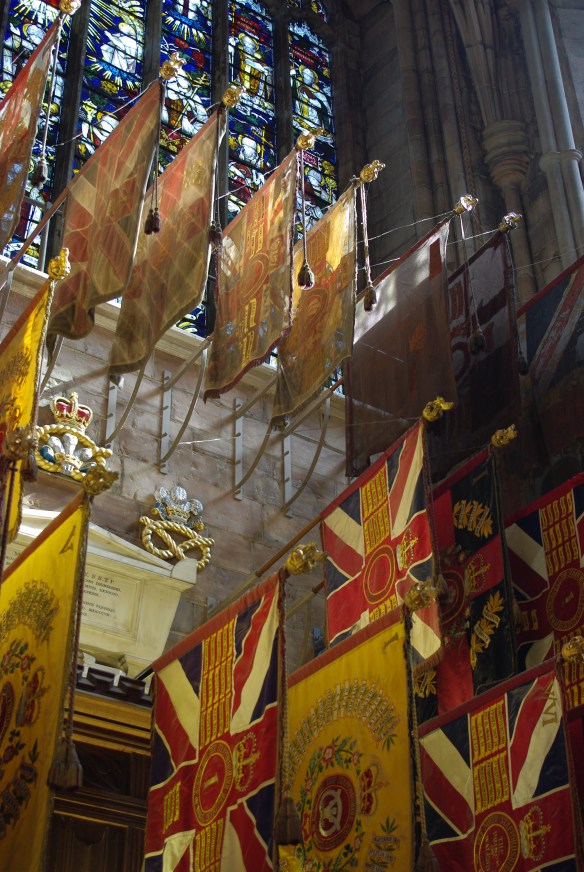
Military flags, Lichfield Cathedral

This photograph was taken a few years ago in a Cathedral. I forget which one- Lichfield perhaps? Here we see a whole wall of regimental flags, and I was struck by the incongruity. How can these things hang, here? Scattered amongst the flags were memorials to soldiers killed in forgotten wars across the empire, mostly Victorian skirmishes, carried out when we had convinced ourselves that the British Empire was civilising the world, not subjugating it.

Religion and war seem to be such easy bedfellows.

The Prince of Peace must wonder why on earth no one ever listened.

He must wish that the Old Testament, full of all its war mongering, had been lost in the desert. He must wish that the Dead sea scrolls were indeed dead.

Yesterday I wrote of my disquiet in relation to the national celebration of remembrance that will be held throughout the UK.

Today I offer this poem of hope.


The fruit of the Spirit is peace…


After the rain squalling

And the bombs falling

After the back stabbing

And the tongue lashing

After love is betrayed

And dreams disarrayed

When the knife cuts and slashes

After sackcloth and ashes

Comes the peace


After the tumours

And cruel vicious rumours

After bodies broken

And evil words spoken

After guns cease their shooting

Troops no longer jack-booting

With the grave trodden down

And the trees turned brown

Comes peace


Even after the failure

Of life-long labour

And after deadlines missed

After the getting pissed

When the pressure’s done mounting

And it’s all over – even the shouting

When the race has been run

In the setting of sun

Comes the peace


When anger burns out

After faith turns to doubt

When we give up on walking

And wolf packs are stalking

When the money is spent

Safety curtains are rent

At the end of all coping

Even Pollyanna’s done hoping

Even then

Will fall

My peace


From ‘Listing’. Available here.


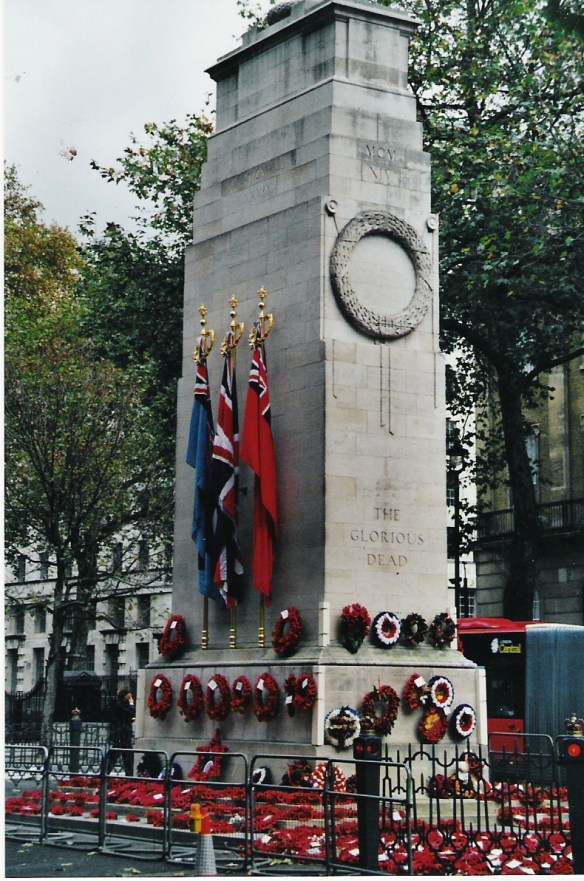
Why I will (probably) not be wearing a poppy this year…


cenotaph_london

It troubles me. It has for years.

Every year, we remember those who died in the world wars of the last century. Industrial slaughter after industrial slaughter.

They died for us, we are told. To preserve our way of life.

At some point, I fear that the act of remembrance was hijacked. We do not remember the terrible first war as being a futile obscene expression of empire. Rather we remember it as a mass exercise in noble sacrifice. The dead soldier is sacred. We must worship him.

And we do not remember the second war as arising in brutal consequence of the first, in that it created the precise broken and splintered context into which populism and fascism could flourish. Rather we glorify and obsess over Merlin engines and the Dunkirk spirit. Britain is sacred. Her empire will last for a thousand years.

I fear that both kinds of remembering are an exercise in forgetting. They miss the point, perhaps deliberately.

Perhaps the war generations did not die for us after all. They died for them– the others, those for whom war is simply politics by another name.

What is the answer? If you share my disquiet, is it possible to opt out of all the jingoism? Can we still remember in a way that has meaning? Perhaps we can, but it will not be easy.

I have worn poppies before, both the red and the white kind. I probably will not this year. Not because I do not want to remember, rather because I do.

The myth of meritocracy…

social class
A long time ago, I was was awarded a degree in applied social science. even though this was a time when fewer people went into higher education, particularly those like me who came from a disadvantaged background, my degree sometimes felt like it was not worth much- as if it was something achieved too easily, with no obvious practical application. More and more however, events in our society have told me that this is not true.
The subjects of my degree were these things- sociology, psychology, social history, social policy. We worked hard to understand underlying factors that govern the way our society works, particularly in relation to the great evils of our time- poverty, unequal health outcomes and discrimination.
There is a huge body of research in these areas, and whilst there is inevitably a spectrum of conclusions possible from it, it bothers me that successive governments (New Labour and Conservatives) have acted as if none of the research ever existed. It is almost as if it was ‘tainted’ somehow- made irrelevant by some kind of outdated bias.
Perhaps it is. It was biased towards the idea that if we could just understand the forces that keep the poor poor and the rich rich, then we could challenge them. We could make our education systems fairer. We could find ways to improve the health of poor kids. It was about engineering society towards the common good. How antiquated an idea is that?
It is no surprise that these ideas had no place in a world dominated by neoliberalism, with all its doctrines of small government (at least in terms of public expenditure), free market economics and (above all) the prevailing myth of meritocracy.
I was reminded of all this after reading a brilliant article in The Guardian this morning which exposes this myth for what it really is. He quotes the great 20th C reformer and sociologist, Michael Young, one of the architects (and critics) of our post war welfare state;

Young, who died in 2002 at the age of 86, saw what was happening. “Education has put its seal of approval on a minority,” he wrote, “and its seal of disapproval on the many who fail to shine from the time they are relegated to the bottom streams at the age of seven or before.” What should have been mechanisms of mobility had become fortresses of privilege. He saw an emerging cohort of mercantile meritocrats who can be insufferably smug, much more so than the people who knew they had achieved advancement not on their own merit but because they were, as somebody’s son or daughter, the beneficiaries of nepotism. The newcomers can actually believe they have morality on their side. So assured have the elite become that there is almost no block on the rewards they arrogate to themselves.

The carapace of “merit”, Young argued, had only inoculated the winners from shame and reproach.

We have a serious problem in our society with inequality. Pretending that this equation – IQ+effort=merit – dictates your worth in society is simply not credible when exposed to even the bluntest set of measures. If you don’t believe me- consider this. Donald Trump believes that he rules by reason of his merit. He believes his is a rich man because he is worth it.

Or check out this article, which describes a long term study of ‘Wealth Managers’ and their behaviours.

The question is- what do we replace the idea of a meritocracy with?

Young wrote a satirical book about this very subject;

Young’s vision was decidedly dystopian. As wealth increasingly reflects the innate distribution of natural talent, and the wealthy increasingly marry one another, society sorts into two main classes, in which everyone accepts that they have more or less what they deserve. He imagined a country in which “the eminent know that success is a just reward for their own capacity, their own efforts”, and in which the lower orders know that they have failed every chance they were given. “They are tested again and again … If they have been labelled ‘dunce’ repeatedly they cannot any longer pretend; their image of themselves is more nearly a true, unflattering reflection.”

But one immediate difficulty was that, as Young’s narrator concedes, “nearly all parents are going to try to gain unfair advantages for their offspring”. And when you have inequalities of income, one thing people can do with extra money is to pursue that goal. If the financial status of your parents helped determine your economic rewards, you would no longer be living by the formula that “IQ + effort = merit”.

Those cautions have, of course, proved well founded. In the US, the top fifth of households enjoyed a $4tn increase in pretax income between 1979 and 2013 – $1tn more than came to all the rest. When increased access to higher education was introduced in the US and Britain, it was seen as a great equaliser. But a couple of generations later, researchers tell us that higher education is now a great stratifier. Economists have found that many elite US universities – including Brown, Dartmouth, Penn, Princeton, and Yale – take more students from the top 1% of the income distribution than from the bottom 60%. To achieve a position in the top tier of wealth, power and privilege, in short, it helps enormously to start there. “American meritocracy,” the Yale law professor Daniel Markovits argues, has “become precisely what it was invented to combat: a mechanism for the dynastic transmission of wealth and privilege across generations.”

The problem is that hierarchies are inevitable. For a while it seemed as if we might be evolving a way to make them less fixed and more flattened, until those at the top found ways (and words) to convince us that they were there by merit all along.

The problem, according to Young, was that we equate WORTH with WEALTH. But who can really measure a good life? Young was concerned with how we might find ways to increase social capital and connectedness, ways of exchanging and sharing lives to add value that was non-monetary.

But the problem of wealth remains. Just let’s not pretend that, if we have it, we deserve it.

Bookshop…

bookpoint-003

Most of us speak in hallowed tones about bookshops, even if we visit them with less frequency these days. So many have closed, but perhaps there is some room for optimism. Our infatuation with the compromised convenience of Amazon (that great tax avoider) has waned and the promised digital publishing revolution has stalled, for now at least.

Relative poverty might have driven me pack to the library of late (Dunoon has a beautiful new library that overlooks the water from the re-developed Queens Hall) but still, the thrill of a bookshop, loaded with endless possibilities for adventure, remains on me.

Most of us love the feel of a book. The weight of it in our hands. The smell of new pages as they are turned. The investment in the narrative that is close to something called ownership.

The other day, I was privileged to do a poetry reading in the lovely Bookpoint, our local bookshop in Dunoon. It was a last minute invitation, intended to mark National Poetry day. The idea was to be there a couple of hours, hang about in the tea shop, to read some poems and interact with the punters. I am not the easiest at impromptu sociability- I never quite learnt the art of small talk. But we had poetry…

… and books.


Roe2

In a lull between poems, I started to sketch out this poem. It is my small contribution to National Poetry Day;


Bookshop

Written in ‘Bookpoint, for ‘National poetry day’ 2018


So many books

Every spine like undrunk wine

Every page contagious


For words weigh nothing here

They are floating free

while I sup tea.

Perhaps two or three might land on me-

Like birds – or spores – or seeds,

For I am like soil in winter.


High on a shelf

sits poor Gandalf.

Atticus Finch is caught in a clinch

with Molly Bloom.

Tom Sawyer hides poor Jim

In the bottom drawer.

Moriarty invites Jack Kerouac

to party out back.

Catherine Earnshaw

roams the moor no more

She drinks tea with me

In Bookpoint

Poetry of protest, ice and water…

Two stories in The Guardian today rather stood out. Firstly, this one; apparently North Carolina did no like the science on climate change, so passed a law to ensure than no policy was made that was based upon it. You could not make it up.

Think about it- is this not the very definition of madness? Legislate to make truth irrelevant.

I know, NC legislators are claiming that the science they are referring to is ‘worst case scenario’- as if when preparing for disaster, you would do anything else. It is hard not to see these assaults on inconvenient truth of the kind that does not chime with your ideology as anything other than collective madness that is passing the burden on to future generations.

Which brings me to this;


Excerpt from Rise by Kathy Jetnil-Kijiner and Aka Niviana

The very same beasts

That now decide

Who should live

And who should die …

We demand that the world see beyond

SUVs, ACs, their pre-package convenience

Their oil-slicked dreams, beyond the belief

That tomorrow will never happen

And yet there’s a generosity to their witness – a recognition that whoever started the trouble, we’re now in it together.

Let me bring my home to yours

Let’s watch as Miami, New York,

Shanghai, Amsterdam, London

Rio de Janeiro and Osaka

Try to breathe underwater …

None of us is immune.

Life in all forms demands

The same respect we all give to money …

So each and every one of us

Has to decide

If we

Will

Rise

Is Tamimi part of the problem, or part of the solution?

She is an impressive young woman – surely everyone can agree on that, no matter which side of the Palestinian/Israeli wall your sympathies lie.

She has almost certainly grown up in a world totally unlike yours; a world characterised by violence and protest against what is regarded even by the United Nations as an army of occupation. Check out her story, here. She has watched parents and brothers arrested for protests against this occupation, as they have thrown words and rocks at men carrying American automatic weapons.

To much of the world, she represents the best of us. A child still, who has been brave enough to stand up against oppression. A young girl whose photogenic shock of curly hair and gift of erudition has made it on to the international media outlets. She has become the face of a whole people. What a burden for one so young.

To many others however, she is part of the problem. Yes, she may have been one of the hundreds of Palestinian children jailed by Israeli courts, but she was in fact convicted of an assault that is there for all to see. She taunted, slapped and insulted an Israeli soldier, who did his best to ignore her. She was convicted of something that she had in fact, done.

There is a danger here however  that we judge her actions by the things that happen on our streets, and the law practised in our courts. The West Bank, where Tamimi and her family live, is a war zone under military law. What this means for children is that since 2000, some estimates say that over 1500 children have been killed, and 10,000 have been arrested. What the Israeli state describe as moderate, appropriate response to terrorism and public unrest has to be seen in this context.

Think about this for a moment. Let us make a comparison with Northern Ireland. It is not a very good comparison for all sorts of reasons that I will not go in to here, but certainly at times the streets of NI were full of rioting, stone throwing young people. This led to ugly violence as locals and soldiers alike were brutalised. The event known as Bloody Sunday, in which soldiers fired into a crowd of people, killing 28, took years to be acknowledged by the Government, but the use of live ammunition to suppress protest was an extremely rare abomination, even in that poisoned atmosphere. Compare that, to this;

I think that most of us will find this utterly abhorrent, even if we agree that the Israeli forces have to confront violent unrest in some fashion. Shooting unarmed kids throwing rocks? Really? Is this what passes for crowd control in a democratic western country? Note how shooting people has become normalised, like putting a bullet in the leg or shoulder of a child is nothing. Just something that has to be done.

This is the context into which we have to place the story of Ahed Tamimi. Routine violence has led to more and more… violence. In such a polarising context, where one side views the other over Trump style ‘Beautiful Walls’, or through the sights of high velocity weaponry. The layers of hurt lie on the land like strata, each layer absorbing the bones of another generation of martyrs.

So, is the belligerent, teenage protest of Tamimi part of the problem or part of the solution?

It is not a fair question is it? She is far too young to carry such terrible responsibility.

But what would you do? What other means of expression are available to the children of the West Bank?

She wants to become a solicitor, because perhaps justice can be pursued through the law. That does not seem to be working at the moment, but perhaps in the future, the tide of history will turn, and then there may be a moment when the laws of the land will have value once again. But not now. Think of all those UN resolutions that are being ignored. Think of the Biblical commandments not to kill (muddied as they are by all the stories of a God who seems just as bloodthirsty as we are.)

Perhaps the question is one of those both-and dichotomies. Perhaps Tamimi is part of the problem. How could she not be? But perhaps too she might be part of the solution.

She has been given a platform. She is far too young. She will make mistakes. Powerful forces will be trying to undermine and vilify her at every turn. But she is from a new generation and that in itself is a source of hope.

May her heart be turned to love. May her hands be hands of peace. And may she see the tumbling of walls, not their increased fortification.

Of course, if this is to happen, the democratic state of Israel, forged as it was out of genocide and oppression, will have to come to realised the now THEY are the oppressors.

Or am I being antisemitic?


Antisemitism and left wing politics…

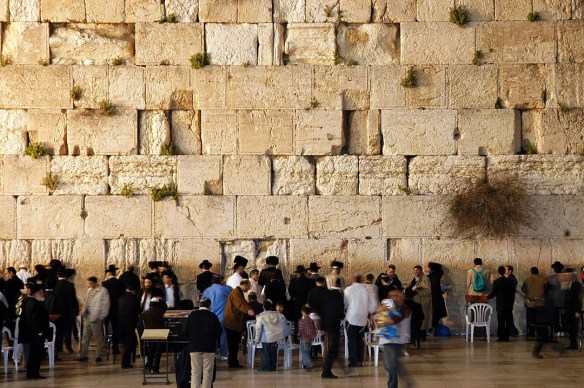
1200px-Western_wall_jerusalem_night

The Labour party seems to be in the headlines not for challenging the manifestly unjust policies of austerity which have lead us to rising homelessness, vastly increased use of food banks, rampant child poverty and a yawning gap between rich and poor. Rather the media is full of stories about antisemitism in the rank and file of the party.

At a point in our history when social injustice has (arguably) been weaponised by the ruling elite, who have convinced us that the greatest dangers to our national security are 1. immigrants, 2. the feckless benefits scrounger, 3. house prices, the radical left can be painted as racist and therefore tainted and irrelevant.

Perhaps the left does indeed have a real problem with antisemitism. Check out this timeline of Labour’s troubles. At very least, it seems to be a crisis that has not been well ‘managed’- which is in itself a crime in an age of the political spin doctor. Is there more than this however? Is there an underlying antipathy towards Jewish people lurking beneath the surface of the otherwise painfully politically correct rank and file of the party? How we love to call out hypocrisy in others after all, so it is delicious to be able to reveal the prejudices of those who proclaim themselves to be engaged in a fight against racism.

Corbyn is a case in point. He has been long regarded as the champion of the underdog, the patron saint of small people and lost causes. He has stood on platforms wherever people have been oppressed, and waved flags on a thousand ant-racism marches. Yet one of his own party’s grandees, Margaret Hodge, screamed abuse at him in the House of Commons, calling him out for being antisemitic. I am listening to ‘Woman’s hour’ BBC radio 4 right now, and here is Margaret Hodge being interviewed about her family background, describing the horrors that her family went through during the holocaust, and how she has been getting an increasing amount of abuse because of her Jewish background on twitter. Hodge was allowed to lay out her case against Corbyn, and how he has ‘lost the trust of the Jewish community’. There is no balancing opinion being offered. Hodge was particularly weak when asked about the rights of Palestinian people to protest. It would be difficult to hear an interview like this and not wonder about media bias. She finished by describing how ‘middle England is offended’ by the way the the party is insisting on focussing on the right of Palestinians and being racist towards Israel. Perhaps she is right. She said it on Woman’s hour after all.

I am not a member of the Labour Party, although I have been in the past. This is more because I am not a natural joiner these days, rather I am more comfortable in the role of observer. However, for all his limitations, I have listened intently to the politics of Corbyn, and felt my hopes soar. We desperately need a channel through which an alternative set of ideas about what is a good way to manage our political, economic and environmental relationships to the world and to each other. There is also much that is being done in our name, under the dodgy alibi of ‘democracy’, that should be resisted, and this requires a strong opposition. History tells us that social change that helps the poor has always required a strong movement of working people. Following in the footsteps of my big sister, I almost did join the Party a couple of years ago.

So, because of all of this, I have done my very best to try to understand this issue. I care about racism and antisemitism. Striving towards equality and social justice has been part of my whole life and career. I confess however that after all the reading, discussions and questioning I have engaged in, I remain to a certain extent confused. I have read a number of examples of racism where members of the party, such as Ken Livingstone, have used extremely ill chosen words. As the video below makes clear, it seems however that the words might well reveal something more ugly.


Perhaps we have to return to definitions. There has been a huge outcry about Labour not adopting the International Human Rights Association definition of anti-semitism in full. This was part of the Hodge row with Corbyn. It might not be common knowledge however that this definition is in itself controversial, in that it is regarded as imperfect and imprecise. This debate here makes clear the breadth of views on it.

The four ‘examples’ that Labour left out are also interesting, in that they shine a light on some of the heat of this debate.

  • Accusing Jewish people of being more loyal to Israel than their home country
  • Claiming that Israel’s existence as a state is a racist endeavour
  • Requiring higher standards of behaviour from Israel than other nations
  • Comparing contemporary Israeli policies to those of the Nazis

The first thing to say that these are examples, not part of the actual definition. All of these issues are covered elsewhere. Secondly, perhaps we should ask this; how might these ‘examples’ of antisemitism read from the perspective of someone living in the Gaza Strip? We might know the answer to this, because in an open letter to The Guardian leading members of the Palestinian community in the UK said this;

The reality of the Palestinian people’s ongoing dispossession belongs to the public space: Palestinian people have the right to impart information about these present and past injustices, as every British citizen has the right to hear this information, along with the ideas and arguments that emerge directly from it.

Accordingly, any use by public bodies of the IHRA examples on antisemitism that either inhibits discussion relating to our dispossession by ethnic cleansing, when Israel was established, or attempts to silence public discussions on current or past practices of settler colonialism, apartheid, racism and discrimination, and the ongoing violent military occupation, directly contravenes core rights. First, the inalienable rights of the Palestinian people, who remain protected by international laws and conventions; and second, the rights of all those British citizens who stand by our side, in the solidarity of a common humanity.

There is something fundamental here about the right to give and take offence, and how power is used to make and suppress protest. In international terms, Israel is now seen by many as the oppressor. THEY are the neighbourhood bullies, not the victim of international politics. THEY have the big guns and the powerful allies. The violence they can perpetrate is on an industrial scale, often aimed at soft targets. Small wonder that we might baulk at the idea that we should limit the degree to which we hold them accountable, no matter what provocation in the form of terrorism is aimed their way.

Perhaps there is more to this issue than just ‘siding with one side or the other’ though. I find myself returning to my training as a social scientist, and old definitions of racism, which we often used to divide into two kinds; overt racism and institutional racism.

The overt kind is easier to see for what it is. There are those who will still tell you that black people are less intelligent, or who would treat people differently because of their religion or the colour of their skin. Within left wing politics, in my experience, this is a rare thing in total contrast to right wing politics of course- this example being a case in point.


That is not to let the left wing off the hook entirely however. I am told that one of the things that might underpin antisemitism is a particular kind of conspiracy theory, in which some kind of shadowy Cabal, like the Illuminati, exists that controls world affairs. Where this become antisemitic is that this Cabal is regarded to be dominated by Jews. This kind of nonsense is remarkably pervasive, despite a total lack of evidence.

Turning to the other kind of racism however, the institutional kind, which was defined by Sir William Macpherson in the 1999 Lawrence report (UK) as: “The collective failure of an organisation to provide an appropriate and professional service to people because of their colour, culture, or ethnic origin. It can be seen or detected in processes, attitudes and behaviour which amount to discrimination through unwitting prejudice, ignorance, thoughtlessness and racist stereotyping which disadvantage minority ethnic people.”

Might the Labour party be regarded as institutionally antisemitic? Certainly Jewish leaders have levelled this accusation.


My past way of trying to understand this kind of racism has been to listen to the voices of those oppressed by it. There seems little doubt that Jewish people feel oppressed, and that they regard Corbyn as being responsible, either through commission or omission for creating a hostile environment for Jews within the party. It would clearly be a mistake however to suggest that this is a consensus view, as made clear by this article. Some have gone further, such as Jewsforjeremy or jewishvoiceforlabour both of whom regard much of the criticism as mere gaslighting.

So, after all of this reading, where am I up to? Don’t get me wrong, I claim no deep insight. I am an outsider after all, just trying to make sense of the avalanche of crap that comes down to us through all of the media and social media outlets all day long. For what it is worth, here are my thoughts;

  1. The Labour party is a conglomeration, made up a wide body of views. It is also in a process of change. Blairite loyalist are being squeezed out by a new grass root politics. This has led to a poisonous atmosphere in which abuse has flown around on both sides. We have to see the antisemitism row in this context.
  2. There seems little doubt that Corbyn has not handled this well. But the reason he seems to offer the hope of a new politics is precisely because he is not interested in sound bite slick spin manipulation. He is perhaps naive in this, and certainly vulnerable. He wants to have a debate and thinks that things can be resolved by reasoned argument. He has been proven wrong.
  3. Antisemitism and anti-Israeli sentiments are not the same. We have to resist oppression of the individual because of their ethnic background. We also have to resist oppression by a nation state. We have every right to hold them MORE accountable because they are supposedly our allies. They are supposedly a liberal democracy.
  4. Jewish hate crime is on the rise. But so is hate crime generally. We must hold our society to account for ALL racism. Brexit was about racism, of a kind that was fostered by our politics. We should fear these politics.
  5. We should listen to Jewish people in the UK
  6. We should listen to Palestinian people in Palestine.

Final words I will leave to Jewish critic of Israel, Noam Chomski, who incidentally is banned from entering Israel;

Giving you poetry…

Reaching for Mercy Cover4-page-001

Over the last year and a half or so, I have been working with a fantastic group of people to edit a poetry collection, entitled ‘Reaching for Mercy’. I am delighted to say that collection is now complete and will be launched at Greenbelt Festival. on Saturday night 25th August when poets will be reading works from the book. Early copies of the book will also be available at the Greenbelt pop-up bookshop G-Books throughout the festival.

(By the way, if you are one of the poets, and planning to be at the festival, can you let me know?)

We are sharing some sneak preview of poems from the book on our facebook page.

I have long had a theory about poetry, which is that lots of the best poems grow where there may have been pain and damage. A bit like mushrooms from damaged tree roots. Emily showed me this poem recently which backs up my theory. Warning, it might act upon the tear ducts…