Archbishop suggests adding meditation to curriculum- shock…

Well, not quite.

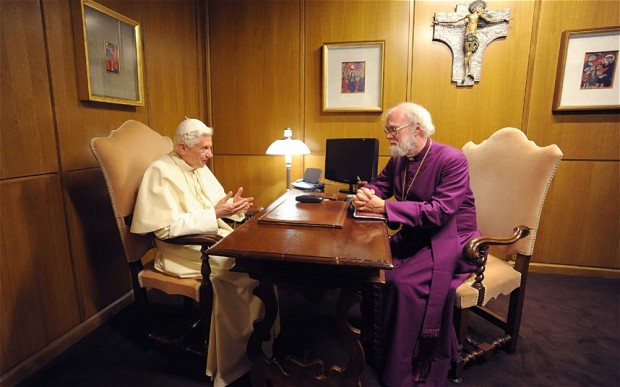
Rowan Williams spoke to some Catholic Bishops at the invitation of an unusually reconciliatory Pope Benedict. The meeting focussed on how the Church might be more relevant to an increasingly secular world.

The good Archbish offered up the idea of teaching kids to meditate;

“To put it boldly, contemplation is the only ultimate answer to the unreal and insane world that our financial systems and our advertising culture and our chaotic and unexamined emotions encourage us to inhabit,” he said.

“To learn contemplative practice is to learn what we need so as to live truthfully and honestly and lovingly. It is a deeply revolutionary matter.”

“Having seen at first hand, in Anglican schools in Britain, how warmly young children can respond to the invitation offered by meditation in this tradition, I believe its potential for introducing young people to the depths of our faith to be very great indeed.” Dr Williams added that for adults who had “drifted away” from regular attendance at Church, the style of worship practised in places such as Taizé could offer a “way back”.

From the Telegraph.

What do you think? Can developing a contemplative life really have such a transformational effect on the next generation? Can you really inculcate the practice of spiritual contemplation at an early age in this way?

Benches…

Aoradh have been planning some installations to coincide with Cowalfest (walking festival) and the MOD (annual festival of Gaelic culture held in a different place in Scotland each year) both which will run in Dunoon over the next couple of weeks.

We have decided to use benches along a 1-2 mile stretch of coastline. Each bench will have a piece of poetry, scripture or an activity to help with meditation.

As ever, we are leaving everything until the last minute, but if you are in Dunoon over the next couple of weeks we really hope you enjoy the things we are creating.

Prodigals…

I uploaded a couple of old liturgies on Twelvebaskets the other day, which is a great collection of worship resources for those of you on the look out for material to use in services and house gatherings.

I came across an old piece that I wrote from one of our Greenbelt worship events, entitled ‘Prodigals’, and thought it worth re-posting;

Prodigals, coming home

A liturgy for one voice with congregational response, examining our relationship with our Father God.


Our fathering arises from human brokenness

And so is easily broken

We are your prodigals, coming home

Our fathering arises in a place where we struggle for power and control

And so it can become oppressive

Or even abusive

We are your prodigals, coming home

Our fathering finds the limits of our patience, our tolerance and our finances

It can be conditional

And we can be easily angered

We are your prodigals, coming home

Our fathering can be decayed by divorce and marital disharmony

It can become distant and removed

We are your prodigals, coming home

Our fathering can be stolen by death, leaving us in desperate grief

And terribly alone

We are your prodigals, coming home

Yet even we, who are so human

Know how to love

It is shaped within us

Waiting

We know how to give the best for our children

We do not give a stone when they ask for bread

Or a razor blade

When they ask for a plastic toy

Or a used syringe

When they ask for expensive shoes

How much more…

How much more will we encounter

When we meet you-

Heavenly father?

We are your prodigals, coming home


There is no Father

Unless there is also a son

Or a daughter

We were made for relationship

All of us- with no exceptions

Every one of God’s children

From the star pupil,

To the remedial

Poorly clothed

Last-to-be-picked

Back-of-the-classroom loser

Who becomes the favourite

The Chosen One

The last-

Now made first

There is no Father

Without us


The sons and daughters-

The beloved

Of the most high God

Aoradh family day…

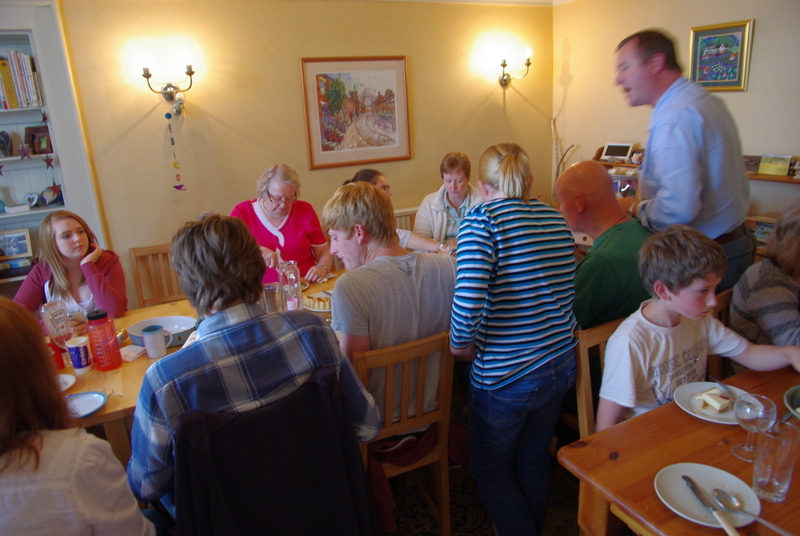
We had a lovely Aoradh gathering today. The kids planned their own worship service, around the theme of food (food in the bible, being grateful, being more fruitful) then- well we ate of course!

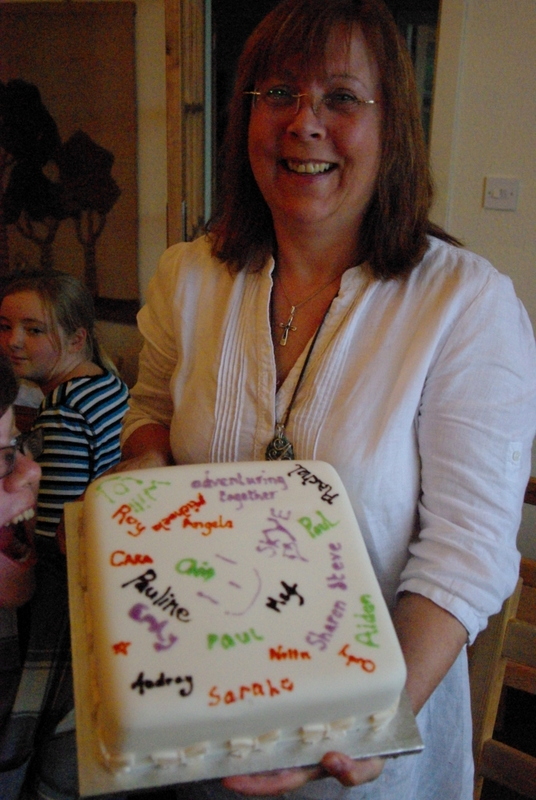
Sharon had made a cake, which we all wrote our names on in icing, then we ate that too.

Lots of our young people are in transition. Two of them away to university, one to college, others to new schools or new exam years. We decided to give them all an envelope full of things each adult had written to each child.

A good cake takes care.

All those lovely ingredients gathered and mixed and moulded.

Bowls licked clean.

Oven warmed and ready to raise and brown.

So it is with you my girl. All the lovely parts of you are in the mix. God is stirring them up, and the oven is warm.

You will feed many with rich lovely things.

You will feed many with love.


Spiritual Capitalism…

(Thanks to today’s Minimergent.)

We’ve all imbibed the culture of unrest so deeply. We just cannot believe that we could be respected or admired or received or loved without some level of performance. We are all performers and overachievers, and we think “when we do that” we will finally be lovable. Once you ride on the performance principle, you don’t even allow yourself to achieve it. Even when you “achieve” a good day of “performing,” it will never be enough, because it is inherently self-advancing and therefore self-defeating. You might call it “spiritual capitalism”.

Richard Rohr

Following the Mystics through the Narrow Gate 

Clatter of rails…

Image taken on Yorkshire Moors Railway, 2010.

Thanks to today’s minimergent;

This side of Paradise, people are with God in such a remote and spotty way that their experience of Eternal Life is at best like the experience you get of approaching a place at night in a fast train. Even the saints see only an occasional light go whipping by, hear only a sound or two over the clatter of the rails.

Frederick Buechner

Vocation…

Yesterday I received my redundancy letter. It was not a surprise- it has been two years plus in the writing. Neither was it entirely without choice, I have decided not to accept offers of alternative employment within the social work department.

Which brings me to this word-vocation, defined in the dictionary as

vo·ca·tion

[voh-key-shuhn]  Show IPA

noun

1.

a particular occupation, business, or profession; calling.
2.

a strong impulse or inclination to follow a particular activityor career.
3.

a divine call to God’s service or to the Christian life.
4.

a function or station in life to which one is called by God: thereligious vocation; the vocation of marriage.

But also defined here like this;

The idea of vocation is central to the Christian belief that God has created each person with gifts and talents oriented toward specific purposes and a way of life. In the broadest sense, as stated in the Catechism of the Catholic Church, “Love is the fundamental and innate vocation of every human being” (CCC 2392). More specifically, in the Orthodox and Catholic Churches, this idea of vocation is especially associated with a divine call to service to the Church and humanity through particular vocational life commitments such as marriage to a particular person, consecration as a religious, ordination to priestly ministry in the Church and even a holy life as a single person. In the broader sense, Christian vocation includes the use of one’s gifts in their profession, family life, church and civic commitments for the sake of the greater common good.

I entered social work as a vocation. It was almost a priestly thing for me. This might be difficult for others to understand-it is not as though social work has a status that might be seen to deserve respect. But there are lots of parallels- both are concerned with pastoral care, both are (or were) driven by higher ideas and ideology, both are embedded in institutions in the main.

To leave a vocation is no easy matter.

Reading through the second definition of the word (above) I wonder about this suggestion that God has created each person with gifts and talents oriented toward specific purposes and a way of life. This reminds me too much of old conversations about some kind of plan that God has written for each of us in some kind of massive ledger, and woe betide us if, like Christian in Pilgrims progress, we step off the golden path into some kind of career apostasy.

Such determinism has little place in my understanding of our pilgrim journeys, but we all make choices, even if the choice is to not change a thing. I do not know clearly what my vocation is at the moment. I have some clues of course- if I was to get to the very heart of things, it would be to create– to write words that inspire and shape the thinking of others. Whether this is a realistic vocation now has to be tested!

But this bit of the definition above I can stand on firmly;

Love is the fundamental and innate vocation of every human being”

And the application of this in the ways that we come to live, this is the long road that we Christian pilgrims have to travel.

Travel well…

Aoradh Easter service…

We are just back from a lovely Easter service.

Thanks to the kindness of Aileen, one of our local ministers, we were given permission to use the beautiful Inverchaolain Chapel– out along Loch Striven. It is a small simple stone building, cupped in the bowl of the hills next to the Loch.

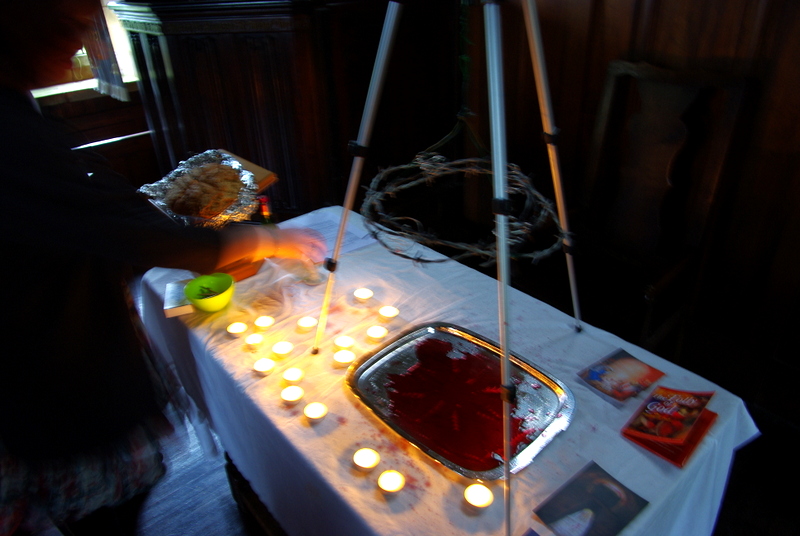
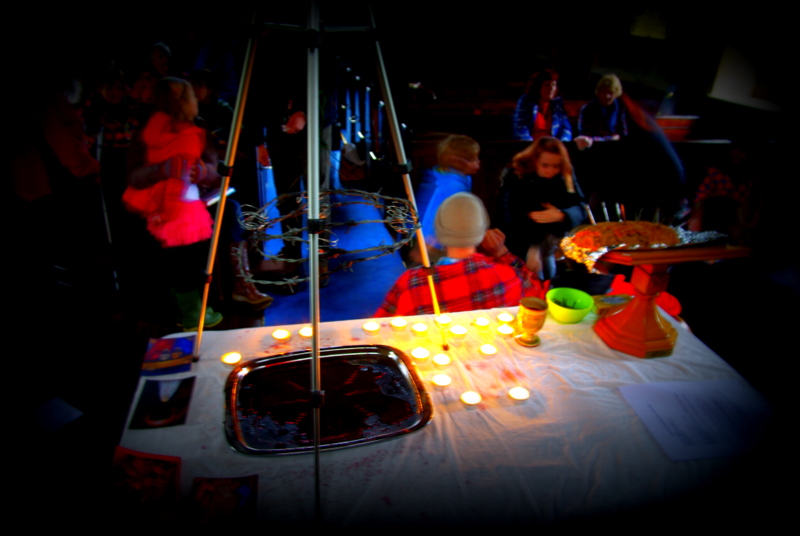
Audrey led us through a liturgy, using some ideas borrowed from Tabled– which is a fantastic collection of creative ideas for communion. We used two objects- one was a crown of thorns suspended with little baskets containing frozen cubes of wine, which dripped down onto a silver tray and a white cloth. The other was a loaf of bread into which we asked people to push nails. The images were powerful and Audrey’s words complimented them wonderfully.

(By the way- if you try the frozen wine thing, bear in mind that wine does not freeze very well- better to use water with some food colouring.)

Afterwards we went back to Andy and Angela’s as the planned picnic was rather rained off. No matter though, we took with us something precious that brought a deeper sense of the death of Jesus, and his resurrection then, and through us, now.

What do you want to be when you grow up?

Michaela reckons that when you are small this is what people ask. They do not ask what you want to do but rather what you want to be.

A subtle but important difference she felt.

Michaela wanted to be a nurse. Nothing really surprising there, it is a rather typical thing for girls to aspire to, or rather it used to be. Hopefully the options have broadened out these days. Certainly Michaela has no desire to be a nurse any more, although when you think about what nursing might have seemed all about to a small girl- the caring, the looking after, the seeking to heal and restore- these attributes are still part of who she is. You might even say that these were who she was always meant to be.

Can you remember what you wanted to be when you were small? Might it contain something significant about your way of being, if not your current way of doing?

I wanted to be in the Navy.

I wanted to sail to far away places and have adventures. I wanted to be in a fast ship along with lots of people doing similar things. I still get a little excited when sleek grey ships pass the house on the way out to who knows where. I want no part in war, but still I find myself proud and unable to turn away.

As I think about it now, I wonder about the longing in me for the far horizon. There is in still the need to form a band of adventurers and go to explore new places, new ideas, new ways of being.

That ‘being’ word again…

Or perhaps it was always just about the uniforms.