This collection came from the idea that poetry could and should be a valid expression of our spiritual journeys, our protests, our pain, our longing and our hopes. It also came from a conviction that many people write poems, and even the best of these often have no outlet- no way of connecting with other people.
I had no real way of knowing what people would send, but all I can say is that I already have some fantastic writing. I sat on the train coming back from London reading poems that made me cry- one of the best measures of a poem in my opinion!
However- if you are hovering and wondering whether or not to send something in- please do.
The best poems for this collection are not necessarily the ones written by ‘poets’- rather they are ones written by people who have been opened up by something deeper, and are suddenly able to express this on paper.
There are also some of you who I am waiting for content from. You know who you are – don’t make me come and fetch them!
What is it that makes cynicism seem like common sense?
How come cynicism is the attitude that seems most socially proscribed and enforced?
Why is it socially safer to sneer rather than enthuse?
Think about it- that place of cynical distance we hide behind- or is it just me? Despite myself, with a random assortment of passions and creativities, life teaches me still that the best defence against failure, against exposure, against being beached on some shoal of stupidity, is cynicism.
But nothing ever was made or created or celebrated by cynicism. Cynicism can only destroy, undermine, denude.
To achieve something new, to change the world for the better- this always requires hope. Even those of us who struggle to reach the high watermark of optimism (lets us not get carried away after all.)
Hope carries risk. Cynicism condemns us to slow decline into the mundanity of the just-enough, or even worse, the passivity of mass inertia.
So why is it that as I re-read this I still feel…. cynical?
Not in the ‘other worldly’ sense, the God who is removed and distant. For me, Transcendence means something hyper-real, something that saturates the ordinary, but which somehow connects us with the divine.
… I mean the experience of God in the ordinary. The incarnation of the maker of the universe within the temporal, messy world in which we live and love.
Transcendent moments fill our lives if we look for them. And the more we attune ourselves to the looking the more we see.
They are everywhere in the natural world; sunsets, new leaves, mushrooms in caves, the lick of new born fur, the light of the moon on still water, the smell of rain on dry earth, the sea that goes on for ever. All these things will happen whether or not we are there as witnesses. But when we look in a certain kind of way a hollow space opens up in the middle of them into which we can meet with something transcendent. Into which we can invite/be invited by the living God.
They are everywhere too where humans also are. In conversations, in touch, in the longing for justice, in the decision to forgive, in the deciding to repay hurt with love, in the listening and in the laughing. Because God is a God of communion. God commands love, and love requires direction. Perhaps above all, the transcendent God is immanent when we come together in community.
They are encountered in art, because art can become a bridge to something beyond our business. Films, books, poems, paintings, sculptures, music.
They can even be encountered in church – for me, especially when we sing, when the chordal voices find the vault of the building and make it vibrate.
I have been thinking about what all this might mean to us again, and wrote this;
In the Name of Greatness is Dorothy Allen-Pickard’s winning film in the documentary category of the Intergenerational Foundation young filmmakers’ short film competition in association with the Guardian and the National Union of Students. It is written and performed by Nicki Williams.
It combines a powerful poem with moving images to address questions of debt, greed, consumerism and the need for community.
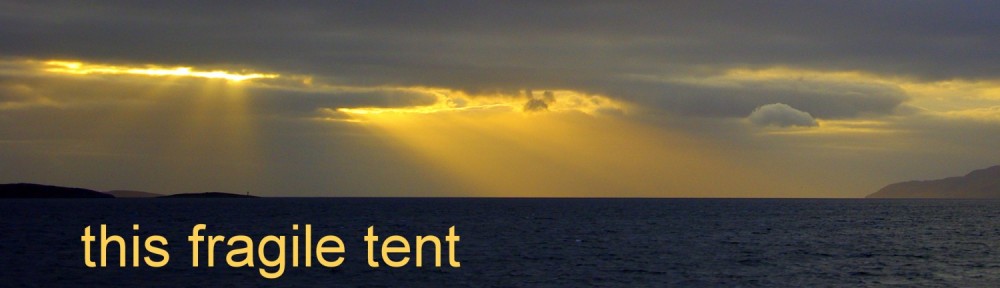
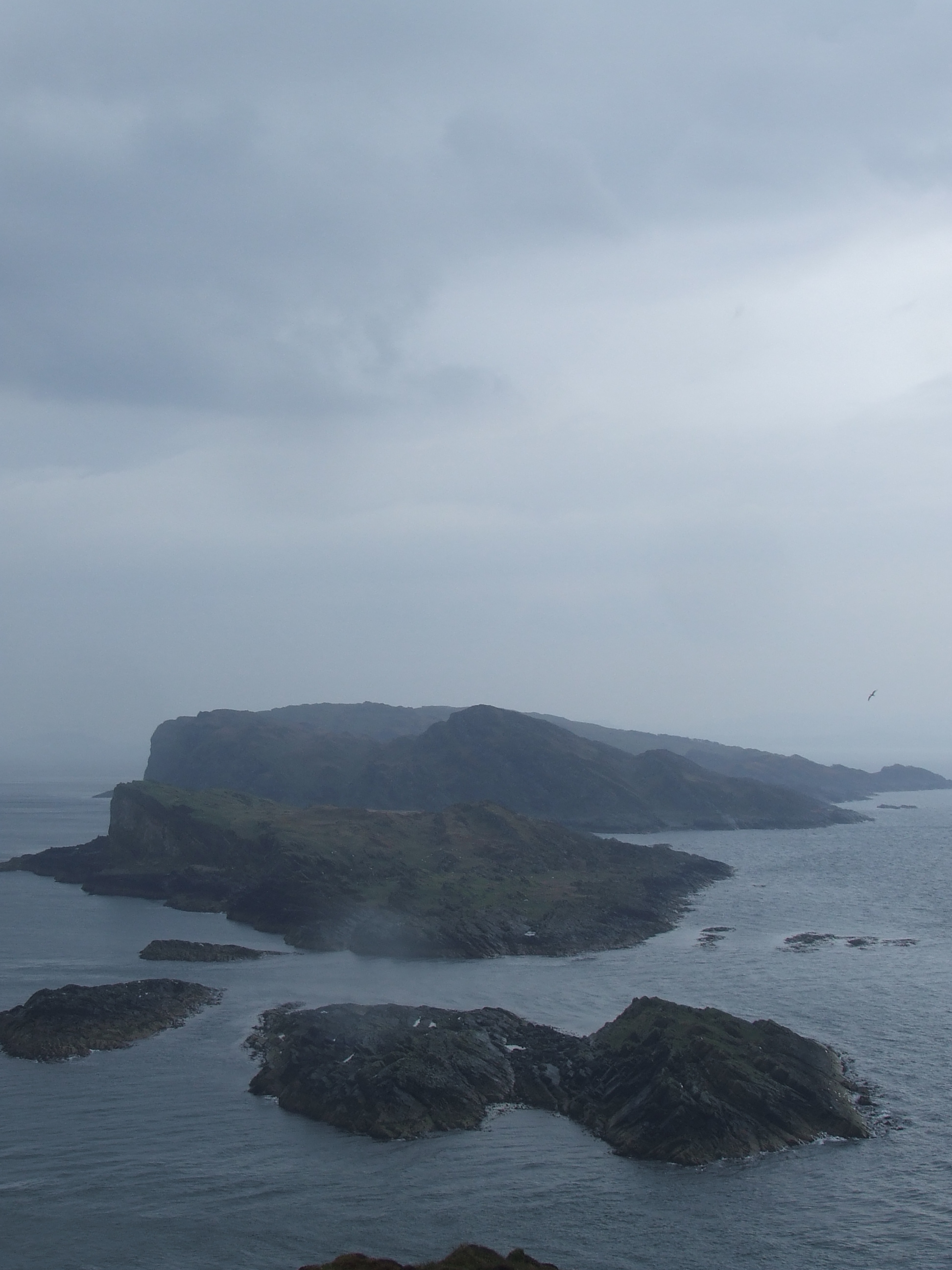
It is time for our annual Aoradh wilderness retreat. Each May bank holiday weekend, usually with old friends and invited guests, we hire a boat to drop us off for a couple of nights camping wild on an uninhabited island. This year we are returning to Eileach an Naoimh, one of the Garvellachs in the Ross of Mull, Inner Hebrides. The photo above was taken looking north at the other islands in the chain a few years ago, in less than ideal weather. The forecast for this weekend is better thankfully.
Eileach an Naoimh, even by west coast of Scotland standards, is a stunning place. It has soaring cliffs full of nesting birds on one side, and a rising green slope the other. It is also the site of an ancient Celtic monastery;
About 542, St. Brendan the Navigator founded a monastery on Eilach, presumed to be the island, possibly because of the combination of its isolation and good grazing. This may make the remains the oldest extant church buildings in Britain, although the earliest written record of its existence dates from the late 9th century. Columba is believed to have visited the island and it is one of the proposed locations of the Columban retreat isle of Hinba. Eileach an Naoimh may be the burial site of Columba’s mother Eithne.[5][6]
Remains of a chapel on Eileach an Naoimh
The monastery was destroyed by – or, at least, may have become excessively vulnerable to – Viking raiders, from about 800. The island has probably seen only intermittent occupation since, which has contributed to the survival of the ruins of many of the monastic buildings, including two chapels, beehive cells, and a graveyard with three crosses and another circular grave. The cells are contained in a pentagonal enclosure overlooking the rocky landing place on the south, which is guarded by various skerries. Beyond the enclosure there is another cell with two rooms. The oldest chapel is rectangular and may date from the 11th or 12th centuries.[7] The monastic ruins are the oldest ecclesiastical buildings in Scotland and the site is in the care of Historic Scotland.[8][9]
One of the lovely things about our retreats has been the chance to share the experience with others- friends and friends of friends – people who sometimes have never camped before, and certainly have never experienced that ‘noisy silence’ that is a Hebridean evening.
In case this sounds a little bit too idylic and romantic- there are many challenges of such journeys. It can be cold, very wet, and uncomfortable. There are no toilets, no tap water, no shelter apart from that which we make for ourselves. If the weather is kind, it is easy, but the weather changes so much even over a couple of days- this is one of the joys of being in such places; you see the weather coming, and you see it go. Sometimes it hits you right between the eyes.
I have been having lots of conversations with my friends about what we do, how we prepare, what we take etc. There are all the practical details- how much kit, what to leave out etc.
Then there have been discussions about what makes this a retreat, rather than a group of daft folk who like to get down with wilderness (which is worth doing in its own right after all.) Our trips evolved from friends being fools to friends trying to be more deliberate in our engagement with the God of wild places. These days we have simplified what we do considerably- we divide time into silent and communal, and gather round a fire in the evening using simple rituals to reflect on the day. This time we intend to use one of the chapel buildings to follow a days monastic pattern.
Finally I have had lots of discussions about how we best use our time, and what to bring that might help. I usually suggest that less is more- the fewer things we have between us and the nakedness of a wilderness experience the better. All sorts of things that in their own right can be good- books, cameras, art stuff etc, can become like static clutter: flotsam that chokes the pristine shore line.
What I always find most powerful is the combination of immersion in beauty alone, and then sharing this with times of companionship, laughter- making our individual experience communal.
One discussion with Sam surrounded what to take to write on. I have always taken notebooks and pens, but despite my conviction that (for me at least) writing is a primary spiritual discipline and practice, I usually write very little- in fact, when I try, what I write tends to feel forced and false- like I am doing it more for someone else rather than for me (or God.) I have felt a little guilty about this in the past- almost as if I am not doing it right- that I am playing at something.
I was reminded about this when listening to one of my favourite poets speak. Norman MacCaig’s work is saturated with wild Scotland- in particular the area called Assynt. He spent each summer there walking fishing, meeting friends and sharing a dram or two. What he did not do over these summers was to write- this belonged to the darker times- when the wilderness came back to him- sometimes all in a rush- his famous ‘two fag’ poems. MacCaig had no religion- he was a avowed athiest – but his words have a life in them that I love.
Here he is speaking, and I find myself startlingly in agreement with much of what he says about the creative process- my love of free verse, and music, and my love/hate with imagery, which I feel like an addiction. I do not smoke, but my poems also usually drop out in no time at all, as if from nowhere. Or perhaps from seeds sown in the wilderness.
But I am getting technical again- there is time for all this writing later.




 this fragile tent