A postcard from our community…

dscf36141

Another piece of heaven.

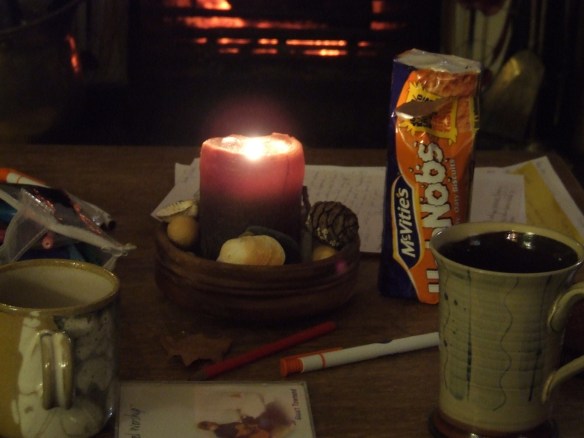
Housegroup has just finished again tonight. Just 9 of us, a log fire, and a packet of hobnobs.

And this evening, we shared with a friend who had finally made contact with a long lost daughter, we laughed a lot, and cried a little.

We shared our struggles with all the stories of God ordering genocide in the OT (Check out 1 Samuel chapter 15.)

And we wrote letters to some friends.

Lovely. And I am so grateful.

That familiar question- what is emerging?

building_church1

Like many others, I have been participating in the emerging church ‘conversation’ for a few years now.

It has been wonderful.

It has transformed the way I think about and understand faith, and brought me again to a deep love of Jesus and all he calls us to.

It has brought me into contact with wonderful people who are traveling in the same direction.

It has given me a genuine hope that things are changing- that something NEW is happening.

The Lion of Judah is circling again…

But it has also brought me into conflict with others- whose core beliefs lead them to adopting different positions in relation to some of the building blocks of faith. And within me, after these years of discussing and blogging and reading- I also wonder where we are up to with this thing.

I particularly wonder where we are up to in Scotland, 2009.

So- some questions!

Where are new forms of church emerging and in what ways are they different?

Where are the agitators, the innovators, the people who pioneer new (emerging) forms of church?

The term seems to be used too as a way for traditional churches to seek renewal. Is this genuine change, or is it merely an attempt to do the same things, but be a bit more trendy?

Where is leadership coming from? Do we need it, or is there still a reaction against centralisation and control?

How do we find mentoring and companionship? Do we still need sympathetic and skillful people who will hold us accountable? Where are these people?

These seems to me to be a difficult, but very important questions. Our reaction to them will no doubt very much depend on where we start from.

I am part of a small group of people outside established church. We meet in houses and celebrate in non-religious environments. We form partnerships where we can, and have many friends, and some folk who view us with at best considerable suspicion! Groups like ours have many advantages- freedom, mobility, passion and excitement. But they are also fragile and ephemeral. They tend to depend on a small group of innovators, and are held together by friendship. When the storms begin (as the surely will) many things can simply destroy such gatherings.

This may be the natural order of things. Perhaps what survives is what is of worth. But perhaps too, like me, you are hungry for connection and for ways to seek and to provide support. Perhaps you are facing a difficult situation, and just need to speak to someone who has been there before.

Perhaps too you are, or have been, part of church situations where you no longer feel at home, New ideas and ways of doing things are in your mind, but the leadership of the place where you are is not open to such things. Perhaps what you need is to find others who have adventured still within such a situation.

There is a discussion thread that digs into some of these things on the Emerging Scotland site.

So we begin lent…

Giving it up for lent?

Giving it up for lent?

Last night we celebrated the start of the lent season by getting together in The Crown in Dunoon. There were a few of us from Aoradh, along with some friends and others who had read about the event in the paper.

Brian from The Crown put on some pancakes, and we performed ’40’- Si Smith’s images, along with script, sound and music. We used this first last year in Kilmun village hall, also on shrove Tuesday, and it has since been part of a lent resources pack produced by the Church Mission Society. We also used a shortened version at Greenbelt festival last year. Powerful stuff.

Lent has had little significance in my Christian background, but like many others, I find myself increasingly drawn towards the rhythms given to the year by Christian festivals.

I am not sure if I will mark lent in giving up something specific. Last year, as a family we used an information pack produced by Christian Aid-  they have done something else this year here. Need to discuss tonight with the kids!

Photo’s  from last night below! (Click to enlarge.)

Words

ch11-newspaperclippings-950x1219

Words are such wonderful things.

Some of them bite. They are hard and brittle, snapping at the heels of postmen.

But others pour on you like oil, and when applied to the sore bits at just the right time, they are miraculous in their restorative power

Even the simplest of words carry within them Trojan horses of layered and hidden meaning.

In combination, they can contain all that we are. All we are for the good, but also all that we are for the bad.

Our lechery

And our lust

Our hatred

And narrow prejudice

Our grasping

And our empire building

Our war mongering

And our hard unyielding doctrines

Tears falling

Hearts breaking.

Woven from the same vowels and consonants as these things-

The tender glances of a girl who found love

The arms of a father encircling a child, growing all too fast

The crisp cotton of a woman lingering at the bedside of a dying man

Hope stoked by kindness

And creativity nurtured by praise

Life fully lived

And shared

The ancient Hebrews, in their attempt to understand God, looked for a word that might describe the presence that they half knew. God must have chuckled, because he gave them the name YHVH or YHWH, written with four consonants only; the holy unpronounceable Tetragramaton. By the time the Hebrew language evolved to include vowels, the early pronunciation of this word had been forgotten, as people had been forbidden from using this most holy precious name.

This name for God, this word for God, it was so precious, so full of unfathomable mystery, so unreachable, uncontainable, so fearful and awe inspiring- that it could not be allowed to pass the lips, but rather should rest on the soul.

I have sometimes wondered if we Christians, in becoming people of the book, have lost what it means to be people of the word.

We talk about ‘The Word of God’ as if it can be contained, categorised and shackled to our particular denomination.

But the words of the Bible, they are not easily classified. They tend to escape the butterfly net we swipe at them with. I think that was the intention behind the inspiration- not to confuse, but to draw us on into the adventure.

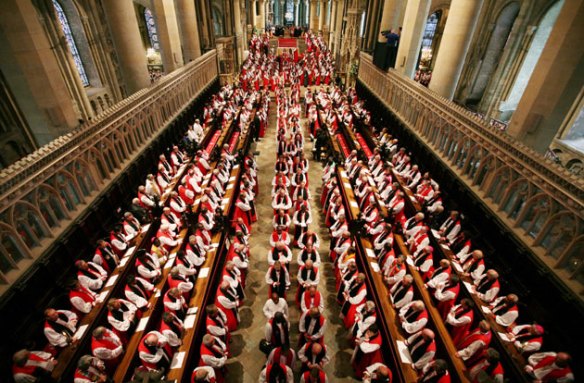
Church attendance on the rise in the UK?

canterbury-cathedral_39564a

Well I never.

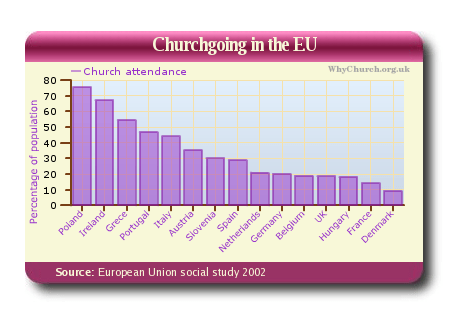
There has been a bit of a buzz around that church attendance figures in the UK are on the up! This after decades of dropping like a stone. These are the sorts of stats we have become used to (from here)

att_trend_chart

eu_church_att_chart

att_trend_chart

Of course, the picture was never simple- some individual churches are growing- the odd American imported super church, Black Pentecostal churches, and Orthodox churches- these have all been on the increase… albeit from a low base.

But statistics- they can be very misleading, so I did a bit of searching to see if I could find specific details of the studies.

The first one concerns a study done by Tearfund- mentioned in the Telegraph here.

A survey of 7,000 people by Tearfund found that 26 per cent say they went to a church service in 2008, up from 21 per cent the year before.

In addition, the proportion who say they attend church every month has risen from 13 per cent to 15 per cent, while one in 10 claim they go at least once a week, up from 9 per cent.

These are the highest figures recorded by the development agency for more than three years, contradicting research that has claimed churchgoing is in steady decline across Britain.

Young adults and pensioners are said to have taken up churchgoing in the greatest numbers, with a 10 per cent rise in attendance reported among the over-75s. Geographically, the biggest increase was seen in Wales (12 per cent).

It would mean that 7.3million adults now go to church – excluding weddings, baptisms and funerals – once a month. Official figures show that only 1.7m people attend Church of England services every month, while a further million attend weekly Mass at a Roman Catholic church.

The full details of the Tearfund study can be found on their website- here.

Another Telegraph articles makes the link with the deepening economic crisis- here.

Numbers of people attending Cathedral services have been on the increase for a while- see here and here.

So what are we to make of this? One swallow does not make a summer, but the numbers quoted in the Tearfund study are significant- as is the year on year 4% Cathedral attendance increase since 2000.

I think we people of faith should pay little heed to these figures. Let us instead remember some lessons learnt when church attendance figures looked like the charts above, which I think should include some of these-

  • We can no longer expect ‘attractional’ models of church to fill the pews.
  • Church is not about sacred buildings, but about letting loose the people of faith into the towns and cities about us.
  • The new context requires new ways of interpreting the gospel, and a re-examination of how the enculturalisation of church has contributed to a lack of relevance.
  • But the old mystical/contemplative traditions have much to teach us too.
  • Faith is discovered through action and interaction, not through didactic teaching.
  • Doctrine is not the most important thing.
  • Love is.

Saul of Tarsus- he was only human… wasn’t he?

Interesting discussion in housegroup the other night.

We are continuing with a study on Acts of the Apostles as part of the Exilio study, and we are up to chapters 25 and 26. It is in this passage that Paul manages to offend the Jews (again) and they get the Roman Governor to throw him into prison.
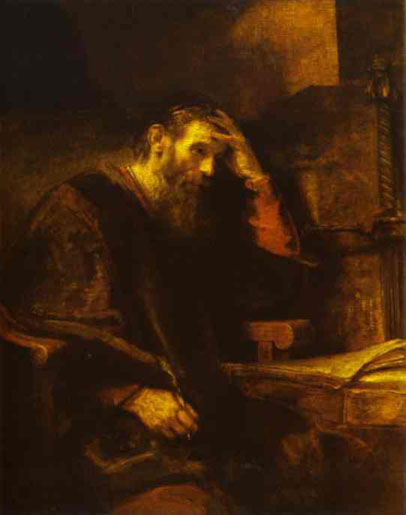
rembrandt-saint-paul-in-prison

This is not a new thing, Paul has been on the end of imprisonments and beatings in just about every town across the region. Each time, it works out for the best in the end.

But this time, when he is offered a trial, he does something he has not done before- he appeals to Caesar.

Paul was a Roman Citizen. We do not know how he acquired this status, but according to Wikipedia (so it must be true) citizenship was granted for one of the following reasons

  • Roman citizenship was granted automatically to every male child born in a legal marriage of a Roman citizen.
  • Freed slaves were given a limited form of Roman citizenship; they were still obliged in some aspects to their former owner who automatically became their patron.
  • The sons of freed slaves became full citizens.
  • Auxilia were rewarded with Roman citizenship after their term of service. Their children also became citizens.
  • Only Roman citizens could enlist in the Roman Legion. However an enlisted Roman legionary was deprived of many of his rights. He could not legally marry, and therefore all his children born during his military service were denied citizenship, unless and until he married their mother after his discharge.
  • Some individuals received Roman citizenship as a reward for outstanding service to Rome.
  • One could also buy citizenship, but at a very high price.
  • People who were from the Latin states were gradually granted citizenship.
  • Rome gradually granted citizenship to whole provinces; the third-century Constitutio Antoniniana granted it to all free male inhabitants of the Empire.

It iseems clear that in acquiring and then using  his rights as a full Roman Citizen, Paul was pulling rank. I wonder if in some way he was taking a step back- no longer being Paul, but rather reverting to Saul…

Citizenship seemed to involve swimming in some murky waters;

Roman citizenship was also used as a tool of foreign policy and control. Colonies and political allies would be granted a “minor” form of Roman citizenship, there being several graduated levels of citizenship and legal rights (the Latin Right was one of them). The promise of improved standing within the Roman “sphere of influence”, and the rivalry for standing with one’s neighbours, kept the focus of many of Rome’s neighbours and allies centered on the status quo of Roman culture, rather than trying to subvert or overthrow Rome’s influence.

The granting of citizenship to allies and the conquered was a vital step in the process of Romanization. This step was one of the most effective political tools and (at that point in history) original political ideas (perhaps one of the most important reasons for the success of Rome).

As a precursor to this, Alexander the Great had tried to “mingle” his Macedonians and other Greeks with the Persians, Egyptians, Syrians, etc in order to assimilate the people of the conquered Persian Empire, but after his death this policy was largely ignored by his successors. The idea was to assimilate, to turn a defeated and potentially rebellious enemy (or his sons) into a Roman citizen. Instead of having to wait for the unavoidable revolt of a conquered people (a tribe or a city-state) like Sparta and the conquered Helots, Rome made the “known” (conquered) world Roman.

There is the rather telling line in Acts 26 in which Festus suggests that Paul had done nothing wrong, and so would have been free to go, had he not have appealed to Caesar.

Paul was never free again after this point.

So- the question that hit me was whether in playing this political game, Paul got it wrong somehow. Perhaps he stopped relying on God, and the rollercoaster ride of following the Spirit into the missional life he was called to.

Because he was human. We easily forget this, I think as we read the accounts of his life in Acts, and as we live out doctrine based on his inspired writings. But there are enough hints of his human frailty despite the esteem in which he is described. The falling out with other people, the ‘thorn in his flesh’.

But if we can read the Roman Citizenship thing in this way- it seems harsh. Almost as if God is vengeful, merciless towards the mistakes of Paul, his faithful but imperfect servant. Is this a God you recognise?

It kind of reminds me of Pilgrims Progress, by Bunyan- a work that I have always disliked. Pilgrim has a road laid out before him, and should he step off this road- should he make the wrong turn, then he is in for trouble…

The fact is, this way of understanding the life of faith is just too deterministic. Almost as if Paul lived out a life of micro cause and effect, making choices like moving chess pieces, leading to sacred or profane consequences.

Almost as if God has mapped out a plan- a pre-determined track for each of our lives, and our task in life is to find it, and stumble along taking the utmost care to stay on this path at all costs…

footrpints

If this is not true, then how does God interact or respond to our choices? Is he just a (mostly) benign presence watching from afar as we, the ephemera, live out our little lives?

I think that this view of God neither matches the account from the Bible, nor my own experience.

I have come to believe that life is indeed about choice- decisions made in the presence of the Spirit of God, as we move through the difficult terrain of life. Some things go bad. But the Spirit is still there, still prompting and calling us on to a higher deeper way of loving others and serving the Kingdom.

And some decisions have consequences that go beyond the immediate situation. Does that mean that we can count on miraculous intervention by Angels to rescue us? I do not think so. But then again…

But if not, it is perhaps good to remember that the mission of Paul began anew- on a journey to Rome, and through the wonderful letters written to early outposts of the Kingdom that survive today.

Communing in the overlap…

Just Mooching Around (geddit?)

A story;

A man called Isaac grows and lives in a small village. He works hard on his farm, rising with the sun and tending the garden God gave him, tilling the rich brown earth. Rains come and water the green growth and plumps the ripening fruit. Life is good.

Next door lives his great friend Joseph. In the evenings they sit in the light of the harvest moon and share their hopes and dreams. They drink toasts to the future and laugh and joke and dream.

God looked upon them and smiled.

One day, Joseph inherits money from a long lost relative- just enough to buy a cow. And he walks it home up the hill and the evening light shines on its hide like velvet. He runs over to Isaac and invites him over to see the cow in its green pasture, solid and big and bountiful. “Look…” he says, “Look what God has brought to us- now we can have milk in the mornings- butter, cheese!”

But the cow became a shadow between Isaac and Joseph.

And one day, God visited Isaac and asked him what was wrong. Isaac said “It is the cow Lord- it has made Joseph into someone else. He used to be my friend.”

And God was sad.

“Isaac,” he said quietly, “If I can do anything for you- if I can grant you a wish, what would it be?”

Isaac looked up at God with cunning eyes.

“Kill the cow” he said.

Community.

As followers of Jesus, it is our calling, our aspiration, our tranforming power, and the very characteristic of the children of the living God.

Oh… and it can be hard.

Because real community implies closeness to those around us. It suggests relationships that go beyond the surface into the deep, undefended vulnerable parts of us.

And in doing this we are beautiful- as we serve and support, as we learn to love and let go our selfish stuff for the sake of the beautiful other. As we break bread and share wine.

But in doing this- we also are ugly- as we compete and squabble, as we dominate and oppress in the small things of a day, as we take in information and filter it through a screen of past hurts. As we nurse wounds and pick at the stitches until they burst and bleed on our communal table.

What was Jesus thinking of when he threw together his own band of disputing disciples? When he cautioned them that others will know that they are his followers by the love they had for one another?

Perhaps, just perhaps if we survive the examination of the stuff that we hide most carefully from the other- and we do not run away to build our own ego’s from bricks formed out of the manifest failings of our perceived inquisitors…

Perhaps then we might find that community is possible.

Because we Christians live in the overlap of what life is, and what we long for it to become.

The legacy of church in the lives of children of the fundamentalists…

I met with some friends yesterday as part of our on-going attempt to get a supportive network for people who are interested in emerging/missional stuff in Scotland (details here for those who are interested- I will post an account of our meeting later.)

It was a great day- with many interesting conversations, and capped off with a visit to Glasgow to see some live music (Welsh language band 9Bach and The Broken Family Band- brilliant both.)

godstop1

One conversation we had was about kids and church. Like me, quite a few of my friends have grown up in church situations in which narrow belief systems and codes for living were espoused. For me it was to be part of an evangelical/Charismatic tradition, in a difficult family context. For a couple of other friends, their history comes from Lewis, and the stern austere, almost puritan, Free Church of Scotland. Then there are a few Baptists, or Pentecostals, and Catholics.

For many of us, the journey of faith ever since has contained an attempt to come to terms with some aspects and attributes of God- and what he expected of us- that were given to us by our backgrounds. When I say ‘given’, I include things we were told, and a wider way of seeing things that we just internalised though socialisation, if not indoctrinisation.

Some of my friends came to a point where they rejected church, because they could no longer live with some of the narrow and judgmental views that it represented for them. In losing church, it was difficult not to lose God too- at least for a while. Add the abusive actions of some of  the servants of Jesus in churches we are familiar with, and it perhaps makes it all the more difficult for people to find church again, or even to hold on to faith at all. (There is some more stuff about abuse in churches here and here and here.)

businessman-voodoo-doll-giclee-print-c12350887

But my friends and I- we remain drawn by the wonderful person of Jesus- and he leads us back to God the Father, God the Spirit- and the ecclesia- the collectives of the agents of the Kingdom of God.

As previously mentioned, yesterday, the discussion turned to children in Church. We all grew up with Sunday schools, and weekends regulated by attendance at a series of mostly boring services. The question concerned how much of this we felt we could inflict on our own kids?

Can we protect them from our experiences?

Where our experiences actually bad?

If so, in the balance of things- was there more bad than good?

The interesting thing was that all of us came to the conclusion that despite the difficulties, our church backgrounds, with all their guilt-and-confusion-inducing narrow viewpoints, brought to us mostly good and positive things.

Perhaps this was because we are a limited sample- people who still try to follow Jesus, rather than the many who have lost him entirely. These people are the prodigal lost sheep the Church may never return to the fold. My prayer is that Jesus will still bring them to him…

But I wonder if there is also something of a generational passing of the baton towards the new post-modern generation. We represent a punk generation, who later find an ironic pleasure in prog-rock, whilst also being drawn to Madrigals and Gregorian chant. There has been the necessary rebellion- but ultimately, there is nothing new under the sun, and the next generation will need their points of departure from ours!

Time will tell whether what they inherit from understudying the whole missional/emerging experiment equips them for their own journeys of faith more than our own childhoods.

For their own children’s sake- I hope so.

kids-in-church

Doing battle with the atheists- ‘probably’ a waste of time…

atheism

So, Christians find themselves in the news again.

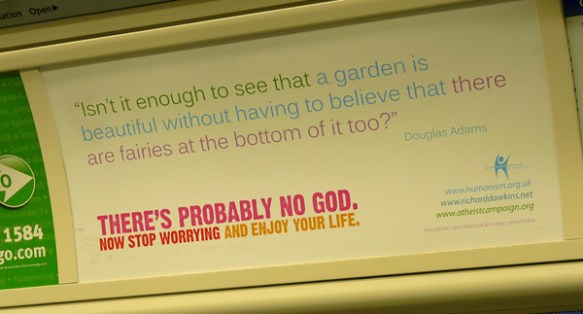
Ron Heather, a bus driver from Southampton turned up for work last week, and found himself faced with a vehicle emblazoned with advertising paid for by an Atheistic campaign, with the slogan- ‘There is probably no God, now stop worrying and enjoy your life.’ Ron, as a Christian, found this objectionable, and so told his employers that he could not drive the bus. Ron seems to be a good bloke from the little we can see of him, and his dilemma heart felt and honest. Check out the story here.

But the story of the campaign is a fascinating one for many of us. It seems to shine a light on the place of faith and belief in our time and context, and perhaps it may yet enable healthy debate and discussion.

So- what is it all about?

Step forward the first protagonists- atheist campaign.org (It is well worth checking out their website.)

The campaign, interestingly enough, seems to have started as a REACTION to bus campaigns about judgment and sinners burning in lakes of fire run by Christians! Here is some footage from the launch;

Toynbee and Dawkins- the heavy hitters behind this campaign- are interesting figures. One a broadsheet columnist, and intellectual- the other a scientist who has a brilliant but flawed reputation. Neither of them are people who could be thought to have their finger on the pulse of post modern Britain. In fact, Dawkins in particular seems to me to be regarded as a severe and arrogant figure, whose rationalistic determinism is particularly modern.

Then we have the counter reaction from Christian Voice. Here is a quote from their director Stephen Green

‘According to one national newspaper, ‘some atheist supporters of the campaign were disappointed that the wording of the adverts did not declare categorically that God does not exist, although there were fears that this could break advertising guidelines.’

‘Well, I believe the ad breaks the Advertising Code anyway, unless the advertisers hold evidence that God probably does not exist.

‘The ASA does not just cover goods and services, it covers all advertising. The advertisers cannot hide behind the ASA’s ‘matters of opinion’ exclusion, because no person or body is named as the author of the statement. It is given as a statement of fact and that means it must be capable of substantiation if it is not to break the rules.

‘There is plenty of evidence for God, from peoples’ personal experience, to the complexity, interdependence, beauty and design of the natural world. But there is scant evidence on the other side, so I think the advertisers are really going to struggle to show their claim is not an exaggeration or inaccurate, as the ASA code puts it.

The Christian evangelist is not concerned by fears that his complaint will lead to atheists complaining about Christian adverts. ‘I am sure many of them have complained about Christian advertising already,’ he said, ‘but a statement such as “The Bible says ‘the wages of sin is death but the gift of God is eternal life through Jesus Christ our Lord'” is entirely factual. The Bible does say that. The statement “Jesus said, ‘I am the way, the truth and the life – no-one comes to the Father but by me,'” to take another example, is a Biblical quote, from the same Bible which is part of our Christian Constitution and upon which witnesses promise to tell the truth in Court. The Bible is, to coin a phrase, our Bible.’

So, the battle is joined over whether you can ‘prove’ God exists, and predictably, for some Christians the proof is to be found in the didactic statements taken from the Bible(the King James version of course)- and so that is enough. For others, this argument is akin to believing in Klingons because we saw them on Star Trek.

Again- it is well worth checking out the Christian voice website. The message given is that Britain is a land that is sliding into a cess pit of sin, promiscuity, perversion and homosexuality. Christian voice casts itself as a lone voice speaking for the truth of God in the middle of a the Godless heathen, who are all heading for the fires of hell, lest they heed the warning.

In reading it I find myself, even as a Christian, alienated and ashamed of what these people have made of the Gospel of Jesus. I find myself disagreeing with both the substance and the tone of the message. It sits at such odds with everything that I understand the Gospel of Jesus to be about.

But what might be the outcome of this little splash of media attention given to we people of faith, and the militant evangelists of atheism?

I have mixed feelings- and feel another list coming on!

  1. As a Christian, I find the atheist slogans upsetting- but think that they have as much right to display them as Christians have to display our evangelical messages.
  2. Some of the Christian slogans make me feel just as uncomfortable!
  3. I wonder whether this is a real opportunity for people to think again about God, and rather than a negative campaign, this might encourage people to ask questions and in fact, draw them closer to God?
  4. This battle seems to belong to an earlier age- a time of Christendom and modernism. It seems to me to engage with a debate about spirituality that most people have no interest in at all. It is as likely to alienate people from Dawkins and his disciples as it is to turn them from God.
  5. Is our role as Christians to ‘defend the faith’ or to ‘defend God’? Is it to set ourselves up as moral arbiters for our society- pointing the finger at the ungodly and the sinful wherever we see it? Or is it rather to let others know our allegiance by the love we show for one another?

So- here’s a question. Please vote!

Dancing Drakes prayer…

Thanks to Mark Berry for this-

A link to a collection of worship resources, including a setting of a prayer thought to be by the Elizabethan adventurer Sir Francis Drake- he of the cloak-in-the-mud and the bowling-whilst-the-Spanish armada is approaching fame. (Or was that Walter Raleigh?)

It kind of resonated with something I had written before- here.

Here it is- thanks guys!