Kindness- as a measure of spiritual maturity

Another great collection on Radio 4’s start the week programme. Listen again to it here.

There was this fascinating discussion about KINDNESS, relating to this new book, co written by a psycho analyst Adam Philips  and Historian Barbara Taylor.

on-kindness

They appear to take the view that our society has retreated from kindness as a way of interacting and engaging with the people around us. We assume that we are no longer inter-dependent and needful of others, and so kindness becomes identified with a kind of weakness and vulnerability.

They go as far as to suggest that we tend naturally towards kindness, but learn to suppress this as we grow into our culture. All Kindness, suggests Philips, is a RISK- but a risk that is transformative in the taking.

There is a review of this book in Guardian by Mary Warnock where she says this

Kindness to others arises out of sympathy. As the authors note, there is much evidence that other animals besides human beings (or “men” as they properly designate them) can enter into the sufferings and fears of others of their kind. But it is human animals alone who, because of their imaginative powers, can enter into the feelings of other people far removed from them, whom they cannot see or touch, but whose plight as fellow-humans they can share

In the Gospel of St Luke, a lawyer is told by Jesus that to live well he must love his neighbour as himself and, when he further asks who is to count as his neighbour, Jesus answers with the story of the good Samaritan, for many the very essence of Christianity. Kindness here arose spontaneously, not in obedience to any rule, in fact in defiance of convention. But as Christianity became increasingly ecclesiastical and hierarchical, with the consequent corruption of the priesthood, the good Samaritan was forgotten.

The new Protestantism declared man to be fundamentally sinful, such good actions as he could do dependent on the grace of God; and so the possibility of natural kindness disappeared.

So we come back to Jesus, and his call to live for a radically different agenda, according to the rules of a New Kingdom. And one of the watch-words of this new kingdom- is kindness.

It is one of those fruit listed by Paul as evidence of the indwelling of the Holy Spirit. (See here for some more ponderings on this.)

When we come into contact with kindness at a point of real need, we rarely forget it. It lives on in our souls. As Paul said in 1 Corinthians- all sorts of other loud and visible manifestations of faith will clang like gongs and then fall silent- but love will last for ever.

Which makes me think again about the myth of the super-Christian. I am interested in the stature aquired and the adoration we give to some of our leaders- perhaps for their charisma, their vision or their oratory power. When one of these paragons of Christianity falls from Grace, how dreadful it seems… how shocking.

Might this be because we measure spirituality according to a strange criteria? We equate knowledge with understanding, declaration with practice and power with ordination from on high.

Might we best return to a simple measure- of kindness shown, and a skew towards grace in all things. These are the leaders I look for. Jesus has ruined the others for me!
Why should the Devil have all the good apples?

wassail3

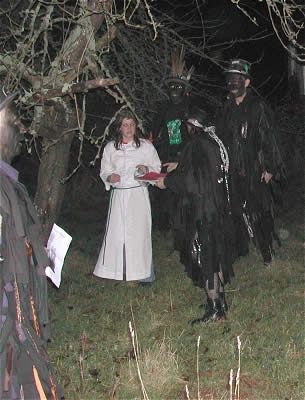
Apparently, in the old orchards of Somerset and Devon, we are entering Wassailing season- traditionaly 12th night (5th January.)

A lovely word is wassailing- thought to be from the old Norse influenced English- meaning ‘good health’. It rolls on the tongue like scrumpy.

Which is kind of appropriate, as the most common use of the word concerns an old tradition of ceremonies of song and dance and drinking to bless the apple trees, warding off evil spirits and willing the tree to produce a crop for the coming year.

Wassailing also is a word used to describe carol singing in the streets, around new year, and also seems to have been a time when feudal masters were celebrated by their subjects, in response to their seasonal munificence.

The origins of these ceremonies have all been lost in time, but they seem to have more than a whiff of the Pagan about them. The old festivals of the passing of the winter equinox, and the hope of a coming spring. The early Church, as with other festivals, embraced it, and made it Christian. The songs of the wassailers became ones seeking the blessing of God.

So the most well known Wassailing song is this one;

Here we come a wassailing
among the leaves so green,
Here we come a wandering
So fair to be seen.

Chorus:
Love and joy come to you
and to your good Christmas too
And God bless you and send you a happy New Year
And God send you a happy New Year.

We are not daily beggars
that beg from door to door,
We are your neighbor’s children
whom you have seen before.

Chorus

We have got a little purse
of stretching leather skin;
We want a little money
to line it well within.

Chorus

God bless the master of this house,
likewise the mistress, too,
And all the little children
that round the table go.

Chorus

So- why on earth am I going on about this, I hear you ask?

Well, I have been part of groups of charismatic Christians who have tended to understand spirituality as a warfare, first and foremost. So all things come to be measured according to what significance they might have within this unseen war.

This insight is an important one. In Pauls letter to the Ephesians, we read this famous passage-

Finally, be strong in the Lord and in his mighty power. Put on the full armor of God so that you can take your stand against the devil’s schemes. For our struggle is not against flesh and blood, but against the rulers, against the authorities, against the powers of this dark world and against the spiritual forces of evil in the heavenly realms. Therefore put on the full armor of God, so that when the day of evil comes, you may be able to stand your ground, and after you have done everything, to stand.

An understanding flowing from these passages has led to a rejection of anything that has a hint of alternative spirituality- whether this comes from other religions, or perhaps even more so when Pagan traditions are invoked.

People seemed to express real fear that exposure to such things could in some way corrupt or damage us- we could be affected by a ‘Spirit-of….’, which could only be dealt with by those who practice deliverance ministry-releasing us from the bondage of evil influence on our lives.

This view of the world and the many things within it can lead to an intense exclusivity and isolation. Whatever the truth of the spiritual powers understood or suspected (and I should confess to a skepticism in some cases at least!) then I think it important to remember that like the festivals noted above, the early church seemed to have a very different way of working with the traditions and cultural symbols that they encountered.

Paul and the temple to the unknown God, recorded in Acts.

Peter and the Gentiles- the sheet from Heaven etc.

The establishment of early Christian shrines on pre-Christian religious sites that appears to have been common practice.

The example of the early Celtic Church and the use of pre-Christian images and symbols and practices to celebrate the new faith.

Is this corruption or syncretism? I do not think so. Accommodation with a spirituality that is damaging is indeed something that we should guard against- but boxing ourselves into fearful religious enclaves- this seems to me to be even more damaging.

We live in a post-Christian world here in the west, and increasingly, the world around us draws it’s spirituality from outside the Christian tradition. Like those early Celtic missionaries, we have no choice but to engage with this reality. The question that should concern us is how we bring Jesus with us as we move into an alien landscape. How do we live as Agents of the Kingdom in this foreign land?

So on this 12th night, let us put on the armour of the Living God and walk tall- secure in the knowledge that before Him, nothing will stand.

Why should the Devil have all the good apples?


The spiritual discipline of no longer coping…

not-coping

If any of you wants to be my follower, you must put aside your own pleasures, your own ways of coping, and follow the way of the cross.

Walk close with me…

If you insist on saving your life- you will just end up losing it.

You will just end up WASTING it.

Only those who are prepared to lose it all for my sake, and for the sake of my Kingdom, will ever know what it really means to LIVE…

From Mark 8:34-35.

Heres a question: Is it possible that the things we do to enable us to survive, or to socialise-even to succeed- easily become the seeds of our downfall? Perhaps the stuff that insulates us from one another, and from God?

I have thought about this a lot. It is one of those many areas where my understanding of God has been enhanced by my work with people who have mental health problems.

You see, perhaps the most influential therapeutic approach today is Cognitive Behavioural Therapy (CBT). CBT encourages us to look at the way our thoughts, emotions, actions and physical sensations interact to form repetitive feedback loops that can be enslaving and extremely difficult to escape.

That is not to say that these loops are always dysfunctional. The truth is, much of how we engage with the world about us seems to be built on these things. We find ways, sometimes at a very early age, of managing the interface with the stresses and strains of life, and these tend to just continue into adulthood. For most of the time, this is just how it is- we do not need to examine this in any detail.

One of the things that CBT therapists will look for as we try to help people are ‘safety behaviours’. These are the things we do to enable us to get through. Of particular significance, and introducing the most complication, are those things we get into to cope with SOCIAL risks- that most subtle of human response to the risk of exposure, ridicule an embarrassment.

For some people, the safety behaviours may be highly damaging- drugs, alcohol, dependency on sex, or imprisonment in abusive relationships. For some, violence and anger become their defining emotion- enabling them always to be right.

For many of us, they may include more manageable, but still potentially unhelpful ways of keeping the world at bay- food, stuff that makes us feel good for a while, possessions, the pursuit of recognition and significance…

Then there are even more of us who appear to be doing OK. We have our things, our successes, and our projects. We know where we are going, more or less, and who we are going there with. We can cope with most of what life throws at us, because we are moving on our own tram lines- we have bought a ticket, and the only way is forward…

For those of us in the latter group, it is often only CRISIS that makes us take stock.

That makes us look at the safety behaviours we wrap ourselves in, and ask whether they are worth holding on to.

When I look at the passage above from Mark’s gospel, I wonder if Jesus knew all about this. I wonder if he understood that life lived for nothing is no life at all. That life insulated from people and from God is a lesser existence. That life where safety-comes-first will only ever be half life.

So I wondered about the need for us all to STOP coping.

To stop being in control.

To step outside the treadmill of the expected, the predictable, the manageable.

Into the great glorious unknown.

Where God is.

Imagine theres no heaven. Above us only sky…

WARNING- sweary-words to be heard in the following clip.

Avoid if of a sensitive disposition- or if you are under/over the age at which knowledge of profanity should not be encouraged…

If like me, your tolerance for such things hints at your backslidden sinful state, then click on…

I stumbled across this whilst wasting time when I should have been DIYing (I now have water coming through the ceiling beneath where I recently installed a new shower. AGHHH!)

It set me thinking again about heaven, and hell, and what we might encounter when we die…

Oh, and I liked the accents too.

So what do we think about heaven and hell?

It seems that we Christians have two options to choose from-

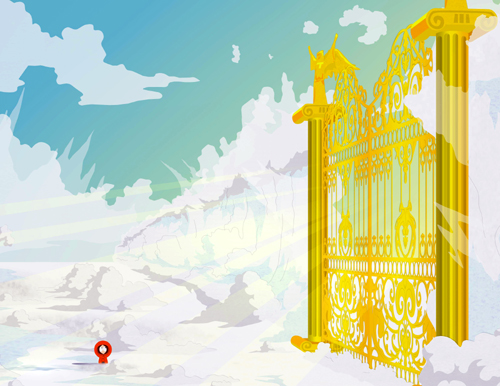
Option 1- lots of soft clouds, harps and gold- HEAVEN

Option 1- lots of soft clouds, harps and gold- HEAVEN

Option 2- fire, smoke, eternal torment- HELL

Option 2- fire, smoke, eternal torment- HELL

Hmmmm- which one do you fancy?

This, I suppose has been the evangelical strategy of church for a long time. Even though it has always troubled me- (back to those old Chick cartoons again I suppose!) It was not really that this narrow view of our impending fate was questionable within the theological understanding I was part of, but more that it was usually played down by most, and perhaps OVERPLAYED by some others.

But questions about the essential truth of this equation were never encouraged. Some of this was about Biblical truth, and the unassailable network that had been constructed around particular meanings, and some of it was about POWER- and the in-out stuff that allows us to decide who is OK, and who is not.

My concerns have always been for the following reasons-

  1. Is it OK to SCARE people into the Kingdom? Or are we just telling it like it is?
  2. Will a God of love REALLY throw all these people- good and bad, kids and those who have learning disabilities- any who died without a profession of faith- into a lake of fire to burn in agony for eternity?
  3. What about Jesus? What did he have to say about this? These words are often quoted– And if your foot causes you to sin, cut it off. It is better for you to enter life crippled than to have two feet and be thrown into hell. And if your eye causes you to sin, pluck it out. It is better for you to enter the kingdom of God with one eye than to have two eyes and be thrown into hell, where “their worm does not die, and the fire is not quenched. (Mark 9:45-45)
  4. And what about heaven? Does it not just sound slightly boring? A church service that never ends? (I have been in a few of those- or it seemed like it at the time!) Is this just the least-worse option?
  5. Then there is the ‘your-reward-will-be-in-heaven’ business. Do lots of good, as you will get a nice big mansion, with a throne view.

So where am I up to now?

Well I realised that lots of Christian traditions have different views about heaven and hell. Some people have always had the concerns above, and even dared to express them.

To give McLaren another plug, I read his book ‘The last word and the word after that‘ a few years51ez759rekl_bo2204203200_pisitb-sticker-arrow-clicktopright35-76_aa240_sh20_ou02_ ago, and it was another one of those painful experiences, where I found myself confronting things I had avoided for fear of losing faith altogether.

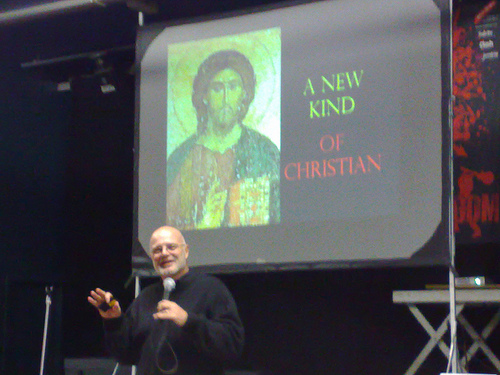
But the end result was a deepening of the sense of who God might be, and how he might engage with us all.

In particular I was amazed to discover that the view of heaven and hell I had accepted as a fixed Biblical position appeared to have its origins outside the Bible, and perhaps even outside the Judeo-Christian world (this is not an idea original to McLaren, it seems, but is well understood by many Theologians, but ignored as irrelevant by others.)

A quote from Brian (pinched from an interesting blog post here)

One of the discoveries that led to the book came to me several years ago, but I don’t remember exactly how. I remember noticing that a number of Old Testament writers didn’t seem to believe in an afterlife. It was obvious in Ecclesiastes, but you know – that whole book seems odd. It struck me in some of the Psalms especially. Then I noticed this lack of belief in afterlife in other places, and I realized that Sheol wasn’t the same as hell.

Then I began to notice that Jesus talked about hell a lot, which let me know that something must have happened between the end of the Old Testament and the beginning of the New. I was curious about what happened during that time.

What appears to have happened is that some Jewish sects/denominations (but not all) adopted ideas of heaven and hell from other religions- such as the Zoroastrians, and this synthesis of belief systems became the understanding through which the Jewish people engaged with God.

There were apparently significant differences in for example, the Pharisees understanding of heaven and hell, and that of the Saducees. The former believed in the resurrection of the dead and the latter did not. Interestingly, it seems that the Saducees rejected the Pharisaical views on an afterlife on the basis of a literalistic interpretation of the Bible, rejecting the exegesis and oral traditions of the Pharisees. Truth wars were raging then too!

It seems that these grouping effectively became political parties too- so religion was definitely mixed with politics!

Does this matter?

Well when you read again the questions put to Jesus in the form of tests by these groups, it seems at least possible that they were attempting to either bring Jesus within their own fold, or expose his theology to be outside their understanding of truth, and so reject him.

The wonderful thing about Jesus is that these attempts failed, because he saw the trap coming a mile away, and neatly stepped around it. He seemed to have no time for this way of seeing faith.

Is it possible then that at least some of the words of Jesus in relation to heaven and hell can be read in the light of the context in which he was engaging? Does this change our understanding of what he was saying, or how it was recorded?

STOP! I hear you cry. This is going too far- it is a liberal re-interpretation of the Bible that will end in heresy!

In my defense, I offer no fixed positions to invite you to join me onto, and thereby defend.

But I dare to believe that the life that goes on when we are done here will always remain to us a wonderful mystery.

And I dare to hope that Jesus may yet find a way to save those who we have lost.

Hell may or may not be the place that burns up that part of us that is unworthy and unwelcome in the presence of the Living God.

And I pray that by his mercy, I will fall into the arms of a loving God.

The Underground Railway…

In response to Brian McLaren’s event in Glasgow (mentioned in my previous post- here), here is an excerpt from part of a book called ‘Blue-dark’, available here.

I reproduce it as a kind of mission statement- a reminder of what I set myself towards.

I have a feeling I may have posted this before, but for my own sake at least, I think it is worth saying again!

The term ‘underground railroad’ was first used in relation to an organisation of people who helped slaves escape from the American south to the northern states who had declared against slavery.

80906515CJ001_AUSHWITZ_BIRK

In the dark days of the Third Reich, when the whole of Europe was under the heel of dictatorship, still there was a remnant. There were men and women who were uncontaminated by circumstance, and emboldened by passions born of a different Kingdom. Sleeping now like spring in winter were memories of better times now gone. And with the sleep came dreams of justice for the oppressed, liberation for captives, and ministry to the sick and the lame and the alien in a conquered land.

Ordinary people – just like you and me, in an extraordinary situation, performing simple acts of heroism, in the face of certain prosecution and possible death. At first they were loud in their outrage, but hard lessons taught caution and subterfuge, and so they went underground.

And quietly, in the shadows, they grew bolder, and found that they were not alone. Many people opened up their lives and their homes, and began to gather the unlovely and the unloved, to give food, and warmth and shelter. They found others who still kept the light alive. And so they formed a network. No-one knew the whole of this network – the overall plan was less important than the simplicity of saving those immediately at risk. But almost by some hidden hand, Jews, gypsies, gentiles, escaped soldiers, political undesirables – all were passed down the line – closer to freedom, closer to the other Kingdom.

So was born a time of heroes.

And the Underground Railway…

I think that we are called to live what we believe.

And to believe in how we live.

It sounds simple, but so few do. Jesus said that when we are born again in him, we become new creations. The old parts of us are dead and gone, and the new person is made in His image. This means that we become more like him.

More passionate
More compassionate
More holy
More real
More loving
More merciful
More open
More hungry for justice
More whole
More like a child
More willing to go for it!

Less selfish
Less concerned about earthly security
Less proud
Less jealous of what others have
Less carnal
Less judging of others
Less earthbound
Less empty.

So what gets in the way? Why is it that the old habits drag me down? It is almost as if the old man, who is dead, rises in me like a corpse and fills me with the smell of death.

And somehow this becomes normal. It becomes culturally acceptable. We see it all around us, in both the secular and the so-called sacred. Jesus told us to enter through the narrow gate, because the alternative is broad and easy, but leads to destruction. Narrow is the way to life, and only a few find it (Matt 7: 13-14).

He was never much into going with the flow.

What would it be like to live what we believe? It would mean loving God, and loving others. Simple.

Unlearning lots of layers of stuff that get between us and Him, between us and people.

I believe it is possible. Because I have seen it. I have seen men changed. I have felt it. I am not the same.

And I am not my own – I belong to a different kingdom. This kingdom has different rules and has a different culture.

So I decided to set myself again to live what I believe. I became less tolerant of the smell of death, and instead went for life, and laughter, and freedom. Like Lazarus, I walked to the mouth of the tomb, and looked out.

And I began to see a world full of different colours. It brought me to tears, but still I wanted to sing praise songs, redemption songs, songs of freedom.

But also, I saw again the people all about me through new eyes. Some were broken almost beyond repair, at least in this world. Others were hungry, others were homeless. And here and there were people captured by addictions and close to death. Many of them had been inoculated against God by their experience of religion. It was almost as if he was giving me a window into their souls. And my heart broke open.

I decided that it was wrong, and something needed to be done. But it is hard to go against the culture, to swim against the tide.

What is needed, I thought, is an underground railway…

(From ‘Blue Dark, 2006, by Chris Goan)

Lessons on Kingdom from Brian McLaren…

brian-mclaren

I took a trip into Glasgow last night to hear Brian McLaren speak at Strathclyde university. His writing has been hugely influential on my spiritual life and my understandings of faith, and so I felt a bit like a groupie!

I went with a couple of friends from Dunoon, Simon and Ali, and had a chance to meet up with a couple of on-line buddies too- Stewart and Thomas. In fact, the picture above is Stewart’s- who had the technology (royalty check in t’post!)

It was a great night. Finished off by a lovely drive home over the Rest and be Thankful pass under a clear starry sky. Oh and a good take-away in Balloch…

Brian McLaren was profound in what he said- and although not much of it was new to me, the words were like food to the soul. Lots of people seem to have this experience of listening to him almost telling their story- allowing them to ask questions, and permitting them to start a new journey with God. I am reluctant to build him up with labels that will later become millstones around his neck, but he has something of the Apostle about him that is not taken, but rests as a result of who he is.

Yesterday is a case in point- it was not just what he said, but the way he said it. There was a kindness to his words- a respect for all things, but always a gentle invitation for as all to aim for something better.

Highlights? For me there were many. He got into a lot of discussion about the Kingdom of God- and old theme for me, which has been the subject of much discussion in our housegroup. We had previously playfully tried to find new names for the Kingdom of God, and I was delighted to see McLaren taking this to a whole new level.

The suggestion is, that Jesus was using the term ‘Kingdom of God’ as a way to engage with the people of his time in words they would understand. If he was here today- he would do the same, but would not necessarily use the same words.

‘Kingdom’ today ( suggested McLaren) is a word that has lost it’s potency- it is embedded in an ancient understanding of power and authority. What Jesus was doing was suggesting that there was a new way of doing Kingdom.

He then went on to list a whole series of words that Jesus might use if he was here today (Stewart gives a list of these on his blog- The Dream of God, The Peace Revolution of God, The Mission of God, The Party of God, Network of God, Ecosystem of God, God’s New Planet, Beloved Community, God’s Economy, The democracy of God.)

But there were two that I really liked.

One was

The dance of God

The idea that we learn to take part in a dance, in which we are part of an interrelated, dependent cycle of life and love- moving in response to divine music…

And perhaps most of all, I liked

The non-terror cell of God, or The insurgency of God

These seemed redolent with an idea that has been buzzing about my head for a while about a subversive group of Christians modeled loosely on the underground railway- I’ll post it soon I reckon.

The men who talk too much…

whiskyI met up with a friend this evening who I had not seen for a couple of years. We met at a conference in Holland at which I was leading worship a few years ago. He is a lovely guy with a deep and passionate faith and a restless, driven energy.

It was great to see him again- to hear of his news from Ireland and work in Finland. And so sit in front of a fire with a glass or two of Whisky.

It came to me again how much or paths have taken different directions.

When I met him he was a Charismatic Catholic and I was attending a Baptist Church. He left Catholicism and moved into a Charismatic Evangelical church, and now is in a small house church. His theology is firmly towards Spirit inspiration of the Holy Word of God.

As for me, well I meet with friends in a house, get involved with other things via an arts group and seek wider fellowship with people who have found a place within the ’emerging church’ discussion.

My friend and I, as we have done previously, soon got into deep discussion. Sometimes this conversation verged on argument, but not really- although it was passionate and heart felt. Another friend bowed out early and went home, and Michaela kept out of our way too…

The point of conflict was about the usual things around emerging church- the totemic issue of homosexuality, the way we understand and read the Bible and the issue of ‘Demonic deception’ that began in the roots of the emerging church movement. He had read a book that spelled out the dangerous errors present within and underneath the EC. We could not go into detail, as Michaela was giving him a lift home, and called time at 1 AM.

Is there any point in these conversations? Neither of us was likely to make any major shifts in thinking.

I suppose you could say that they have the effect of rehearsing the arguments, testing the core assumptions and developing a deeper understanding.

But I think they may be also energy sapping and distracting. The EC has not got it all sorted- but then, who has?

Meanwhile, there is the real stuff to get on with- the living and loving and the serving and greeting of old friends.

Church: as garden, park, glen and meadow…

the-church-in-emerging-culture

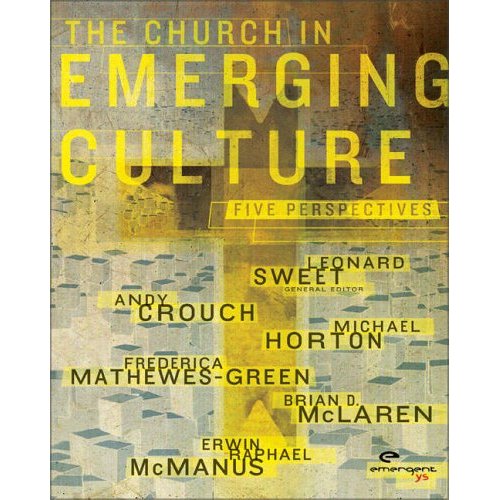
I have been reading this book- ‘The church in emerging culture’, ed Leonard Sweet. It takes a look at where church is up to from 5 perspectives- Andy Crouch, Michael Horton, Fredrica Mathewes-Green, Brian McLaren and Erwin McManus.

I have lost my way with it a little- more because of the format I think. Each person writes a chapter, then the other authors get a chance to put in footnotes and comments. I like the idea, but in practice, it makes for a strange book- lots of the comments are congratulatory, or disagreeing whilst being terribly nice.

However, there is an introduction by Leonard Sweet in which he uses this image to make us think about the different ways of being church. I have simplified (because I had to- the bloke it too clever for me!) the discussion, and reproduce it here.

What do you think? Is this a good analogy?

I suppose the interesting thing is that flowers and fruit grow in all of these places- and they can all be very beautiful…

Garden- traditional church?formal-garden

An ‘enclosure’- fenced off enclave of righteousness. Rooted in traditions. Collaboration between divine gardener (God), master gardeners (ministers) and horticulturalists (theologians), along with the canonical seasons.

Fruit and flowers grow and are appreciated.

The outside of the garden is of little concern. The garden is shaped and hallowed.

The garden demands that we walk slowly, prune quickly, earn the flowers by hard work- composting them well with the goodness distilled from previous generations.

Alien seeds are not tolerated. Constant struggle to win back the garden from the encroachment of time and surrounding wilderness.

Park- evangelical church?phoenix-park

Made for walking. Tied together by paths and vistas. Taking the old story of nature, and reforming it in new ways.

Rather than setting up high barriers, the park regulates the space by RULES. It is open to visitors at appointed times and under the supervision of park-keepers.

Technology and innovation are employed in parks- fountains, play areas- things that attract visitors.

The park manager decides which features to include in the park, borrowing from a wide variety of flora and fauna- but does not do so uncritically- always striving to work within the opportunities given by landscape and tradition.

Glen- progressive church?welcome-to-glen-clova-scotland

The glen is an open and unprotected, surrounded by encroaching vegetation and forest.

It is defined by the relationship between landscape and soil fertility that allows settlement. The edges of the glen- its crags and steep slopes, require hard work to navigate. People avoid these places because of the fear of falling.

Glen dwellers revel in the mystery of the seed and season. They travel in packs of people of group consciousness. They are concerned with the cultivation of food from the land to feed the hungry, not about the beauty of gardens and parklands.

In the garden, you are what your parents planted- here, you are what your seeds become…

The people of the glen have to be highly adaptable and innovative to survive. The thin soil easily washes away, and new production methods have to be embraced.

However, in the Glen, tradition is powerful. People are more likely to look backwards than forwards. The reformers often seek to purify what already exists…

The meadow- emerging church?meadow-grass-blue-flowers

A tract of moist grassland where flowers and grasses grow in profusion- all muddled together. There are also boggy places with fragile mosses and lichens. Willows and shrubs also grow there. They just happen. They are not managed by humans. The are rich in botanical (theological) diversity.

They are what first grows after devastation- for example, a forest fire.

Meadows are then inventive, creative and developmental.

The plants that grow in the meadow are intermingled and to some extent dependent. A Flax will never become a meadowsweet, but they will grow side by side. Beauty is evident in each. Fruit grows amid flowers and weeds.

Dwellers in the meadow are not interested in rules or doctrines- but rather in images and relationships and stories that bring people together.

There may be no easy, well trodden paths, but the meadow invites you to run through it bare foot. In this way, every generation can cut its own path. Every generation can turn from a world in which we have tried to garden everything and walk free.

In the meadow, all parties are active, none are passive.

In the meadow, there is a high rate of invention, but a high rate of failure. Plants come for a while, but die away to be replaced by other plants, as the soil conditions and moisture levels change.

Consumption 2- Advent conspiracy…

Thanks Stewart for this link to the Something Beautiful podcast which has an interview with Greg Holder about a campaign called Advent Conspiracy

Check it out.

(There’s loads more interesting stuff on the Something Beautiful podcast too for those of you with long journeys and an MP3 player!)

Here’s the low down in visual form…

Which kind of set me thinking again…

Christmas and consumption- can we really turn this around?

For us it will not be easy. Friendship and relationship is very important. As Christians we care called to prioritise both- and the more connections and relationships you have of any depth, then the more present-giving you will find yourself in the middle of.

We have tried various measures over the years to break the consumption-obligation cycles that this can place on both us and friends. These have included-

Making stuff
I have painted, hammered, written and made a million jars of pickle (the house has just recovered from the smell of the last lot!)
Michaela is really good with her hands, and makes cards and all sorts of other things. She usually tries to bring other ‘crafty’ friends together and they have a communal session around the table, which always seems great to me.

But this requires a lot of that precious commodity called TIME- and as Christmas approaches, we tend to be very short of this. Kids plays, church services, carol singing, friend and family visiting and (of course) shopping…

Agreeing not to give gifts
With some close friends we have come to arrangements not to give stuff- but then we often weaken, We say “just the kids”, and then end up giving ‘a token’, simply because we like each other…

Giving stuff to people who need it most!
A lot of charities now allow you to give presents to a third party on behalf of someone else. Check out Oxfam unwrapped– we use this at work rather than giving cards and presents.

The advent conspiracy folk suggest these things;

The other thing that we can do is to organise some time for ourselves and our community to focus on Jesus during Advent– before the Christmas business fills all the diary space.

Think about the business of WAITING. Of anticipating the coming king. Think about the giving of God, and the beautiful pregnancy of a season that will give birth to grace…and peace…and truth.