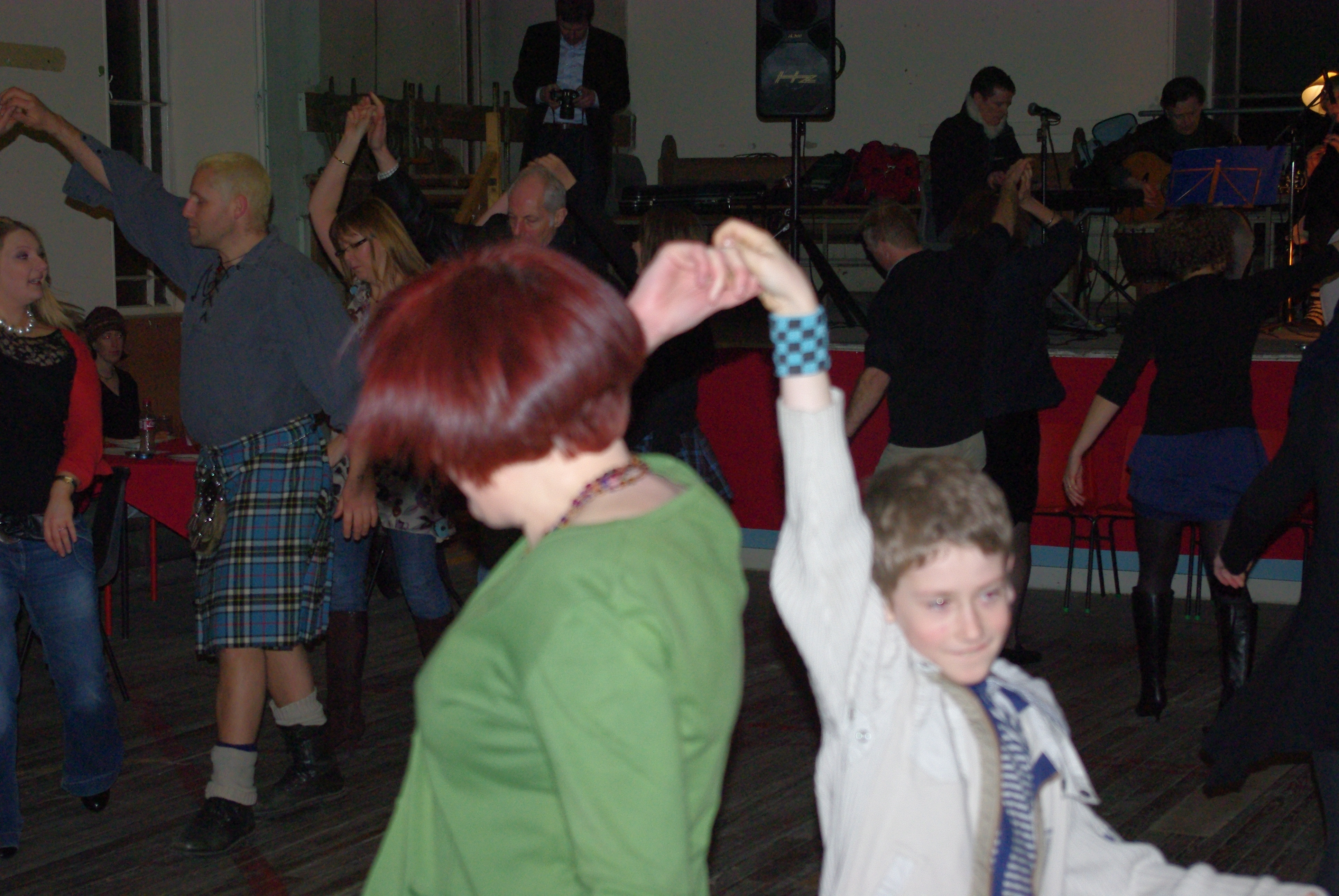
We have just had a lovely weekend with our friends Andy and Clare, along with their kids Sam and Hannah. The sun shone, and it was great to spend time with them all, and for them to meet some of our friends up here too.
We have known them for a long time- I reckon I have known Andy half of my life, and Clare not much less. We have been around each other through lots of changes and challenges. We attended the same church in England, and Andy and I played music and led worship. We also spent a lot of time in the mountains together.
Life sends you in different directions. We moved to Scotland, but Andy has taken the radical step of stepping outside the rat race (he was an IT consultant/project manager) and working for a Christian charity called Fusion.
In fact, if you are interested in how church might better connect with the community that surrounds its crumbling walls- then I recommend you check out some of the things that they are doing. In fact, Andy would love to hear from you if you want to know more- he has responsibility for developing contacts in the North of the UK- and Scotland.
Some photos (note that Clare managed to avoid the lens- she is good at that)-
This made me smile- I hope it does you too. I loved the combination of folk music, space monsters and animation.The music is by a collection of folk superstars that make up ‘The Imagined Village‘- vocal on this track by Eliza Carthy…
I was saddened today to hear of the death of Michael Foot, journalist, writer and former leader of the Labour Party whilst in opposition from 1980 to 1983.
Foot was the leader of the Labour party at the time I discovered politics. It was a time that we can barely remember let alone understand- when great ideologies confronted each other across the dispatch box. On the one side, Thatcherism– in all its free market elitism and on the other, a Labour ideal of the rise of moral egalitarianism, and the battle for a fairer and more equal society.
It was a time before sound bites, and when media manipulation was not the primary skill required by a political leader. Rather, the ability to debate with passion and integrity, and to move people by the power of your voice- these things were still of value.
And Foot was part of this long tradition- a Labour man from a very non working class background, who nevertheless will forever be associated with ‘Old Labour’, whose core principles still have a hold over me.
Foot also presided over a party whose radical policies of nuclear disarmament and opposition to war in the Falkland islands were formed in a time of chaotic social change. It was a time when the left wing of the party, under the strong influence of supporters of Tony Benn.
And yet Labour suffered their heaviest ever defeat in the General Election in 1983.
Foot, aged 67, frail and always scruffy in his Donkey Jackets, crumpled suits and wild hair, resigned soon afterwards.
Principled, passionate, intelligent and perhaps a little eccentric. How I miss politicians like Foot. I suspect we will not see his like again…
By way of a tribute- here are some clips. Each one a little time capsule from a different time. From the dark years of mass unemployment, the decimation of Britain’s industrial base, and before the euphoria (then betrayal) many of us felt under Tony Blair…
It seems that comments by Tennis player Andy Murray have been taken to a T Shirt. In 2006, whilst being interviewed by a Daily Mail journalist (and I know that many of you might agree with me that those words may contain an inherent contradiction) Murray got himself in trouble as follows-
So, for the hard of thinking, let me state here that: I did the interview with Andy Murray and Tim Henman a couple of years back where Murray talked about ‘supporting whoever England were playing against’.
It was a clearly a sarcastic remark. He was responding to teasing from your columnist about Scotland’s absence from the 2006 World Cup and derisive laughter from the mischievous Henman.
It was reported in that context in this newspaper at the time and the exchange was run as a transcript.
A couple of days later a red-top got excited about the comments, lifted a couple of them into a ‘story’ that took on a life of its own and from there the truth was lost.
But the story has carried on.
The latest incarnation of this can be seen in the sale of these T-shirts-
These shirts are being sold as Football World Cup shirts. ABE stands of course, for ‘Anyone But England.’
The perhaps overly zealous policeman who reacted to the shirts appeared to have some concern that the shirts might foster and encourage racism- which is of course an offence.
At very least it appears to tap into wider popular prejudice and division between our neighbouring countries. Football has this way of being a conduit for all sorts of prejudice and base emotions- it is like a kind of religion without a moral code sometimes.
I know my own reaction to this- which is that I find this narrow sectarian stuff very depressing. I do not often feel the heat of prejudice personally, despite living in Scotland and having an English accent (although someone did call me a ‘white settle’r today- albeit with a smile.) I just think that most of us should just know better. The fostering and celebration of narrow judgemental views is never really victimless- there are always vulnerable people who suffer, if only kids in the playground. There is also the fear in me that these fires, once lit, might become conflagrations- if not in our generation, then perhaps in the next…
Today, one week after my recent adventure, I took a trip over to Bute.
It was a lovely day- very cold, but full of sunshine. As ever- the camera travelled with me…
During lunch, I visited the local Coastguard office, to fetch my canoe. There was some confusion as to who had the key- it turned out that the lock up that the canoe was in was actually used by a former member of the coastguard to store his scaffolding. This is Argyll after all.
Eventually a very nice man turned up with a large bunch of keys, and what he called a ‘universal key’ in the form of a large hacksaw. The universal key was not needed, as the first actual key opened the padlock, and I was reunited with an old, battered and rather well travelled green canoe.
It was good to see it again. We have some more adventuring to do.
Here is a photo someone took- I am out of view behind the police launch.
Michaela and I took a trip down to the west bay this morning. We went to see David Torrance, the man who raised the alarm, and said thanks. He seems a really nice guy, and I will be forever in his debt. He was in the right place, at the right time, and did the right things.
We then went round to the Rock Cafe for breakfast, and stood watching the sun sparkling on the sea around the Gantock Rocks. It is a lovely cold sunny day today. I looked a where I entered the water and marvelled at how far I swam.
Basically, it seems that a group of American Southern Baptists, led by a charismatic failed businesswoman Laura Silsby, travelled into Haiti, gathered together as many people from a shattered town as they possibly could, and showed pictures of a lovely hotel complex over the border in the Dominican Republic, making promises of how they wished to take any children that wanted to come along for a better life.
And understandably, families looked around at the ruins their kids were sitting in, and handed over their young ones- from as little as a few months old, up to 12 years old.
Except some, including other charities- most notably SOS Childrens Villages International were outraged. They pointed out that this looked like child trafficking- but was at very least a totally inappropriate removal of children from home, culture and extended family at a point of terrible vulnerability. No checks were done as to whether families could be supported to look after the kids long term. No proper background checks were possible. It amounted to cultural imperialism of staggering insensitivity.
The Guardian yesterday carried a long article digging into some of the background to what has become a bit of a media feeding frenzy. Now the Guardian is not noted for its sympathy for right wing evangelicalism, but I think made some sobering points about the place of religion, and oversees mission in this matter. Here are a few quotes-
Further clues as to the mindset and intentions of the Baptists are provided by a written plan of action they prepared at the outset of the trip, which they called an “Haitian orphan rescue mission”. The plan discloses their ultimate aim: to “gather” up to 100 orphans from the streets and collapsed orphanages and take them to a new life in the Dominican Republic.
The document is striking in that it displays profound ignorance of the geography and society of Haiti. It anticipates driving the round trip from Santo Domingo in the Dominican Republic to Port-au-Prince, collecting the children and bringing them back, in just two days – a wildly overambitious schedule given the destroyed infrastructure of Haiti. It talks of rescuing orphans “abandoned in the streets”, which was fanciful as very few children who lost parents would have been abandoned; most Haitians live in extended families with relatives ready to step into the childcare role.
Such behaviour raises questions about Silsby’s motives and objectives. But for the remaining nine ignorance and naivety appear to go some way to explain how they got in the mess they now find themselves in. Certainly, that would fit a changing pattern of behaviour within the Southern Baptist Convention, the largest Protestant denomination in the US to which Central Valley Baptist church belongs. Over the past 20 years there has been a dramatic shift away from “career missionaries” who spend years immersed in the culture and language of the people they seek to turn to God, in favour of “missionary tourists” who dip in and out of communities for mere days or weeks and have much less cultural sensitivity.
According to David Key, director of Baptist Studies at Emory University’s Candler School of Theology in Atlanta, that sea change has come at a time when the convention has been increasingly focused on domestic social and political issues as part of the Christian right, which has led it to sound a strong note of American superiority. “Anyone under 40 years of age will have spent their entire life in the America First model of evangelism,” says Key.
The business of ‘short term mission’ has fascinated me. I spent some time in America as the guest of some really wonderful people- Southern Baptists in fact- who I met when they came to Scotland as part of a mission trip. They subsequently invited me to go over to lead some worship and run some workshops. It was a roller coaster of a trip- full of highs and lows- you would say it gave me a taste of ‘short term mission’- only in this case, in reverse.
‘Short term mission’ is big business in the Bible Belt. There are travel agencies that exist just to set these up, and Americans pay thousands of dollars to go on trips across the world- taking choirs, paint pots, projectors- all for an inclusive price. Check out this site for example.
Does that make this kind of mission bad? My experience of the folk who came over to Scotland was a very good one. Lovely folk on an adventure, trying to serve God on an adventure holiday.
But at the same time, the ethos of these mission trips have always made me feel very uncomfortable. They are a way of fitting mission into a lifestyle. They organise a kind of package tour evangelism, that costs nothing that can not be afforded. The long term value of such trips seem to offer far more to the missioners than to any of the places to which they are ‘sent’.
Back to the kids in Haiti.
The people who took the kids are clearly convinced that they were doing the work of God. They were able to believe this, it seems to me, because the worldview that they plugged God into gave them a set of goggles that filtered out all other viewpoints.
I have just finished reading a book to my son William at bed time. It was a book that I had read at primary school. In fact I think I never took the book back to the school library, so it is still the property of Croft Primary School, Nottinghamshire County Council. I must turn myself in to the police…
But the book had a profound effect on me.
It told the story of a boy who ran away from home in New York, and made a life for himself in the Catskill mountains. He lived off the land, and hollowed out a tree to make a house.
I think it had such an effect on me as some aspects of my childhood were very difficult, and I spent hours in my own dream world, longing for some kind of magical escape.
But it also filled me up with a longing for wild places.
I now realise this this book (which I have never heard anyone else mention) is a famous work of children’s fiction, and was made into a film. Indeed it is part of a trilogy, and so I plan to read the rest of the series with Will.
I found some bits of the film (made in 1969, when I was 2 years old)- and was amazed how much it still stirred me. Some liberties appear to have been taken with the book though- don’t they know that they are messing with my memories?!
I am thinking a lot about wilderness again- because of my weekend in the mountains, but also as Nick and I are getting further into our next writing project- trying to gather together a collection of things we are calling ‘wilderness meditations’.
The place of wilderness in this world seems more important to me than ever. As we continue to move into a post modern world where the rise of scientific rationalism has been put to the sword, the longing for simpler, more sustainable way of living is ever more on us. Getting ourselves loose from the noose of debt and wage earning in order to maintain the debt payments- this is a dream for many.
And a reality to few.
I came across this man recently, building his beautiful hut in the Alaskan wilderness.
And the envy was on me.
To live in a pristine land unchanged by man…
to roam a wilderness through which few other humans have passed…
to choose an idyllic site, cut trees and build a log cabin…
to be a self-sufficient craftsman, making what is needed from materials available…
to be not at odds with the world, but content with one’s own thoughts and company…
Thousands have had such dreams, but Dick Proenneke lived them. He found a place, built a cabin, and stayed to become part of the country. This video “Alone in the Wilderness” is a simple account of the day-to-day explorations and activities he carried out alone, and the constant chain of nature’s events that kept him company.