Thought it time for a change of banner.
A bit mournful, but I like it.
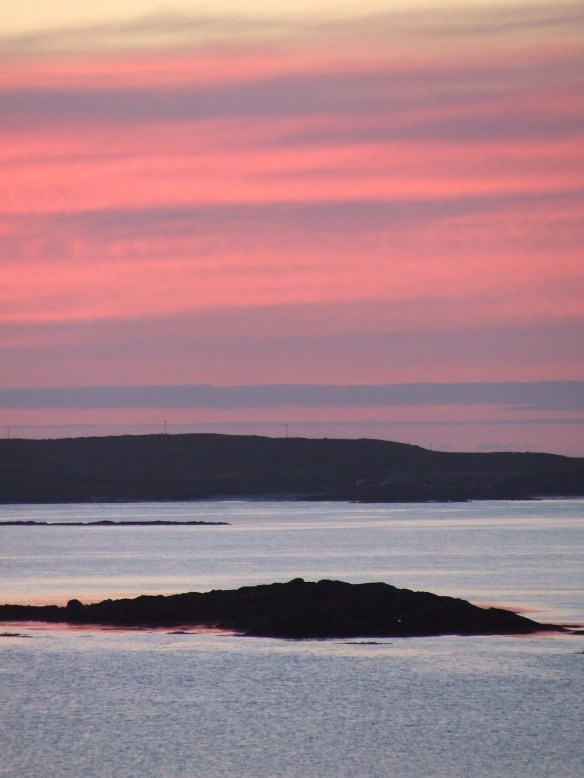
It came from this photo, taken in Eriskay on a soft Hebridean evening…

And in the other direction-
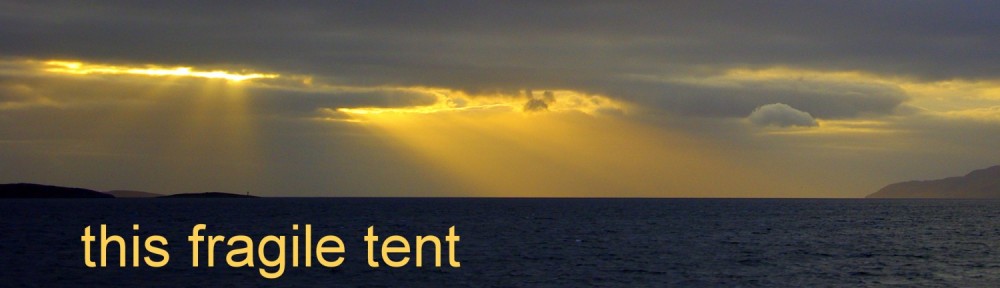
Thought it time for a change of banner.
A bit mournful, but I like it.
It came from this photo, taken in Eriskay on a soft Hebridean evening…
And in the other direction-
Vodpod videos no longer available.
I came across some short clips of films made by The Work of the People who are a collection of artists, poets, theologians and film makers in the US. They have loads of great resources that you can buy from their site if you are looking for loops or visuals…
I have picked one of their pieces as it resonated with thoughts about our relationship with the simpler parts of what we are as humans- based around relationships-
Relationships with one another.
Relationships with the land that sustains us.
And perhaps particularly, relationships with those who have been, or would be, our enemies.
The voices of indigenous people have lots to teach us about all of these things. I have posted before about the work of Bob Randall and the concept of Kanyini. You can watch Bob’s wonderful hope filled film here.
But back to the Work of the People clips.
This clip is from Richard Twiss, author, speaker and member of the Rosebud Lakota/Sioux Tribe
Vodpod videos no longer available.

Back to work tomorrow. I wonder what is waiting for me?
Say a few prayers for me friends…
Right, we now leave luxury and head off down to the Uists, Benbecula and Barra- camping on beaches in small tents.
We expect very mixed weather, and very strong wind, but this kind of camping is the very best (as well as perhaps potentially the very worst!)
No internet- so the blogging will cease for a while!
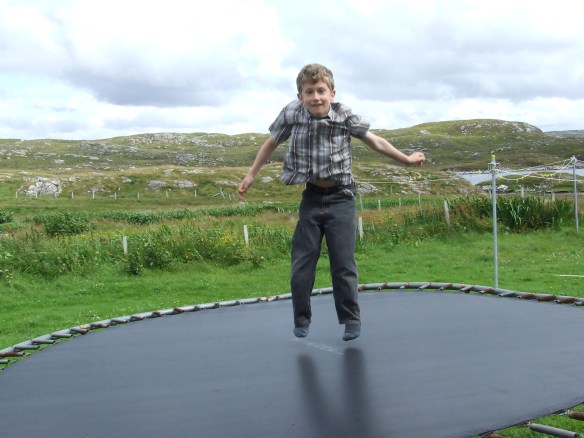
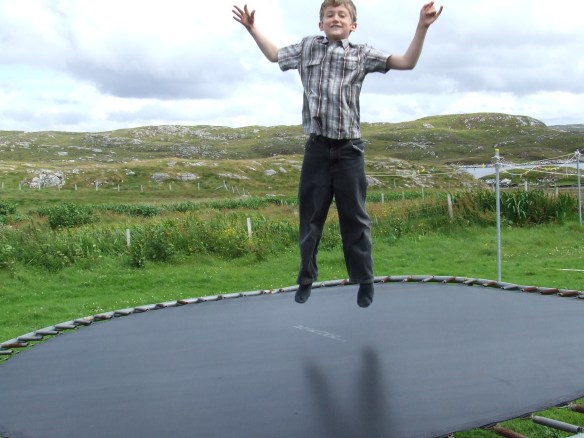
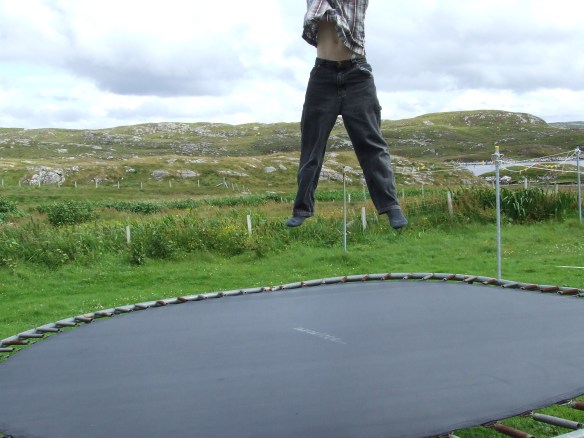
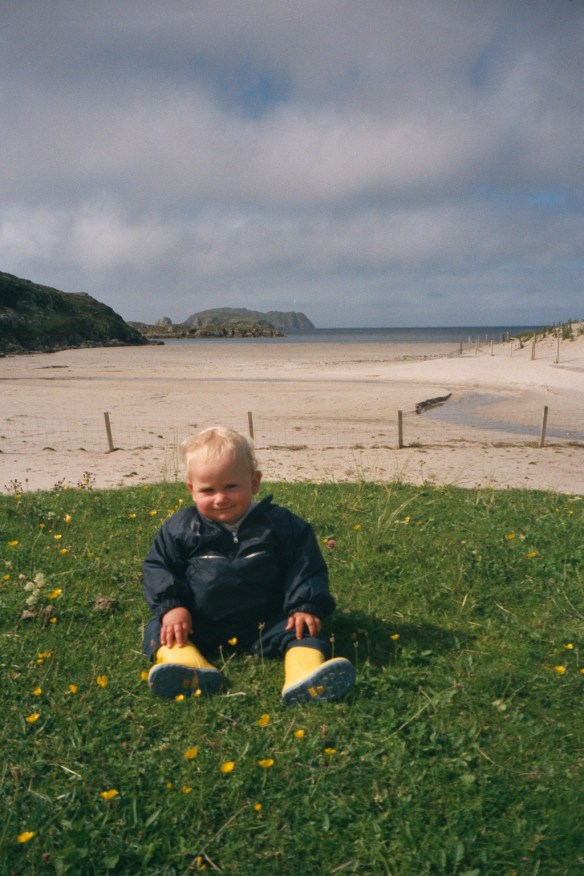
So here we are, on Bernera, a little island connected to Lewis by a causeway. The last time we were here will was one year old, and took his first unaided steps on the ferry. Here he is as he was, and where we now are (if you see what I mean.)
We are staying in a holiday cottage with wide open windswept views in every direction. Funny thing is, when we checked out the guest book, we saw the name of some old friends from England, Mark and Joy Headley, who stayed here in 2006. Well I never…
Bernera has a lovely community feel about it- and they have a new play area for the kids near the community centre.
The first thing we did was cycle over there and Emily and Will (and mum and dad too) became monkeys for a while.
But faced with a rather scary pole slide thing, Will became a rather timid monkey. Step forward Big Sister…
(Click to enlarge.)


The other Scottish Goans
We have been very busy over the last few weeks- doing a lot of traveling. It has been really good to catch up with family.
Michaela’s mum and step dad are staying with us this week.
A couple of weeks ago we were in the midlands of England, spending time with my mother, and my sister Katherine and her family. Katherine lives in a house that is always full of young people. She has four of her own- Josh the medical student, Elizabeth the ballet dancer, Ben the musician, and Nathaniel the youngest and apple of the eye. I don’t see enough of them all- but despite the distance, I love them dearly.
Then last week, we stayed for a night with my brother Steve, his wife Kate and little Jamie. There is a bigger story here, as we have only recently met.
My father and mother divorced when I was small, and I never knew him. We made contact again 2 years ago (my dad now lives in Northern Ireland,) and I was amazed to discover that I had a half brother who lives in Scotland, only a short drive from us.
You can imagine that the process of getting to know another branch of family that were strangers to us until recently has been wonderful, but deeply challenging.
Conversations with my father- and finding understanding of a sort.
Trying to explain to my mother the reasons why I would want such contact.
Taking my sister with me on the journey.
Last week, Steve and I had another of those ‘what if?’ discussions- wondering how our shared genetics interacted with out very different upbringings, and turned us into the people that we have become.
And I wonder. What might I have been with a different compost to grow in? Would the sensitivity that dogs me (and also inspires me) be mediated? Would I be more like me on my best days, or more like me on my worst?
These are impossible questions to resolve. All that we can do is note some of the ingredients, but the rest of it just IS.
And in this- like in all things- all will be well.
All manner of things shall be well…

Like many others who have found such life in and around this thing we have come to call ’emerging church’, I have such a love for these words ‘Kingdom of Heaven’.
For many years they were words of condemnation for me…
Something other.
Something distant and dangerous.
Something I had to fight to enter, and at best, I might scrape my way into on a technicality.
Something that was wrapped up in charismatic ideas of spiritual warfare and triumphalistic ecstatic wierdness.
Something that in order to serve, I needed to be Holy. And I was not.
I remember that moment when I began to catch a glimpse of a different meaning of the words- as spoken by Jesus.
Of the Kingdom of God as something that grows inside me, like an infectious bubble of blessing.
As something that is here now, but also still to come.
As something that I participate in, but is beyond my understanding.
That welcomes the weak, and the weary, and the child like.
And is glimpsed, almost as a mirage, in our communing and loving and laughing together.
And the call on us, the agents of this kingdom, not to turn the whole world blind or salty, but to shine light on truth and beauty, and to season the flavours of Jesus wherever we taste them.
If these ideas are new-ish to you, or you would like to hear some more about the context that Jesus was speaking into, when he spoke of the Kingdom- check out this excellent Aussie radio programme…
Just realised that this blog is just over a year old.
It feels longer. It is strange how this exercise of on-line contemplation has become integrated into my life. It has marked a year of happenings- family, faith and other stuff that found a way beneath the contemplative radar.

22,000 hits (but who is counting?!)
370 posts
308 comments
Has it been a good thing to spend time doing? I suppose the answer to this is inevitably mixed. Blogging can be such a selfish, self absorbed, even obsessive activity. But it has become one of the ways that I process thought. Even if no-one ever reads what I write, the process of writing for an invisible readership means that I am forced to structure and construct thought in a way that otherwise I may well not.
As for there being any wider value to the things I write- I leave this for you to judge.
So, to those of you who read- thanks!
Time for a revamp I think- expect some changes to how the blog looks…

