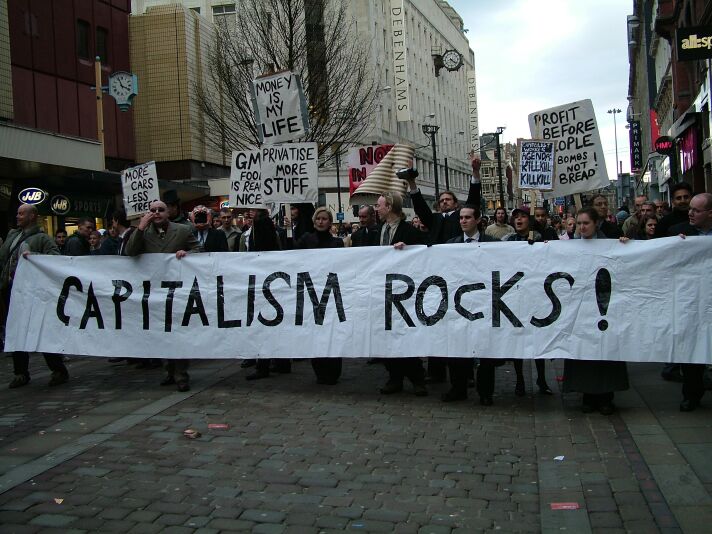
Economic growth; lie number two…

How do we know that we are in recessiondouble dip or triple dip as it may be? What mysterious yardsticks are used in the Bank of England to make them reach for the strings on which we all dangle?

economic_growth_3

Above all, it is this one; Economic Growth.

Economic growth usually refers to the growth in value of GDP (gross domestic product).

The total output of the country – the value of all the food produced, all the pharmaceuticals manufactured, cars assembled and services rendered – forms GDP.

GDP also takes into account the effect of imports and foreign investment.

If GDP is bigger this year than last year, then the UK is experiencing ‘economic growth’.

But inflation will also have driven up prices since last year, and thus GDP. To assess whether the economy is actually growing, the rate of inflation has to be subtracted from the nominal rate of growth to get the real rate of growth.

Lets be clear about this- economic growth happens when the overall value of what have, what we make, what we own, gets bigger. Our system is set up to be always dissatisfied with what we have, with what we are. No growth is regarded as stagnation, shrinking is recession, and recession is to be avoided at all costs- particularly at the cost of those who have the least.

We can only have economic growth if we continue living the kind of lifestyles that we are living now- if we continue spending money on the next gadget, another car, the latest trend in exotic food, the newest cut of skirt and suit. We can only have economic growth if we exhibit enough collective desire for new bathrooms, conservatories, paved driveways.

Increasingly we can only have economic growth if we can persuade other people to be just like us– to want the things that we want, the food that we eat, the mobile phones that we have glued to our ears. And so was born the globalisation of markets; the ubiquitousness of product. The penetration of our ways of being into every far corner of the earth.

Is this a problem?

Well, perhaps we need to distinguish between different periods of economic growth. In the UK we went from being an agrarian economy, whose countryside could only support a certain population number to being a place of canals, coal mines, factories and population explosion- all in the space of around 100 years. During this time our economy was growing exponentially- rather like that of China now. Victorian Britain was a place of huge inequality and the accumulation of vast wealth by the few on the backs of the labour of many. Like China now.

Of course to achieve this continued economic growth, Britain also needed an export market and control of sources of cheap natural resources-  for this we colonised and enslaved half the world.

More recently our economic growth has slowed- we achieve figures of one, two, three percent, and call it success. This ‘success’ is nothing to do with society changing, but everything to do with a desire to stay the same. Our growth is conditional on the pursuit of technological innovation by those who would sell us more product- rendering those we already have as obsolete.

Economists have a word for our willingness to spend- to slap down the cash rather than salting it away- they call it confidence. A healthy economy is full of confident consumers. Or, as Wikipedia put it;

Schumpeterian growth is an economic theory named after the 20th century Austrian economist Joseph Schumpeter. Unlike other economic growth theories, his approach explains growth by innovation as a process of creative destruction, which captures the dual nature of technological progress: in terms of creation, entrepreneurs introduce new products or processes in the hope that they will enjoy temporary monopoly-like profits as they capture markets. In doing so, they make old technologies or products obsolete: this is the destruction[disambiguation needed] referred to by Schumpeter, that could also be referred to as the annulment of previous technologies which makes them obsolete, and “which destroys the rents generated by previous innovations” (Aghion 855).

pile-o-cellphones1

Now, back to the LIE that are at the centre of all this. We are told that for our economy, even our society, to survive and prosper, we have to have sustained economic growth. The spectre of the Great Depression hangs over us- lives ruined, people starving in the streets. Economic growth is a holy cow that we have to keep feeding.

Everywhere we hear people asking questions of this cow however;

  • Is it sustainable? Can we really just keep producing more and more? Are we not burning up our resources at an alarming rate? Are we not slowly poisoning our planet with it all?
  • Is it fair? Can we really continue to live in a world where our lifestyles are dependent on the raw materials and cheap labour of others who are half way across the world?
  • Is it working? Given the instability in the system, can we really trust it to maintain our lifestyles? Is it not all just coming unraveled anyway?
  • Is it not just terribly wasteful? Do we really need all this stuff? Is there not a simpler way to live?
  • Is it making us happy, fulfilled, complete?

The relationships between economic growth and equality within society is one that has been the cause of much argument- think about the Marxist analysis, or of recent arguments that suggest that stable economic growth always leads to greater equality.

The argument has taken a new turn recently however- this from here;

Labour is drawing on research by the New Democrat Network (NDN) central to the Obama re-election campaign to shape its own election thinking.

The research was described by the Obama campaign as its North Star. It tracked three trends in the US economy between 1992 and 2009, showing how two – higher growth and higher productivity – had not been matched by a rise in living standards for the majority…

Douglas Alexander, the shadow foreign secretary and a close student of US politics, told the Guardian: “Back in 1992 the famous dictum of Bill Clinton’s adviser James Carville was: ‘It’s the economy, stupid.’ It contained the implicit assumption that economic growth ensured rising living standards.

“Today that no longer can be taken for granted, as this important research by NDN and the Resolution Foundation shows. I’ve worked closely with the NDN in recent years and that collaboration confirms to me this is one of the defining challenges for today’s progressives on both sides of the Atlantic.”

Similarly, work in Britain maps how growth before 2008 did not guarantee a rise in living standards, and how the bottom half of society suffered. UK wage stagnation is more recent than in the US – theirs started in the 1970s, the UK’s in the early 2000s.

And that is just within our own society. No mention of this sort of thing;

poverty

So, what is the alternative? Can our society, our economy, really kick our addiction to economic growth as the primary measure of our worth?

What might replace it?

Can commerce ever be based on a fair exchange of skills based on need (although surely there is always room too for celebration, for art, for pleasure.)

Can we learn to live in ways that are sustainable- that only cost the earth what it can afford to give to us?

If the answer to these questions are ‘yes’ (and I deeply hope that they are) then might these not result in negative economic growth?

Because in the Kingdom that Jesus talked about, things often get turned upside down and inside out- the last become first and the least of these become the keys to the Kingdom.

The Kingdom of God is not interested in statistics, in abstract measurement- it is rooted in the here and now- the shit and blood and spit of being ME, and my individual relationship with you. Everything else just gets in the way.

Trickle down economics; economic lie number one…

The first of a little mini series about Capitalism that has been nagging at me for a while…

trickle down economics

There was an article in out local paper last week- Argyll and Bute council, like most of our councils, has to make significant cuts to the budget. Despite our large geographical area, Argyll has a low density of population and services are already stretched tight. The article listed the sordid detail of the cuts- older peoples care, youth rehab, road schemes, outsourcing services to the private sector who will do the support of our most vulnerable more cheaply etc etc.

And what is all this about? Why is money suddenly so tight? Why do we all buy into the collective idea that ‘times are hard’ and so ‘we all have to tighten our belts?’

The fact is that not all of us do tighten our belts. Many people are doing very well out of the crisis. This from the Guardian;

The super-rich – the top 1% of earners – now pocket 10p in every pound of income paid in Britain, while the poorest half of the population take home only 18p of every pound between them, according to a report published this week by the Resolution Foundation thinktank, which reveals the widening gap between those at the very top and the rest of society.

Inequality has grown sharply over the past 15 years, according to Resolution’s analysis: the top 1% of earners have seen their slice of the pie increase from 7% in the mid-1990s to 10% today, while the bottom half have seen their share drop from 19% to 18%.

And then there are those right at the bottom- the Strivers who are forced to become Scyvers, or the Skyvers who have lost hope, or those who never had a fair crack of the whip in the first place. Have you noticed that when the economy takes a dip, they always take a hit? They become the problem– the scapegoats.

So we see all these regressive punative policy decisions being pursued by our current government- lower benefits to fewer people, changes to housing benefit to force people to leave their homes if they have an extra bedroom. All this in the context of reductions in care provision, and less funding for voluntary bodies and charities. Our current government is doing things that even Thatcher at her most strident would have baulked at.

But again- why? Where does all this come from?

What the neo-liberal economists will tell us is that the problem is caused by natural adjustments made by a self regulating economic system. That the job of us all is to get out of the way and let it all sort itself out like some kind of higher intelligent life form. The problem, they would say, is an over inflated public sector, whose interference in the natural order of things by public spending, taxation and welfare provision means that the economy fails to self regulate.

This kind of economic thinking has become so pervasive, so wrapped up in the political system, so much in service of powerful self interests, that we all wriggle on its hook. We are compliant because we have bought in to some of the lies that the system has sold to us- perhaps the biggest one is this one- Trickle down theory.

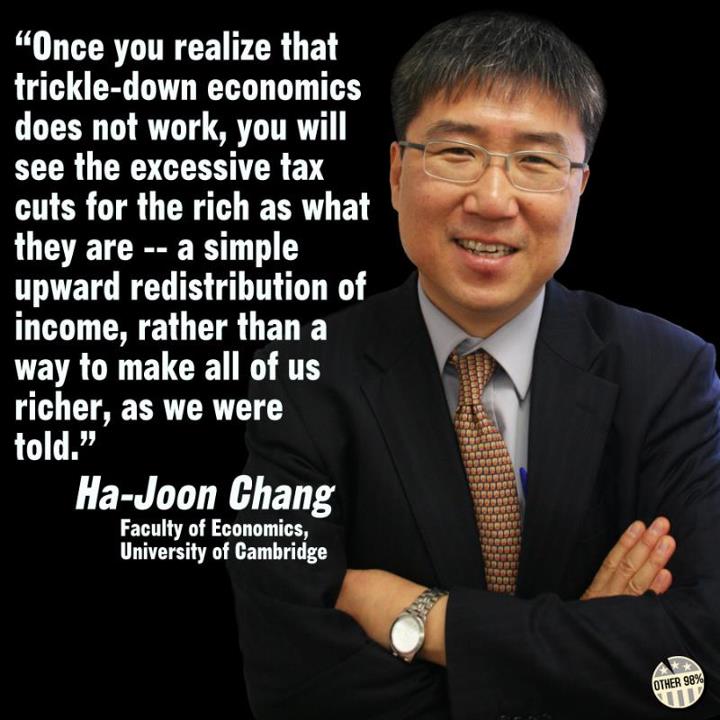
In a nu­tshell, trickle-down theory is based on the premise that within an economy, giving tax cutsto the top earners makes them more likely to earn more. Top earners invest that extra money in productive economic activities or spend more of their time at the high-paying trade they do best (whether that be creating inventions or performing heart surgeries). Either way, these activities will be productive, reinvigorate economic growth and, in the end, generate more tax revenue from these earners and the people they’ve helped. According to the theory, this boost in growth will ultimately help those in lower income brackets as well.

So, the argument is, if we have lots of rich people, and they are encouraged to become super rich, then our country, and our economy, will benefit- right down to the roots.

This analysis does not regard the wealth of the few as contingent upon the poverty of many- in this country and even more crucially in the poor countries around the world whose raw materials and cheap labour we are entirely dependent upon.

It also does not conform with the facts, as the rich get richer, and the poor get poorer.

As the worlds resources are over consumed by the few and our environment continues to be damaged, perhaps beyond repair.

As austerity plans are still touted as ‘good housekeeping’, as if the UK economy could be compared to a household budget.

So, what is the alternative? Fairer, more progressive tax systems? This might be a start- but I think the problem is the system- and we are all part of the system aren’t we? It is really hard to get out of it- the mortgages, the gadgets, the foreign holidays and the dependency on technology to deliver distraction, entertainment and connection.

Where is the Kingdom of God in all of this? What are we, the agents of this Kingdom , to put our energy towards? I am convinced that we need to be engaged critics of injustice wherever we see it- particularly towards the poor and the marginalised.

And the beginning of how we can do this is to take a look at the system through a different set of lenses…

Stained glass…

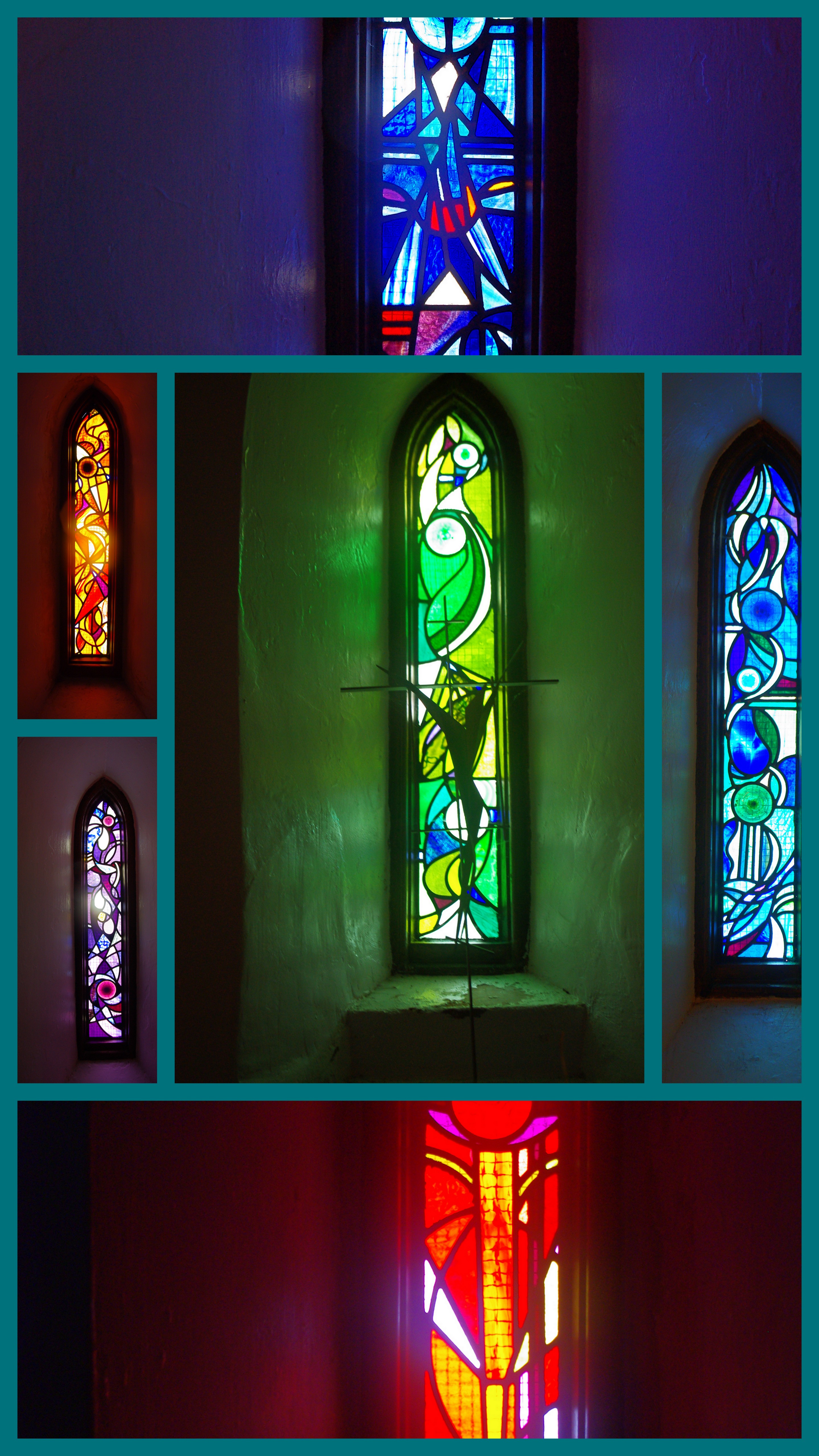
Here are some photos of the lovely stained glass from the Rock Chapel at St Beuno’s.

The story goes that a retreatant called Claire Mulholland overheard a conversation about a fund raising bid to fit new windows in the chapel, and she offered her services. There is an account of her decisions to use the different colours and shapes to display different moods here.

Winter 20122013


A trip back in time…

IMGP3943

And lovely it was too.

This weekend we have been down to our former church in Preston, to attend the wedding of an old friend- Kev Duffell, who was marrying a lovely German lass called Michaela. The wedding was half in German, and full of delicious miss-communications- although not between bride and groom, whose first kiss after being pronounced Herr und Frau was quite the most passionate thing I have ever witnessed inside a church. I felt like I was intruding…

But it was great to catch up with old friends- particularly some that I had not seen for years and years. Mark and Joy, Graham and Ruth, Andrew and Mary.

It was able too to spend some time with Steve and his wife Ros, who I had not seen for donkeys years. Steve and I used to play worship music together, and initially had our moments of tension but became good friends. He has gone from high flying executive to dog trainer, bike mechanic, pig and chicken farmer- on his own down shifting, living more simply pilgrimage.

Life takes us in all sorts of directions, and hearing the stories of old friends is such a privilege.

As for the happy couple- may they be richly blessed…

IMGP3946

Three jars…

Wine 2

The first miracle that Jesus performed was at a wedding- recorded in John 2 1-11.

Why does John choose to tell us this strange story? What was Jesus doing at a wedding, encouraging people to drink to excess?

The use of wine as an analogy of plenty, of blessing, of the fullness of life, is found everywhere in the Bible. Amos talks of wine running down the mountains in streams, as a sign of the restoration of the land of the Israelites.

It occurred to me, not for the first time, that although we can not command blessing – we can never presume that life is going to be full of plenty, or without challenge – we can still live in ways that become shallow imitations of the life of outrageous grace we see modeled by Jesus. We cease to be people of passion, and become instead bound by cynicism and small boundaries.

So, open up a bottle, raise a jar, uncork the fizzy stuff.

Symbolically speaking of course…

Three Jars


Three jars are waiting by

One of water, one of wine

The other one lies empty


Like Jesus at a wedding feast

These jars are waiting to release

The living waiting for us


The empty jar is hollow life

Like a married man without a wife

Like a cake that’s never eaten


The water jar will fill us up

Then leave us staring in the cup

Wanting something other


But rich red wine will satisfy

Blood will flow, the days will fly

Our passion consummated


Imaginative encounters with scripture…

israel-125year-old-man-laughing

There are many ways to read scripture passages; some of you may remember a list I once reproduced here of some of them.

There is also this one- an imaginative reading. In this kind of reading, we immerse ourselves in one of the stories of the Bible- placing ourselves as one of the characters, seeing it from a human perspective, being part of the action. This kind of reading is often applied to stories from the gospels.

It is also a kind of interaction with scripture which appeals to people like me who write.

One of the passages I was given to aid reflection in my silence last year was the story of Blind Bartimaeus, in Mark, chapter 10. It is a lovely story, full of Grace, and here is my imaginative response;

Once-blind Bartimaeus

What a day.

There I was, sitting in the town square tying to sell a few pots, when everyone started to run down towards the road. Naomi and old Jebediah almost knocked each other flying in their haste.

“What is going on?” I shouted “What’s all the excitement about?” But no one would stop to tell me- they were all heading down to the road- even blind Bartemaeus picked up his stick and started to rattle his way out of the square, taking his begging bowl with him. Soon there was just me and old Martha who is so old that she has forgotten what day it is.

Despite myself I followed the whole village down the hill. They were all craning their necks to catch sight of something. “What is going on?” I repeated myself. Finally Naomi answered- “It’s that man Jesus- the Rabbi. The one I told you about. He is coming here! James saw him this morning and ran all the way back to tell us!”

Jesus of Nazareth! Of course I knew something of him- who didn’t? The stories were flying back and forward about what he was up to. Some said he was a new Prophet sent to speak to the people of Israel just like the old times. Others said he was a fraud who was just making trouble, and there had been quite enough of his sort in these parts.

There are even those would say that he is The One– the Messiah- come to fulfil all those old scriptures. Come to release captives, to bring sight to the blind, a declare the year of the Lord’s favour (if I remember my school boy Isaiah properly.)

What did I think of all this? A load of crap I said to all who asked- another loud mouth living off the bread of folk who have little to give in the first place. The country was full of ‘messiahs’ after all- every one with their own set of followers. Naomi is a little more gullible than me, shall we say- this was the third teacher this year that she had got all excited about. “This one is different” she would say, “he is not interested in money, or fame, or power- he just seems to talk about love and this thing that he calls the New Kingdom.” She also told me stories of miracles- but we have heard them before as well. A bit of religious trickery always seems to make people more ready to part with their coin. Naomi might live and breathe this sort of thing but I for one give it no attention.

Just then the crowd started to hush “He’s coming!” someone said. I was standing at the back as people lined the road, so I quietly climbed on the branch of a low tree to get a better view.

There were quite a few people on the road- mostly men, but a few women. I had no idea which one was Jesus- they all looked pretty ragged, but at the same time somehow ‘road fit’- these people clearly knew how to put in the miles. They walked in groups, talking animatedly and gesturing at one another- there was a lot of laughter and one man even turned a cartwheel to please the crowd.

Just then, right in front of me, blind Bartimaeus started to shout. He had no idea exactly how close he was to the travellers so he shouted really loudly;

“Jesus, son of David, have mercy on me! Jesus, son of David, have mercy on me!”

Son of David’ no less- how did this beggar know so much scripture? His father, old Timaeus, used to have a broken down farm over the other side of the village and he had no time for such things when he was alive. This blind man was calling Jesus ‘Son of David’- more or less calling him ‘Messiah’!

The folk of the village did not like it- they turned on him. I think some were just embarrassed- an important, famous Rabbi comes to town and gets shouted at by a beggar- it just does not look good does it? Others thought Bartimeaus was after money (he normally was after all) although if he could see the state of the travellers he would have known that they did not have much in the way of cash. There were also more than a few religious folk in the crowd who were scandalised by the suggestion that somewhere in this ragged bunch was to be found Messiah.

So they hushed Bartimaeus, aimed a few kicks at him- but he would not be quiet. Even louder he shouted;

“Jesus- son of David. Have mercy on me!”

The travellers stopped in the road and turned towards the noise and the crowd went still- apart from Bartimeaus that is who shouted even louder. Then out of the group of travellers, a man started walking towards him.

I do not know why I had not seen him before- certainly he did not look much different, his clothes were just as ragged and his feet covered with the same road dust- but there was no doubt in my mind that this was Jesus of Nazareth. He had this presence, this quiet authority. Not the kind of authority that requires a title or a set of soldiers to enforce- this was something I had not seen before. There was nothing threatening about him at all, and yet I still found myself shrinking back a little.

This man would walk into any crowd and would become its centre. He could walk into a room and it would almost change colour. I at once saw what the fuss was all about- why he had upset people so much, why people were talking about him everywhere.

Bartimaeus was not at the front of the crowd- he was towards the back, quite close to me and I watched as Jesus walked towards him. The crowd parted like the red sea for Moses and I thought it best to climb down from my tree, not wanting to be noticed rubbernecking. I was then more than a little embarrassed to find myself standing almost right next to Blind Batrimaeus, who was still shouting for all that he was worth.

“All right, all right Bart old son” I said urgently “he heard you- and he is coming. Hush now!”

And he did. He sat there in the dust and blinked into the mid day sun, arms outstretched. I looked up and Jesus had stopped about ten feet away from Bartimaeus, and the crowd formed a ring around us like a thick hedge to keep in the goats.

He was close enough now for me to see his face. He was young – younger than me – that much I can tell you but yet I struggle to describe what his features actually looked like. All I know is that his face was so alive. His eyes seemed to be laughing even though his mouth was still.

I wondered then if he had stopped short of actually coming right up to Bartemaeus because he realised has was just a blind beggar- the sort that line all the major roads shouting for mercy. A man of no worth and no consequence. A man who some religious types described as bearing the consequences of sin. An unclean man, an outcast. The only reason that Bartimaeus survived at all was because people in my town remembered his mother, who was a good soul and had a lot to put up with what with her waster of a husband and her only child born blind, so many of us dropped him a coin or a piece of bread (when no one else was looking of course.)

Suddenly Jesus spoke.

“Tell him to stand up and come to me”

I realised with a start that he was talking to me- that he was looking right at me. And in the presence of this ragged stranger, my heart started pounding. I opened my mouth, but words seemed to have got stuck.

“Come on man- introduce your friend to me and tell him to stand up” said Jesus.

My friend? I thought- does he think we are the same? Was he mocking me? Certainly there was laughter in his voice.


Still, I bent over and spoke to Bartimaeus again “Come on Bart old son- he wants to speak to you.” I put my hand on the arm of this unclean wretch and helped him to his feet. “He is right in front of you, waiting.”

Bartimaeus put out his hands- he had left his stick on the ground- and took a step towards Jesus.

Then another, and another, until his hands were actually in contact with this strange compelling man. Jesus did not flinch as the beggars hands even began to explore his face; instead he opened his mouth and roared with laughter.

And his followers laughed too- not an unkind laugh; not the sort of laugh that happens when a man trips over a stray dog or a woman drops her bucket down a well. There was no victim to this laugh, rather it was an inclusive laugh- the sort that sucks you in and holds you in its embrace. It seemed to arise from a kind of emotion that I can only call joy. I found myself laughing too- really laughing. It was as if the trees and the stone walls laughed with us.

Then Jesus leaned forward and spoke again; “What do you want me to do for you?” he said, softly- so softly that I think only a few of us heard him.

That’s done it, I thought- clearly he has no money and there was no way he could take this poor wretch with him, wherever he was going. This is where it gets ugly again.

Bartimaeus did not ask for money though. Instead he dropped his hands, stood an inch taller and said this;

“Rabbi, I want to see.”

The crowd let out a communal gasp. Many had heard the rumours- lepers who had been made clean, mad men who were calmed, even a man called Lazarus over in Bethany who seems to have been raised up out of his own tomb. But talk was cheap and anyway things like that never happened in my town. Not here. Not to some smelly blind beggar who we all stepped over on the street every day of our lives.

But Jesus seemed to have heard only what he expected to hear- he appeared delighted. There was mischief in his voice when he said;

“Go on then- on your way. Your faith has healed you.”

And with that, Jesus turned about and started to walk down the road.

Is that it I said to myself. Is this the work of a Messiah? He throws out a few smart words then is on his way? I felt cheated somehow- despite my cynicism, even I had started to believe that this Jesus was different from all the other would-be Messiahs.

Bartimaeus just stood there- eyes wide open, wriggling his fingers between the sky and his face. I felt sorry for him.

“Well that’s that then Bart.” I said. “Come on up to town with me and let’s get something to eat…”

But before I could finish my sentence, he was shouting again at the top of his voice!

“I can see! I can see! I can bloody well SEE!”

The crowd parted again as he stumbled towards them, dumfounded as he pointed out the branches of the trees against the blue sky, the lichen on the wall next to the field, the marks he had made in the dust with his feet, and the smoke rising from the village chimneys in the distance. We all watched dumbfounded as he ran back to his stick, picked it up, kissed it then hurled it far over the wall shouting;

“Good bye you old bugger, I’ll not be needing you any more!”

Then he stopped in his tracks and spoke more slowly;

Go he told me- on my way. Where on earth would I be going… if it is not with him?”

With that, once-blind Bartimaeus was up and half running, half stumbling down the road, still with a hand held out in front like the blind man he used to be, chasing after Jesus for all that he was worth.

As for me, I stood with the others, watching him go- unable to take it all in. Unable to believe that the most important thing that ever happened to this town- no, the most important thing that ever happened to me– was wrapped up in the rags of this creature running like a drunken goat down the road.

I was wondering what it meant. Wondering what had just changed right before my eyes. Looking for something to anchor myself to, but not able to see it…

But that was all years ago now. Bartimaeus came back a few weeks later. He told us the story of what happened over the next few weeks. He was our eye-witness as to how Jesus rode in to Jerusalem on a borrowed donkey, only to be arrested on trumped-up charges and put on trial. Bartimaeus was there when Jesus was whipped and beaten up. He was there when they paraded him through the streets, and watched as they crucified him and hung him there until he died. He also told of how the curtain in the great temple ripped right down the middle and the sky went dark at mid day.

And Bartimaeus told us how a couple of the women went to take care of his body early in the morning, only to find Jesus not dead but alive– of how he met with his followers, and even let once-blind Bartemaeus touch his face again, and of how they all laughed till they cried.

Bartimaeus is my friend now. He lives with Naomi and I and helps me make pots- all those years of living by touch alone has turned him into the most gifted potter in these parts- people come from miles around to buy what he has made.

Or perhaps they come to hear the stories. Of a man called Jesus, who on some days even I have come to believe was indeed the Messiah.

Reflecting on silence…

st beauno's in the snow

So here I am, sitting on a lovely Virgin train leaning its way around the corners that lead me back to home. Just the place to reflect on the 8 days now past- spent in silence at St Beuno’s Ignatian Retreat Centre near St Asaph, North Wales.

I went with as few expectations as my over active imagination could avoid, just hungry to make a new spiritual journey towards God.

The experience was not about fireworks, emotional and spiritual highs, but it was every much a spiritual journey for all that- full of humour, grace and peace. You may also be surprised to hear that 8 days spent in silence, with little reading even, was rarely boring! I thought the best way to describe it was to share some excerpts from my journal, so here we go;

Friday (on arrival.)

(St Beuno’s) is a place that feels comfortable, in a rather staid way. Because of its Jesuit ethos of silent contemplation, people do not speak to one another- rather they walk past one another and do not as much as nod. To someone schooled in the primacy of communication, it seems somehow alien. I can not decide whether it is a relief not to have to make small talk with all these strangers, or slightly missing the overt hospitality.

(I wrote down some prayers;)

Free me from performance and the need to impress

Free me from the need to be liked

Free me from the need to compete in order to feel of worth

Let me be me

So you can be you

Saturday

After a snooze I went to the Eucharist service. The out-of-placeness returned. Strange liturgy, ritual I did not understand and sung elements I did not know. I decided not to take communion as this seems to be a hot issue in the Catholic church at the moment.

I sat looking through the song book- lots of unfamiliar hymns and songs, but lots of familiar ones too. I came across this one and it made me cry

My song is love unknown. My Savour’s love to me: love to the loveless shown that they might lovely be. O who am I that for my sake my Lord should take frail flesh and die?

Sunday

Brian (retreat guide) gave me a couple of pieces of scripture again- one from Isaiah and another from the Gospel of Mark…

I then sat in the summerhouse and read Isaiah 43 1-4- which is of course very familiar- it is the same passage that Mary and Andrew gave to us when we came up to Scotland. Hmmmm. The same mixed passage- about him being with us when we pass through fire and through waters. And then the bit about sending people from the north south, east and west. Did this happen? Is it just a co-incidence- it is a rather obvious bit of scripture to give to anyone who is feeling cut off from God I suppose? Let us just hold it there and see what happens next…

Interior, rock chapel, high contrast

Monday

(in the hills in the tiny rock chapel)

I intended to read some of the passages that Brian had given me, but before I did so I decided to listen to some music. I thumbed through the options of my Mp3 player and decided first on some choral music- that was enough to break open the floodgates, next I listened to black gospel, then Matt Redman- I was singing along and crying. Matt Redman had these constant references to breathing and breath, and each time I breathed there was a cloud of vapour mist. I spent nearly two hours in there in the end.

Tuesday

After lunch, a long walk- the sun is shining and I went over the other side of the main road, along some quiet lanes, and eventually up into the hills and forest, crunching the snow and putting up pheasants. I took no photographs, just put my head down and tramped. I think I must have walked around 6-7 miles.

On my return, after the bath, I was tired and a bit head achy and not feeling well. I did not go to the service.

If I go come home now, I would. Perhaps just as well that I can’t as who knows what the next few days will bring?

sheep, snow, hills

Wednesday

Time to go to the chapel and just be for a while.

…Back now after who knows how long- half and hour, and hour? I sat breathing out the words “Do not be afraid”, then the other translation “Peace be with you” words that Jesus seems to use a lot, and then I realised that I am not often at peace. I am usually either distracted (often with good things, but many times with trash) or slightly disturbed- chewing over things, picking at scars, hoping for things (particularly myself) to be better/more productive, more fulfilled…

…This afternoon and evening I did art. Lots of art! I am even sort of pleased with one of them… I am just back from the art space and it is nearly 11. I missed the service and everything.

Thursday

Went out to Labyrinth and sat in the hut to read Mark 4, 35-41 (Jesus Calms the storm) and Luke 12 12-32 (The rich fool and not worrying)

I liked this from the message; “…not to be so preoccupied with getting, so you can respond to God’s giving.”

There is the line too- “The father wants to give you the Kingdom itself!”

I went to the chapel for a while, then to the art space. Made a picture collage. Enjoyed it, and it more or less looks like I hoped it would. Needs a layer of PVA glue tomorrow. Also messed around with water colours- for the first time in years. Less pleased with those! I think I spent 7 hours in there- which went in a flash.

Friday

(with retreat guide)

We were talking too about reading the Bible, how a poetic reading of the Bible is different- no less truthful, but in poetry we read for a deeper truth. The words are just as precise, just as rich as any textbook, but they are set free to become active, even ambiguous. So it is that the words of God (as opposed the The Word) can come to lead us on and on and on. I suggested that I had often wished that the words of St Paul had been written as poems. “Or READ as poems” retorted Brian…

It is amazing how much we still communicate with others even in silence, or rather how much communication we perceive from others. You find yourself, after many silent days spent in the company of strangers, ascribing to them personalities based on clothes, body movement, smileyness and general demeanour. So there is one bloke who I have taken a dislike to as he stares malevolently at me, and seems to always push others out his direction of travel- particularly in the food queue. Then there is the shy woman who always scurries, and the self possessed at-ease-with-herself one. There is the man who wears expensive suits and exudes control and the nice bloke who I can only hold in the highest admiration for his willingness to fart at a silent retreat not once but three times- smiling benevolently throughout. I like him! What do they all make of me?

(after long journey in my head through Jesus death, theories of atonement…)

but this is enough for now. Pretty soon we are going to have a communion service, and I am going to take bread and wine.

Saturday

Met with Brian- told about yesterday- he gave me the death of Jesus again, then told be to be silent, and then read the resurrection! Followed by good old Thomas.

I was fairly lazy today- spent a slow morning in the bedroom reading the passages, then in the afternoon took a long walk on a loop round some roads, back into the fields, then a bath, and it was time to go out for a meal with Maggy.

Lovely meal, now just looking forward to coming home…

In reading through these fairly random excerpts, I am not sure that they fully communicate the richness of silence as a means to open up deep things of this world and the next. I was not always purposeful or fully engaged in my silence- I am a past master at going into my own skull and disappearing- part of the survival skills learnt in a troubled childhood. However, there was always a turn around, new thing to encounter. If ever things became ’empty’, I did something else- I headed for the hills, one of the chapels, or made some art.

Thanks to the lovely Brian McClorry there was also lots of humour to be had! He has an impish intelligence that often tripped over into glee with who God is.

If you are considering going on retreat- go for it. It is something you are unlikely to regret.

Labyrinth, St Beuno's, high contrast


I will posting a few more bits and pieces from my retreat over the next days…

Falling into the arms of the Empire…

genesis

For years now we have had a more or less regular ‘housegroup’, which meets (as decreed somewhere in the Bible) on Tuesday evenings. A few months ago we moved out of the living room into a pub- it was time to change things around a bit. We have been using the shape of some of Brian McLaren’s writing to aid our discussion- from ‘A new kind of Christianity’. It is a great book, and has started to put some firmness into parts of my faith that had been decidedly muddied by all of the Emerging Church discussions and debates. (Not that I regret a single question mark!)

Last week we continued a discussion about how we might understand the storyline of the Bible. McLaren (or Bazzer as we decided to call him) suggested that many of us had become used to reading the whole of the Bible backwards through all those towering figures of our theological landscape, back through the Reformation, into the middle ages, then the dark ages, and in particular, the days of the Holy Roman Empire, which Bazzer considers the real cusp of the matter. At this point the new religion (Christianity) became mixed up not only with Empire, but also with Greco-Roman philosophy. The end result it that it is really hard to see backwards because of all the edifices that we have built along the way.

Read the book for more detail on all this, but we tried to chew a little on the Polarity of Greco-Roman thought- giving us the polar opposites of Platonic perfection and the fallen state of mankind. We did this by looking again at those early stories in Genesis- of Adam and Eve with their troubled offspring, the subsistence hunter-gatherers who became farmers, then city builders, and fanally Empire makers- the rise/fall of man.

Here, the Roman Zeus- living in a removed, perfect state, setting impossible goals for his ephemeral people to reach towards, and seeking to rescue a few only be the skin of their teeth (eventually through a legalistic confidence trick with his son Jesus) starts to come unraveled. Zeus is replaced by Elohim.

Looking backwards, we read the early stories of Genesis in the Greco-Roman philosophical polarity- perfection/fallen. The garden was perfect, and as we mucked it all up, we were cast out, imperfect, therefore God could not be around us- Plato again.

But Elohim never mentions perfection- he talks of things being ‘good’, or even ‘very good’. In these stories, the journey from the garden is not one of lost perfection, but rather lost innocence. Rather than going from a perfect state casting us out into the darkness, Elohim makes clothing, avoids issuing the death penalty as promised to those who eat the fruit of the tree, and so on and so on. Elohim constantly engages, constantly circles back into the rise/fall of mankind. Even when they start empire building.

As we talked about this, I saw Michaela becoming frustrated. Eventually she spoke up- “So why did Jesus have to die? What was his mission if not to rescue, to save?”

I have been thinking about this question and the discussion we had the other night. Unsurprisingly, it leaves me with more questions;

If there has been a ‘fall’ of man, is it really the kind of fall I grew up talking about- one of individual sin, inherited by each subsequent generation as part of our human DNA? This kind of ‘fall’ keeps us trapped in the old Platonic polarity. It allowed Evangelical Christianity to focus on private morality to the exclusion of almost all else and  the purpose of the death of Jesus in this understanding is to give a chosen few backdoor perfection– undeserved, but gloriously exclusive.

But there is this other version of the fall of man(kind) encountered in Genesis. It is a fall upwards- away from our root and branch engagement in the soil of the world that we live in- towards enclosure and management of the land first for storage of food, then for personal profit. The more we have the more we want and our ambitions grow to the sky like the tower of Babel. Then there is this word again- Empire. If there is a polar opposite to the Shalom of Elohim it is Empire. Power used and abused. Richness accumulated at the point of sword and on the backs of the slavery of others. From Genesis to Revelation this the Bible is shadowed by Empire. This fall is not an individual one, it is collective.

But Elohim does not retreat even from Empire. He is there in and through it all. Hating some of it, raging against it sometimes- particularly when his people accommodated with it- even became the enslavers themselves.

Back to Michaela’s question- Jesus death, in relation to this collective fall can be understood clearly in his own use of the words of Isaiah, spoken from exile, in slavery to empire;

The Spirit of the Sovereign Lord is on me,
because the Lord has anointed me
to proclaim good news to the poor.
He has sent me to bind up the brokenhearted,
to proclaim freedom for the captives
and release from darkness for the prisoners,[a]
to proclaim the year of the Lord’s favor
and the day of vengeance of our God,
to comfort all who mourn,
    and provide for those who grieve in Zion—
to bestow on them a crown of beauty
instead of ashes,
the oil of joy
instead of mourning,
and a garment of praise
instead of a spirit of despair.
They will be called oaks of righteousness,
a planting of the Lord
for the display of his splendor.

Isaiah 61

Here it is- the kernel of the nut. The Shalom of Elohim; the New Kingdom. A totally different kind of empire. One based on love of one another, on the joy of life and the refusal of the power of Empire.

The first kind of fall- the individualistic perfect/fallen polarity seems to have allowed for Christianity to exist within empire with hardly a ripple. It allows us to set aside the revolutionary stuff and focus on saving the few for the really important stuff, not the Aristotelian stuff of boring reality, but the Platonic promise of eternal perfection.

But the New Kingdom can not exist in the other kind of fallen world without challenging empire. We can not live alongside poverty, injustice disease, broken lives, etc without wishing, praying, working upon it the Shalom of Elohim.

Or can we? The forces of empire are strong after all…

Michaela told a story right at the end of a place she had worked- a job that was supposed to be all about community building- encouraging participation and engagement with marginalised people and groups. A new manager came in who knew all the language, but seemed driven only towards establishing and using power; she was building an empire. The rules of the organisation had changed overnight. Suddenly success was measured by a business model- by conquests won over other ‘competing’ community groups. It tore Michaela apart.

And there you have it; the shalom of God opened wide, but the Empire rises again. But Elohim is waiting…

Politics does not matter- or does it?

Michaela and I were sitting looking miserably into our tea cups today and talking about the vote in parliament to cut welfare payments.

All this depressing divisive and stigmatizing talk of ‘strivers and skyvers’. Tax cuts to the rich to encourage them all to generate ‘growth’ in the economy (best measured it seems by how much the rich get even richer.) As if the poor are somehow culpable- a useless drain on society that we are better without. As if they were the cause of all this economic turmoil rather than its primary victims.

Writing in the Guardian, Aditya Chakrabortty pronounced this vote as the final nail in the coffin of the welfare state. Some may regard this as overdue- as we lurch to the right, and find our political language dominated by America. But we are not America. We have our own proud history- not the Kings-and-Queens stuff, but the history of the rise of a kind of shared decency that characterises these islands. The history of the small people in fields and factories. Here is Chakrobortty;

 the golden period of Welfare really came in the 60s and 70s as, thanks to the work of Barbara Castle, Jeff Rooker, Audrey Wise and others, pensions and allowances were made more generous and tied to typical earnings.

“If you were poor, you were far less behind than at any other time in contemporary British history,” according to Richard Exell, a senior policy officer at the TUC and a campaigner on welfare issues for more than 30 years. “It produced a Britain that was one of the most equal societies in western Europe.”

Just before Margaret Thatcher came to power, a single person out of work would get unemployment benefit worth almost 21% of average earnings; last year, jobseeker’s allowance was nearly half that, amounting to just over 11%.

Welfare’s big decline came in the 1980s, as the Conservatives moved more benefits from available to all to on offer only to the poor. This was justified as making public spending more efficient.

But, according to a famous and much quoted study by Walter Korpi and Joakim Palme, such means-testing is far less effective and more expensive than universal benefits. In a study of 18 rich countries, the academics found that targetting benefits at the poorest usually generated resentment among those just above – and led to smaller entitlements.

This “paradox of redistribution” was certainly observable in Britain, where Welfare retained its status as one of the 20th century’s most exalted creations, even while those claiming benefits were treated with ever greater contempt.

“If you look at unemployment and sickness benefit as a proportion of average earnings, then Britain has one of the meanest welfare systems in Europe,” says Palme. “Worse than Greece, Bulgaria or Romania.”

Some of that same meanness can be seen in the way Welfare was discussed as it moved into its sixth and seventh decades. It was no longer about social security but benefits. Those who received them were no longer unfortunate but “slackers“, as Iain Duncan Smith referred to them. A recent study by Declan Gaffney, Ben Baumberg and Kate Bell of 6,600 national newspaper articles on Welfare published between 1995 and 2011 found 29% referred to benefit fraud. The government’s own estimate of fraud is that it is less than 1% across all benefit cases.

Is this what we come to- this great nation of ours? Mean and whinging and judgmental?  Are we not better than this? Which brings me back to politics. Michaela remembered reading something recently about one of the finest politic speeches of the last 50 years in the UK- Neil Kinnock, speaking in 1985, at a time when we were young and fired up by ideas and hope that things could be better;

If Margaret Thatcher is re-elected as prime minister on Thursday, I warn you.

I warn you that you will have pain–when healing and relief depend upon payment.

I warn you that you will have ignorance–when talents are untended and wits are wasted, when learning is a privilege and not a right.

I warn you that you will have poverty–when pensions slip and benefits are whittled away by a government that won’t pay in an economy that can’t pay.

I warn you that you will be cold–when fuel charges are used as a tax system that the rich don’t notice and the poor can’t afford.

I warn you that you must not expect work–when many cannot spend, more will not be able to earn. When they don’t earn, they don’t spend. When they don’t spend, work dies.

I warn you not to go into the streets alone after dark or into the streets in large crowds of protest in the light.

I warn you that you will be quiet–when the curfew of fear and the gibbet of unemployment make you obedient.

I warn you that you will have defence of a sort–with a risk and at a price that passes all understanding.

I warn you that you will be home-bound–when fares and transport bills kill leisure and lock you up.

I warn you that you will borrow less–when credit, loans, mortgages and easy payments are refused to people on your melting income.

If Margaret Thatcher wins on Thursday–

– I warn you not to be ordinary

– I warn you not to be young

– I warn you not to fall ill

– I warn you not to get old.

Neil Kinnock

For the record, Thatcher won the election and we live in her rain shadow still. Cameron and his whipping boy Clegg have now gone further than even Thatcher would ever have dared go however.

Politics matters. We need some more Kinnocks- for all their faults…

Our B and B is now open for bookings!

IMGP3339

It feels like a big step forward!

Over the past few months I have been working hard on getting the house ready to serve as place of hospitality- a guest house, retreat centre, pottery, etc. Thanks to my mate Andy Prosser’s work on our website, we can now take on line bookings for our B and B rooms! Or you can just contact us direct.

We have two main rooms- a double room and a family room (2 plus 2.) Both are en suite, and costs are as follows;

Double room £70 a night for double occupancy, £45 for single Occupancy.

Family room £70 for double, £45 for single. Kids under 12 free, over 12 add £10 per child per night.

We also have an adjoining single bedroom that is available as an add on booking only as the occupant will share the en suite shower facilities in one of the other rooms. This might be suitable for older kids or for friends travelling together. This costs £25 per night.

If you are thinking of making time for yourself- to be quiet, to be creative or to be closer to the wild country- then please come and see us!

Here are some photos of the new Family Room;

Family room window

IMGP3733