Revenge…

Mt5.44


I have been thinking about revenge today on my drive around Argyll.

This was stimulated in part by a story that the news is full of over here in the UK about a former Member of Parliament and his ex wife who have both been found guilty of perverting the course of justice. Many years ago he persuaded her to take some speeding points onto her licence by saying she was driving when in fact it had been him. Later on, he had an affair with a work colleague and left his wife for her. His wife, by way of revenge, decided that she would tell the press about the speeding thing, knowing that it would end his political career.

What she did not anticipate was that both of them would end up in court, with the details of their intimate lives being dragged out in front of the media, at the end of which both are now facing a jail sentence.

Revenge, red in tooth and claw, let loose to ravage this way and that, doing damage to all.

I was also thinking about revenge because of another situation we are faced with- involving some people who have acted vindictively towards us, in a way that I will not spell out here. We are sort of in the position to give pay back.

Now I do not claim to be better than most- I am not in any way morally superior. But the words of Matthew 5 above- they gave me a problem.

What do we do when faced with personal injustice? How do we deal with people who slight us, who treat us with disrespect, who see what we are and find it wanting?

I know what my natural reaction is- I lick my wounds, I seek conversations of conspiracy- with people who will speak words of partiality and hostility. I obsessively pick over my rights, my own just cause. I look accross no-mans land and watch for weaknesses in the opposing trench line. In my mind I prepare for war.

But those words of Jesus about turning the other cheek, offering the shirt when they take my coat, walking two miles when forced to march one… they slow me down, discomfort me. Surely he is not wanting some kind of wimpy doormat for others to wipe their feet on?

Well, think about the politician and his wife.

He had it coming-  right?


Cardinals, McLaren and the charge of hypocrisy…

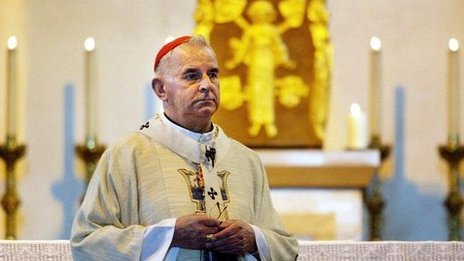
Cardinal O'Brian

No one could have missed the story of Cardinal O’Brian and the scandal engulfing the Catholic Church at the moment, but just in case you have, it goes something like this;

Cardinal O’Brian, the only British Cardinal, starts off (20 years ago) as a moderate within the church, upsetting conservative Catholics with his liberal views on contraception, homosexuality and whether priests should marry. Over time however, as the Vatican became increasingly hard line, he seemed to swing towards the right, becoming a strident and belligerent voice proclaiming the need to Christian morality, family values and for Conservative Catholicism. There was even talk of him being the next Pope.

Last year he made a splash because of his rather bizarre comment comparing Gay Marriage to slavery. I wrote about it at the time, here. 

Then, totally out of the blue, in the wake of the shocking resignation of the Pope, just as Cardinal O’Brian is about to go to Rome to take part in the election of the next Pope, 4 men- three priests and one ex-priest, let it be known that he used his power and authority to impose sexual acts on them whilst they were young men.

He initially denies it. The Church starts to close ranks. Then he admits it and resigns his office.

I have avoided discussing this matter up until now on this blog- partly because I did not want anything I wrote to seem triumphalist. I have ‘come out’ as a Christian who has a very different position on  the (unfortunately) totemic issue of homosexuality to that espoused by the Cardinal (and many other good people, including close friends.)

I was also staggered by the scale of the fall of this man- for whom I feel great sympathy. I know what it is like to be trapped in an unyielding and inflexible hermaneutic- to resort to compartmentalism to cope with the cognitive dissonance. Many people describe O’Brian as a good man, a kind man who has the capacity for so much good. None of us are just one thing, we are all many- and those who attack him should beware throwing the first stone.

Finally, I feel a collective shame for the Church. Scandals like this confirm the worst of prejudice about what the Church has become- it tells the world that we are that most despicable thing- we are hypocrites. This story proves our guilt- and the guilt is collective. As soon as we (the Church) begin to stand on moral high ground, we will always be in danger of the crumbling cliff edge.

That is NOT to say that we should have no moral voice. Our job is to be a people who present a radical alternative. We are to be an irritant  and conscience of those in power, not because we are better than others, but because we are prepared to try this thing called love. All morality is captured by this simple word- love. As soon as love is subordinate to morality, then morality becomes the worst form of religion.

So in this sense, Cardinal O’Brian is both perpetrator and victim of a system of faith that makes individual salvation from private sin the most important issue. It IS an important issue- but we all have logs in our own eyes. And there are other issues…

Which were brought to me again when listening to clip in my previous post.
brian-mclaren

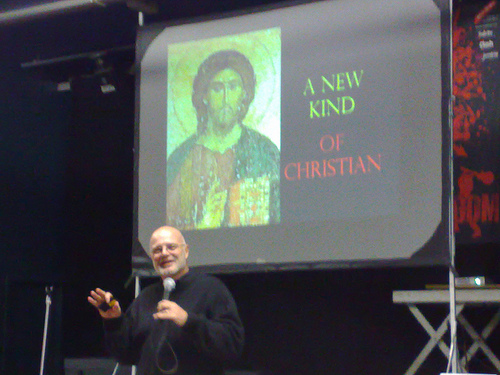
Brian McLaren, speaking in St Paul’s Cathedral mentioned that he had a son who was gay. I have read and listened to a lot of his stuff, but did not know this. It seems that he performed a marriage ceremony for his son and partner last year, which predictably got him in to a lot of trouble. A case in point is this entry on his blog, in response to a man who had publicly ‘broken rank’ with him as a result of his stance on homosexuality, and his decision to participate in his sons marriage ceremony. Some of his response is as follows;

My view on human sexuality has indeed changed over a period of thirty years, and actually, the views of most conservative Christians have also been changing over that period. It wasn’t too long ago that the only conservative position was, “It’s a choice and an abomination.” When that position became untenable due to increasing data, the conservative position evolved to “it’s a changeable disposition, and we know how to change it.” When fewer and fewer people who claimed to have been reoriented were able to sustain the reorientation, the position shifted to “it’s a hard-to-change disposition, but it can be done with great difficulty.” More recently, I hear conservatives say “the disposition may be unchangeable but the behavior is a choice, so people may choose to live a celibate life or a heterosexual life, even against their orientation.” All that’s to say that it would be unfair of me to break fellowship with people who are themselves on a journey, just because they aren’t where I am at this point…

In my case, I inherited a theology that told me exactly what you said: homosexuality is a sin, so although we should not condemn (i.e. stone them), we must tell people to “go and sin no more.” Believe me, for many years as a pastor I tried to faithfully uphold this position, and sadly, I now feel that I unintentionally damaged many people in doing so. Thankfully, I had a long succession of friends who were gay. And then I had a long succession of parishioners come out to me. They endured my pronouncements. They listened and responded patiently as I brought up the famous six or seven Bible passages again and again. They didn’t break ranks with me and in fact showed amazing grace and patience to me when I was showing something much less to them.

Over time, I could not square their stories and experiences with the theology I had inherited. So I re-opened the issue, read a lot of books, re-studied the Scriptures, and eventually came to believe that just as the Western church had been wrong on slavery, wrong on colonialism, wrong on environmental plunder, wrong on subordinating women, wrong on segregation and apartheid (all of which it justified biblically) … we had been wrong on this issue. In this process, I did not reject the Bible. In fact, my love and reverence for the Bible increased when I became more aware of the hermeneutical assumptions on which many now-discredited traditional interpretations were based and defended. I was able to distinguish “what the Bible says” from “what this school of interpretation says the Bible says,” and that helped me in many ways.

So – many years before I learned I had members of my own close family who were gay – my view changed. As you can imagine, when this issue suddenly became a live issue in my own family, I was relieved that I was already in a place where I would not harm them as (I’m ashamed to say this) I had harmed some gay people (other people’s sons and daughters) earlier in my ministry…

This post hints at what must have been great personal pain through all this, but also a great strength- the sort that feels (to me at least) right. McLaren ends his post like this;

I want to add one more brief comment. You ask, if we change our way of interpreting the Bible on this issue (my words, not yours) “- what else will happen next?” Here’s what I hope will happen. After acknowledging the full humanity and human rights of gay people, I hope we will tackle the elephant in the room, so to speak – the big subject of poverty. If homosexuality directly and indirectly affects 6 – 30% of the population, poverty indirectly and directly affects 60 – 100%. What would happen if we acknowledged the full humanity and full human rights of poor people? And then people with physical disabilities and mental illnesses and impairments? And then, what after that? What would happen if we acknowledged the spiritual, theological, moral value – far beyond monetary or corporate value – of the birds of the air, the flowers of the field, of seas and mountains and valleys and ecosystems? To me, Jesus’ proclamation of the reign or commonwealth of God requires us to keep pressing forward, opening blind eyes, setting captives free, proclaiming God’s amazing grace to all creation.

What he is able to do here is lift our eyes from a  grubby obsession with what goes on in people private bedroom space to the call of the Kingdom of God.

This is the greater charge of hypocrisy that I feel myself constantly to be under. How all the distractions and comforts of my life and lifestyle prevent me from living as a full agent of  the commonwealth of God as spelled out above.

In this, as with the Cardinal, I am reliant on Grace, and the hope that I may yet become what I aspire to be…

Evangelism revisited…

Keswick3

Michaela and I had a strange encounter the other day whilst walking around Keswick.

We were stopped by three boys- all aged around 12-13, two of them standing slightly to one side and letting the bravest one do all the talking. He stuttered and stumbled his way into asking us if we minded answering a ‘small questionnaire’. We were in no hurry and they seemed like nice lads so we agreed. We assumed it was some kind of school project (although I had this nagging suspicion…)

The lads had no prepared written questions, nor any apparent need to write down our answers- and the conversation went something like this;

“Erm, have you ever, erm, told a lie?”

I replied that I had not- apart from what I had just said- but then realised that irony was pointless so just said that I had indeed told lies.

“What do you call someone who tells lies?” 

We agreed that they were called liars

“Erm, have you ever hated anyone?”

A little bit, I replied, and we settled on the fact that people who hate were called haters.

“Erm, Ok then, right, so have you ever, like, stolen anything? Even like, a tiny little thing?”

I said that I had but Michaela said that she had not- which if you know her is quite believable. The boy however seemed highly skeptical. We then agreed that people who steal things are theives

Then things got rather surreal.

Ok, have you ever looked at a member of the opposite sex with lust?” 

The poor lad flushed up a bit and his two mates shuffled their feet and looked pointedly away. I was tempted to point out that I was stood next to my wife and lust had indeed had a part to play in our relationship, but in the end just said that I would never dream of doing such a thing. By now of course I knew exactly where the conversation was heading, as I am sure you do too.

The lad then brought out his killer line; his closer; his hook; his sales pitch;

“The Bible says that if you do any of these things in your mind then it is like you are doing them for real. If you look at anyone with hate you are murdering them, and if you look at them with lust you are raping them.”

He then wound himself up a little and looked at me- not Michaela.

You have just told me – I have not said it, it came out of your own mouth – that you are a liar, and thief, a murderer and a rapist… what do you think you need to do about that?”

Michaela and I could take no more, and politely pointed out that these were not new issues for us and that we were actually Christians. We wished the lads well and went on our way.

Which was a shame really as both of us wanted to know where the lads were from- what Christian group would send them out into the crowds of a holiday town with that kind of material, and whether they really believed they were doing something good, something right.

Both of us were troubled by our encounter.We shook our heads and raised our eyebrows for about an hour afterwards.

These questions still linger with me;

  • Did the organisers of this group of kids really expect us to be convicted of our sin by this kind of approach; to repent and turn to God on the spot?
  • Does this kind of evangelism ever work? Are we not all innoculated against it now, and if not- how many encounters are required for even a single conversion? How many are required for a single meaningful conversation even?
  • Is it not just a little creepy to set young boys on the task of asking about the lust-fullness of a random middle aged couple? Then to tell us that we are murderers and rapists?
  • If the real issue was shock- training for the boys in holy boldness and firmness of their own faith, then what might they be learning from these encounters? Chronic embarrassment or the power of the gospel let loose on the mean streets?
  • Where is the creativity, the playful engagement with culture, the relevance to the relaxed holidaymakers in a busy market town?
  • Where is the honesty? Sucking people into a conversation like this, only to sting them with what some people might find offensive?

Of course, viewed through the lens of conservative evangelicalism all of these are non-questions. What the boys were doing was to follow the purest expression of the Great Commission. They were giving people the opportunity to save their souls from the eternal torment that is our just punishment for sin. This was what Jesus came into the world for and any other Christian activity is subservient to this task.

The passage that the boys had built their ‘questionnaire’ on is of course Matthew chapter 5- the sermon on the mount. Jesus takes on the surface religiosity of the Pharisees and turns it on its head.

And religiosity always needs to be turned on its head.

I really hope that the faith of these boys will survive their encounter with religion.

The lady of the lakes…

Michaela, Derwent water


She will not thanks me for this- but here are a few photo’s of my wife. The one above was taken somewhere near where the photo in my previous post was taken.

We had a lovely couple of days- walking around Keswick which was at the beginning of the ‘Words by the Water’ festival, so full of poetry and posh people who read it enough to go to a festival about it.

We went to see Arthur Smith do a couple of hours of comedy, inter spaced with anecdotes and poems.

Then we walked round shops selling stuff that we did not need so did not buy, and sat sipping tea and talking of slow things.

On the next day we climbed Cat Bells with the crowds doing the same and stared at the view out over the lake towards Skiddaw and Blencathra.

All made the more lovely I was with Michaela…

Michaela, winter sun

Michaela, Cat Bells

picnic spot

Off to pastures old…

M and I are down to the lakes for a couple of days- a present from the kids for Christmas- they found a deal in a hotel near Cockermouth.

Poor Michaela is riddled with a cold, so I think we will be tea-shopping, lake-side walking and standing arm in arm looking at views.

And perhaps contemplating how things change. It is not so long ago that the mountains of the lakes were like Eden to me- they pulled at me like a much loved but half remembered memory. So trips up there with Michaela were quite rare as I was often off into the hills alone or with friends. The times we did go together – taking boat trips and carrying our little ones in back packs – were special too however.

But how odd to be going without the kids. It is almost like a rehearsal for the next stage of life, which is upon us, like it or not.

Emily received her first offer from a University this week- she has an unconditional offer from Glasgow Caledonian to go and do Psychology there. Not her first choice, as she wants to combine physiology with psychology, but well done her anyway as we wait for the other responses.

Which all seems a long road from this trip to the lakes;

Michaela with Emily, some time in the late nineties, Keswick.

The false-god of economic growth…

Interesting article in the Guardian today about this book;

GetImage


Interesting title- considering discussions about apocalyptic end times obsessiveness in some parts of the Christian world. A timely reminder of how we can get snarled up in religion at the expense of hope for the future this beautiful planet.

The book opens up again the question about what we can do as a nation to break economic mono culture that we have spent ourselves into. Here is a quote from the article;

Consume less, he says. Be sceptical about new technology. Slow down. And do not fall for the modern political class’s post-Blair belief that history is bunk, and to draw on the past is to be a hopeless throwback: it is only a comparative blink since the second world war found millions of people reshaping their lives in the cause of a common endeavour, and the same thing could yet happen again.

And then there is the fetish of growth, or rather growth-ism. As Simms points out, the idea that economies necessarily have their limits was being voiced when capitalism was still young: in 1848, John Stuart Mill argued that “a stationary condition of capital and population implies no stationary state of human improvement”. A century and a half later, Adair Turner, a former director of the CBI, told Simms that if anyone thinks “the most important objective of public policy is to get growth from 1.9 per cent to 2 per cent and even better 2.1 per cent”, they’re worshipping a “false god”, and “extra growth does not automatically translate into extra human welfare and happiness”.

These are pretty ordinary thoughts, but ones that the dull noise coming from Westminster renders almost exotic – and essential.


Christianity and Capitalism- to resist or to accommodate?

I have been dwelling on economics over the past few weeks. One of the things that has often troubled me has been the role that Christianity has had to play in developing a culture of enforced inequality, both locally and globally. At best we have become guilty by association, at worst we provided the moral justification for the whole shebang and then enshrined it in liturgy.

I have written about this before- if you are interested you might like to check out these posts;

Capitalism; a conspiracy against the common good?

Capitalism and Durkheim

capitalismrocks

Jason Clark has an interesting piece on his blog about the relationship between Evangelicalism and Capitalism, particularly in the US. It is a tough read, but basically, he contrasts two potential kinds of analysis which he characterises as ‘Cultural dispisers’ and ‘Cultural accomodators’.

Firstly the dispisers;

William Connolly, in his 2008 work Capitalism and Christianity, American Style, sets out firstly to diagnose how the ‘capitalist project’ has been perverted and warped by its resonant relationship with conservative right-wing Christian religious beliefs.[1]

Connolly describes how this relationship between an Evangelical right-wing ethos and capitalism is best understood through ‘assemblages’ of media, churches, cultural consciousness, and a ‘spiral of resonances’ that produce the Evangelical capitalist resonance machine.[4]

Connolly’s response to this contention and diagnosis is to suggest that it is within an alternative and ‘counter political movement’,[6] a democratic and left-wing visualisation of a new ethos, that capitalism might be redeemed.[7]

Now for the accommodators;

Pete Ward, in his 2002 work Liquid Church, offers an account of the relationship with Evangelicalism to capitalism that contrasts starkly with those of Milbank and Connolly.

Where Milbank would warn us of the complicity of the Evangelical Church in conforming to the practices of capitalism, and Connolly of the pathologies of the Christian ethos that shapes those practices, Ward critiques the Church for failing to embrace commodification as a spiritual practice and suggests that the Church should be engaged with it even more. For ‘rather than condemn the shopper as materialist Liquid Church would take shopping seriously as a spiritual exercise.’[17] Where the underwriting of commodification by ecclesial practice is inherently evil for Milbank, according to Ward it is a vital and theologically necessary ecclesial practice to the Church.

I have not read Connolly’s book, but I have read Pete Ward’s Liquid Church- which is a great book, although I do not think the points made by Jason do it full justice. What Ward was seeking to do was to get the church to engage fully with the culture we are part of- to flow in its veins. He reckons that it is only by doing this that we understand, that we become relevant, that we can become part of the mission of God for our times. I am not sure that this is the same thing as ‘accommodation’.

Ward uses the example of advertising as a case in point- he suggested that rather than dismissing all such commercialism as ‘of the world’ and therefore having no spiritual significance for the followers of Jesus, rather we can learn so much about the collective spiritual yearnings of our age from advertising. Is this accommodation, or is it being engaged as thoughtful critics?

I am much more convinced by Mike Frost’s book Exiles, in which he compares Christians living in our post-modern, post-Chistendom world to the Jews exiled in Babylon. It is simply not possible to live lives of isolation- neither is it our calling. Rather we have to learn to live as engaged, loving, active agents of the Kingdom of God. This might involve the celebration of aspects of culture, or it might also require us to resist other elements- injustice, prejudice, the power of the strong over the weak. This also brings us into contact with the language of sin and evil- the ways of living that tear into each other and destroy us.

The other polarity that Jason proposes in his piece is that of the dispisers. This is not a word I would have chosen to apply to myself in relation to Capitalism- more because I do not think it would be honest. At the same time as asking my intellectual and theological questions about Capitalism I am very conscious that my whole lifestyle is wrapped up in it.

Back to the direct relationship between Christianity (particularly Evangelical Christianity) and Capitalism. How might we characterise the ways that faith has accommodated? I started making a list;

  1. By emphasising personal, individual salvation above all else. The only useful purpose of mission is to save people from hell after they die.
  2. By embracing success culture. We use the same corporate structures, we reward our religious successes as we would our CEO’s, we value hard measurable outcomes, we construct programmes.
  3. We make mission a kind of hostile take over. Business success involves out performing the opposition, and rejoicing in their bankruptcy. So it is that we see any form of religion not our own as our economic enemies.
  4. Christianity is a lifestyle choice that requires no change to the way we live our economic lives. Yes, I know there is the old ‘tithing’ argument around Evangelical churches, but we drive the same cars, live in the same houses, take the same holidays, fill our lives with the same gadgets- or (and here is the sting) even if we do not have these things, we aspire to them.
  5. We bought into lives characterised by individualism over the collective. The model given to us by the life of Jesus and the early church was all about the collective- how we live for one another, how we hold things in common, how we find ways of including the poor, the weak. Yet these things are not really part of our DNA.
  6. We failed to demonstrate any kind of radical alternative. The best that we have been able to offer is how to live as better Capitalists- more sensible, more responsible, with greater probity.
  7. We did not see injustice, inequality, poverty, unfair taxation, usury, over consumption, environmental destruction, as any of our business. Which relates to point 1.
  8. And where there was visible discomfort with Capitalism, we lacked any coherance, we lacked leadership, we did not become a critical movement. Rather we splintered and focused on totemic side shows live homosexuality and women bishops- all of which is destroying our credibility anyway.
  9. Our mission to the poor was conditional on redeeming them to become like us. Difficult one this, but stay with me. There is lots of wonderful Christian history of engagement with the poor from the Salvation Army right through to local soup kitchens. These activities clean up the edges of Capitalism- but also justify the dominant ethos. It encourages us to lift people back into becoming productive consumers. Like us. It does not suggest that the problem might be in any way systemic.
  10. We forgot that the Church exists not to give us a better life, but to serve the lost and the least. If we are serving the lost and the least, how can we have convinced ourselves that our unsustainable greedy lifestyles are God-given rewards for our moral superiority- which we Brits built an Empire on, and then passed the baton to the USA?

So, the question at the head of this piece- to resist, or to accommodate?

I think we need to resist what should be resisted, and to where there are seeds of justice, of beauty, of grace- there we should plant ourselves alongside and accommodate for all we are worth.

And what would church look like if we took each of these 10 points above and reversed them?


Low…

No, not more melancholic ramblings- rather the name of a band.

My friend Graham (he of ‘Digging a lot‘) always has a batch of interesting music up his sleeve and this is another one of his.

Low make music that is difficult to peg- although someone coined the phrase ‘Slowcore’ to sum up what they do- combining slow, emotional rich harmonies with crunching guitars, electronica and fuzz bass. Not my usual fare at all but I love it.