The last weekend of a week off is always hard. The weight of the week ahead, and the mountain of tasks waiting loom large. It has been a full and lovely weekend though.
Yesterday we dug the garden, mended the canoe, and planted some willow to make willow tunnel down to one of the sheds. It will take a year or so to be big enough but it is exciting nevertheless. Today we played cricket, dug the garden and planted more willow for an Arbour, and greeted Emily back after a week sailing in Norfolk.
Yesterday we also took a visit to Ardentinny beach to barbecue and celebrate little Aidan’s birthday. No so little I suppose- he was 5.
Whilst we were there we encountered a few monsters!
I have been really busy this week making a bedroom for William out of one of our scruffy box rooms. This always involves far more work than you think- particularly when you want to make the most out of a small space. He is delighted with his new room, and this means that his old room, with amazing views out over the Clyde, can start it’s transformation into a B and B room.
In the middle of all the chaos I sat down with a cup of tea and flicked on the TV, and a film was showing that I had heard about, but never seen- an old Michael Powell film, made in 1937 called ‘The Edge of the World‘.
The film was Powell’s first feature film and grew out of his fascination with the changes happening out on the edge of the British Isles- the depopulation of St Kilda in 1930 in particular. He wanted to film there but it just was not practical, so he made his film on another wild wonderful island- Foula, 20 miles West of the Shetland Islands. The cast and crew lived there for several months, even having to build their own dwellings.
I think this film, dated as it is, contains fascinating glimpses of a life now gone in our far flung islands. A time before air travel or fast ferries and mobile telephones. A time of the corncrake at the edge of hand harvested fields and hands twisted from hard work.
Anyone who has spent time in any of these isolated wild places will know that they can have the capacity to change you inside. Powell went back to Foula in 1978, thankfully still with a thriving community, and made another film for the BBC. He too had been shaped and changed by the islands.
This is one of the reasons why I take my own pilgrimages out into the Hebrides whenever I can. We will be heading out again in a couple of weeks.
Hmmm- I feel another plug coming on; if anyone wants to join one of our wilderness pilgrimages you may like to check out some of the photo’s and info on our Facebook page.
Graham sent us a copy of the recording of our talk about making small missional communities at Calvary Christian Fellowship near Preston.
We were invited to take a road trip to describe something of our experiences with Aoradh, and we structured the discussion into three main sections ‘in’, ‘out’, ‘up’ with me talking about some of the background and theory (such as it is!) behind what we do, and Michaela describing our activities in a bit more detail. We tried to be really honest about the difficult bits as well as all the great stuff.
I have uploaded it as a series of podcasts, partly because other folk in Aoradh might be interested to know what we said about them, and also because the issue of how we make and sustain community in these fluid postmodern times seems to be pretty important, so others might like to hear something of our story.
You should be able to download the different sections on these links, but I am told that ‘ourmedia’ sometimes takes a little while to make uploads ‘live’, so you may need to come back a little later…
I hear the words ‘Motivational Speaker’ and instantly want to run the other way with my hands over my ears shouting “OMMMMMMMM” as loudly as I can. Motivational speakers are for salesmen and pyramid selling schemes and in all other areas of life should be politely shown the door towards the nearest soup kitchen to learn some silent humility.
Then my mate Andy sent me a clip of this bloke, and I had to eat a slice of my own humble pie;
Thanks to the kindness of Aileen, one of our local ministers, we were given permission to use the beautiful Inverchaolain Chapel– out along Loch Striven. It is a small simple stone building, cupped in the bowl of the hills next to the Loch.
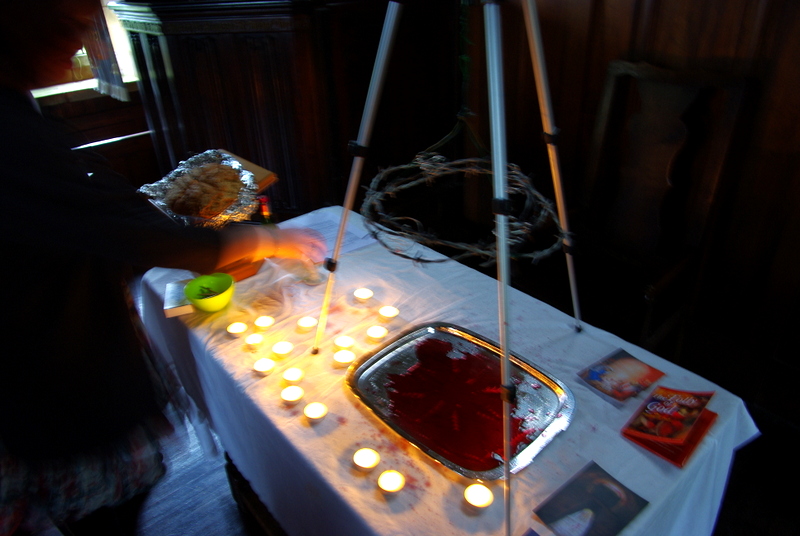
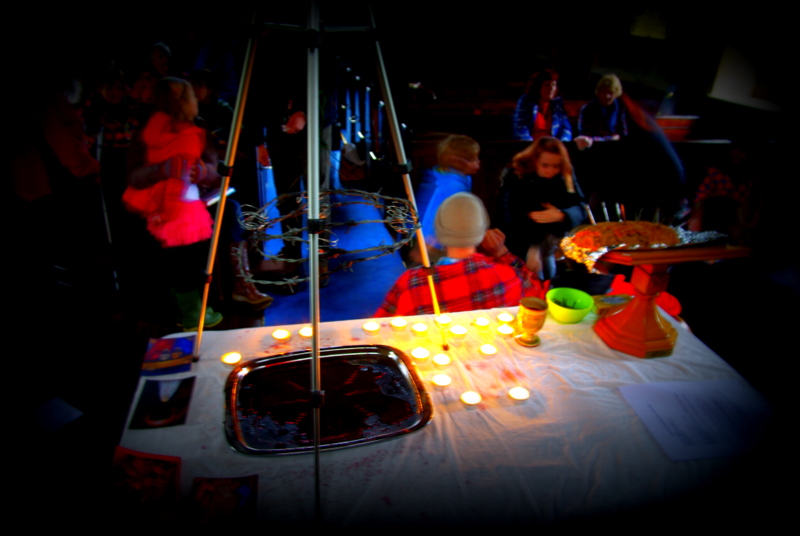
Audrey led us through a liturgy, using some ideas borrowed from Tabled– which is a fantastic collection of creative ideas for communion. We used two objects- one was a crown of thorns suspended with little baskets containing frozen cubes of wine, which dripped down onto a silver tray and a white cloth. The other was a loaf of bread into which we asked people to push nails. The images were powerful and Audrey’s words complimented them wonderfully.
(By the way- if you try the frozen wine thing, bear in mind that wine does not freeze very well- better to use water with some food colouring.)
Afterwards we went back to Andy and Angela’s as the planned picnic was rather rained off. No matter though, we took with us something precious that brought a deeper sense of the death of Jesus, and his resurrection then, and through us, now.
I wrote this piece for our Aoradh Easter gathering… He is alive!
It was still dark when Mary left the house.
Not that she had been sleeping. The house was full of fear since Jesus had been taken. Fear of the soldiers coming by torchlight and beating on their doors. Fear that they too would face a long lingering death on a cross.
But there was something worse than fear- worse even than death. When they killed Jesus, everything that Mary had hoped for- everything she had believed in- had fallen apart.
All she had left was a dead body.
To prepare for the grave.
She would have gone sooner- but yesterday had been a religious festival, and the pew police would have been out in force to prevent anything that looked like work. Particularly this kind of work, for this kind of man.
When we visited out old church in Preston a couple of weeks ago, they were all talking about this up and coming event in the old bus station in the city centre. Lots of my friends were involved in the choir, or the crowd scenes. Today it was televised on the BBC, and the whole thing was quite remarkable. Those in the UK can watch it again here.
The Passion was a retelling of the Easter story using three short films set in Preston- a mayor dealing with riots in 1842, women waiting for the return of sons from the first world war, and a young girl (above) who was caring for her brothers and sisters because her mother was drunk. In the mix was a live performance of music and dance based at the huge Preston bus station– itself a rather famous example of brutalist architecture from the 1960s.
It made me cry lots. In a good way. It was possible to visualise an incarnate loving God permeating everything. In the muck and gristle of human existence. And to see this in the TV in these supposedly secular and post Christian times was wonderful to an old Christian like me.
Some of the places in the films were so familiar too- Michaela and I met a couple of hundred yards from one of them.
If I was to be at all critical, the black gospel bits at the end seemed tacked on, almost like the only way we Brits can do celebratory spiritual music is this way. I love this music, but it just seemed a bit cliched. Having said that, Preston has a sizeable Afro-Caribbean population so perhaps I am being harsh.
Within churches across the western world, many of us will be singing this line today- from the modern hymn by Stuart Townend, ‘In Christ alone’. The whole verse goes something like this;
In Christ alone! who took on flesh
Fulness of God in helpless babe!
This gift of love and righteousness
Scorned by the ones he came to save:
Till on that cross as Jesus died,
The wrath of God was satisfied –
For every sin on Him was laid;
Here in the death of Christ I live.
It is a great hymn, deeply emotional and soaring in its melody. However I increasingly find the one dimensional nature of it’s theology really difficult. It is this one line about the wrath of God. It conjures up the idea of some kind of unstoppable force of holy hate and destruction in the universe that was narrowly averted only by the torture and death of Jesus.
This is another one of those underpinning assumptions of Evangelicalism that most of us accepted as unassailable truth- Jesus died the horrible death on the cross that was rightfully ours and because of this, God was able to undertake some kind of divine conjuring trick for some of us. This was the only way to overcome the natural forces of justice in the universe. It was the only way to deal with the wrath of God.
For non theologians like me, the fact that this kind of understanding of the atonement of the cross is not the ONLY way of understanding the central drama of the Christian faith might come as a surprise. Recently of course, a number of hugely controversial books have emerged taking a new look at the issue. The authors of these books (Rob Bell, Steve Chalke, Brian McLaren) have often been subjected to the outrage of the faithful.
So, on this Good Friday, I thought that it might be worth examining some of the other understandings of atonement- the other ways that followers of Jesus have attempted to come to terms with the enormity of a God who would come to earth to die such a death.
The name given to the theory of atonement outlined above is ‘Substitutionary atonement’ or sometimes ‘Penal Substitution’. However rather than talk more about I think it would be useful to take a journey through atonement in church history.
Firstly, there is a summary of some of the ideas in this clip by Tony Jones, along with some of his own hard hitting alternatives;
There are other theories of atonement, but here is a quick summary of the dominant ones again;
Moral influence
In this view the core of Christianity is positive moral change, and the purpose of everything Jesus did was to lead humans toward that moral change. He is understood to have accomplished this variously through his teachings, example, founding of the Church, and the inspiring power of his death and resurrection.
This was the atonement theory dominant in the early church in the second and third centuries and was taught by the Church Fathers. It was also popular into the middle ages and beyond.
Ransom theory
Jesus liberates mankind from slavery to Satan and thus death by giving his own life as a ransom. Victory over Satan consists of swapping the life of the perfect (Jesus), for the lives of the imperfect (mankind).
Christus victor
Here Jesus is not used as a ransom but rather defeated Satan in a spiritual battle and thus frees enslaved mankind by defeating the captor. This theory continued to influence Christian theology for a thousand years.
Satisfaction
This theory grew from the work of the 11th century theologian Anselm. Mankind owes a debt not to Satan, but to sovereign God himself. A sovereign may well be able to forgive an insult or an injury in his private capacity, but because he is a sovereign he cannot if the state has been dishonoured. Anselm argued that the insult given to God is so great that only a perfect sacrifice could satisfy and Jesus, being both God and man, was this perfect sacrifice. Here we see the influence of earthly politics projected onto the heavens.
Penal substitution
The Protestant reformers developed Anselm’s theory. Instead of considering sin as an affront to God’s honour, rather sin is regarded as the breaking of God’s moral law. Placing a particular emphasis on Romans 6:23 (the wages of sin is death), penal substitution sees sinful man as being rightfully deserving God’s wrath with the essence of Jesus’ saving work being his substitution in the sinner’s place, bearing the curse in the place of man (Galatians 3:13).
A variation that also falls within this metaphor is Hugo Grotius’ “governmental theory“, which sees Jesus receiving a punishment as a public example of the lengths to which God will go to uphold the moral order.
Some would argue that all these theories contain part of the truth, and (in the absence of certainty) I think I would agree with this.
Apart from this thing that we call ‘the wrath of God’.
I would contend that our theological projections of God are always partial, always incomplete and always emerging from our cultural perspective. So it was natural for the children of the modern enlightenment to see God as embodying a force of logical, highly technical justice. It seemed like the elevation of mankind towards democratic freedom mediated by the purity of the law was a process ordained by God, and so this must also be the character of God himself.
God the judge- stern, inflexible, bound by the fine detail of the law, but able to save a narrow few through a technicality.
But today we remember the death of a man Jesus.
The scandal of the cross.
The unreasonableness of the cross.
The injustice of the the cross.
The laying down of all power and majesty, the ultimate vulnerability of the cross.















 this fragile tent