Thanks Prossers!

We have just had a road trip down to Leyland for an overnight visit to some old friends. Cue lots of laughter and appreciation of shared stories. Things are rarely better than this- friendship, food and mirth all mingled. Andy and I have been making some kind of music together on and off for almost 20 years.

Our other reason for going down south was to do some recording- Andy has a studio in his garage. The idea was to simply record some poetry- which is to be used for a Greenbelt ‘Silent Pilgrimage’. However we got a bit carried away- using music, soundscapes and all sorts of things to weave some things together.

If you are at GB this year, pick up some headphones at the Angels Lounge and I hope you enjoy!


A little rant about personality testing…

I know, I know- it is here to stay. It will increasingly be used to support appointments to employment, and to put together teams in all sorts of industrial/Managerial situations.

All those carefully developed questionnaires- testable, measurable, repeatable-giving pithy truisms that can then become the means to understand the mess of humanity. As a psychology student I had to understand something of the ‘science’ behind all this- enough to understand the strengths and weaknesses of the approach.

The arguments for such testing are powerful- enabling understanding oneself in a new and clear way- and suggesting the basis of likely conflict with others in the performance of joint tasks, thereby allowing teamwork to be better understood.

But that is not to say I have to like it.

Some of this is because everything in me hates the idea of easy categorisations- as if what we are is reducible to a simple set of generalisations. In the name of individualisation, we strip people of their individuality and replace it with a letter, or a position against two axes.

It has always seemed to me too that some kinds of personalities are pre-disposed to loving personality testing. Ah the irony- those who love to organise, to place everything in order, to control- both themselves and their immediate environment- they will fall upon personality testing in all its different forms like a starving man on a bag of chips.

And it can become a real danger- to both them and to others around them.

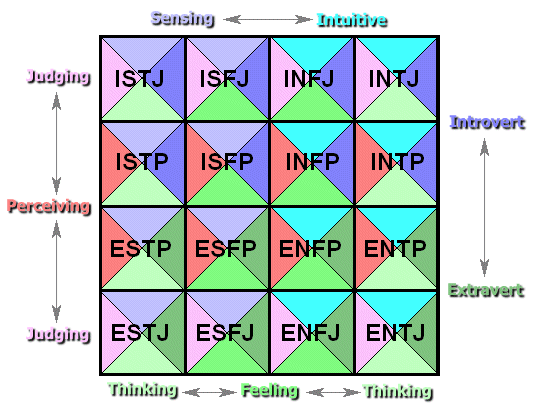
Let me give you an example of a typical description from Myers Briggs, one of the most common types of personality test.

ISTP

ISTPs excel at analyzing situations to reach the heart of a problem so that they can swiftly implement a functional repair, making them ideally suited to the field of engineering. Naturally quiet people, they are interested in understanding how systems operate, focusing on efficient operation and structure. They are open to new information and approaches. But contrary to their seemingly detached natures, ISTPs are often capable of humorously insightful observations about the world around them. They can also be closet daredevils who gravitate toward fast-moving or risky hobbies (such as bungee jumping, hang gliding, racing, motorcycling, andparachuting), recreational sports (such as downhill skiing, paintball, ice hockey, and scuba diving), and careers (such as aviation and firefighting).

ISTPs may sometimes seem to act without regard for procedures, directions, protocol, or even their own safety. But while their approach may seem haphazard, it is in fact based on a broad store of knowledge developed over time through action and keen observation. ISTPs enjoy self-sufficiency and take pride in developing their own solutions to problems.

ISTPs are content to let others live according to their own rules, as long as the favor is reciprocated. ISTPs endure reasonable impositions without complaint—but if their “territory” is encroached upon, eroded, or violated, they defend what they view as rightfully theirs.

This category is thought to describe 4-6% of the population of the world.

There are twin dangers here- the first is that, presented with this truism (and these categorisations always read a little like astrological predictions to me) we might actually come to believe that this is who we are– and this effectively becomes a self fulfilling prophecy- it becomes formational in terms of our self image. There is some evidence that we are often too quick to identify personality traits in others, and despite the fact that all the personality types identified in Myers-Briggs are deliberately positive, we tend to reject and condemn those that we see as different to ours.

The likely result here is that those positive attributes of personality we find ourselves labelled with, become enhanced, but the less positive ones we are able to excuse as they are not who we are.

Secondly, it ignores the possibility of development, change, encounter and growth. Sure, I know that some would describe these personality traits as fixed and immovable- stable through our life time, but there is a chorus of psychologists that would entirely disagree with this too. Some of this debate can be seen here.

I would add one more objection however- and I think that this perhaps the greater part of my concern- I believe that personality tests are dangerous in the hands of powerful people- in the same way that machine guns should never be given to despots. They are too often used as means of achieving the opposite of their stated intention. It is a way of manipulating and shaping a workforce to achieve efficiencies, redundancies or restructuring.

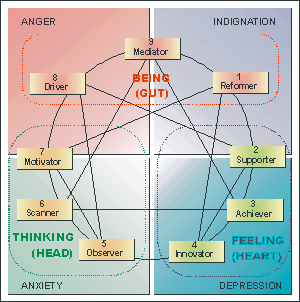
There is another area in which these methods are forcing their way- self help methods, and even spiritual practices. People are being encouraged to buy into a method of success and self fulfilment that starts with insights gained from measurement and categorisation. Typical of this approach is the Enneagram. Whilst some people have clearly found these approaches useful- they can also become a kind of cult- like a successful slimming programme or a pyramid sales system. And the whole thing is based on an intuition, with no evidence that any of the nine types of personality actually exist.

So- after my little rant, time for a few soft conclusions…

  1. We a gloriously diverse, yet tend towards convergence- it is the nature of the human condition. Let us together celebrate difference without seeking to categorise and codify.
  2. We are not the sum total of these narrow categorisations- we respond to situations and people in a varied way, dependent on all sorts of other criteria.
  3. They are very blunt instruments- and such course measurement is very dangerous when dealing with individuals.
  4. We need to be open to the possibility of change- not just of our aspirations and success, but also in more subtle ways- the Jesus way is towards love, acceptance, grace, kindness, self control. These soft, imponderable traits are not optional in The Way- no matter what personality trait you might be tagged with.
  5. Let us not take this stuff too seriously. It is not science, it is population management.

Shared journeys…

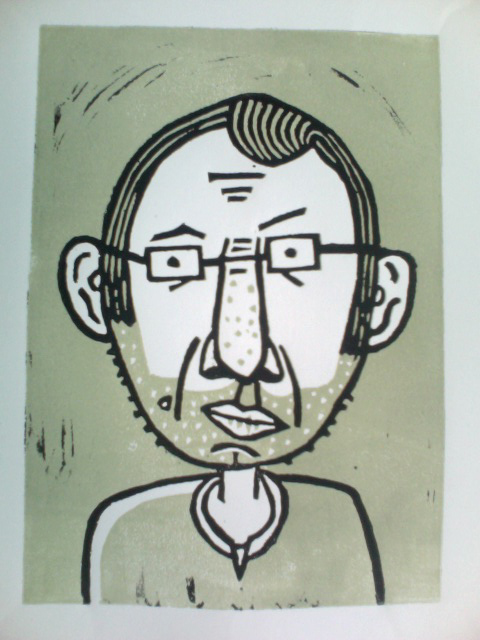
We had a lovely evening last night with Si and Sue Smith, who are up here on holiday at the moment. Above is a picture of Si by his son Jonah- who is obviously following in his talented father’s footsteps…

Si works as an illustrator/artist/all round creative person, and was responsible for the ’40’ images that I wrote some meditations for (See here.)

Last night however, we shared stories of faith journeys- through churches, experiments with new forms of church, leaving church, alternative worship groups and our concerns about our kids in all of this. It was a good conversation, because in many ways our stories are similar. And there is something about the path that we have found ourselves on that at times makes us think that we are alone.

I think the truth is that we are very far from alone- there are many of us who have been ‘activists’ within the church who have found that the institution form of organised faith has become simply impossible to remain within- and so we have set out alone- at least for now.

That is not to say that community and connections with others with whom we can share life is not important- in fact it is all the more so, hence the deep goodness of conversations like last night…

(Happy anniversary to Si and Sue by the way!)

The law, or the Spirit?

It has been said that cricket was exported by the British Empire as a way of selling some kind of idea of ‘Britishness’- characterised by fair play, individual skills realised in a team context and adherence to rules. Cricket has moved on a long way since then- the seat of power has shifted firmly towards India, and there is a hard edged professionalism to the game.

However, the high drama of the international arena still has a way of throwing up controversies- there is a great test series being played between India and England at the moment- and yesterday one of the England players, who was batting brilliantly and playing his team into a potentially match winning position, found himself in the middle of a conflict with the laws of the game, and what cricketers still call ‘the spirit of the game’.

In case you are interested, this is what happened-

All very interesting if you are a cricket fan- but also, I think there is a useful theological parallel here. Much of the letters of Paul in the Bible constantly debate the primacy of the LAW as against the NEW KINGDOM- and the rule of love. More recently, this whole controversy has surfaced again with the discussions about what might happen to we sinners when we die (eg Rob Bell’s book ‘Love Wins’) and also all this discussion about homosexuality (see yesterday’s post.)

Our ‘modern’ interpretation of the law is characterised by an idea of inflexible, unyielding black and white rules, and whilst many who practice the law might suggest that this may well be an illusion, we assume that this is the kind of law making that God adheres to also.

But what if the universe has a higher court- not of law, but of principle- you could say the ‘spirit of the game’? What if ultimately, the rule of love will indeed overcome all- not to condemn the law, but to fulfill it. Not to ignore the law, but rather to dwell in the midst of the laws purpose?

A musical time machine makes me ponder…

I watched some of one of those late night music compilation programmes last night- hits of the 80’s. Rather than flicking past as I would normally have done, I found myself back in Preston, as a student. Or slow dancing to Tears For Fears at parties in my earlier teens. Music does this to you- even music that may not have been a personal preference- it somehow becomes a powerful cue for memory.

One of the tracks that surprised me in this way last night was The Communards ‘Don’t leave me this way’- suddenly I was in the Student Union again, with my house mates Mark and Steve- and the electronic pulse of this track, combined with Jimmy Sommerville’s astonishing falsetto singing was carrying us along.

I was never really a fan of The Communards- I did not own any of their music. Partly this was because I was never into dance music, but also (to be honest) there was this sexuality thing, that made me uncomfortable. The band were openly gay- at the forefront of the campaign against homophobia. This was the time of AIDS- seen as a ‘Gay plague’ and ‘section 28’.

Listening to this song yesterday was more than just a nostalgia trip- it made me think again about how far my thinking- and that of wider society- has come since the 80’s in relation to homosexuality. Don’t get me wrong, I was never openly homophobic. I lived in a house with two other lads- one who was gay. I was a very left leaning student of sociology and social science.

But I was also from a Christian background- and always there was this conflict in me- because there were hard lines drawn here- homosexuality was sin. End of discussion. Sure, people like Tony Campolo proposed a path of grace in which we should accept that people were born gay (rather than the prevailing view that it was a debauched ‘lifestyle choice’, or perhaps the product of some kind of childhood damage or weakness of character.) Campolo’s view was that the way to resolve the issue was to accept people as gay, but to expect celibacy. This was not an argument that went well with my gay friends at the time- most of whom longed for companionship after desperately lonely and stigmatised early lives.

Watching The Communards yesterday made me feel ashamed of my rejection of their music on the basis of their sexuality. I have written before how I have come to believe that the Church will look back on it’s teaching on homosexuality in the same way that it does now on its previous teaching on other culturally based rights issues- on the basis of race, or gender for example. Another example is the change (over the last 30 years) in relation to divorce/remarriage in most of the Protestant church at least. The meat of this issue always comes back to how we understand the nature of Scripture of course- but I will not re-rehearse these arguments here.

I also discovered something about the other member of the band- Richard Coles– a classically trained musician who played most of the instruments. He has since presented programmes on Radio 4 and BBC 2, but the surprising thing about him is that he is now a Church of England vicar.

Coles talks about coming to faith after attending the funeral of a friend who died of AIDs. Which reminded me of this song- which I offer here as a lament for all of this faith based homophobia…

Home…

M and I are off work this week- we are experiencing the strange luxury of a holiday at home.

A strange kind of holiday- as we are working really hard. The list of tasks is long- gardening, painting the outside of the house, and if it rains, there is some plumbing and decorating inside.

An old house like ours always demands time money and energy- which always begs the question as to whether we might do something better with all three. Whether we really should be spending so much time creating a space to live in, rather than just getting on with living.

There is slightly more to this though- we are trying to create spaces for hospitality and retreat, both as a means of making our living, and as a means of living with simple integrity. Whether this might ever be a means to fully sustain our family is unclear, but it is a path we are set on. (See here for more information on what we are about.)

It is an interesting point to be asking these questions- as I am also in the middle of trying to create some poetry for a Greenbelt Festival installation- on the theme of ‘Dreams of Home’. So far I have written a few poems and rejected most of them for the project- which involves the broadcasting of poetry at different points around the festival site.

Here is one of the rejected ones- which I suppose is kind of apt-

Home is where the flowers grow

In neatly ordered style

Well betide the weed or slug

Who seeks to there defile


Home is castellated

All English men agree

From high suburban battlements

Old Empires can be seen


Home is lit by cathode rays

As the sofa eats the day

Home is when the door shuts tight

To keep the world away


Home is where we worship

The gods of DIY

With flat pack chipboard altars

Pastel paints to soothe the eye


Home is where the mortgage bill

Lands hard upon the soul

The shadow of satanic mills

Pulls us like a black holes


Home is where the children

Are heard but seldom seen

They play the X box all night long

Blasting aliens from the screen


Home is where the heart breaks

Where lies the empty bed

Home is where these memories

Are made but now lie dead


Home seems somewhere far away

We can’t get here from there

This pilgrim Diaspora

Are searching unaware


For home is like a twitch

In a phantom missing limb

Like a prophecy of silence

Before the birds begin to sing


Home is hidden low

By folding falling ground

It pulls me like a magnet

It’s a well I’m tumbling down

Tree of Life film…

.

We went to watch this film the other day. I had not heard of it, nor read any of the reviews- rather we had an opportunity to go and watch a’ grown up film’ for the first time in ages, and this one looked interesting.

The director, Terrence Malcik, appears to be using the film as an intimate exploration of the meaning of life and of faith.

Is it any good?

Well- the first thing to say is that it made us cry- several times. This might be because we do not get out much, but it is also because if it is full of tender lovely moments. The photography is stunning at times, and the acting (Penn, Pitt and the mesmeric Jessica Chastain) is brilliant.

Not to mention the performances of the young kids.

At times it is rambling, and certainly pretentious (although all good films need to be to a certain extent.) Then there is the rather overblown creation/evolution imagery- including a rather dodgy CGI dinosaur.

And the lovely music/image combinations-

Is this a great film? I think not- it is too flawed, too rambling, too indulgent.

Is it a great experience- yes.

What about the theology? Not sure what to say here- Malick’s conclusion after all his meanderings seem to be that life is beautiful, precious- but if we do not love it flashes by. He also finishes with a strange afterlife scene where everyone is united on some kind of beach at dusk.

Watch it- and enjoy the tender moments. You may forgive him the rest.

I have to say- on the way out of the cinema, a young attendant asked people if they enjoyed the film, and in front of us a very grumpy man barked- ‘Was it POSSIBLE to enjoy it?’ He had sat through the whole thing though…

So- having collected some of my own thoughts, I went to look at what the critics said about the film. It has certainly divided opinion- one critic pointed out that there was only one consonant between ‘comic’ and ‘cosmic’- whilst others called it a masterpiece. Some just said it was ‘Christian’ as if this was enough to sum up this film.

I find myself in full agreement of this review in the Guardian.

The Tree of Life may well come to be seen as this decade’s great Christian artwork. But I still prefer to think of it as something other than that. Just as Dietrich Bonhöffer called for a religionless Christianity, so the movie for me created a Christianityless metaphysics.

It is a magnificent, toweringly ambitious and visionary work – brilliantly shot by Emmanuel Lubezki, passionately felt, and deeply serious in its address to the audience. The Tree of Life is about the inner crisis of a tormented man in his middle years and the terrible unchangeability of the past. As this man briefly forces himself to consider his own negligible place in the universe, the film gestures at the unimaginable reaches of geological and stellar time, depicting nothing less than the origins of the cosmos and man himself in a colossal Kubrickian symphony of images.

Holiday photos…

We are back after a lovely few days in St Andrews- the sun shone and it was great to spend time together and to visit somewhere new.

Highlights-

Beach cricket (ours and watching a beach fixture played on Elie Beach.)

All those lovely little villages.

Sailing with Em and Will.

Slow days of sunshine and easy laughter.

Too much good food.

Holiday!

AHHHHHhhhhhhhhhhhhhhhhhhhhhhhhhhhhhhhhhh………….

He sighed.

Off for a couple of weeks. We are heading over to the East Coast to do a bit of exploring- a bit of a new thing for us as the other side of Scotland is a bit of a mystery- we have been too addicted to mountains and lochs (and midges.) St Andrews here we come…

See you when we get back.